
An agreement for lease (AFL) is a binding contract that commits both parties to entering a formal lease once agreed conditions are met, and it typically operates as a bridge while building works, fit-outs or approvals are still in progress.
You’ll usually need one when:
- The premises are still under construction or undergoing a major refurbishment.
- The landlord must complete works or the tenant needs approvals or a fit-out sign-off before occupation.
- Council consents, financier conditions, or design plans are still pending at the time terms are agreed.
Here’s the catch most people miss: because an AFL is legally binding, you can be locked into taking a lease on premises you haven’t seen finished. Get the conditions precedent and sunset date wrong, and you’re contractually stuck long before the doors open.
Key Takeaways
An agreement for lease is a binding bridge document that allocates pre-lease risk, and getting its practical completion, sunset and clawback clauses wrong can lock you into an unfavourable outcome before occupation even begins.
| Point | Details |
|---|---|
| AFL is binding, not preliminary | Unlike a heads of agreement, an AFL commits both parties before the lease itself takes effect. |
| Define practical completion objectively | Tie it to an occupancy certificate or independent certifier, never vague wording like “substantially complete.” |
| Align EOTs with sunset dates | An extension of time that shifts practical completion but not the sunset date can trap either party. |
| Reconcile all three documents | Cross-check the heads of agreement, AFL and draft lease for conflicting terms before signing. |
| Engage a tenant adviser early | Nicheadvisory helps align commercial terms, construction programmes and incentive clawbacks before they’re locked into a binding AFL. |
Table of Contents
- What is an agreement for lease and how does it work?
- When do you actually need an agreement for lease?
- What clauses should an agreement for lease include?
- How is an agreement for lease different from a lease?
- What are the most common risks in agreement for lease negotiations?
- How do practical completion and sunset dates affect your timeline?
- How do financiers affect an agreement for lease?
- When should you bring in a specialist tenant adviser?
- What clause headings and red flags should you watch for?
- Nicheadvisory: your partner for agreement for lease negotiations
- Frequently asked questions
- Sources
What is an agreement for lease and how does it work?
An AFL sits between a commercial handshake and a signed lease. It sets out exactly what has to happen, and by when, before the lease itself starts. In practice, that means:
- Conditions precedent — approvals, certificates, or third-party consents that must be satisfied first.
- A draft lease annexure — the actual lease terms attached and agreed upfront, not left to be negotiated later.
- A practical completion trigger — the building or fit-out milestone that starts the clock on occupation.
- Rent commencement — the date rent starts, which may or may not align with physical handover.
- Security and guarantees — bank guarantees, bonds or personal guarantees locked in before settlement.
This is where people confuse an AFL with a heads of agreement. A heads of agreement is usually non-binding and high level, a summary of commercial intent. An AFL is the opposite: detailed, binding, and built specifically to allocate risk during the pre-lease phase, who pays if council approvals blow out, who wears the cost of a fit-out delay, who covers a defect found at handover.
Picture a retailer taking space in a new development still six months from completion. The landlord isn’t ready to grant a lease over premises that don’t exist yet, but the tenant needs certainty on rent, size and terms now. The AFL bridges that gap, binding both sides to specific milestones before the formal lease takes effect.
Pro Tip: Always ask whether the draft lease is annexed to the AFL, not just referenced. An unannexed “lease to be agreed” clause is where later disputes come from.
When do you actually need an agreement for lease?
Not every deal needs one. An AFL earns its place when there’s a gap between agreeing terms and being ready to occupy.
- New construction — delay risk usually sits with the landlord, but the AFL must say so explicitly.
- Significant landlord works — who pays for cost overruns needs to be nailed down before you sign anything.
- Tenant fit-out requiring approvals — council or authority delays can push out your opening date, and someone has to wear that.
- Landlord title or financier conditions — settlement or refinancing conditions can stall the whole deal.
- Incentive-linked deals — rent-free periods or contributions tied to milestones need clear payment triggers.
If two or more of these overlap, get advice before you sign anything described as “just a formality.”
What clauses should an agreement for lease include?
This is the checklist that actually protects you. A properly drafted AFL should cover:
- Parties and premises — precise legal descriptions, not just a street address.
- Conditions precedent — every pre-condition, with a deadline and a consequence if it’s not met.
- Practical completion definition — an objective test, ideally tied to an occupancy certificate or independent certifier sign-off.
- Rent and rent commencement — the trigger date and whether it can shift.
- Sunset or long-stop date — the outer date by which the deal ends if conditions aren’t satisfied.
- Extensions of time (EOT) — trigger events, notice periods, and whether an EOT pushes out the sunset date too.
- Liquidated damages — pre-agreed compensation for landlord delay.
- Landlord works vs tenant fit-out — a clear split of scope, cost and standard.
- Approvals and who pays — council, authority, and building consents allocated by name.
- Handover and access — when the tenant can enter for fit-out before rent starts.
- Security and guarantees — bond amounts, guarantor caps, and release conditions.
- Incentives and clawback — fit-out contributions or rent-free periods, with clawback triggers spelled out.
- Make-good obligations — condition on handback, referenced consistently with the lease.
- Assignment and subletting — rights to transfer before the lease even starts.
- Insurance and indemnities — cover required during the works and fit-out period.
- Dispute resolution and costs — how disagreements over practical completion or delay get resolved.
Pro Tip: Define practical completion by reference to an occupancy certificate or an independent certifier, never a vague phrase like “substantially complete.” Align every extension of time clause with the sunset date, and attach the plans and specifications as schedules so there’s no argument later about what was promised.
Expect to see clause headings along the lines of “Conditions Precedent,” “Practical Completion,” “Sunset Date,” “Extensions of Time,” “Liquidated Damages,” “Landlord’s Works,” “Tenant’s Fit-Out Works,” and “Incentive Deed.” If any of these are missing from a draft you’re reviewing, ask why.
How is an agreement for lease different from a lease?
They look similar on paper but do different jobs.
- Timing and occupation — a lease gives possession now or on a fixed date; an AFL governs the period before that possession right exists.
- Risk allocation pre-commencement — an AFL specifically allocates delay, approval and works risk; a lease assumes the premises are ready.
- Detail level — an AFL often annexes a full draft lease, so the detail is arguably higher, not lower.
- Enforceability and lock-in — both are binding, but an AFL can lock you into a future lease on premises you haven’t inspected.
- Incentives — these often sit in a separate deed referenced by both the AFL and the lease, so consistency between documents matters.
As a rough guide: if the premises exist, are approved, and are ready to occupy, you can often go straight to a lease. If there’s construction, fit-out, or approvals still outstanding, you need an AFL first.
Most experienced parties negotiate the AFL and the lease at the same time, not sequentially. Doing it together avoids agreeing to commercial terms in the AFL, only to find the lease drafted months later contradicts them. It also means both documents get reviewed against the same set of facts, rather than one being rubber-stamped after the deal’s already locked in.
What are the most common risks in agreement for lease negotiations?
Five mistakes show up again and again in AFL disputes.
- Vague practical completion tests — “substantially finished” invites argument. Push for a certificate-based test.
- Misaligned extensions of time and sunset dates — an EOT that extends practical completion but not the sunset date can trap a tenant in limbo.
- Unclear approvals allocation — if the AFL doesn’t say who’s responsible for a specific council consent, expect a fight when it’s delayed.
- Incentive clawback traps — a clawback triggered by early assignment or default needs a defined, capped mechanism, not open-ended wording.
- Insufficient security or uncapped guarantees — landlords want protection, but an unlimited personal guarantee is a red flag for any tenant.
Pro Tip: For tenants, insist on objective completion tests, independent certification, and capped liability. For landlords, secure adequate bank guarantees and a liquidated damages clause that reflects real holding costs, not a punitive figure.
Before signing, reconcile the heads of agreement, the AFL, and the draft lease side by side. Conflicting terms between these three documents are the single most common cause of post-occupancy disputes, and they’re entirely avoidable with one careful read-through.
How do practical completion and sunset dates affect your timeline?
The sequence matters more than most parties expect going in.
- Execution — the AFL is signed, conditions precedent start running.
- Landlord works — construction or refurbishment proceeds against the agreed programme.
- Practical completion — the trigger event, usually certified independently.
- Tenant access and fit-out — the tenant enters to complete its own works.
- Lease commencement — rent starts, and the formal lease takes over.
The sunset or long-stop date is the outer limit. If practical completion hasn’t happened by then, either party may gain a right to terminate, and compensation or liquidated damages can come into play. Negotiate fairness into these clauses by tying extensions of time to genuine, evidenced delay events, not open-ended landlord discretion.
How do financiers affect an agreement for lease?
Financiers rarely stay out of the picture on a purpose-built or major refurbishment deal, and their involvement can genuinely change the negotiation.
- Priority security — a financier’s mortgage usually ranks ahead of a tenant’s interest, so the AFL needs to address priority clearly.
- Cure and step-in rights — financiers commonly want the right to step in and complete works if the landlord defaults.
- Tri-partite deed requirements — a formal deed between landlord, tenant and financier is often required for large developments.
Ask for notice rights, defined cure periods, and confirmation that any financier consents are actually in place before you commit. Financier conditions are also a common, underappreciated cause of milestone delays, worth factoring into your own timeline expectations. Get legal counsel involved early if a tri-partite deed is on the table.
When should you bring in a specialist tenant adviser?
Some AFLs are simple. Others involve a construction programme, a financier, a multi-stage fit-out and an incentive package all running at once, and that’s when a tenant adviser earns their fee. Consider engaging one when:
- The fit-out is complex, multi-trade, or tied to specialist equipment.
- The build has multiple milestones with cascading delay risk.
- A financier or tri-partite arrangement is involved.
- The incentive package is substantial enough that a clawback dispute would hurt.
A good adviser does more than review clauses. They align the commercial deal actually struck with what’s drafted in the lease, manage the construction programme against the AFL’s dates, document variations as they happen (not after a dispute starts), and negotiate make-good and incentive clawback terms before they become a fight.
Pro Tip: Bring in your adviser before you sign the heads of agreement, not after. Commercial terms agreed at that early stage, particularly around make-good and incentives, are far harder to renegotiate once they’ve flowed into a signed AFL.
Get a lawyer to review anything binding, always. And if you want someone managing the commercial and construction side of the deal in parallel with the legal review, that’s exactly where tenant advisers and specialist leasing lawyers work together well.
What clause headings and red flags should you watch for?
Expect a properly drafted AFL to include headings such as “Conditions Precedent,” “Practical Completion,” “Sunset Date,” “Liquidated Damages,” and “Incentive Deed.” If any is missing or buried in vague general wording, that’s worth flagging.
Three red flags warrant an immediate stop and a call to your lawyer:
- Ambiguous practical completion wording with no objective test or certifier reference.
- Unlimited personal guarantees with no cap or release trigger.
- One-sided incentive clawback clauses that trigger on almost any tenant action.
An agreement for lease can create an equitable interest in the land, which in some cases allows a tenant to lodge a caveat to protect its position, a protection simply not available under a non-binding heads of agreement.
If you spot any of these red flags, pause, get advice, and negotiate an amendment before signing. It’s far cheaper than fixing it after the fact.
Nicheadvisory: your partner for agreement for lease negotiations
Reviewing an AFL clause by clause is only half the job. The commercial side, aligning the construction programme with your fit-out timeline, negotiating make-good obligations, and making sure incentive clawbacks don’t blindside you later, is where deals actually get won or lost. That’s the gap Nicheadvisory fills for corporate tenants across Sydney, Melbourne, Brisbane and Adelaide.
Nicheadvisory works alongside your lawyers rather than replacing them, managing the practical detail: tracking milestones against the AFL’s conditions precedent, coordinating fit-out works, and negotiating incentive and make-good terms so they match what was actually agreed at heads of agreement stage. If you’re heading into a new build, a major refurbishment, or a fit-out with approvals still pending, get in touch with Nicheadvisory to scope out how an integrated tenant adviser can protect your position before you sign.
Frequently asked questions
Is an agreement for lease legally binding?
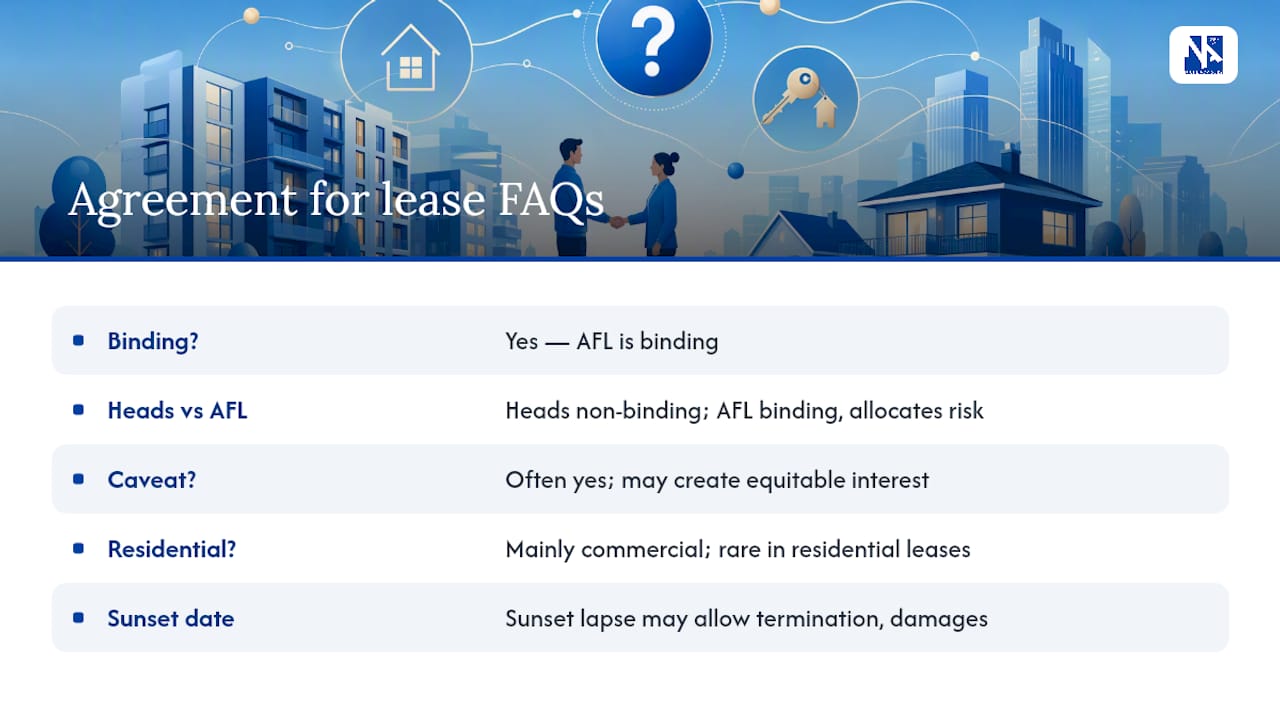
Yes. Unlike a heads of agreement, an AFL is a binding contract, and failing to complete the lease once conditions are met can expose you to a breach claim.
What’s the difference between an agreement for lease and a heads of agreement?
A heads of agreement is typically a non-binding summary of commercial terms. An AFL is detailed, binding, and specifically allocates risk during the period before the lease starts.
Can I lodge a caveat under an agreement for lease?
In many cases, yes. An AFL can create an equitable interest in the land, which may allow a tenant to protect its position with a caveat, something not available under a non-binding heads of agreement.
Does an agreement for lease apply to residential leases?
It’s overwhelmingly a commercial mechanism, used where construction, fit-out or approvals sit between deal agreement and occupation. Residential tenancies rarely involve this level of pre-lease conditionality.
What happens if the sunset date passes without practical completion?
Depending on the drafting, either party may gain a right to terminate, and compensation or liquidated damages provisions can be triggered. This is exactly why the sunset clause needs careful negotiation upfront.
Sources
- Agreement to Lease in Australia | Sprintlaw Australia
- Agreement for Lease and development of purpose-built facilities | Mondaq / Bartier Perry
Treat these as a starting point, not a substitute for advice tailored to your specific deal.