
A flexible workspace strategy is a portfolio-level plan that blends owned, leased and on-demand space so headcount and floor space finally match. The immediate move for most Australian organisations is a governed pilot, ideally timed against an upcoming lease expiry, tested against real utilisation data before you scale. Market evidence from the ABS, the Sidespace flex office index and practitioners like Niche Advisory all point the same way: measure first, commit second.
TL;DR:
- Most flexible workspace pilots should start with a data-driven assessment, focusing on actual utilization and lease expiry timelines before scaling.
- The recommended pilot duration is between eight and twelve weeks, with KPIs such as utilization above 60%, adoption over 70%, and minimal policy violations.
- Building a flexible workspace involves choosing and combining formats like coworking, hot-desking, satellite hubs, and virtual offices based on specific team needs.
- Effective governance requires integrated booking and occupancy analytics, clear policies, consolidated billing, and designated admin roles to prevent costs and measurement issues.
- Cost-per-employee in flexible spaces must be compared against traditional lease costs, considering hidden expenses like exit fees, overage charges, and management agreement costs.
Table of Contents
- What does a flexible workspace strategy actually cover?
- Why does this matter to corporate real estate leaders right now?
- How do you build and roll out a flexible workspace strategy?
- What technology and policies keep flexible workspaces running smoothly?
- What will a flexible workspace actually cost your portfolio?
- How do you know if your flexible workspace strategy is working?
- What goes wrong with flexible workspace rollouts, and how do you avoid it?
- What does Niche Advisory bring to this kind of transition?
- Ready to pilot your flexible workspace strategy?
- Sources
What does a flexible workspace strategy actually cover?
A flexible workspace strategy is the deliberate mix of committed leases, owned floors and on-demand or flexible access that a company uses to house its people. It’s not just “let people work from home some days.” It’s a portfolio decision about where every dollar of occupancy spend goes and why.
Most organisations end up choosing from a handful of formats, often blended across a portfolio rather than picked as one single answer:
- Coworking and managed offices — shared amenity, flexible terms, ideal for teams under 20 or fast-growing functions.
- Hot-desking — unassigned desks shared across a team, suited to sales or consulting staff who are rarely in one seat two days running.
- Desk hoteling — bookable desks reserved in advance, better for hybrid teams that need predictability without permanent allocation.
- Satellite hubs — smaller regional or suburban offices that cut commute time for staff who don’t need the CBD tower every day.
- Virtual offices — a registered business address and mail handling with no physical desk, useful for compliance or a light regional footprint.
- On-demand meeting rooms — booked by the hour for client pitches, workshops or overflow when the home office runs out of room.
The trick isn’t picking one format. It’s matching format to need: project teams that spin up and down suit coworking memberships, client-facing functions want a polished managed office, and a national sales team scattered across three states is better served by a network of satellite hubs than one expensive CBD lease. JAGA Workspaces frames this shift as flexibility becoming a corporate essential rather than a perk, and that’s the mindset shift underpinning the whole exercise.
Why does this matter to corporate real estate leaders right now?
The case for flexible workspace strategy isn’t philosophical, it’s financial. Every fixed lease is a bet on headcount five years out, and most of those bets have been wrong since 2020. Flex access lets you scale space up or down closer to real demand, which keeps capital free for the things the business actually needs to fund.
There’s a talent dimension too. Staff increasingly expect proximity and choice: a desk near home some days, a CBD hub for client meetings, decent amenity wherever they land. RealCommercial’s reporting on the shift to high-design hubs quotes industry voices describing flexibility as core commercial strategy now, not a lifestyle add-on, with landlords and operators restructuring commercial arrangements to keep pace.
Resilience matters just as much as attraction. Project-based teams and companies going through growth spurts or contractions need a way to flex without breaking a ten-year lease. A blended flex portfolio absorbs that volatility far better than a single large floor plate does.
A quick reality check on trade-offs:
- Culture can fragment when nobody is reliably in the same room on the same day.
- Policy complexity increases fast once you’re managing bookings across multiple sites and providers.
- Cost leakage is real: unmanaged flex memberships and unused desk bookings quietly erode the savings you’re chasing.
Australia’s flex-office sector has grown into a genuine commercial category, with investor interest and enterprise uptake reported across the market, according to RealCommercial’s coverage of the sector. That scale is exactly why governance can’t be an afterthought.
How do you build and roll out a flexible workspace strategy?
Most successful rollouts follow a five-phase sequence: Assess, Design, Pilot, Scale, Measure. This structure is common across workplace transformation guidance, including Gable’s five-phase playbook, because skipping a phase is where most programs quietly go wrong.
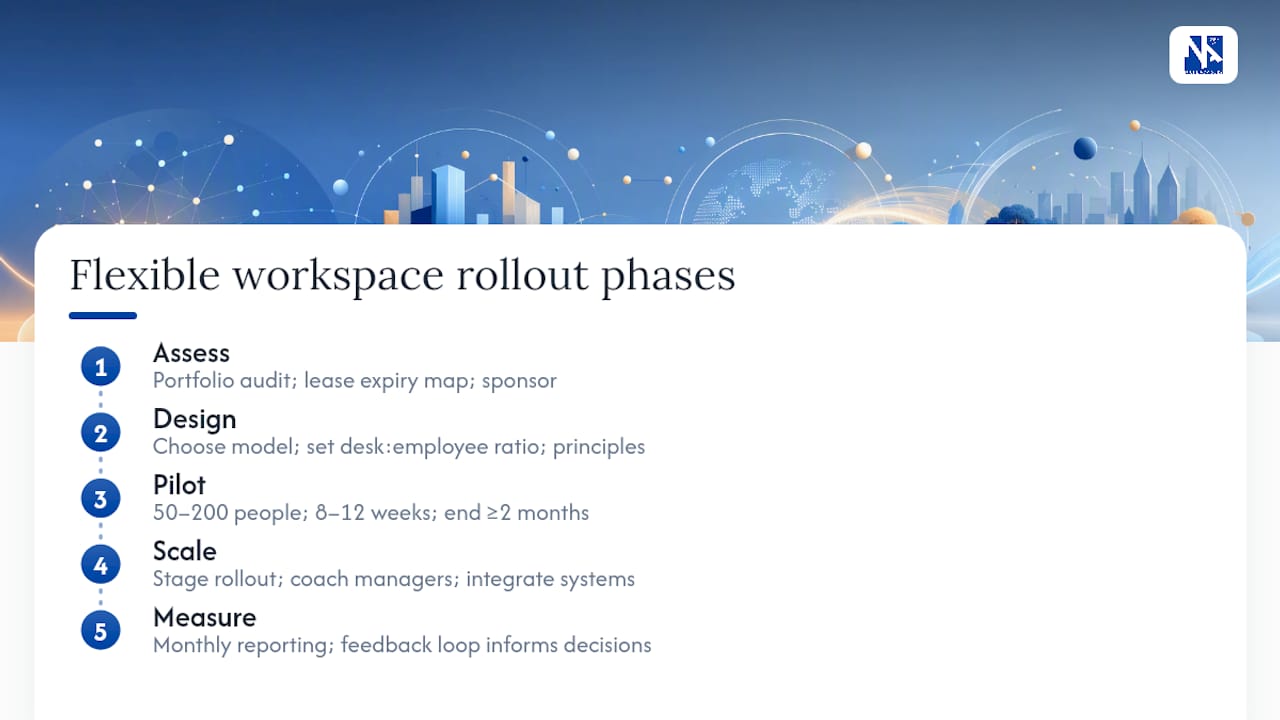
1. Assess. Start with a portfolio audit: every lease, its expiry date, current rent per square metre, and actual utilisation (not booked capacity, actual bums on seats). Overlay a lease expiry map so you know which sites give you a natural decision point in the next 12 to 24 months. Get an executive sponsor locked in early. Without one, phase three tends to stall the moment a department head pushes back.

2. Design. Pick your model based on what phase one told you. If utilisation sits under 50% in a function that isn’t client-facing, hot-desking or desk hoteling is worth testing. If a satellite hub could cut commute times for a cluster of staff, decentralised “work near home” hubs are worth scoping properly rather than assumed. Set a desk-to-employee ratio target commonly recommended for hybrid-heavy teams to balance space efficiency and employee needs, and write down your guiding principles: who gets priority booking, how equity is protected across seniority levels, what “core days” mean if you have them.
3. Pilot. This is where most organisations either earn trust in the model or burn it. Keep the cohort tight, somewhere between 50 and 200 employees works well, and run it for eight to twelve weeks, long enough to see real usage patterns beyond a novelty spike. Deskpass’s guidance on de-risking a hybrid rollout recommends consolidated billing from day one so you’re not reconciling five separate flex vendor invoices, plus a defined governance gate: specific KPIs the pilot must hit before you’re allowed to scale it. Sample thresholds worth adopting: utilisation at a healthy level or higher, adoption reaching a majority percentage among the pilot cohort.

4. Scale. Roll out in stages rather than all at once, site by site or business unit by business unit. Manager coaching matters more than most rollout plans account for: a manager who doesn’t understand the booking system or the policy rationale will undermine adoption faster than any technical glitch. Integrate scheduling with your existing calendar and HR systems before scale, not after.
5. Measure. Set a reporting cadence (monthly is typical) and build a feedback loop where the KPI data actually changes decisions, not just decorates a dashboard nobody reads.
Pro Tip: Time your pilot to end at least two months before your next major lease renewal decision. That gives you real usage data to negotiate with, instead of walking into a renewal conversation on gut feel.
What technology and policies keep flexible workspaces running smoothly?
The operational stack is where good strategy either holds together or falls apart quietly over six months. You need four technology categories working together: desk and room booking, visitor management, occupancy analytics, and integrations with your calendar and HRIS systems. Gable’s workplace transformation guidance is blunt about this: fragmented, disconnected tools make measurement practically impossible, because nobody can reconcile booking data from three different systems into one honest picture of utilisation.
Operational controls matter as much as the software itself:
- Consolidated billing across every flex provider, so finance sees one invoice, not a scattered mess of vendor charges.
- Spend caps set at the team or cost-centre level to stop flex membership costs creeping upward unnoticed.
- Clear approval flows for anyone booking outside their default site or cohort.
- Defined admin roles, someone specific owns the booking platform, someone specific owns the vendor relationships.
Policy templates need to cover eligibility (who qualifies for hot-desking versus a dedicated desk), booking limits (how far ahead, how many days per week), equity guardrails (so senior staff don’t quietly monopolise the best desks or best days), and manager approval thresholds for anything unusual. Data governance deserves a proper look too: occupancy analytics can capture quite granular movement data, and your policy needs to say plainly what’s collected and why, before an employee asks.
Pro Tip: Assign one person as the single “flex admin” across your whole portfolio before you scale past one site. Split ownership across multiple site managers is how spend caps quietly get ignored.
What will a flexible workspace actually cost your portfolio?
Cost-per-employee is the number that makes flexible workspace strategy either obviously worthwhile or obviously not. Calculate it simply: total flex spend (membership, booking fees, any management agreement costs) divided by average monthly headcount using the space, then compare that against your current fully-loaded lease cost per employee (rent, outgoings, fitout amortisation, all of it).
Australian market pricing gives you a real anchor for that comparison. The Sidespace flex office index shows entry-level private offices starting from a low monthly price point, with a wide national spread from there up to premium fitted floors. Sydney has the deepest market by volume of listings, Melbourne offers the widest choice of operators, and pricing varies meaningfully by city, so costs differ per desk across locations.
Commercial models beyond a simple membership are worth understanding too. Pooled budgets let departments share a flex allowance rather than each holding separate contracts. Managed office agreements bundle fitout, furniture and services into one all-in rate. Landlord management agreements, an arrangement RealCommercial’s reporting notes is becoming more common, let landlords operate flexible space directly rather than leasing it to a third-party operator, which can change your negotiating position entirely.
Watch for hidden costs: exit fees on membership agreements, meeting room overage charges that don’t show up until the invoice lands, and fitout costs on managed offices that get quoted separately from the headline monthly rate. Budget for all three before you sign anything.
How do you know if your flexible workspace strategy is working?
You need a small dashboard, not a big one. Five metrics do almost all the work: utilisation rate (seats or desks actually used against seats available), cost-per-employee per month, adoption rate (staff actually using the flex option versus staff eligible for it), user satisfaction (an NPS-style score works fine), and policy violations (bookings outside guardrails, no-shows, overbooking).
Diagnostic thresholds give the dashboard teeth rather than leaving it as background reporting:
- Utilisation below 60% signals you’re carrying more capacity than you need, cut it before you scale further.
- Adoption below 70% among an eligible cohort usually points to a communication problem, not a space problem.
- A rising policy-violation count is often the earliest warning sign of governance decay, well before cost blowouts show up.
- A satisfaction score trending down over two consecutive reporting periods deserves a manager conversation, not just a data note.
Report monthly during a pilot and quarterly once you’ve scaled, and trust the data only once you’ve reconciled it against actual badge or booking-system logs rather than self-reported estimates. Set decision rules in advance: if utilisation sits under threshold for two consecutive periods, that site gets flagged for consolidation, not another quarter of “let’s wait and see.”
What goes wrong with flexible workspace rollouts, and how do you avoid it?
The failures are predictable, which is the good news, because they’re avoidable too. The biggest one is skipping the pilot entirely and jumping straight to a portfolio-wide rollout on the strength of a good pitch deck. Close behind it: fragmented booking tools that make honest measurement impossible, governance that’s too weak to enforce spend caps, and policies so vague that staff genuinely don’t know what they’re allowed to book.
Mitigation isn’t complicated, it’s disciplined. Run every rollout through phased gates rather than one big-bang launch. Consolidate billing from the first day of the pilot, not after month three when the invoices have already piled up. Use a structured change model like ADKAR (awareness, desire, knowledge, ability, reinforcement) to guide communication, and train managers before staff, since managers are the ones fielding questions in week one.
Quick checklist to run at every governance gate:
- Utilisation and adoption both hit their thresholds this period.
- Billing is fully consolidated with no orphan invoices sitting outside the main system.
- No unresolved policy violations carried over from the last review.
- Manager feedback has been collected, not just staff surveys.
Pro Tip: If a pilot site fails its gate, extend the pilot rather than scaling anyway to hit a deadline. A failed metric caught at 50 employees is cheap; the same failure caught at 500 is not.
What does Niche Advisory bring to this kind of transition?
Niche Advisory has run corporate real estate and workplace strategy engagements for more than 12 years, working the tenant side of the table across office and warehouse portfolios. That distinction matters in this space specifically: independent tenant-side advice means the recommendation isn’t shaped by which operator or landlord pays a referral fee.
The work typically spans:
- Portfolio audits and utilisation baselining before any decision gets made.
- Pilot design and governance, including the metrics and gates that decide whether a model scales.
- Lease negotiation and renewal strategy, timed against the data a pilot actually produces.
- Design and fitout delivery once a model is validated, including space rationalisation work that right-sizes a portfolio rather than just shrinking it.
Clients moving from a single large lease to a blended flex portfolio typically see the biggest gains where the pilot data directly informed the renewal negotiation, rather than running the two processes separately. Niche Advisory can share pilot specification templates, KPI dashboard structures and governance checklists on request for organisations at the assessment stage.
Ready to pilot your flexible workspace strategy?
Running a pilot properly, with real governance, consolidated billing and honest utilisation data, is harder to do well internally than most workplace teams expect, mostly because it competes with everyone’s day job. Niche Advisory does this as its core work: independent, tenant-side advisory that runs the portfolio audit, designs the pilot, and carries it through to lease negotiation and fitout without ever taking a cut from a landlord or operator on the other side of the table.
That independence is the practical difference for a workplace leader weighing this up. An operator selling you their own flex product has an obvious incentive to recommend more of it. A tenant-side advisor doesn’t, so the recommendation on hot-desking versus a managed office versus holding your existing lease actually reflects your utilisation data, not someone else’s occupancy target.
If your next lease decision is within 24 months, that’s the natural trigger point to start. Get in touch with Niche Advisory to scope a portfolio audit and pilot design before your renewal clock runs out.
Sources
- How to de-risk a hybrid workspace rollout — Deskpass
- Sidespace flex office index
- ABS — Characteristics of employment, Australia, Aug 2024
Recommended
- The Resurgence of Hot-desking in Sydney Offices – Niche Advisory
- The Best Tips to Save Space in Your Sydney Office – Niche Advisory
- More Space-Saving Tips for Your Sydney Office Fit-Out – Niche Advisory
- Sydney Office Space: Common Mistakes to Avoid When Choosing an Office Space (Part Two) – Niche Advisory