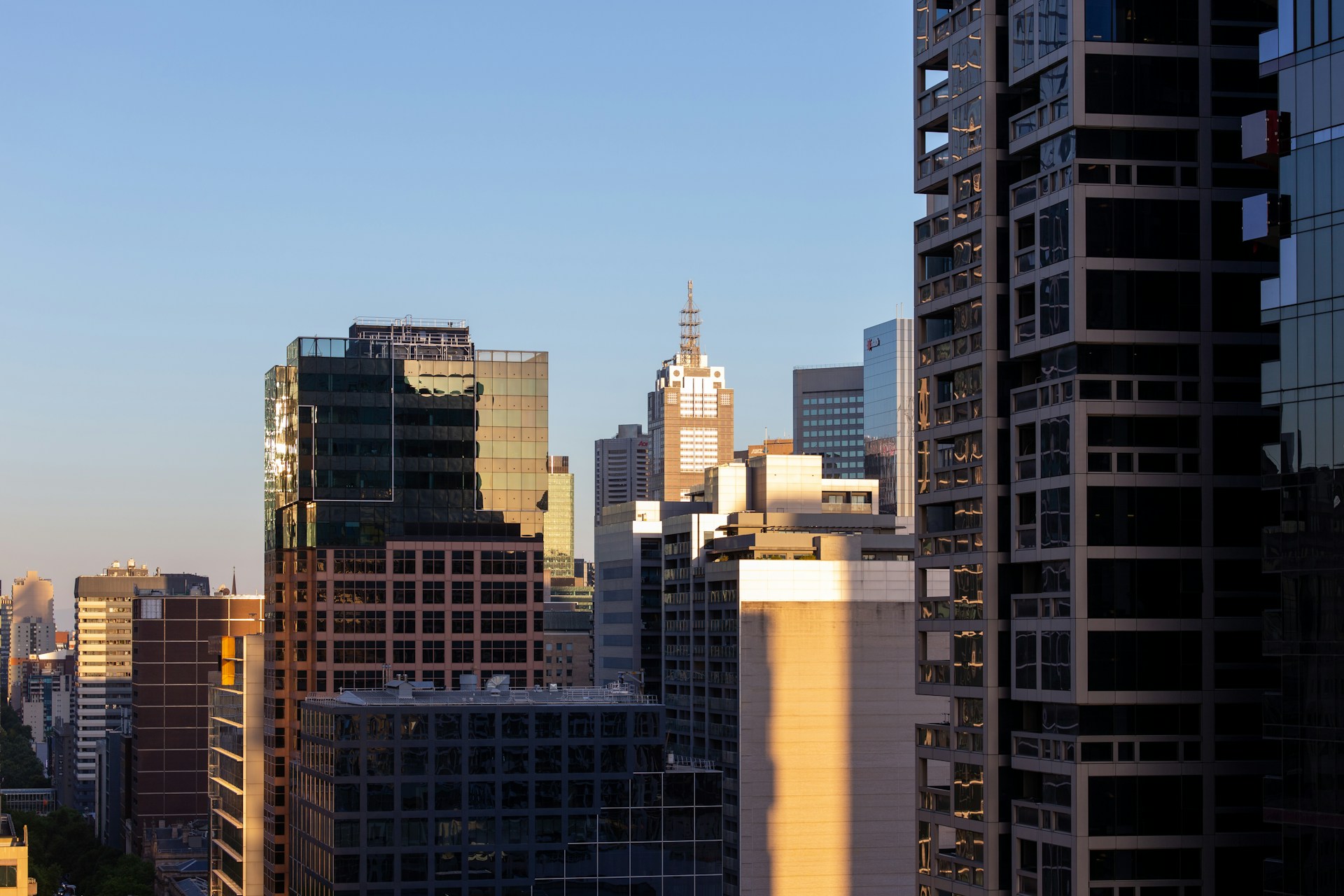
The Melbourne CBD office market remains under pressure, with vacancy still elevated but signs of renewed stability emerging in prime-grade assets. Leasing activity improved modestly, while new completions added to the city’s available space.
Vacancy holds steady amid new completions
The overall vacancy rate in the Melbourne CBD rose slightly to 15.9% in Q3, from 15.5% in the previous quarter. This was largely due to new completions, including 640 Bourke Street (30,000 sqm, fully pre-leased to NAB) and 555 Collins Street Stage 1 (48,000 sqm, 85% leased).
Premium-grade vacancy eased to 10.4%, while secondary space rose above 18%, reflecting weaker demand for older, less efficient buildings. Tenants continue to prioritise central locations, sustainability credentials, and end-of-trip amenities.
Leasing demand improves slightly
Leasing activity lifted modestly through Q3, with around 17,000 sqm of net absorption recorded. Notable transactions included Aware Super’s 5,000 sqm lease at 1000 La Trobe Street and Jacobs Group’s expansion at 80 Collins Street.
CBRE reported 85 leasing briefs totalling more than 105,000 sqm, up from 77 in Q2. Most enquiry came from government, engineering, and professional services firms consolidating operations into higher-quality premises.
Rents stabilise in prime space
Rental performance diverged further between grades. Premium-grade net effective rents rose 3.1% year-on-year to $694/sqm per annum, while incentives remained steady near 38%. A-grade rents held around $558/sqm, with incentives trending slightly higher.
Secondary rents fell 6.2% to an average of $404/sqm per annum, with incentives exceeding 45%. Landlords in this segment continue to rely on fitout contributions and shorter lease terms to attract tenants.
Investment activity picks up
Investor sentiment strengthened as pricing expectations adjusted and yields stabilised. Recent transactions included:
- 222 Exhibition Street – sold to GPT for $128 million (vendor: AMP Capital).
- 600 Bourke Street – acquired by Forza Capital for $210 million.
- 100 Queen Street – purchased by a local syndicate for $65 million.
While total transaction volume remains below long-term averages, active interest from domestic institutions and private buyers indicates improving market confidence.
Outlook for 2026
The Melbourne CBD office market is expected to remain two-tiered through 2026. Prime buildings with strong tenant covenants should continue to outperform as flight-to-quality demand persists. Secondary assets will face higher vacancy and limited rent growth.
However, with the development pipeline easing and economic conditions gradually improving, vacancy rates could begin to stabilise by late 2026, setting the stage for moderate recovery in rents and capital values.
Sources