
Start the renewal decision 12 to 18 months before your lease expires, and open with a market survey, not a phone call to the landlord. That window preserves your leverage, because it gives you time to inspect alternatives, collect competing offers, and walk away credibly if the numbers don’t stack up. TenantBase’s guidance on renewal versus relocation is blunt on this point: tenants who wait until the final six months typically negotiate from a position of weakness.
The decision itself comes down to four things: how well your current space fits your headcount and floor plan, how your rent compares to market, how much unamortised fitout value you’d walk away from, and whether your landlord relationship is worth preserving.
Your immediate next step is simple:
- Commission a market comparables survey now, even if renewal feels likely.
- Ask Nicheadvisory or a comparable tenant-side adviser to run a competitive Letter of Intent process in parallel.
- Do not issue formal renewal notice until you’ve seen genuine alternatives on paper.
Key Takeaways
Renewal decisions made 12 to 18 months out, backed by real market comparables and a clear cost model, consistently outperform late, reactive negotiations.
| Point | Details |
|---|---|
| Start early | Begin the renewal decision 12 to 18 months before expiry to preserve leverage and avoid holdover penalties. |
| Score before deciding | Weigh space fit, rent versus market, fitout amortisation, and landlord relationship before choosing renew or relocate. |
| Prioritise the right clauses | Push hardest on rent review mechanics, TI allowances, CAM caps, and make-good limits, not just headline rent. |
| Model costs apples to apples | Compare effective rent, TI, moving costs, and fitout amortisation across every option, not just the sticker price. |
| Engage advisers early | Bring in Nicheadvisory or a comparable tenant rep at the market-survey stage, and a lawyer before signing any Heads of Agreement. |
Table of Contents
- A renew-or-relocate scoring framework you can use today
- An 18-month checklist for renewal negotiations
- Which lease clauses matter most at renewal
- How do you compare renewal and relocation costs fairly?
- Turning refurbishment into renewal leverage
- When to bring in a tenant rep and a leasing lawyer
- Making sure the new lease actually gets followed
- How Nicheadvisory Helps You Run This Playbook
- Sources
A renew-or-relocate scoring framework you can use today
Most tenants either renew reflexively or relocate on gut feel. Neither is a strategy. Score your situation against these factors before you commit either way.
Renewal tends to win when:
- Your current space fits headcount within 10 to 20 percent, up or down.
- You’ve sunk significant capital into fitout that hasn’t finished depreciating.
- The landlord relationship has been genuinely responsive, not just tolerable.
- Market rent sits close to, or below, what you’re already paying.
Relocation tends to win when:
- Space mismatch exceeds 30 percent, either too big or too cramped.
- Comparable buildings are offering materially lower effective rents once incentives are counted.
- The landlord shows signs of redevelopment intent, financial distress, or has been slow on maintenance and repairs.
- Your lease has no workable renewal option and the landlord knows it.
Market conditions shift this calculus too. In softer office markets, tenants can extract larger TI allowances and longer free rent periods, while tight retail precincts tend to hand landlords the upper hand. Know which market you’re in before you set expectations.
The most common mistake isn’t indecision. It’s starting the clock too late, or tipping your hand too early by signalling intent to stay before you’ve tested the market. Both errors cost real money.
Pro Tip: Never issue your formal renewal notice before you’ve received at least one credible competing offer in writing. A landlord who believes you’ve already decided to stay has no reason to improve terms.
An 18-month checklist for renewal negotiations
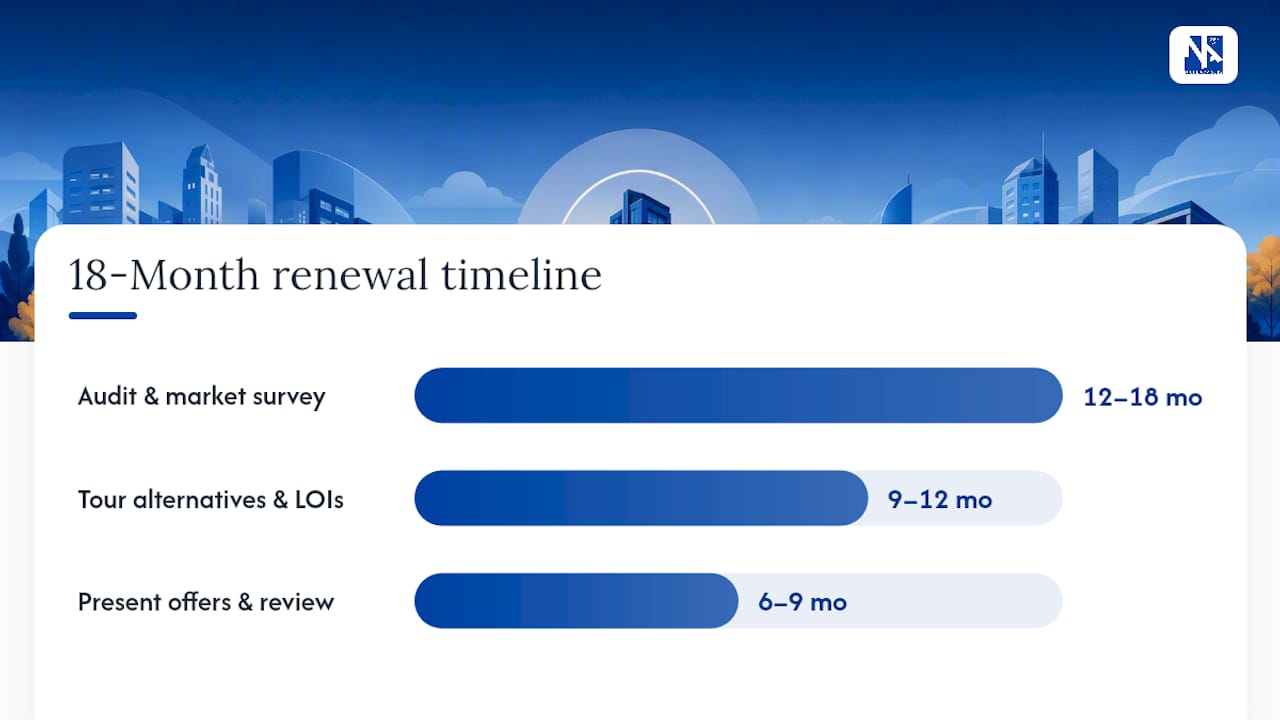
Treat the renewal timeline like a project plan with fixed milestones, not a vague intention to “sort it out later.”
12 to 18 months before expiry:
- Audit your existing lease for renewal notice periods, break clauses, and holdover rates.
- Run a space needs assessment against current and projected headcount.
- Commission a market survey covering three to five comparable buildings.
9 to 12 months before expiry:
- Tour shortlisted alternatives and request formal Letters of Intent.
- Build a financial model comparing renewal against relocation on equal terms.
6 to 9 months before expiry:
- Present competing offers to your existing landlord.
- Negotiate the Heads of Agreement and instruct your lawyer to review it.
Calendar these dates without exception:
- Your renewal notice deadline (often the single most consequential date in the whole file).
- The holdover rate that applies if you overstay without a signed renewal.
- Any break clause windows that could reset your negotiating position.
Which lease clauses matter most at renewal
Rent isn’t the only lever, and often it isn’t even the biggest one. Sprintlaw’s guide to Australian commercial leasing points tenants toward a specific set of clauses worth fighting for at renewal:
- Term and options. A longer term can fund bigger incentives, but only take it if you’re confident about your space needs for the full period.
- Rent review mechanism. Push for a defined method, whether CPI-linked, fixed percentage, or market review, with a cap so a market review can’t blow out unpredictably.
- TI allowance and free rent. Ask for both. Landlords in softer markets will often trade one for the other depending on their own cash position.
- CAM and outgoings caps. Uncapped outgoings can erode a good headline rent within two years.
- Assignment and subletting rights. Critical if your headcount is volatile or you’re planning any restructuring.
- Make-good limits and relocation/demolition protections. These determine what you owe on exit and whether the landlord can move you mid-term.
- Holdover rate and personal guarantee relief. Holdover penalties commonly sit well above your standard rent, so know the number before you risk triggering it.
The most useful trade is length for cash: landlords value certainty, and many will hand over a larger TI allowance or a capped CAM increase in exchange for two or three extra years on the lease. A genuine competing Letter of Intent is what makes that trade credible rather than theoretical.
Pro Tip: Before signing any Heads of Agreement, get it reviewed by a leasing lawyer. The Victorian Government Solicitor’s Office warns tenants specifically about vague HoAs locking in terms that prove unfavourable once the full lease is drafted.
How do you compare renewal and relocation costs fairly?
A headline rent comparison tells you almost nothing. Build a model that captures every real cost:
- Headline rent per square metre, for both the current space and alternatives.
- Effective rent after free rent periods are amortised across the term.
- TI allowance expressed per square metre, and what portion the landlord funds versus what you’re expected to cover.
- Moving and disruption costs, including IT relocation, downtime, and staff productivity loss during transition.
- Ongoing CAM and outgoings, projected across the full term, not just year one.
- Fitout amortisation period, and how many years of value you’d forfeit by moving early.
A quick way to sense-check the outcome: if the TI allowance and free rent on offer at a new building fully offset your estimated moving costs within the first 12 months, relocation is financially neutral at worst. If it takes three or more years to recover moving costs through incentives, staying put usually wins on the numbers alone, even before you weigh disruption to the business.
Turning refurbishment into renewal leverage
A tired office is a bargaining chip if you use it right. Combining refurbishment with renewal can unlock genuine landlord contributions, but only if you structure it properly.
- Ask whether the landlord’s contribution comes as cash or rental credit. Rental credit is easier for landlords to approve but delays your cash flow benefit.
- Negotiate make-good obligations for anything you upgrade, and insist on fitout-for-make-good offsets or clear exclusions for tenant-funded assets so you’re not paying to remove something you paid to install.
- Match your lease term to the payback period of the capital spend. A major fitout with a seven-year payback needs a lease term to match, or the economics fall apart.
When to bring in a tenant rep and a leasing lawyer
Get a tenant-side adviser involved at the market-survey stage, not after you’ve already narrowed to one building. A tenant rep generates the credible competing LOIs that actually shift a landlord’s position, because paper offers without genuine alternatives behind them rarely move anyone.
- Engage a tenant rep as soon as you start the 12 to 18 month clock, for market intelligence and LOI generation.
- Bring in a leasing lawyer before you agree to any Heads of Agreement, not after.
- Add a project manager once fitout planning begins, to keep design and construction aligned with your lease timeline.
Nicheadvisory has run this process across Sydney commercial lease renegotiations for over 12 years, and the pattern holds regardless of sector: tenants who engage advisers early consistently negotiate from a stronger position than those who call in help once the landlord has already sensed they’re staying.
Making sure the new lease actually gets followed
Signing the renewal isn’t the finish line. Once terms are locked in, someone on your team needs to own compliance: tracking CAM reconciliations against the agreed cap, confirming rent reviews land on the correct formula, and flagging make-good obligations well before they become exit-day surprises. Set a calendar reminder at each rent review date and each anniversary of the lease to check actual costs against what was negotiated. Landlords rarely chase you down to apply a cap in your favour.

How Nicheadvisory Helps You Run This Playbook
Running a proper renewal strategy while managing your actual job is the real challenge here, not the theory. Nicheadvisory exists specifically for that gap: instead of hiring a traditional agency that represents landlords most of the year, you get advisers who work exclusively for tenants, which changes the incentives at every stage of the negotiation. Nicheadvisory combines workplace strategy, independent tenant representation, and project management under one roof, so the same team that runs your market survey and generates competing LOIs also manages the fitout planning if you decide to refurbish or relocate. That’s a genuinely different model to piecing together a broker, a lawyer, and a project manager separately and hoping they coordinate.
If your lease expires within the next 18 months, the practical next step is straightforward: get in touch with Nicheadvisory to scope a market survey and find out where you actually stand before you talk to your landlord again.
Sources
For legal detail on Heads of Agreement risk, see the Victorian Government Solicitor’s Office guidance. For process detail specific to Sydney tenants, Nicheadvisory’s page on lease renegotiation and why office leases are getting more expensive are worth a read before your next review.
- Don’t play heads or tails – your leasing heads of agreement: seek legal advice (Victorian Government Solicitor’s Office)
- Should I renew my commercial lease or relocate? (TenantBase)
- Corporate leasing explained: guide for Australian businesses (Sprintlaw)
- Office refurbishment for lease renewal (Stemar Group)