Budget between $800 and $3,500 per square metre for an office fitout in Australia in 2026, with a medium-quality fitout averaging around $3,011/m² according to JLL. For early-stage budgeting, use Sydney or Melbourne benchmarks of roughly $2,600 to $3,000/m² as your starting point, then adjust for building condition and services scope.
- National range: $800–$3,500/m², with Cat B office work typically landing between $1,500 and $2,500/m²
- Working figure: $3,011/m² for a medium-quality fitout, rising 3.5–6% year on year
- Contingency: add 10–15% for a well-scoped project, 20% or more where base-building condition is unknown
Pro Tip: Don’t anchor your budget to the lowest number you find online. Quick-refresh calculators often quote $550–$850/m², but that’s a paint-and-carpet overlay, not a genuine tenant fitout. The Interior Fitout Association (IFA) points out that small swings in labour and material costs can erode margins fast, which is exactly why accurate early benchmarking matters more than ever. Niche Advisory works with these numbers daily across Sydney, Melbourne, Brisbane and Adelaide tenancies.
TL;DR:
- Labour shortages due to competing infrastructure projects in Sydney and Brisbane are pushing up rates, especially for skilled trades.
- Building condition significantly impacts costs, with older towers requiring mechanical upgrades that can add hundreds of thousands of dollars.
- Accurate scope definition before pricing helps prevent budget overruns, especially when comparing different fitout scope levels like Cat A and Cat B.
- Pre-fitted or landlord-provided suites are increasingly favored for reducing delivery risk amid rising material and labour costs.
- Engaging an independent advisor before tendering can help lock in scope, negotiate better terms, and control variation costs effectively.
Table of Contents
- City benchmarks: what a square metre of office fitout costs in 2026
- Cat A, Cat B standard and Cat B premium: what you’re actually paying for
- Where the money actually goes in a fitout budget
- What drives the price up and how to keep it down
- Turning a per-m² number into a real project budget
- Three worked examples: turning benchmarks into real totals
- Why an independent advisor changes the maths on your budget
- Beyond the capital cities: regional cost variations
- Compliance costs: accessibility, safety and building codes
- How current market conditions are pushing costs higher
- Getting a better deal from suppliers and contractors
- Why work with Nicheadvisory on your fitout budget
- Key Takeaways
- Sources
City benchmarks: what a square metre of office fitout costs in 2026
Sydney and Melbourne generally have higher fitout costs due to factors like dense construction pipelines competing for trades, tighter access in CBD towers, and higher specified services. Brisbane and Perth usually have somewhat lower costs, though both are catching up as major projects pull skilled labour away from smaller commercial jobs.
These figures come from current city-by-city fitout cost benchmarking and JLL’s national figure sits slightly above the individual city midpoints, reflecting the weighting toward premium CBD work.
- CBD towers: use the upper half of the range, particularly in heritage-listed or older stock with limited after-hours access
- Fringe or suburban tenancies: the lower half generally applies, thanks to simpler logistics and less competition for trades
- Perth’s wide band reflects resource-sector volatility, where mining-linked demand spikes can push skilled labour costs sharply in either direction
Cat A, Cat B standard and Cat B premium: what you’re actually paying for
Quotes that look wildly different often describe wildly different scopes. Getting the specification level right before you compare prices avoids the most common budgeting mistake we see at Niche Advisory: comparing a bare-shell quote against a fully furnished one and assuming someone’s ripping you off.
- Cat A (base fitout): roughly $800–$1,200/m². Covers raised floors, suspended ceilings, basic mechanical and electrical distribution, and painted walls. Excludes partitions, joinery, and furniture.
- Cat B standard: roughly $1,500–$2,500/m². Adds partitioning, meeting rooms, kitchen and breakout areas, standard lighting and data cabling, and basic joinery.
- Cat B premium: roughly $2,800–$3,500/m² and beyond. Adds glazed partitions, feature ceilings, bespoke joinery, advanced AV, and branded finishes throughout.
Where the money actually goes in a fitout budget
Builders’ works, meaning the physical construction trades, typically account for around half of total fitout costs, with technology investment now sitting at a significant portion of budgets and climbing as businesses specify better AV and connectivity from day one.
Within a typical trade breakdown, partitions carry 20 to 30% of the budget in partition-heavy layouts, services (mechanical and electrical) run 20 to 25%, ceilings sit at 8 to 12%, and finishes take another 10 to 15%. The rest is preliminaries: site management, hoarding, waste removal, and after-hours access fees.
- Partitions: 20–30% in cellular office layouts, far less in open-plan designs
- Services (M&E): 20–25%, and the trade most likely to blow a budget if base-building infrastructure needs upgrading
- Ceilings: 8–12%
- Finishes: 10–15%
One choice moves the needle more than almost any other: glazed partitions versus plasterboard. Glazing can run two to three times the cost per linear metre of standard plasterboard partitions, and if your design brief calls for glass-fronted meeting rooms throughout, that single decision can add tens of thousands to a mid-sized fitout.
What drives the price up and how to keep it down
Labour is the biggest wildcard right now. The IFA has flagged that competing infrastructure pipelines, including major transport projects, data centre builds, and Olympics-linked construction, are pulling skilled trades away from commercial fitout work and pushing up rates in constrained regions, particularly Sydney and Brisbane.
Base-building condition is the second big trigger. An older tower with tired mechanical services or inadequate power distribution can add hundreds of thousands to a project before a single partition goes up.
- Lock your procurement route early. A design and construct model shifts risk to the contractor but usually costs more upfront; a traditional tender process can save money if your scope is genuinely fixed.
- Freeze the scope before pricing. Every change after contracts are signed costs more than the same change made at design stage.
- Use staged approvals and variation control. Review and approve variations as they arise rather than at project close, when leverage has evaporated.
Pro Tip: Ask contractors to itemise their preliminaries separately from trade costs. A short programme window in a CBD tower can double preliminaries costs through after-hours labour loadings alone.
Turning a per-m² number into a real project budget
A benchmark rate is a starting point, not a budget. Getting from one to the other takes four steps.
- Choose your benchmark and adjust for city and specification. Start with the city figure, then move toward Cat A, standard Cat B, or premium Cat B depending on your design brief.
- Add allowances for services and preliminaries. If the building’s base services are dated, budget separately for mechanical upgrades rather than assuming they’re baked into the per-m² rate.
- Include professional fees, permits, FF&E and GST. Design and project management fees typically run 8 to 15% of construction cost; furniture is almost always a separate line item.
- Apply contingency based on scope certainty. A well-documented brief with a confirmed building condition report might only need 10%. An unknown base-building or a compressed programme should carry 20% or more.
- Get a building condition report before finalising your budget, not after
- Separate FF&E from construction costs in your own tracking, even if a single contractor is managing both
- Treat GST as a pass-through in your budget planning, not part of the construction figure itself
Three worked examples: turning benchmarks into real totals
Numbers on a spreadsheet only mean something once you attach them to a floor plate you can picture.
- 150 m² open-plan, Cat A-plus: at $800 to $1,500/m², this lands between roughly $120,000 and $225,000 total. Minimal partitioning keeps costs at the lower end.
- 300 m² standard Cat B: at $1,500 to $2,500/m², total costs run $450,000 to $750,000. Variance here usually comes down to meeting room count and services complexity.
- 100 m² premium, joinery-heavy: at $2,800 to $3,500/m² plus fitted cabinetry, totals reach $280,000 to $350,000 or higher, driven almost entirely by bespoke joinery and feature finishes rather than floor area.
| Example | Size | Spec level | Total range |
|---|---|---|---|
| A | 150 m² | Cat A-plus | $120,000–$225,000 |
| B | 300 m² | Standard Cat B | $450,000–$750,000 |
| C | 100 m² | Premium/joinery-heavy | $280,000–$350,000+ |
Why an independent advisor changes the maths on your budget
Twelve-plus years of tenant-side advisory work across Sydney, Melbourne, Brisbane and Adelaide has taught Niche Advisory one consistent lesson: the businesses that overspend aren’t the ones with expensive tastes, they’re the ones who lock in a contractor before they’ve locked in a scope.
An independent advisor sits on your side of the table, not the builder’s, which changes what gets negotiated and when.
- Scope clarity before pricing, so quotes from different contractors are actually comparable
- Contractor selection based on track record, not just the lowest headline number
- Variation control throughout construction, catching cost creep before it compounds
- Make-good negotiation at lease end, which affects your total occupancy cost far more than most tenants realise
Read more about how combining relocation and fitout services reduces duplicated procurement risk, particularly if you’re moving premises and fitting out at the same time.
Beyond the capital cities: regional cost variations
That gap narrows quickly when a regional centre has its own construction boom underway.
The Gold Coast is a good example: with sustained residential and commercial construction activity in the region, trade pricing has crept closer to Brisbane levels for comparable Cat B fitouts, even though headline rents remain lower. Newcastle, by contrast, still tends to offer a genuine discount against Sydney rates because its commercial construction pipeline is smaller and more predictable.
Adelaide sits in an interesting middle ground. Adelaide CBD and Adelaide Hills projects often benefit from lower labour costs than the eastern seaboard, but building stock in the CBD skews older, so services upgrades can claw back some of that saving. The lesson for anyone budgeting outside Sydney or Melbourne: don’t assume a regional or secondary-city discount applies evenly across every line item. Labour rates might be lower, but if the building itself needs more remedial work, the total per-m² figure can land closer to capital city benchmarks than the headline suggests.
Always get a local quote rather than applying a blanket regional discount to a capital city benchmark. The variance between two regional centres can be as significant as the variance between two capital cities.
Compliance costs: accessibility, safety and building codes
Every commercial fitout in Australia has to meet the National Construction Code, and for most Australian office tenancies, that means compliance with the Disability (Access to Premises – Buildings) Standards under the Disability Discrimination Act. Accessible bathrooms, compliant ramps and door clearances, and appropriate signage aren’t optional extras. They’re baked into any legitimate quote, and a contractor who’s left them out hasn’t given you a cheaper price, they’ve given you an incomplete one.
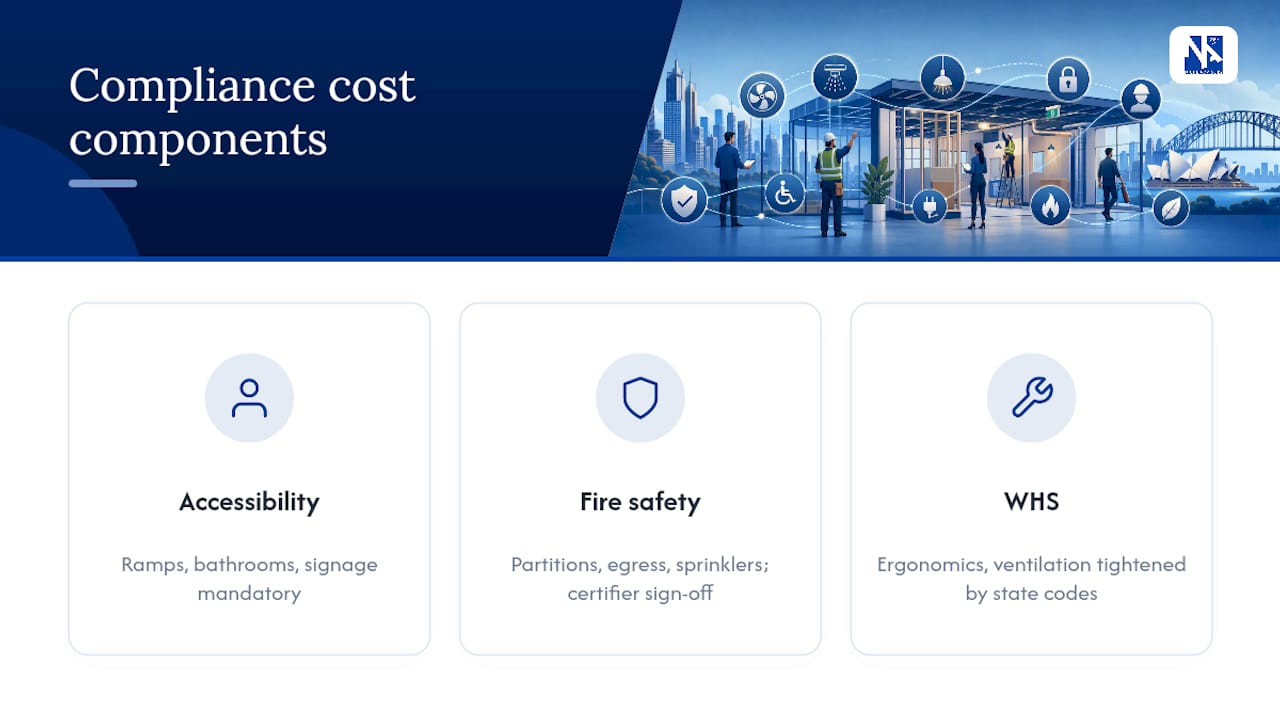
Fire safety compliance is the other major line item that catches out first-time fitout clients. Fire-rated partitions, compliant egress paths, and sprinkler or detection system modifications all need sign-off from a certifier, and in older buildings, bringing existing base-building fire systems up to current standard can be one of the largest hidden costs in the entire project.
Work health and safety obligations under state-based WHS legislation also shape fitout costs, particularly around ergonomic workstation requirements and ventilation standards, which have tightened in most states’ codes over the past several years. None of this is unique to any one city. It applies whether you’re fitting out a 100 m² suite in Adelaide or a full floor in Sydney’s CBD. Build compliance costs into your budget from day one rather than treating them as a contingency line, because a certifier who flags non-compliance late in a project can delay practical completion by weeks.
How current market conditions are pushing costs higher
Material and labour costs in Australian office fitouts have both moved upward, and the 3.5 to 6% year-on-year increase JLL reports isn’t a one-off spike, it’s the current trend line. Two forces are driving it from different directions.
On the labour side, major infrastructure and data centre construction is competing directly with commercial fitout for the same electricians, mechanical fitters and carpenters, particularly in Sydney and Brisbane. That competition doesn’t ease off just because your project is smaller than the one down the road; trades go where the work and the rates are best.
That’s a genuine shift in what “standard” now means for a Cat B fitout, not just inflation on the same scope.
One consequence worth watching: businesses increasingly favour pre-fitted or landlord-provided suites specifically to sidestep this cost and delivery uncertainty, preserving capital rather than committing to a bespoke build with an unpredictable final number. That’s created what’s effectively a two-speed market, where cost-certain, pre-fitted space competes directly against premium bespoke fitouts for the same tenants, and the choice between them increasingly comes down to how much delivery risk a business is willing to absorb.
Getting a better deal from suppliers and contractors
The single most effective negotiating lever in an Australian fitout is scope certainty. Contractors price risk into every quote, and an unclear brief gets a bigger risk margin baked in than a fully documented one. Nail down your scope, your finishes schedule and your programme dates before you go to tender, and you’ll see tighter, more competitive pricing across the board.
Get at least three genuine quotes on a like-for-like scope, not three quotes on three different interpretations of a vague brief. That single discipline exposes more pricing games than any negotiating tactic you could use afterward.
Payment terms matter more than most tenants realise. Staged payments tied to verified milestones, rather than a simple deposit and completion structure, give you leverage throughout the build rather than just at the start. And build variation approval into your contract explicitly: require written cost and time impact before any variation proceeds, not a verbal agreement followed by an invoice.
Finally, treat your contract’s defects liability period as a real negotiating point, not boilerplate. A 12-month defects period with clear response timeframes protects you long after the contractor has moved on to the next job, and it costs nothing to ask for it upfront.
Why work with Nicheadvisory on your fitout budget
Getting the number right on paper is one thing. Keeping it right through procurement, construction and handover is another problem entirely, and it’s the one most businesses underestimate.
Nicheadvisory is the alternative to going straight to a design and construct contractor for your office fitout in Australia: we sit on your side of the negotiation, not the builder’s, which means scope creep and variation costs get caught before they hit your invoice, not after. Our tenant-side advisory work spans workplace strategy, design, project management and lease negotiation across Sydney, Melbourne, Brisbane and Adelaide, and it means you get one team accountable for the whole outcome rather than juggling separate contractors and consultants who each have their own commercial interest in the final number.
If you’re at the point of turning a per-m² benchmark into an actual budget, get in touch with Niche Advisory for a budget review before you go to tender. It’s the cheapest insurance you’ll buy on the whole project.
Key Takeaways
Office fitout costs in Australia in 2026 range from $800 to $3,500 per square metre, and getting the specification level and city benchmark right upfront prevents the most expensive budgeting mistakes.
| Point | Details |
|---|---|
| Use the right benchmark | Start with $2,600–$3,000/m² for Sydney or Melbourne, adjusting down for regional centres and up for premium specification. |
| Match spec to scope | Cat A ($800–$1,200/m²), standard Cat B ($1,500–$2,500/m²) and premium Cat B ($2,800–$3,500/m²) cover very different inclusions. |
| Watch services and builders’ works | Builders’ works can be roughly half of total cost, and base-building condition is the biggest hidden cost trigger. |
| Apply the right contingency | Add 10–15% with a clear scope, 20% or more where the building condition or programme is uncertain. |
| Get advice before tendering | Nicheadvisory’s tenant-side advisory work helps businesses lock in scope, control variations and negotiate make-good before costs escalate. |
Sources
- Australia’s office fit-out costs climb as market reshapes – JLL
- 2026/2027 Federal Budget – What it means for the interior fitout industry | IFA
- Commercial Fitout Cost Australia 2026
- Office Fit-Out Cost Per m² in Australia: 2026 City Guide