
Hire a specialist office fitout project manager. It’s the single decision that protects your timing, your budget, and your sanity, because you get one person accountable for the whole delivery instead of a scatter of designers, builders, and landlords each managing their own slice of the risk. For readers who want an end-to-end advisory partner rather than a series of separate hires, Niche Advisory is the recommended fit.
What that looks like in practice:
- One point of contact from brief through to handover
- A managed budget with contingency built in, not discovered later
- Coordinated approvals so landlord and statutory sign-off doesn’t stall the programme
The fastest way to test the fit is a short scoping call or a fixed-fee brief phase, before you commit to full delivery.
Key Takeaways
Predictable timing, controlled budgets, and single-point accountability come from appointing a specialist office fitout project manager early and locking the brief before design freeze.
| Point | Details |
|---|---|
| Hire before you design | Bring in a project manager at brief stage, not after concept design is already drafted. |
| Respect the design freeze | Sign off design before construction drawings are issued; late changes trigger costly re-permitting. |
| Budget for a multi-month period | Most mid-to-large fitouts run several months from first workshop to move-in, with landlord approvals the biggest variable. |
| Start with fixed-fee scoping | A fixed-fee brief phase reveals real costs and programme before you commit to full delivery. |
| Niche Advisory as the recommended partner | Offers independent, fixed-fee scoping and end-to-end project management across a 12-plus year track record. |
Table of Contents
- What does an office fitout project manager actually do?
- What are the stages of a typical office fitout?
- How much does an office fitout project cost and how long does it take?
- How do you choose the right fitout project manager?
- What approvals and risks need managing during a fitout?
- How does Niche Advisory manage office fitout projects?
- What do you need to do during the fitout as the client?
- Work with us: scoping call and fixed-fee brief phase
- Frequently asked questions
- Sources
What does an office fitout project manager actually do?
The role exists because a fitout has too many moving parts for any one trade to run alone. An office fitout project manager keeps the whole job on track, on budget, and compliant, coordinating designers, builders, suppliers, and the landlord’s own requirements under one accountable lead.
In practice, that coordination covers:
- Briefing and workplace strategy — turning headcount and growth assumptions into a workable brief
- Budget and cost planning — setting realistic numbers before design locks anything in
- Programme management — building and holding the master schedule
- Design coordination — keeping architects, engineers, and services consultants aligned
- Statutory and landlord approvals — chasing permits and base-building sign-off in parallel, not in sequence
- Tendering and procurement — running a fair, documented contractor selection
- Contractor supervision and quality control — site presence, defect tracking, inspections
- FF&E and IT/AV coordination — furniture, data, and technology arriving on time and fitting the plan
- Commissioning and handover — testing systems and compiling documentation
- Defects and aftercare — chasing the builder after you’ve moved in, not before
Most competent providers now run this through programme trackers, shared collaboration platforms, and procurement portals rather than spreadsheets and email chains, which cuts down on the version-control chaos that plagues DIY-managed fitouts.
What are the stages of a typical office fitout?
A fitout follows a fairly consistent sequence, and understanding it tells you exactly when your sign-off actually matters. The standard delivery framework runs through briefing, programme development, design and documentation, tendering, construction, and formal approvals with probity built in at each gate.
- Brief and business requirements — headcount, growth, and workstyle assumptions get locked down
- Concept design — layout options tested against the brief and budget
- Developed design and documentation — drawings, services coordination, and finishes schedules finalised
- Approvals and permits — landlord consent, statutory permits, certifier review
- Tendering — contractors compete on a fixed scope
- Procurement and early works — contracts signed, long-lead items ordered
- Construction — the physical build
- Commissioning — systems tested, snagging resolved
- Practical completion and move-in — keys handed over, staff arrive
The critical moment in that sequence is design freeze, the point where drawings are locked and construction documentation issued for approval. Client sign-off happens here, and it’s the last cheap moment to change your mind. Push a change through after this point and you’re often looking at re-permitting, new fire assessments, and a knock-on delay that costs far more than the original decision would have.
Pro Tip: Treat the design freeze meeting as non-negotiable. Bring every stakeholder who might later say “actually, can we move that wall” and get their sign-off in writing before construction drawings go out.
Sign-off responsibility shifts through the process too: the client approves the brief and design, the designer certifies documentation, and the building owner or certifier signs off approvals before construction can proceed.
How much does an office fitout project cost and how long does it take?
Fee structures for fitout project management generally fall into four models, and each suits a different risk appetite.
- Fixed-fee scoping — a set price for a defined brief and design phase, ideal when you want budget certainty before committing further
- Percentage of construction cost — the manager’s fee scales with the build, common on larger projects
- Time-based retainer — billed on hours or a monthly rate, suited to longer or more fluid engagements
- Milestone billing — payment released against agreed deliverables, which keeps both sides honest on progress
Fixed-fee scoping is the lowest-risk entry point if you haven’t worked with a provider before, because you know exactly what the brief phase costs before you’re locked into anything bigger.
On timing, a typical mid-to-large commercial office fitout runs around 5 to 8 months from first workshop to move-in, with the programme most sensitive to landlord approvals, long-lead furniture and joinery items, and any heritage or base-building constraints.
Cost control comes down to four disciplines: early cost planning before design locks in, sizing contingency realistically (not as an afterthought), a procurement strategy that tests the market properly, and a disciplined process for approving change orders rather than letting them accumulate.
How do you choose the right fitout project manager?
Run a structured selection process rather than picking on gut feel. Here’s the checklist worth working through before you sign anything.
- Demonstrable delivery track record on projects of similar scale
- Current insurances and relevant credentials
- Local approvals experience with your specific building or precinct
- A documented cost-control method, not just a promise to “keep an eye on it”
- A communication cadence you can actually commit to
- Team capacity to run your project alongside their existing workload
Then interview. Questions worth asking every shortlisted provider:
- Can you show me an example where you compressed a schedule without cutting quality?
- How do you manage variations once construction has started?
- What’s your experience with landlord and base-building approvals specifically?
- Can I speak to two recent clients as references?
- How do you size contingency, and what happens when it runs out?
- Who on your team will actually be on site day to day?
- What’s your default fee model, and can it flex to fixed-fee scoping?
- How do you track progress and communicate delays?
Watch for red flags during this process: no willingness to provide references, vague answers about who does what, thin documentation standards, or reluctance to commit to milestones and contingency handling. A proposal worth reading closely spells out scope, fee model, and programme in plain language, not marketing copy. If you can’t tell from the proposal what happens in week six, that’s a problem.
What approvals and risks need managing during a fitout?
Compliance isn’t optional, and missing it late in the programme is expensive. A fitout project delivery framework typically requires:
- Building Act compliance and construction permits
- Fire and life-safety sign-off
- Accessibility compliance
- Landlord and building-owner consents
- Certifier sign-off and any financial approvals tied to the lease
Landlord approvals are rarely a rubber stamp. Building owners often scrutinise base-building impacts closely, and that review can run several weeks independently of statutory permits, so engaging building management early is essential rather than optional.
Reduce risk by getting documentation coordinated before you submit for approval, running procurement transparently so nobody can later claim favouritism, and building contingency into your programme specifically for long-lead items like specialised joinery or imported furniture.
Pro Tip: Submit landlord approval requests the same week you lock concept design, not after developed design is finished. Base-building reviews rarely move faster because your drawings are more detailed.
Responsibility splits roughly as follows: the client owns financial and lease-related approvals, the designer owns documentation for certifier review, and the project manager owns the sequencing so none of these approvals sit idle waiting on another.
How does Niche Advisory manage office fitout projects?
Niche Advisory runs fitout delivery through fixed-fee scoping, integrated workplace strategy, and independent tenant advocacy, meaning the advice you get isn’t shaped by a builder’s or landlord’s commercial interest. The model has been refined across 12-plus years of workplace transformation projects spanning corporate, professional services, and warehouse tenancies.
That track record covers:
- Fixed-fee brief and scoping phases before committing to full delivery
- Independent advisory, meaning no builder kickbacks shaping recommendations
- Coordinated landlord and statutory approvals run in parallel with design
- End-to-end project management through to handover and defects resolution
A tenant that engaged Niche Advisory for a Sydney relocation and fitout needed a compressed programme after a lease deadline forced an early move-out. Running design, landlord approvals, and procurement in parallel rather than in sequence kept the project on its revised date without cutting corners on documentation quality.
This directly answers the selection checklist above: track record, independent advice, and a cost-control method that’s documented rather than assumed.
What do you need to do during the fitout as the client?
A fitout project manager reduces your workload, but it doesn’t eliminate your role. Decisions still need a decision-maker, and delays in your response time are one of the most common causes of programme slippage that has nothing to do with the contractor.
Your responsibilities generally fall into three categories. First, timely decisions: design sign-offs, finishes selections, and furniture choices all sit on the critical path, and a week’s delay on any of them pushes the whole schedule back a week. Second, internal stakeholder management: your project manager can coordinate consultants, but only you can get sign-off from your own executive team, IT department, or HR on workplace policy questions like desk ratios or hot-desking. Third, access and information: providing accurate headcount data, growth forecasts, and existing lease documentation early prevents rework later.
The most useful thing a client can do is nominate one internal decision-maker with actual authority to approve budget and design changes, rather than routing every decision through a committee. Projects where five people need to agree on carpet colour move noticeably slower than projects with one accountable owner on each side. Beyond that, respond to requests for information within the timeframe your project manager sets, and flag internal constraints (budget ceilings, board approval timing, staff consultation requirements) as early as possible rather than midway through construction.

Work with us: scoping call and fixed-fee brief phase
Most fitout providers ask you to commit to full delivery before you’ve seen a real budget or programme. Niche Advisory works the other way round: a fixed-fee brief phase captures your requirements, sets a high-level budget, drafts a realistic programme, and flags the decision points you’ll need to make early, before you commit to anything larger.
That upfront clarity does two things. It removes the guesswork that causes cost blowouts later, and it gives you a properly priced full delivery package instead of a rough estimate padded for risk. You walk away from the brief phase with a document you can take to your board or CFO, not a sales pitch. If you’re weighing up whether to manage a fitout in house or bring in independent advisory, this is the cheapest way to find out what the real numbers look like. Book a scoping call with Niche Advisory and get a fixed-fee brief phase moving before your lease deadline starts dictating the timeline for you.
Frequently asked questions
Do I really need a project manager, or can my facilities team run the fitout?
Facilities teams can run small fitouts, but anything involving landlord approvals, multiple contractors, or a hard move-in date usually benefits from dedicated project management. The coordination workload alone often exceeds what an in-house team can absorb alongside their day job.
How early should I engage an office fitout project manager?
Before you sign a new lease or renew an existing one, ideally. Early engagement lets the project manager influence lease terms, fitout allowances, and access dates, which is far harder to negotiate retroactively.
What’s the difference between office fitout project management and construction project management?
Office fitout project management includes workplace strategy, briefing, and FF&E coordination alongside the build. General construction project management typically focuses on the physical works alone, without the workplace strategy layer.
Can a fitout project manager help negotiate with my landlord?
Yes, and it’s one of the more valuable parts of the role. Landlord approvals often sit on the critical path, and a manager experienced in base-building negotiations can shorten review times considerably.
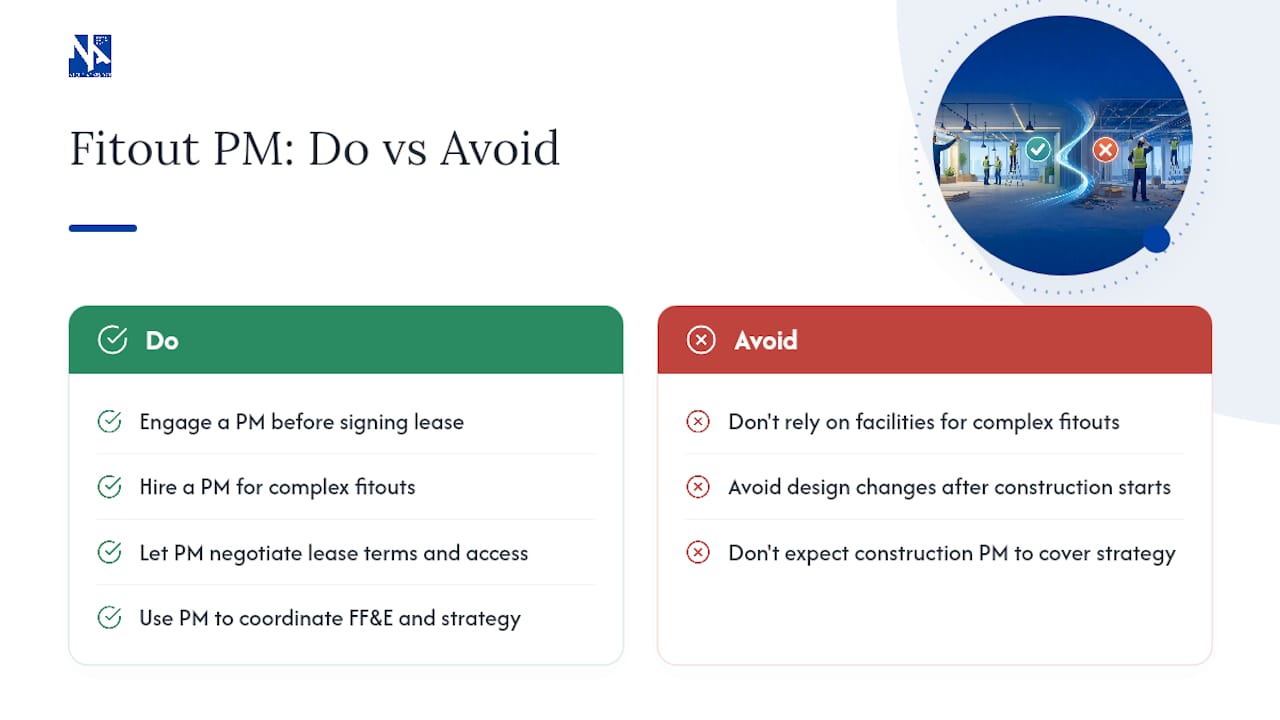
What happens if I need to change the design after construction has started?
It’s possible but costly. Changes after design freeze usually trigger re-documentation, potential re-permitting, and schedule delays, which is why locking the brief early matters more than most clients expect going in.
Sources
- Guideline 3: fitout — the fitout process and framework
- How Long Does an Office Fitout Take? | Graham Nicholas
- What an Office Fitout Project Manager Does – Integrity Office
Recommended
- Workplace Design Services – Niche Advisory
- This is What You Need to Think About When Choosing Floor Finishes for Your Sydney Office Fit-Out – Niche Advisory
- The Resurgence of Hot-desking in Sydney Offices – Niche Advisory
- What is a Depreciation Schedule for Your Sydney Office Fit-Out and Why Do You Need One? – Niche Advisory