
A retail lease is governed by state retail leasing laws that impose mandatory tenant protections, mandatory disclosure and limits on what a landlord can charge. A commercial lease sits under general property and contract law, so almost everything is negotiable and nothing is guaranteed unless it’s written into the lease. The label on the document doesn’t decide which regime applies. Actual use does.
TL;DR:
- Retail leases automatically trigger statutory protections such as mandatory disclosure statements, regulated rent reviews, and dispute resolution pathways, which are absent in commercial leases.
- Confirming whether a lease is retail or commercial depends on actual use, thresholds, and classification tests; assuming based on title alone can lead to costly disputes.
- Retail classification mandates itemized outgoings, regulated rent review processes, and prescriptive rules on assignment and make-good obligations, which alter cash flow and control.
- Dispute resolution for retail leases typically involves low-cost tribunals and mandatory mediation, unlike commercial leases that often rely on costly court proceedings without a standard process.
- Tax implications, including GST and deductibility, hinge on the clarity of cost disclosures and make-good arrangements, making early advice from an accountant essential.
Table of Contents
- Retail vs commercial lease: the legal difference that changes everything
- How to tell whether your lease is retail or commercial
- The practical differences that hit your cashflow and your control
- State and territory quick notes: where to check the rules
- Before you sign: the tenant negotiation checklist
- Common mistakes and the risks of getting classification wrong
- How a tenant adviser helps you get this right
- How lease type changes your insurance and liability exposure
- How disputes get resolved differently
- Tax treatment: where retail and commercial leases actually differ
- Comparing typical lease terms: length, options and rent
- Sources
Retail vs commercial lease: the legal difference that changes everything
Every state and territory has its own retail leasing Act, and each one operates the same way: it overrides any lease clause that tries to contract out of it. If a landlord’s lease says the tenant waives their right to a disclosure statement, that clause is void the moment the Retail Leases Act 1994 No 46 applies to the premises. You cannot draft your way around retail legislation once it’s triggered.
Commercial leases don’t get this scaffolding. There’s no equivalent statute forcing disclosure, no ban on lease preparation fees, no regulator standing behind the tenant. Whatever protection you get, you negotiated for it.
Typical statutory protections under a retail Act include:
- A mandatory lessor’s disclosure statement before signing
- A ban on charging tenants for the landlord’s own lease preparation costs
- Regulated processes for rent reviews, assignment and relocation
- Access to a state tribunal or Small Business Commissioner for disputes
Pro Tip: Don’t assume a shopfront automatically means a commercial lease just because the landlord calls it one. Statutory tests trump the title on the front page every time.
How to tell whether your lease is retail or commercial
Working out which regime applies takes four checks, and skipping any one of them is how tenants end up disputing terms years into occupancy.
- Identify the state or territory and its Act. NSW, Queensland, Victoria, South Australia and every other jurisdiction run separate legislation with separate thresholds.
- Compare permitted use against actual use. A lease drafted as “office” but operating as a public-facing showroom or café can still fall under retail rules, according to guidance on when the Retail Leases Act applies.
- Check the carve-outs. Queensland excludes premises over 1,000 square metres from its Retail Shop Leases Act; other states use rent thresholds or tenant-type exclusions instead.
- Confirm disclosure was actually provided. No lessor’s disclosure statement within the statutory window is itself a red flag that something’s been missed.
Pro Tip: Cafés, salons, repair shops and professional consulting rooms all get caught by retail definitions in most states. If the public walks in off the street to buy something, treat it as retail until proven otherwise.
The practical differences that hit your cashflow and your control
This is where the theory turns into dollars. A retail classification changes five things a commercial lease leaves entirely to negotiation.
- Disclosure statements. Under NSW law, the lessor must hand over a disclosure statement at least seven days before the lease is signed, covering rent, estimated outgoings, permitted use, trading hours and any planned works. Commercial landlords have no equivalent obligation.
- Outgoings. Retail law forces landlords to itemise and justify outgoings recoveries; commercial outgoings clauses are whatever gets negotiated, which means vague wording can leave you exposed to surprise increases.
- Rent review. Retail Acts commonly regulate how market reviews happen and require turnover rent reporting where that model applies. Commercial rent reviews follow whatever mechanism the parties agreed, fixed percentage, CPI, or market, with no statutory backstop.
- Assignment and relocation. Retail tenants get prescriptive notice periods and consent rules around assignment and landlord-initiated relocation or demolition. Commercial tenants rely on whatever the lease says, which is often thin.
- Make-good. Retail leases don’t cap make-good obligations by statute, but the negotiated position matters enormously either way. Our guide to make-good obligations covers how these clauses get drafted and disputed in practice.
State and territory quick notes: where to check the rules
Retail leasing law is not uniform. Each jurisdiction sets its own thresholds, so a premises that’s exempt in one state might be squarely covered in another.
- NSW: Retail Leases Act 1994, with Service NSW guidance for tenants comparing lease types.
- Queensland: Retail Shop Leases Act 1994, excluding shops over 1,000 square metres and defining shopping centres by strict criteria.
- South Australia: Retail and Commercial Leases Act, with guidance referencing a $420,000 per annum rent threshold above which the Act may not apply.
- Victoria, WA, Tasmania, ACT and NT: each runs its own retail leasing statute with different size and rent carve-outs.
Check the current Act text or your state’s Small Business Commissioner before relying on any threshold. These figures get reviewed and updated, and yesterday’s exemption can change without much fanfare.
Before you sign: the tenant negotiation checklist
Get these four things sorted before you put a signature on anything.
- Confirm classification and request disclosure early. Don’t wait for the landlord to volunteer it, ask directly and in writing.
- Demand a real outgoings estimate. Get the reconciliation process spelled out, and clarify any landlord contribution toward fit-out costs.
- Lock in option windows and rent review mechanics. Vague clauses here cause more disputes than almost anything else in a lease. Where incentives or rent-free periods are involved, document them in an Agreement for Lease, as practitioner guidance consistently recommends.
- Negotiate sensible make-good caps and broad permitted use. Narrow permitted-use wording can box you into a corner if your business model shifts.
Pro Tip: Model total occupancy cost, rent plus outgoings plus fit-out plus make-good, before you compare two premises. The headline rent figure on a lease proposal rarely tells the real story.
Common mistakes and the risks of getting classification wrong
The single biggest trap is trusting the lease’s own label. Advisers see this constantly: a lease titled “commercial” that’s actually retail under the statutory test, because the Act looks at actual use, not the document’s heading.
- Signing without checking for a lessor’s disclosure statement, missing or defective disclosure can trigger termination rights or compensation claims under retail law.
- Missing an option exercise window because nobody tracked the notice period, this is one of the most common and most expensive mistakes tenants make, as outlined in our piece on common lease mistakes in Sydney.
- Poorly drafted assignment clauses that leave a tenant unable to exit or sell the business cleanly.
How a tenant adviser helps you get this right
Niche Advisory has spent more than 12 years helping tenants confirm lease classification, review disclosure statements line by line, and model total occupancy cost before anyone signs. We negotiate option windows, make-good caps and assignment terms on the tenant’s side of the table, not the landlord’s. Bring your draft lease, any disclosure statement received, and your floor plan or fit-out brief to an advisory session, and we’ll flag the clauses that matter before they become expensive.
How lease type changes your insurance and liability exposure
Retail leases typically push more prescriptive insurance obligations onto the tenant, because the statutory disclosure regime forces landlords to spell out expectations upfront rather than leaving them buried in a schedule. You’ll commonly see mandatory public liability cover, often at a set minimum sum insured, alongside requirements to name the landlord as an interested party on the policy.
Commercial leases handle this through negotiation alone. That can cut either way: a well-advised commercial tenant might negotiate lighter insurance obligations than a retail tenant would ever get, but a poorly negotiated commercial lease can also leave gaps that a retail Act would have closed automatically.
Liability for injuries in common areas versus the leased premises itself is where disputes actually happen. Retail centres with shared foot traffic, food courts, or public thoroughfares tend to allocate liability more precisely because multiple tenants share the same risk pool. A single-tenant commercial office building has simpler liability lines, generally just landlord versus tenant, with less need for the layered indemnities you see in a shopping centre lease.
Either way, check what public liability minimum your landlord requires and whether business interruption cover is expected as a condition of the lease, not just a recommendation. This detail gets missed constantly because it sits in a schedule most tenants skim.

How disputes get resolved differently
Retail lease disputes route through low-cost, purpose-built pathways: state tribunals, mediation services, or a Small Business Commissioner, depending on jurisdiction. These pathways exist specifically because retail leasing law wants disputes resolved without both sides burning tens of thousands on litigation, and most retail Acts make mediation a mandatory first step before anyone can go to a tribunal or court.
Commercial lease disputes have no equivalent structure. Unless the lease itself specifies a dispute resolution clause, mediation, arbitration, or an expert determination process, both parties default to ordinary court proceedings. That’s slower and considerably more expensive, and it strips away any regulator input.
This is one of the most underrated differences between the two lease types. A retail tenant with a rent review dispute can usually get in front of a low-cost tribunal within months. A commercial tenant in the same argument might be looking at a Supreme Court claim if the lease didn’t provide for anything else. If you’re negotiating a commercial lease, insist on a dispute resolution clause that mirrors the retail model, mediation first, arbitration second, court as the last resort.
Tax treatment: where retail and commercial leases actually differ
For most tenants, the core GST and income tax treatment of lease payments doesn’t change based on retail versus commercial classification, rent is generally a deductible business expense either way, and GST typically applies to commercial and retail premises rentals alike. The differences that matter sit in the detail of how costs are structured and disclosed.
Retail leases with mandatory outgoings disclosure make it easier to identify which costs are capital in nature (and depreciable) versus revenue costs (immediately deductible), because the landlord has to itemise them upfront. Commercial leases negotiated with vague outgoings clauses can blur this line, and that ambiguity sometimes only surfaces at tax time when your accountant asks what a lump-sum “outgoings contribution” actually covered.
Make-good obligations carry their own tax wrinkle. A cash payment in lieu of make-good work, common in negotiated exits, can be treated differently for tax purposes than restoration work performed directly, and this applies whether the lease is retail or commercial. Get this scoped with your accountant before you agree to a make-good settlement figure, not after.
None of this is a substitute for advice tailored to your entity structure. Talk to your accountant early, particularly around any lump-sum incentive or make-good payment, because the tax outcome can shift the real value of a deal that looks identical on the lease’s face.
Comparing typical lease terms: length, options and rent
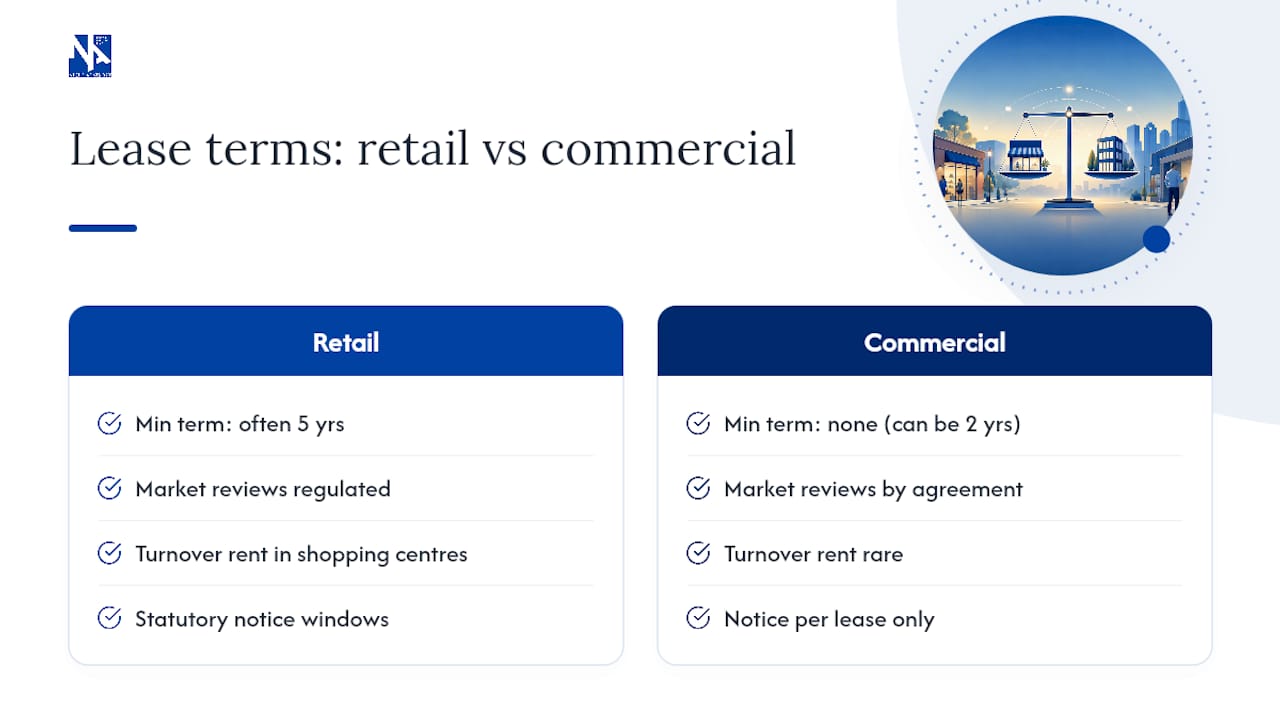
Retail leases in most states carry a minimum term requirement, often five years including any option periods, designed to stop landlords locking small retailers into short, precarious tenancies. Commercial leases have no such floor. A commercial tenant can sign a two-year term if that’s what both sides agree to, with renewal entirely dependent on negotiated option clauses rather than any statutory minimum.
Rent calculation methods look superficially similar across both lease types, fixed increases, CPI-linked reviews, market reviews, but retail leases regulate how market reviews are conducted and can require landlords to justify a market rent claim with comparable evidence. Turnover rent, where a portion of rent is calculated against the tenant’s sales, appears almost exclusively in retail leases inside shopping centres and rarely shows up in a standard commercial office deal.
Renewal options differ in practice more than in principle. Retail tenants generally get clearer statutory notice windows for exercising options, while commercial tenants are entirely at the mercy of whatever notice period got drafted into their specific lease. Missing that window in a commercial lease usually means losing the option outright, with no regulator or tribunal able to save you.
The practical takeaway: never assume rent review or renewal terms are standard just because they look familiar from a previous lease. Compare the actual clause against what your state Act would otherwise require, not what you remember from your last tenancy.
If you’re weighing up a retail shopfront against an office premises right now, or trying to work out which lease regime applies to a hybrid space, Niche Advisory can walk through your draft lease and disclosure statement before you commit. Our team has spent over a decade helping Sydney, Melbourne, Brisbane and Adelaide tenants confirm classification and negotiate the terms that actually protect the business, not just the paperwork.
Sources
- Retail Leases Act 1994 No 46
- Retail Shop Leases Act 1994 (QLD)
- Retail Leases Act (NSW) guidance (MyLawFirm)
- Retail lease vs commercial lease — Sprintlaw
- South Australian Retail and Commercial Leases guide (SASBC)