
Tenant representation means hiring an adviser who works exclusively for you, not the landlord, to negotiate your lease. For most commercial tenants facing a renewal or relocation, engaging one is the right move: independent advisers routinely secure better rent structures, stronger incentives, and lower legal exposure than tenants negotiate alone. The action to take now is simple. Start planning well in advance before your lease event and get independent advice on the table before you talk to any landlord.
TL;DR:
- Engaging a tenant representative before the last six months of a lease is crucial to maintain leverage and avoid accepting weaker terms under time pressure.
- Most of the financial benefit comes from running competing proposals, which requires a structured process starting at least 12 months ahead of lease expiry.
- The most impactful negotiation points are incentives, rent-free periods, cap on outgoings, makegood obligations, and renewal rights, which significantly influence total occupancy costs.
- Choosing an independent adviser with proven local experience and clear fee structures helps prevent conflicts of interest and ensures effective deal outcomes.
- Collaborating with a leasing lawyer is essential to convert negotiated commercial terms into enforceable legal documents that protect the tenant long-term.
Table of Contents
- What is tenant representation and why does it matter?
- When should you engage a tenant representative?
- What does the tenant representation process actually look like?
- Which lease terms do tenant reps prioritise in negotiation?
- How do you choose a tenant representative?
- How are tenant representatives paid, and what’s the ROI?
- How do tenant reps and leasing lawyers work together?
- Niche Advisory: a practical example of tenant representation in action
- What challenges do tenant representatives help overcome?
- Does tenant representation affect retention and long-term occupancy?
- What do successful tenant representation outcomes look like?
- If you want help: how to get started with Niche Advisory
- Sources
- FAQ
What is tenant representation and why does it matter?
Tenant representation is advisory work done exclusively for the tenant’s benefit, structurally separate from the landlord’s leasing agent. That distinction matters because a landlord’s agent is paid by the landlord and owes the landlord loyalty, even when they seem helpful during your negotiation. A tenant representative has no such conflict. Independent tenant advisers negotiate commercial terms specifically to protect the tenant’s interests, which changes the leverage dynamic from the first phone call.
The scope of the work typically covers:
- A needs analysis that translates your headcount, growth plans, and operational requirements into a property brief
- Market search and building shortlisting across comparable stock
- Negotiation of rent, incentives, and lease clauses on your behalf
- Coordination through to fitout and handover
Tenants who engage representation properly tend to walk away with larger incentive packages, rent-free periods that actually cover fitout time, and lease clauses that don’t quietly shift risk onto the tenant. The value isn’t abstract. It shows up in the signed heads of agreement.
When should you engage a tenant representative?
The planning window matters more than most tenants expect. Sprintlaw recommends starting sufficiently before lease expiry to allow proper planning and negotiation so there’s time for market study, benchmarking against comparable buildings, and internal budget approvals before formal negotiations even start.
Here’s a rough sequence that works for most tenants:
- 12 months out: engage a representative, complete the needs analysis, and start market benchmarking
- 9 to 10 months out: shortlist buildings, run inspections, and solicit competing proposals
- 6 to 7 months out: negotiate heads of agreement and lock in incentives
- 3 to 4 months out: finalise legal terms, design fitout, and schedule construction
- 1 to 2 months out: handover, fitout completion, and move logistics
Pro Tip: If you’re inside six months of expiry with no plan, you’ve already lost most of your negotiating leverage. Landlords know a rushed tenant will accept weaker terms just to avoid holdover risk.
Leaving negotiation too late doesn’t just cost you money. It forces decisions under time pressure that you’d otherwise have room to reconsider.
What does the tenant representation process actually look like?
A structured process starts before you ever look at a building. Niche Advisory’s approach begins by identifying business requirements, translating workplace strategy into a concrete property brief rather than jumping straight to available listings.
From there, the workflow generally runs through five stages:
- Requirements workshop: headcount projections, department adjacencies, technology needs, and budget parameters get documented into a brief
- Market search and shortlisting: your representative canvasses available stock, often including options not publicly advertised, and arranges inspections
- Proposal solicitation: rather than negotiating with one landlord, your representative invites competing proposals from multiple buildings to create genuine leverage
- Negotiation and financial modelling: rent, incentives, outgoings, and term length get modelled side by side across shortlisted options before you sign anything
- Due diligence, legal review, and delivery: lease documentation goes to a leasing lawyer for drafting review while fitout and construction planning run in parallel
Running competing proposals is where most of the financial upside comes from. A landlord negotiating against a single interested tenant has little reason to move on price or incentives. A landlord who knows you’re seriously evaluating two other buildings behaves very differently, and that dynamic is difficult to create without someone managing multiple relationships simultaneously.
This is also where timeline and process intersect: the nine to twelve month window exists precisely because proposal solicitation, comparative negotiation, and financial modelling take real time to do properly. Compress it and you lose the comparative leverage that makes the whole process worthwhile.
Which lease terms do tenant reps prioritise in negotiation?
Not every clause in a commercial lease carries equal financial weight. A tenant representative focuses attention on the handful of terms that actually move total occupancy cost, rather than getting distracted by boilerplate.
- Rent structure and incentives: the headline rent matters less than the effective rent once incentives, rent-free periods, and fitout contributions are factored in. Two leases with identical face rent can differ by hundreds of thousands of dollars in real cost.
- Outgoings and operating expense caps: uncapped outgoings clauses let landlords pass through increases with little tenant recourse. Negotiating a cap, or at least a defined methodology, protects your budget forecasting.
- Term length, break options, and renewal mechanics: a longer term often buys a better rate, but only if you’re confident about your space needs. Break clauses and renewal options give you flexibility if the business changes shape.
- Fitout contributions and rent reviews: how the landlord’s contribution is structured, and whether rent reviews are fixed, CPI linked, or market based, affects your cost certainty over the full term.
- Makegood obligations: this is one of the most commonly underestimated clauses in a lease. Experienced tenant advisors play a genuine role in negotiating makegood terms to avoid open-ended reinstatement obligations that can cost tenants tens of thousands of dollars at lease end.
- Assignment and subletting rights: if your business might restructure, merge, or need to sublease part of its space, these rights need to be negotiated up front. Retrofitting them later, once the landlord has no incentive to agree, rarely works.
Common tenant mistakes tend to cluster around exactly these clauses: uncapped outgoings, vague makegood language, and no clear renewal pathway. A representative’s job is catching these before signature, not renegotiating them after the fact when there’s no leverage left.
How do you choose a tenant representative?
Not all advisers bring the same skill set, and the wrong choice can cost you more than going it alone. Look for genuine sector and local market experience, not just a broad real estate background, and ask directly whether the firm ever represents landlords in the same market. That’s a conflict worth ruling out early.
Before engaging anyone, work through this checklist:
- Confirm independence: does the firm ever act for landlords, and if so, in which buildings or precincts?
- Ask for documented case outcomes from comparable transactions, not general marketing claims
- Request sample negotiation strategies for a hypothetical similar to your situation
- Get a clear, written fee disclosure before any work begins
- Check resourcing: who on the team will actually run your negotiation day to day?
Requesting documented case outcomes and a clear fee disclosure before engagement is standard best practice, and any adviser unwilling to provide either is worth treating with caution.
A few direct interview questions cut through marketing language fast:
- “Show me a comparable deal you’ve closed in this precinct in the last two years.”
- “Do you or your firm ever represent landlords, and how do you manage that conflict?”
- “What’s your fee structure, and what happens if the deal falls through?”
- “Who specifically will be negotiating on my behalf?”
Red flags include vague answers about landlord relationships, reluctance to name past clients or outcomes, and fee structures that aren’t explained in writing before you commit.
How are tenant representatives paid, and what’s the ROI?
Fee models vary, and understanding them upfront avoids awkward surprises later. The three common structures are a fixed fee for a defined scope, a retainer plus success fee tied to outcomes, and a percentage-based fee calculated against the lease value or savings achieved.
- Fixed fee: predictable cost, works well for tenants with a narrow, well-defined scope like a straight renewal
- Retainer plus success fee: aligns adviser incentive with tenant outcome, though it requires clarity on what counts as “success”
- Percentage-based: common on larger transactions, but tenants should confirm whether the percentage applies to gross rent, incentives negotiated, or total contract value
A written scope and transparent fee disclosure prevents misunderstandings and keeps adviser incentives aligned with tenant outcomes rather than adviser convenience. Ask for this before signing an engagement letter, not after.
Measuring ROI isn’t complicated once the deal closes. Compare the incentive package secured against market norms for the precinct, check whether outgoings were capped rather than left open-ended, and confirm makegood language was tightened rather than left as boilerplate. A representative who delivers on all three has usually paid for their fee several times over across the lease term.
How do tenant reps and leasing lawyers work together?
These two roles complement each other rather than overlap. A tenant representative drives commercial strategy: market leverage, negotiation tactics, and deal structure. A specialist leasing lawyer focuses on enforceable drafting and legal liability, turning commercial terms into language that actually holds up if a dispute arises later.
The typical sequence runs like this:
- Tenant representative negotiates commercial terms and reaches heads of agreement
- Leasing lawyer reviews the draft lease against those agreed terms, flagging gaps or unfavourable drafting
- Both parties coordinate on makegood clauses specifically, since ambiguous language here creates disputes years down the track
- Costs are typically split by function: representation fees cover negotiation work, legal fees cover drafting and review
Skipping the lawyer to save cost is a false economy. Skipping the representative and going straight to a lawyer means you’ve already lost the market leverage that shapes the deal a lawyer is asked to draft.
Niche Advisory: a practical example of tenant representation in action
Niche Advisory has spent over 12 years working through this exact process for corporate tenants, combining workplace strategy with independent real estate advisory rather than treating leasing as a standalone transaction.
The applied methodology tends to follow the same shape across engagements:
- Identify business requirements first, translating headcount and operational needs into a property brief
- Run market search and shortlisting against that brief, not against whatever’s easiest to find
- Negotiate commercial terms with a specific focus on outgoings caps, incentive structures, and makegood clauses
- Coordinate legal review, fitout design, and project delivery through to handover
Typical outcomes pursued through this process include measurable cost savings against market rent, clearer makegood obligations that avoid open-ended reinstatement costs, and capped outgoings that protect budget forecasting over the lease term. Readers wanting a scoped discussion of their own situation can review how the end-to-end process works in more detail.
What challenges do tenant representatives help overcome?
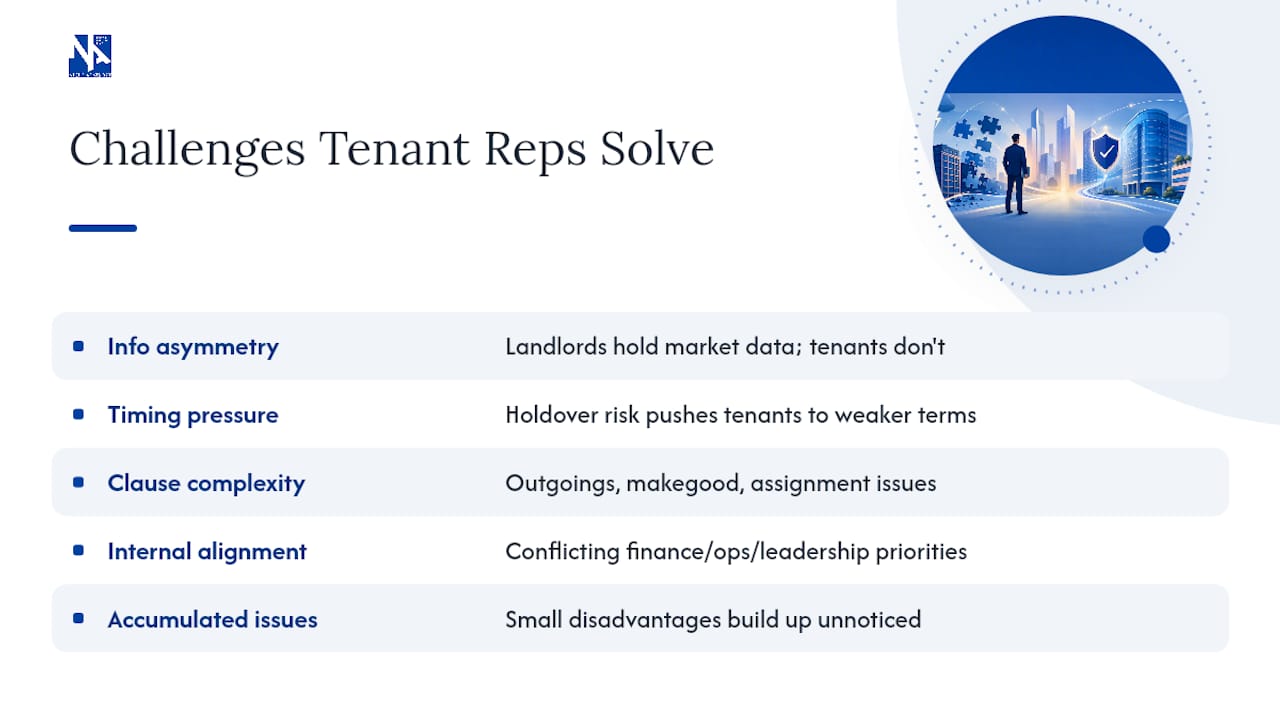
Negotiations rarely fail because of one dramatic disagreement. They fail because of accumulated small disadvantages a tenant doesn’t notice until it’s too late to fix them.
Information asymmetry is the biggest one. Landlords and their agents know the vacancy rate, the incentive levels other tenants secured, and how motivated the landlord actually is to fill the space. Tenants negotiating alone rarely have access to any of that. A representative levels this by bringing comparable transaction data from across the market, not just the one building in front of you.
Timing pressure is the second recurring challenge. Landlords benefit when tenants negotiate close to expiry, because holdover risk pushes tenants toward accepting weaker terms just to avoid disruption. A representative managing multiple building relationships simultaneously removes that pressure, because you’re never negotiating from a position of having only one option left.
Clause complexity is the third. Outgoings allocation, makegood obligations, and assignment rights are dense, and landlords’ standard leases are drafted to favour the landlord by default. A representative who’s negotiated dozens of comparable leases spots the clauses that need pushback before they become expensive problems years later.
Multi-stakeholder alignment inside the tenant’s own organisation causes friction too. Finance wants cost certainty, operations wants flexibility, and leadership wants the deal closed quickly. A representative manages that internal negotiation alongside the external one, keeping the process moving without one department’s priorities silently overriding another’s.
Does tenant representation affect retention and long-term occupancy?
Yes, and the connection is more direct than most tenants assume. A poorly negotiated lease tends to trap a business in space that no longer fits, either because growth outpaced the floor area or because rigid terms made adjusting impossible without penalty.
Break options and renewal mechanics negotiated properly at the outset give a business room to adjust without starting a full relocation search from scratch. Tenants who negotiate flexible terms tend to stay longer in spaces that continue to work for them, simply because the lease structure allows adaptation rather than forcing an all-or-nothing decision at each renewal point.
Occupancy cost certainty plays a role too. When outgoings are capped and rent reviews are structured predictably, a business can forecast its property costs years ahead. That predictability reduces the pressure to relocate purely to escape an unpredictable cost base, which is a more common driver of premature relocation than most executives realise.
There’s also a workplace strategy dimension that goes beyond the lease document itself. Integrating workplace strategy into the property search can reduce long-term occupancy cost beyond simple rent savings by aligning the space itself to how the business actually works, rather than just how much floor area it occupies. A building that fits the organisation’s operating rhythm gets renewed. A building that was chosen on rent alone often gets abandoned at the first opportunity, regardless of how the lease itself was negotiated.
What do successful tenant representation outcomes look like?
The clearest signal of a well-run negotiation isn’t a single headline number. It’s a pattern of decisions that compound across the lease term.
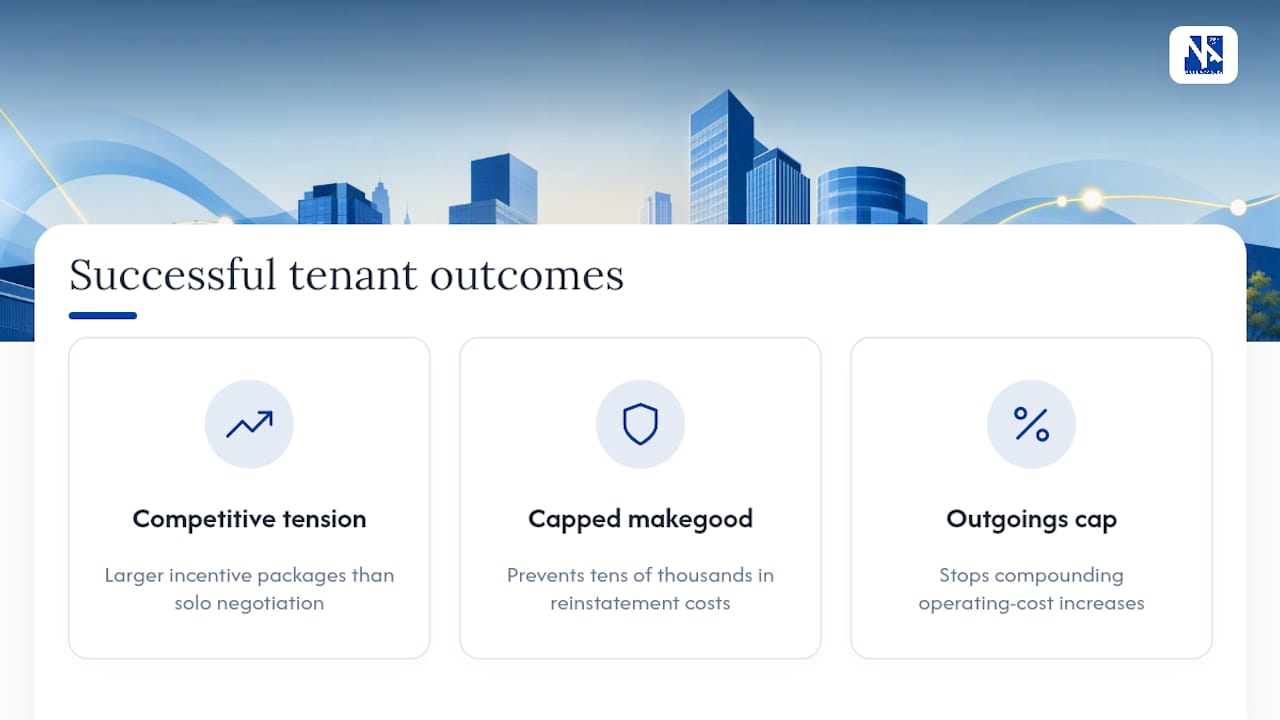
Consider a tenant approaching a renewal with twelve months of runway. Engaging a representative early allowed a genuine market search rather than a single-landlord conversation, which created real competitive tension. That tension typically translates into a larger incentive package than a tenant negotiating solo would see, because landlords respond very differently when they know a business is seriously evaluating alternatives rather than bluffing.
The makegood clause is often where the most value gets protected rather than gained. A lease with vague reinstatement language can leave a departing tenant facing unexpected costs running into tens of thousands of dollars. Negotiating specific, capped makegood terms at the outset, rather than leaving it as generic boilerplate, removes that risk before it ever materialises.
Outgoings caps deliver a similar protection over time. A tenant with an uncapped outgoings clause absorbs every increase in building operating costs for the life of the lease, sometimes several percentage points a year compounding across a five or ten year term. A capped clause negotiated early converts an open-ended risk into a known, budgetable cost.
None of these outcomes depend on aggressive tactics or unusual market conditions. They come from starting early, running a genuine competitive process, and having someone at the table whose only job is protecting the tenant’s position.
If you want help: how to get started with Niche Advisory
Some tenant representation firms work with corporate business owners, executives, and facilities managers who need independent advice on a lease renewal, relocation, or workplace change, not general real estate guidance for personal use. The typical first step is a discovery conversation covering your timeline, current lease position, and workplace requirements, with fees explained clearly before any engagement begins so there are no surprises about scope or cost partway through.
If your lease is approaching expiry or your business is outgrowing its current space, the smartest move is starting that conversation now rather than waiting until you’re negotiating under time pressure. You can get in touch with Niche Advisory to scope out what a tenant representation engagement would look like for your specific situation.
FAQ
What is tenant representation in commercial leasing?
Tenant representation is advisory work performed exclusively for the tenant, negotiating lease terms and market strategy without any obligation to the landlord.
When should I start the tenant representation process?
Start nine to twelve months before your lease expires or before a planned relocation, giving enough time for market benchmarking, internal approvals, and genuine negotiation.
How much does a tenant representative cost?
Fee models vary between fixed fees, retainer plus success fee, and percentage-based structures, so request a written scope and fee disclosure before engaging any adviser.
Do I still need a lawyer if I use a tenant representative?
Yes. A tenant representative handles commercial negotiation and market leverage, while a specialist leasing lawyer drafts and reviews the lease document for enforceability.
How do I know if a tenant representative is genuinely independent?
Ask directly whether the firm or individual ever represents landlords in the same market, and request documented case outcomes before signing an engagement letter.