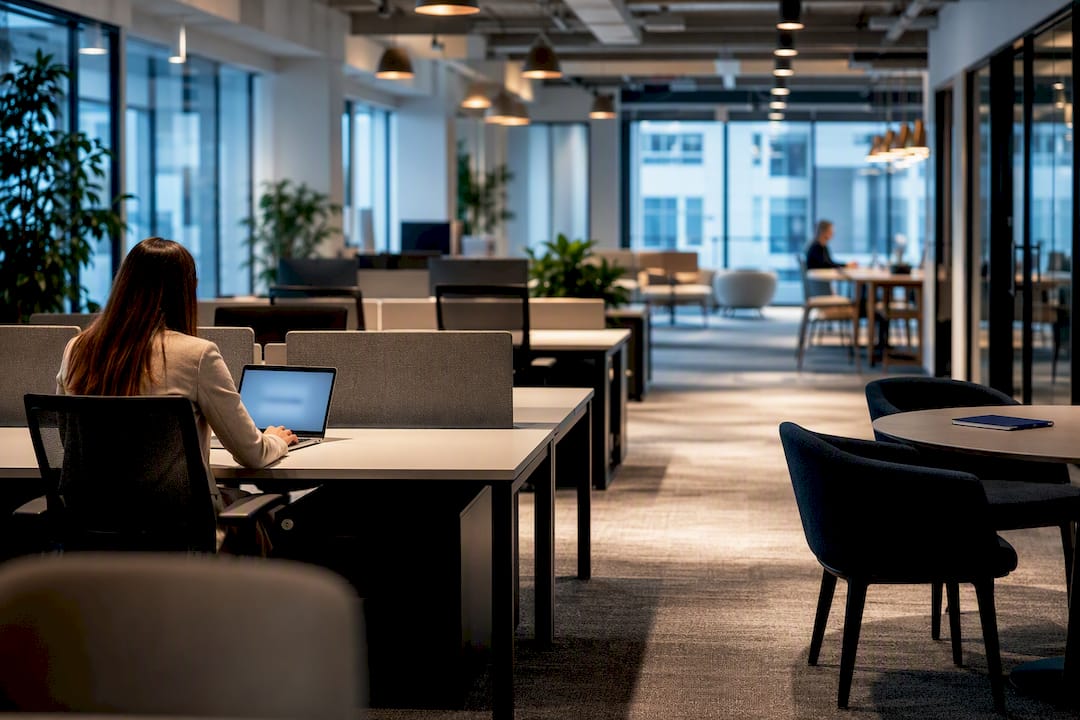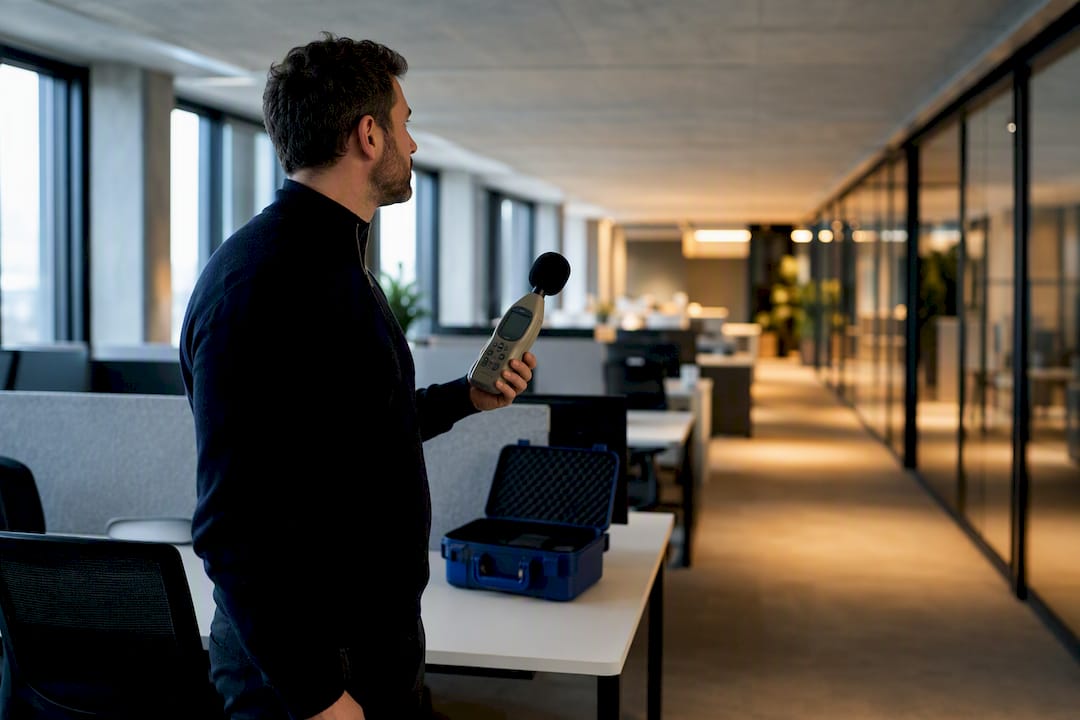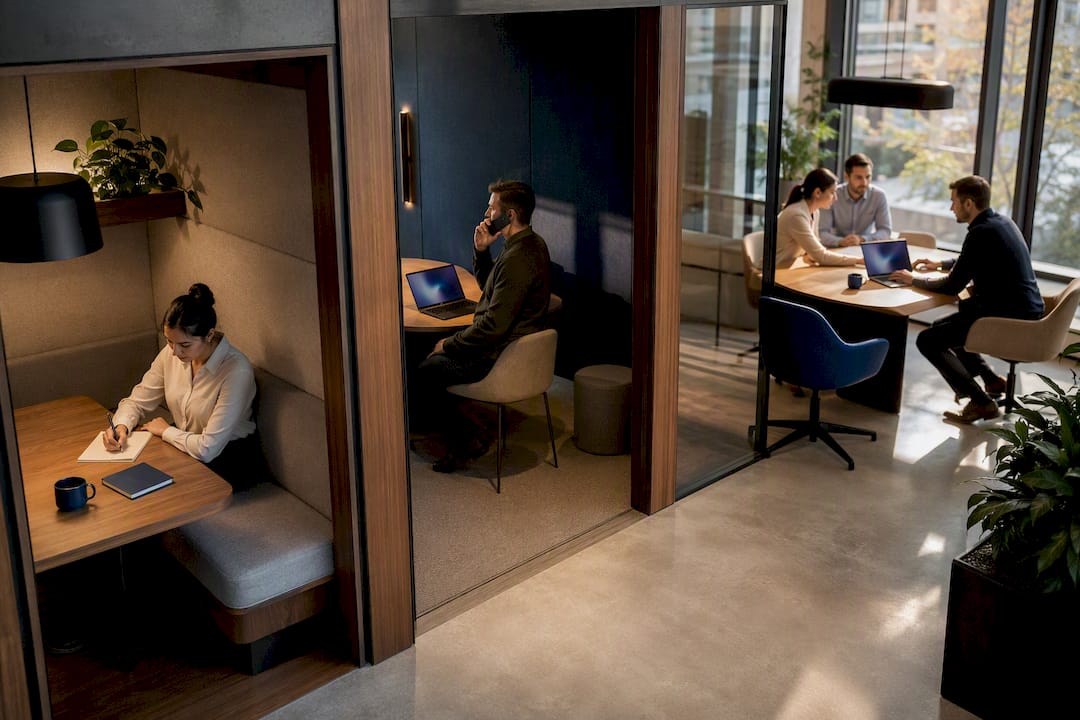
Activity-based working gives staff a mix of purpose-built settings instead of one fixed desk, and it succeeds when leaders pair the physical redesign with the right technology and a genuine change in how people manage teams. It suits knowledge workers who move between focused solo work and collaboration through the day. Skip any of the three pillars, space, tech or leadership, and the model tends to underdeliver.
TL;DR:
- Successful ABW relies on integrating physical space design, reliable technology, and leadership behavior change, with neglecting any pillar causing underperformance.
- Proper zone sizing and acoustic separation are critical to avoid noise issues, while ergonomic and storage provisions must be consistent across all shared spaces.
- Continuous post-occupancy evaluation, through regular data and staff feedback, is essential to adapt and optimize the workspace after implementation.
- Holistic, participatory rollout processes with prior training and staged transitions significantly improve staff satisfaction and overall success.
- Management must establish clear booking rules, privacy options, and monitor usage patterns to address issues early and ensure the space supports productivity.
Table of Contents
- What is activity based working?
- What zones make up an ABW office?
- What are the essential elements of activity-based working?
- Does activity-based working actually improve productivity?
- How do you implement activity-based working step by step?
- How do you measure whether ABW is working?
- What does the latest ABW research tell managers?
- What should managers check before, during and after rollout?
- How Niche Advisory helps you deliver activity-based working
- Sources
- FAQ
What is activity based working?
Activity-based working, commonly shortened to ABW, gives employees a choice of settings matched to the task at hand rather than one assigned desk for the entire day. A person might start in a quiet booth to write a report, move to a huddle room for a client call, then finish the afternoon at a communal table for a team brainstorm. That’s the core distinction from other office models.
Hot-desking simply removes desk ownership and swaps one generic desk for another. Open-plan offices remove walls but keep a single setting for every task. Cellular offices lock staff into private rooms regardless of what they’re doing. ABW is different because it treats the workday as a series of activities, each with its own ideal environment, and designs the office around that variety.
Three pillars hold the model together:
- Physical environment: a deliberate mix of zones, from silent booths to open collaboration hubs, each tuned to a specific kind of work.
- Virtual and technology infrastructure: booking systems, reliable Wi-Fi everywhere, and devices that let staff work from any setting without friction.
- Behavioural and cultural norms: trust-based management, clear etiquette around noise and booking, and leaders who model the new way of working instead of just announcing it.
The concept isn’t new. Consultancies were pushing it through the 1990s and 2000s as a response to expensive city leases and underused desks. It re-emerged strongly after COVID because hybrid work broke the old assumption that everyone needs a permanent desk five days a week. Occupancy data from that period showed most desks sitting empty most of the time, and ABW offered a way to reallocate that wasted square metreage into settings people would actually use.
What zones make up an ABW office?
An ABW fitout is a portfolio of settings, not a single floorplan repeated across the building. Each zone earns its place by supporting one type of work well, rather than trying to do everything adequately.
- Focus booths and quiet rooms support deep, uninterrupted individual work. These are usually one or two-person spaces with acoustic treatment, booked in short blocks of 30 to 90 minutes.
- Silent zones are open areas with a strict no-talking norm, suited to reading, admin and heads-down tasks without the full enclosure of a booth.
- Collaboration hubs are larger, informal spaces with movable furniture and whiteboards, built for small teams working through a problem together.
- Huddle rooms seat two to six people for scheduled calls or quick decisions, typically booked in 15 to 30-minute increments through a room-booking system.
- Café and social areas double as informal meeting spots and a release valve from desk-based work, often the busiest zone by headcount even though they’re rarely booked at all.
- Client and presentation spaces are polished, bookable rooms for external visitors, usually sized for eight to twelve people and positioned near reception.
Sizing matters more than most fitout briefs admit. A common failure is over-building silent zones and under-building huddle rooms, because huddle rooms get used constantly for the two-person catch-up that used to happen at someone’s desk. Some organisations also design hybrid rooms, a huddle room that converts to a focus space after 3pm, stretching utilisation without adding floor area.
What are the essential elements of activity-based working?
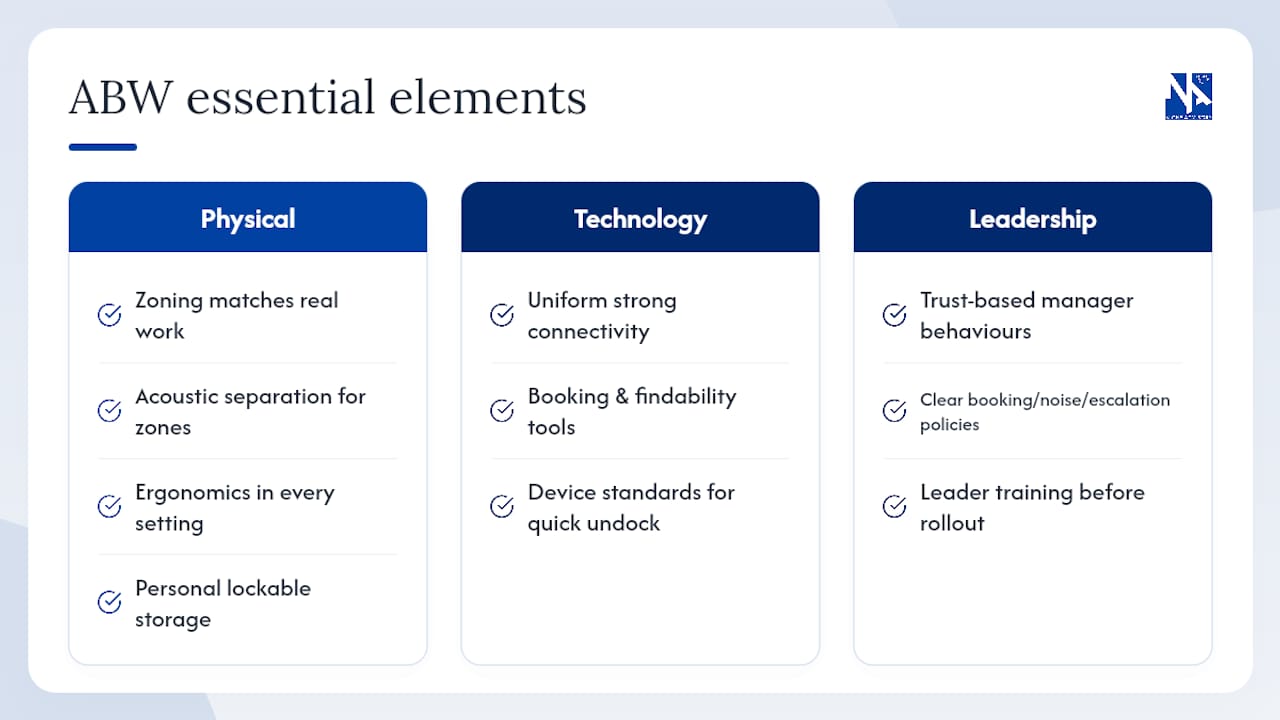
ABW fails when it’s treated as a furniture project. The physical layer, the technology layer and the leadership layer all have to move together, and each one has its own non-negotiables.
Space design fundamentals: zoning has to reflect how people actually work, not how the org chart looks. Acoustic separation between focus zones and collaboration areas is the single most common design failure, because noise bleed from one zone ruins the adjacent one. Ergonomics needs attention across every setting, not just the desks people used to own, since sit-stand adjustability and proper monitor height matter just as much in a shared booth. Storage has to be personal and lockable, because staff without a fixed desk still need somewhere to keep a jacket, a laptop charger and personal items.
Technology needs: connectivity has to be uniformly strong across every zone, not just the main floor, because a huddle room with patchy Wi-Fi gets abandoned within weeks. Booking and findability tools, whether that’s a room-booking app or a simple digital map, remove the daily friction of hunting for a free desk. Device standards matter too: if staff can’t undock and move a laptop in under a minute, they’ll default back to camping at one desk.
People and leadership: managers need new behaviours built around trust rather than visual supervision, since they can no longer see who’s at their desk. Clear policies on booking etiquette, noise, and escalation when zones are misused stop the model collapsing into a free-for-all. Training for team leaders before rollout, not after complaints start, is what separates a smooth transition from a rocky one.
Pro Tip: Bring IT and facilities into the same planning meetings from day one. A booking system chosen by facilities without IT input, or a device rollout planned without facilities’ zoning map, is the fastest way to build a beautiful office nobody can actually use.
Does activity-based working actually improve productivity?
The evidence is genuinely mixed, and that’s worth saying plainly rather than dressing up as universal good news. Comparative research on knowledge-worker productivity finds ABW generally outperforms open-plan offices on perceived productivity, but the comparison against traditional cellular offices is far less clear-cut and depends heavily on context.
The benefits show up consistently across studies that track well-implemented rollouts:
- Better cross-team collaboration, because collaboration hubs and café zones create informal contact that closed offices don’t.
- Genuine flexibility for staff who alternate between deep work and meetings through the day.
- Occupier cost optimisation, since a well-utilised ABW floor typically needs less total area than a desk-per-person model.
The risks are just as consistent, and they cluster around the same handful of complaints: noise bleed between zones, a drop in team cohesion when people no longer sit near their direct colleagues, and ergonomic complaints from staff who never get properly set up in shared settings.
A decade-long review of ABW research found that outcomes depend heavily on how the model is implemented — partial rollouts that change the furniture without changing management practice or technology tend to produce dissatisfaction, while holistic approaches that address all three pillars together show a far higher chance of success.
That single finding explains most of the conflicting headlines you’ll see about ABW. The model isn’t inherently good or bad. It’s highly sensitive to how well the rollout is run, which is precisely why the next section matters more than the floorplan itself.
How do you implement activity-based working step by step?
A rushed rollout is the single biggest predictor of a failed one. Treat this as a five-stage program, not a weekend fitout.
- Define objectives and map activities. Before touching a floorplan, audit what your teams actually do all day, focus work, calls, collaboration, client meetings, and engage stakeholders across HR, IT and facilities to agree on goals.
- Run participatory design and pilots. A mixed-methods study of a Swedish public sector rollout found that a broad, participatory implementation strategy produced better employee perceptions than a narrowly expert-driven approach. Prototype one floor or one wing before committing the whole building.
- Train leaders and set policy before go-live. Managers moving into an ABW plus work-from-home environment often need to shift toward more relationship-oriented, trust-based leadership, and that shift needs deliberate training and support rather than being left to figure out on the fly. Draft booking rules and communication plans in parallel.
- Roll out in stages with clear logistics. Move one team or one floor at a time, with a settling period between waves, and keep an open feedback channel running through the whole rollout.
- Review and adjust continuously. Treat the first six months as a live experiment. Usage patterns almost always differ from the design brief, and the fastest fix is often reallocating an underused silent zone into a second huddle room.
Pro Tip: Budget for a “day zero” walkthrough with every team lead before the first desk gets moved. Fifteen minutes of “here’s how booking works, here’s the noise policy” prevents most of the etiquette disputes that otherwise land on HR’s desk in week one.
Managers in flexible offices consistently report a heavier coordination load than in fixed-desk arrangements, and research on activity-based flexible offices recommends pairing environmental adjustments with genuine leadership support and training rather than assuming the space will manage itself.
How do you measure whether ABW is working?
Post-occupancy evaluation shouldn’t be a one-off survey six months after move-in. Reviews of ABW literature consistently point to continuous evaluation, not a single snapshot, as the practice that keeps a rollout on track, because usage patterns shift as teams adapt.
Quantitative and qualitative measures need to run side by side:
- Utilisation rates by zone type, tracked through sensor data or booking system logs.
- Booking latency, how long staff wait or search before securing a desk or room.
- Meeting room turnaround time between back-to-back bookings.
- Staff satisfaction, perceived productivity, and team cohesion, gathered through short pulse surveys rather than one annual review.
| Metric | Data source | Suggested review cadence |
|---|---|---|
| Zone utilisation rate | Occupancy sensors or booking logs | Monthly |
| Booking/room search latency | Booking app analytics | Monthly |
| Staff satisfaction and wellbeing | Pulse survey | Quarterly |
| Team cohesion and collaboration | Manager and staff interviews | Quarterly |
Feed every cycle back into physical adjustments, whether that’s converting an underused quiet room into a second collaboration hub or tightening booking rules where latency is spiking.
What does the latest ABW research tell managers?
The clearest signal across recent studies is consistency, not novelty: holistic implementations outperform partial ones, again and again. Academic reviews repeatedly find that when ABW rollouts fail, the failure usually sits with the change management process, not the underlying concept.
- Participatory design processes, where staff shape the layout before it’s built, produce measurably better perceptions of the transition than top-down expert rollouts.
- When ABW is layered on top of work-from-home, managers need a genuinely different leadership style, more visible, more relationship-oriented, and built on trust rather than desk-side supervision.
- Manager training has to happen before go-live, not as a reactive fix once complaints start arriving.
- Continuous post-occupancy evaluation is what separates organisations that keep improving their space from ones that let a good initial design slowly decay through unmanaged drift.
The through-line for leadership is straightforward: budget as much time and money for training managers and running the transition well as you do for the fitout itself. The furniture is the easy part.
What should managers check before, during and after rollout?
Use this as a working checklist in meetings with design teams, IT and leadership, rather than a poster on the wall.
- Decide booking rules up front: how far in advance can staff book, what happens with no-shows, and who resolves disputes over double-booked rooms.
- Confirm storage and privacy options: every staff member needs a lockable personal storage point, and at least one enclosed space per floor for confidential calls.
- Check ergonomic provision across every zone, not just the desks people used to sit at permanently.
- Ask suppliers directly about data: what utilisation reporting comes standard with the booking platform, and how is that data exported for your own POE process.
- Confirm change support and training scope: how many manager training sessions are included, and what happens after go-live if adoption stalls.
- Watch for red flags early: sustained low utilisation in any zone past the first quarter, repeated noise complaints tied to the same area, or a measurable dip in team performance scores are all signs the rollout needs adjustment, not more time to “settle in.”
How Niche Advisory helps you deliver activity-based working
There are consultancies that will hand you a floorplan and consultancies that will hand you a change management deck. Some consultancies separate the two services, but integrating both is important since splitting them can cause ABW rollouts to stall. Our workplace strategy work starts with the same activity-mapping and stakeholder engagement covered in the roadmap above, feeds into hands-on space planning and project management through fitout, and continues into post-occupancy evaluation once your team is actually working in the new space.
A typical engagement covers workplace strategy and business requirements through design, construction management, and a structured review cycle after staff settle in, offering independent advice at every stage. If your organisation is weighing an ABW transition, or your current lease is already forcing the conversation, explore how Niche Advisory’s end-to-end advisory and project management works and get in touch to scope your next move.
Sources
- A review of research in activity-based working over the last ten years: lessons for the post-COVID workplace
- New forms of leadership in activity-based work environments in combination with working from home—A qualitative study of managers in Swedish public sector workplaces
- The impact of implementation approaches in activity-based workplace transitions: a mixed methods study in the Swedish public sector
- Navigating productivity dilemmas and conflicting loyalties in activity-based flexible offices – A qualitative study of managers’ perspectives and coping strategies
FAQ
What is activity-based working (ABW)?
ABW is an office model where staff choose from a range of purpose-built settings, focus booths, collaboration hubs, huddle rooms, matched to the task they’re doing, rather than sitting at one assigned desk all day.
What is the activity-based method?
It’s the same concept as ABW: designing an office around the different activities people perform, from silent concentration to group brainstorming, and building zones tuned to each one rather than a single uniform layout.
What is the difference between WFH and WFO?
Working from home (WFH) means staff perform their job from a home location, while working from the office (WFO) means attending a physical workplace; ABW sits inside the WFO side of that split, but it’s increasingly combined with WFH in hybrid models that need distinct leadership approaches.
What is office peacocking?
Office peacocking describes employers investing heavily in visible perks and premium office design, gyms, elaborate breakout spaces, high-end finishes, partly to attract staff back into the office and partly to compete for talent; it’s a design trend adjacent to ABW rather than part of its core methodology.
How long does it take to implement ABW well?
There’s no fixed timeline, but rushing the rollout is the most common cause of failure; a phased approach with pilots, staged training and a settling period between waves, paired with ongoing space planning support, gives a far higher chance of success than a single all-at-once move.