Australia’s office market is stabilising in 2026, with recovery concentrated in premium and A-grade buildings even as overall vacancy sits at an elevated 16.1% nationally. That gap between prime and secondary performance, the flight to quality, is the defining story of the year. For occupiers, it means starting lease renewals earlier; for investors, it means prime assets carry far less risk than secondary stock right now.
TL;DR:
- Gold Coast vacancy was about 7.3% in July, versus 10.2% in Brisbane and 18.9% in Melbourne, the highest among major CBDs.
- Tenants with leases expiring within 18 months should assess fitted options now; briefs exceeding 1,000 square meters face longer lead times as competition grows.
- When negotiating, compare presentation condition, rent review mechanics, and makegood terms alongside headline rent, since incentives may matter more than the quoted face rent.
- Leasing and effective rents are improving, but higher for longer interest rates still put moderate pressure on valuations, separating operating recovery from investor returns.
Table of Contents
- National snapshot: vacancy, absorption and rent trends
- City snapshots: Sydney, Melbourne, Brisbane, Perth, Adelaide, Canberra and Gold Coast
- What’s driving the market: quality, cost pressure and sublease supply
- Supply pipeline to 2028 and the near-term outlook
- Practical next steps: timing, fitout and acquisition posture
- Impact of remote work and hybrid office models on the 2026 office market
- Sustainability trends and their influence on office space demand and design
- Technological integration and smart building features shaping office workspace
- Government policies and regulations affecting corporate real estate in 2026
- Economic factors influencing office market dynamics, including interest rates and inflation
- Sector-specific demand variations: tech, finance and professional services
- How Niche Advisory can help in the 2026 market
- FAQ
- Sources
National snapshot: vacancy, absorption and rent trends
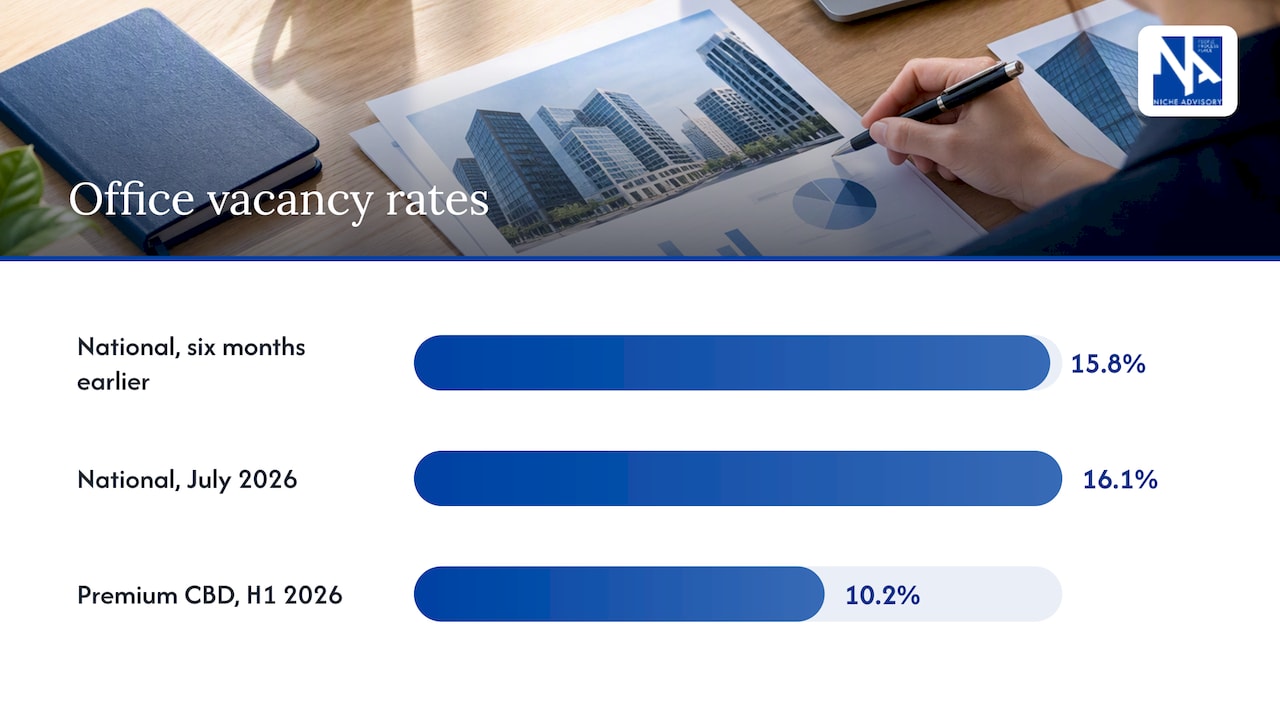
National office vacancy rose modestly over the six months to July 2026, moving from 15.8% to 16.1%, according to the Property Council’s office market chartbook. That headline number hides a split market: CBD vacancy has held broadly stable while non-CBD precincts have continued to soften, a pattern the chartbook attributes to tenants consolidating into premium CBD towers and leaving lower-grade suburban stock behind.
Net absorption tells the same story from a different angle. Positive absorption is concentrated in CBD markets and almost entirely in prime and A-grade buildings, while non-CBD and secondary-grade space is recording negative absorption as leases expire and tenants do not renew. The Property Council describes this directly as a flight to quality, with premium CBD vacancy falling to around 10.2% in the first half of 2026 even as the broader market edged up.
ANZ’s commercial property team frames this as evidence the office sector has reached its floor and is now in recovery, though valuations still face moderate pressure from higher-for-longer interest rates. Effective rents are rising, particularly for prime stock, while incentives are easing back slowly as landlord confidence returns.
A few patterns stand out across the data:
- National vacancy sits at 16.1%, up slightly from 15.8% six months earlier.
- Premium CBD vacancy has fallen to about 10.2%, well below the national average.
- Fitout and construction cost pressure is pushing up the price of delivering fitted space, a trend CBRE expects to continue through to the end of 2027.
[Statistic Callout] Premium CBD vacancy has dropped to around 10.2% while national vacancy sits at 16.1%, a gap that shows just how uneven the recovery is between grades.
City snapshots: Sydney, Melbourne, Brisbane, Perth, Adelaide, Canberra and Gold Coast
Market conditions vary sharply by city, and the differences matter for anyone timing a lease decision or an acquisition in 2026.
- Sydney: Sydney CBD vacancy remains a mid-pack result nationally, with prime absorption concentrated in a handful of premium towers. New supply due through to 2028 will test how much of that demand can be absorbed without pushing vacancy higher. Occupiers assessing North Sydney or city fringe precincts should read current leasing conditions in North Sydney alongside CBD benchmarks.
- Melbourne: Melbourne carries the highest CBD vacancy in the country, easing only marginally to around 18.9% over the six months to July 2026. The Property Council points to policy and tax settings as ongoing drags on investor confidence, and our Melbourne CBD update tracks how that’s played out quarter by quarter.
- Brisbane and Gold Coast: these two markets are the standout performers. Brisbane CBD vacancy has fallen to about 10.2%, the lowest among major CBDs, while the Gold Coast recorded the tightest vacancy nationally at around 7.3% in July 2026. Both markets are seeing positive net absorption concentrated in prime stock, a trend our Brisbane CBD update covers in more detail.
- Perth and Adelaide: both cities are tightening, with prime assets continuing to outperform secondary stock. Positive net absorption in Perth has added to the sense that resource-linked economies are supporting office demand more than east coast markets in some quarters.
- Canberra: continues to face headwinds from government tenant consolidation, which has pushed vacancy higher even as other capital cities stabilise. The ACT market remains the clearest example of how a single large tenant category can move an entire CBD’s numbers.
What’s driving the market: quality, cost pressure and sublease supply
Four forces explain most of what’s happening in 2026. The clearest is flight to quality: tenants with lease events are overwhelmingly choosing premium and A-grade buildings, pushing prime vacancy down while secondary space sits empty for longer.
Rising fitout and construction costs are the second force. Demand for quality fitted space is tightening its supply further, which in turn feeds back into rising effective rents.
A third, less expected trend is sublease availability. Many forecasts assumed a wave of post-pandemic sublease space would hit the market. Instead, CBRE’s commentary shows sublease vacancy sitting below long-run averages in several markets, suggesting businesses are holding onto space rather than shedding it.
Finally, incentives are starting to ease, but cautiously. Landlords are not rushing to cut incentives as confidence returns, wary of losing tenants to competing buildings.
- Flight to quality is concentrating demand and absorption in prime and premium stock.
- Fitout cost pressure is making fitted space a competitive advantage for landlords who have it.
- Sublease vacancy remains below long-run averages, defying earlier forecasts of a glut.
Pro Tip: If your lease expires within 18 months, start scoping fitted options now, competition for quality fitted space is only getting tighter.
Supply pipeline to 2028 and the near-term outlook
New office completions have been unusually low through the first half of 2026, and the pipeline through to 2028 remains below long-run averages in most capital cities. That subdued supply is one of the main reasons prime vacancy has been able to fall even while overall market conditions stay soft.
- Sydney carries the strongest pipeline of the major CBDs through to 2028, meaning any imbalance between new supply and demand will show up there first.
- Melbourne and Brisbane have comparatively thinner near-term pipelines relative to their market size, which should support further vacancy tightening if demand holds.
- Smaller markets such as the Gold Coast and Adelaide have very little new supply due, reinforcing the already tight conditions in those cities.
The practical effect is a market where rents for prime space may keep rising faster than secondary rents if demand continues to outpace the supply of premium space. Secondary buildings, by contrast, face a longer road back unless owners invest in upgrades or repositioning.
Practical next steps: timing, fitout and acquisition posture
The flight to quality cycle rewards decision-makers who move early and negotiate carefully; engaging professional office cleaning in Melbourne services can also ensure workplace hygiene and presentation meet tenant expectations during fitout and handover. A few priorities stand out for 2026.
- Start renewal and relocation processes earlier. Lead times for briefs over 1,000 square metres have lengthened as competition for quality fitted space increases.
- Prioritise fitted or near-fitted space where it fits the brief. Weigh the higher upfront cost of a full fitout against the time and disruption saved, especially given current construction cost pressure.
- Negotiate beyond headline rent. Presentation condition, rent review mechanics and makegood terms are all areas where a structured incentive can matter more than the quoted face rent.
- For investors, favour prime assets with strong amenity and sustainability credentials. Secondary stock carries materially more risk unless pricing has already reset to reflect its weaker position.
Pro Tip: Budget fitout costs early and revisit them quarterly, our fitout cost benchmarks show how much city-to-city variation there is.
Impact of remote work and hybrid office models on the 2026 office market
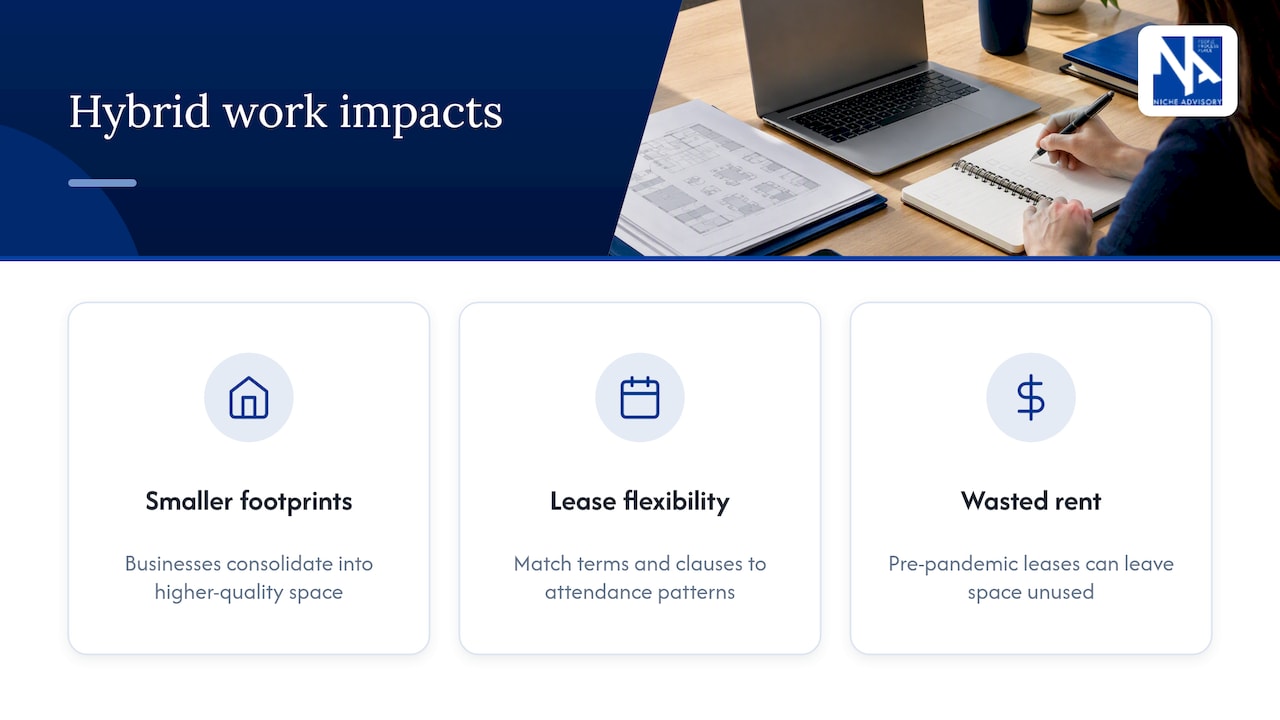
Hybrid work hasn’t gone away, but its effect on the market has matured past the disruption phase. Rather than shrinking footprints across the board, many businesses are now consolidating into smaller amounts of higher-quality space designed around the days staff actually attend. That’s a large part of why demand is concentrating in premium buildings while overall vacancy stays elevated: total square metres leased can fall even as competition for the best buildings intensifies.
For occupiers still working out what their hybrid pattern means for a lease decision, the lease-side implications are often underestimated, particularly around term length and flexibility clauses. Our guide on getting hybrid workplace strategy right on the lease side walks through how to avoid locking into space that doesn’t match attendance patterns.
The other side of this is wasted rent. Businesses that signed pre-pandemic leases on attendance assumptions that no longer hold are often paying for space they don’t use, and a flexible workspace strategy is one of the more effective ways to avoid repeating that mistake at the next renewal.
Sustainability trends and their influence on office space demand and design
Sustainability credentials have moved from a point of difference to a baseline expectation in premium and A-grade buildings. Tenants chasing quality space are increasingly specifying energy performance and building certification as part of their brief, which is reinforcing the flight to quality rather than sitting apart from it.
This shift shows up most clearly in investor behaviour. ANZ’s commentary on the sector notes that assets with stronger sustainability credentials are better placed to attract and retain tenants as the market recovers, a factor that’s starting to influence how secondary buildings are valued relative to prime stock with current certifications.
For occupiers, sustainability requirements also affect fitout design decisions, from materials selection to energy systems, and can add complexity to project timelines if not planned for early. Getting workplace design input involved at the brief stage, rather than after a lease is signed, tends to avoid costly redesign later.
Technological integration and smart building features shaping office workspace
Smart building features, including occupancy sensing, integrated access systems and energy management platforms, are increasingly a differentiator in premium stock competing for tenants. These features support the same hybrid attendance patterns driving demand for higher-quality space, giving facilities teams better data on how space is actually used.
For occupiers negotiating a lease or planning a fitout, technology integration is worth scoping early rather than retrofitting later. It affects cabling, floor plate layout and building services coordination, all of which are easier and cheaper to plan for before construction starts than after.
Government policies and regulations affecting corporate real estate in 2026
Policy and tax settings continue to shape investor confidence differently across states. In Victoria, the Property Council has specifically flagged policy and tax settings as a factor weighing on the Melbourne market’s recovery relative to other capitals.
At a precinct level, state government initiatives can also shift local demand. In New South Wales, the Tech Central precinct is an example of government-backed economic development aimed at concentrating tech sector tenants in a specific part of Sydney, which has implications for occupiers weighing that location against other CBD options.
Congestion and parking levies, such as the one administered in Victoria under the congestion levy scheme, are another cost occupiers with on-site car parking need to factor into total occupancy cost comparisons between buildings and precincts.
Economic factors influencing office market dynamics, including interest rates and inflation
Interest rates remain the single biggest economic factor weighing on office valuations in 2026. ANZ’s Q3 commentary describes moderate pressure on valuations from rates staying higher for longer, even as the sector’s operating fundamentals, leasing enquiry and rents, improve.
That combination matters for investors: an asset can be recovering on a leasing basis while still facing valuation headwinds on a capital basis. It’s part of why ANZ frames the sector as having reached its floor rather than being in full recovery, a more cautious read than the leasing data alone would suggest.
On the labour market side, national job vacancies sat at 325,000 in August 2026, a 0.9% decrease from May, with private sector vacancies at 286,300. Softer labour demand may flow through to office leasing with a lag, so hiring intentions are worth watching as one possible indicator of leasing demand.
Sector-specific demand variations: tech, finance and professional services
Demand isn’t uniform across industries. Professional services and finance tenants have been among the most consistent drivers of prime CBD absorption, often renewing into smaller but higher-quality footprints rather than exiting the market altogether.
Technology sector demand has been more variable, shaped by both the broader hiring slowdown reflected in national vacancy figures and company-specific decisions about hybrid attendance. Where tech tenants are expanding, they’re overwhelmingly choosing premium or A-grade buildings with strong amenity, reinforcing the flight to quality rather than working against it.
Government and public sector tenants remain the clearest exception to prime-led recovery. Canberra’s ongoing vacancy pressure, driven by consolidation of government leases, shows how a single sector’s space decisions can move an entire city’s numbers independent of broader market trends.
How Niche Advisory can help in the 2026 market
Timing a renewal, negotiating incentives and managing a fitout all get harder in a flight to quality market, which is exactly where tenant-side advice pays for itself. We act exclusively for tenants and owner-occupiers, never landlords, which means our advice on buildings, rents and makegood terms is independent of any listing agent’s interests.
- Workplace strategy to align your space decision with actual hybrid attendance patterns.
- Project and construction management to keep fitout budgets and timelines under control as costs rise.
If you’re planning a renewal, relocation or fitout in 2026, get in touch with our team at Niche Advisory to talk through what the current market means for your lease.
FAQ
What is the current office vacancy rate in Australia for 2026?
National office vacancy sits at 16.1% as at July 2026, up slightly from 15.8% six months earlier. Premium CBD vacancy is much lower, around 10.2%, reflecting the flight to quality concentrating demand in top-grade buildings.
Which Australian city has the tightest office market in 2026?
The Gold Coast recorded the tightest office vacancy nationally at around 7.3% in July 2026, with Brisbane CBD close behind at about 10.2%. Both markets have benefited from strong positive net absorption concentrated in prime stock.
Why is Melbourne’s office vacancy higher than other Australian cities?
Melbourne’s CBD vacancy eased only slightly to around 18.9% over the six months to July 2026, the highest among major capital cities. The Property Council points to state policy and tax settings as ongoing factors weighing on investor confidence in the Victorian market.
Is sublease office space increasing in Australia in 2026?
No, sublease vacancy is currently sitting below long-run averages in several Australian markets, according to CBRE’s 2026 commentary. This runs counter to earlier forecasts that expected a larger wave of sublease space to hit the market.
How can a tenant advisor help with 2026 office leasing decisions?
An independent tenant advisor helps occupiers negotiate rent, incentives and makegood terms without the conflict of interest a landlord-side agent carries. Niche Advisory’s corporate tenant advocacy service covers exactly this, acting only for tenants and owner-occupiers across the leasing process.
Sources
- Office Market Report
- Commercial Property Insights Paper Q3 2026
- CBRE commentary: Property Council of Australia office vacancy statistics August 2026 | Commo.
- Job Vacancies, Australia, August 2026 | Australian Bureau of Statistics