Prime Brisbane warehouse rents are currently landing in a landlord-favourable range, with headline asking rents for quality space running well above pre-2021 levels and larger institutional-grade buildings commanding a premium band on top of that. Industrial vacancy sits at a tight 3.2%, and outdoor hardstand is scarcer still. If you’re about to sign or renew, get a proper benchmark before you negotiate or seek expert advice.
TL;DR:
- Prime southern Brisbane listings commonly quote $160 to $210 per square metre, while TradeCoast and port adjacent sites tend toward the upper end.
- Compare effective rent over the full lease term, because incentives can outweigh a lower face rate; add outgoings, insurance, GST, and make good obligations.
- Treat yard space as a separate negotiation: outdoor storage sites are 96.87% utilized, and warehouse vacancy does not indicate hardstand availability.
- Allow at least six to nine months before occupancy; consider a prelease commitment or bridging lease when tight supply leaves few suitable sites.
Table of Contents
- Current market snapshot: headline rents, vacancy and precinct differences in Brisbane city
- Where to find listings and how to read asking rent versus effective rent
- What drives warehouse rents in Brisbane city (supply, precinct quality, hardstand, access and incentives)
- Practical benchmarking checklist for occupiers: how to evaluate a quoted rent for your business
- How Niche Advisory can help Brisbane occupiers benchmark and negotiate warehouse leases
- FAQ
- Sources
Current market snapshot: headline rents, vacancy and precinct differences in Brisbane city
Brisbane’s industrial market has held onto most of the rental growth it picked up through 2022 and 2023, and prime stock in particular has stayed tight. Market briefings have noted that prime rents across Brisbane industrial precincts sit materially higher than 2019 to 2021 levels, with pockets of further growth recorded more recently. Southern Brisbane industrial precincts are commonly quoted with prime face rents in the order of $160 to $210 per square metre, depending on building quality and location, while TradeCoast and port-adjacent precincts often sit at the upper end of that band because of freight access and land scarcity.
Industrial vacancy across Brisbane is sitting at 3.2%, a level tight enough that landlords are generally setting the pace on asking rent and incentive structure rather than tenants.
A few things shape how that headline figure plays out precinct by precinct:
- Prime, modern buildings with clear-span warehousing and good eaves height sit at the top of the rent range and attract the strongest tenant demand.
- Secondary stock, often older buildings with lower clearance or awkward access, trades at a discount but can still be tight in supply-constrained precincts.
- TradeCoast and southside logistics precincts tend to price above outer-metro industrial estates because of proximity to the port, airport and major arterial roads.
- Buildings with usable hardstand or yard space attract a separate premium that is increasingly hard to secure regardless of precinct.
Secondary and older stock gives some room to move, but even that gap has narrowed as tenants who can’t secure prime space push demand into the next tier down. For most occupiers the practical question isn’t just what the headline rent is but which precinct and grade combination actually suits the operation, because the spread between a tight TradeCoast shed and an outer southside equivalent can be substantial.
Where to find listings and how to read asking rent versus effective rent
Most occupiers start their search across three channels: major agency “for lease” pages for Brisbane industrial stock, specialised commercial and industrial property portals, and periodic market reports from bodies tracking supply and vacancy. None of these show you the real number on their own, because every listing quotes a face rent that rarely matches what you’ll actually pay.
- Face rent (or net rent) is the headline $/sqm figure quoted in a listing, before incentives and often before outgoings.
- Gross rent includes outgoings such as rates, insurance and common area costs, so always confirm which basis a listing is quoted on.
- GST applies on top of commercial rent in most cases and should be built into any budget comparison.
- Incentives, rent-free periods, fitout contributions or lease breaks, reduce the effective rent you actually pay over the term.
As a worked example: a 2,000 sqm shed quoted at $180/sqm face rent implies $360,000 a year before outgoings. That example is exactly why comparing face rent alone across two buildings can be misleading.
What drives warehouse rents in Brisbane city (supply, precinct quality, hardstand, access and incentives)
Rent levels in Brisbane are ultimately a supply story. A Property Council report on industrial land supply and vacancy found acute land constraints across South East Queensland, and recommended occupiers assess freight access, expansion capacity and hardstand availability as part of any site decision, not just the headline rent. That supply pressure underpins the direction rents have taken and is likely to keep upward pressure on prime precincts for some time.
Several factors beyond the base $/sqm figure will move your actual cost:
- Precinct quality matters as much as the building itself, with TradeCoast, southside logistics corridors and inner-city industrial land all priced differently because of freight and transport access.
- Outdoor hardstand and yard space are priced on a separate axis entirely, and Property Council data shows Brisbane’s industrial outdoor-storage sites running at 96.87% utilisation, close to full.
- Lease length affects pricing power, with landlords often offering better incentives for longer commitments in exchange for certainty; for expert guidance on lease terms and landlord/tenant obligations, see leasing documentation and advice.
- Makegood obligations at lease end are frequently underestimated and can add a meaningful cost if not negotiated upfront.
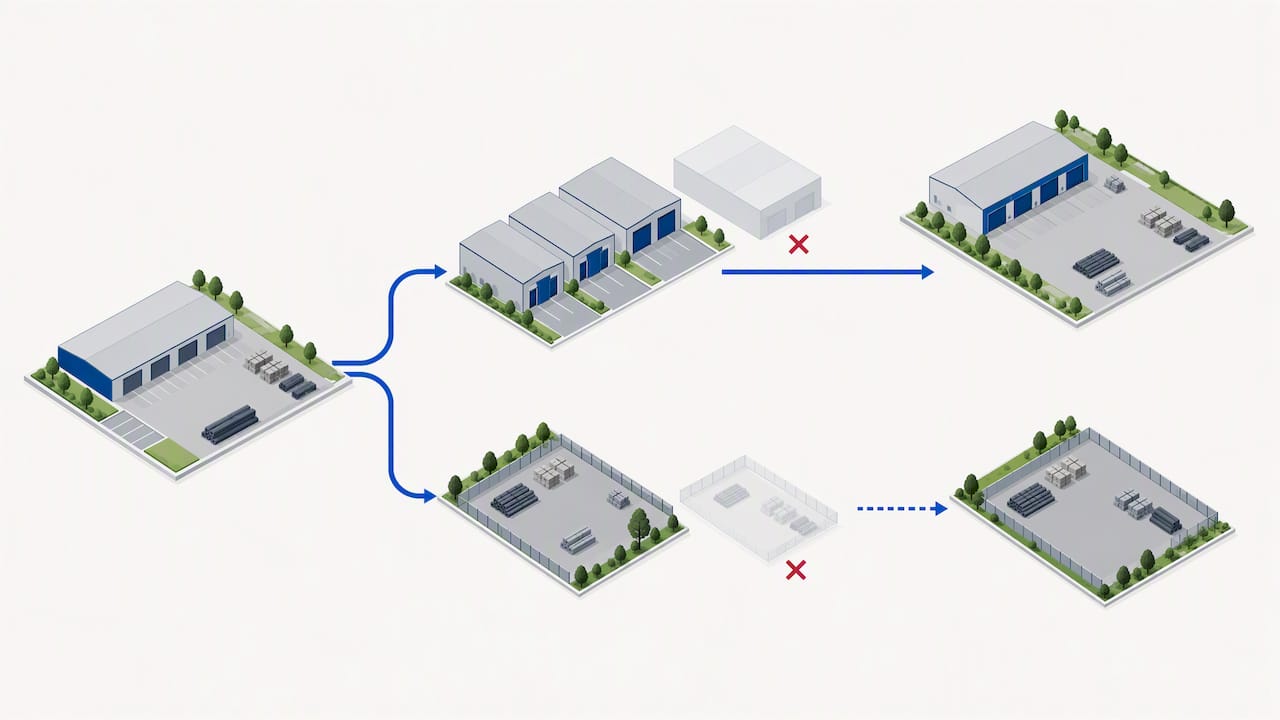
Pro Tip: If your operation needs yard space for trucks, containers or outdoor storage, treat hardstand as a separate negotiation line rather than assuming it comes bundled with the warehouse rent.
Hardstand scarcity in particular catches a lot of occupiers out. Because enclosed warehouse vacancy and outdoor-storage availability move independently, a precinct can look reasonably open on paper while yard space is almost impossible to find, which pushes some tenants into additional off-site arrangements or a premium for the few sites that have both.
Practical benchmarking checklist for occupiers: how to evaluate a quoted rent for your business
A quoted $/sqm figure tells you almost nothing until you run it through your own numbers. Before you commit to a Brisbane warehouse, work through this sequence:
- Confirm the usable square metreage, not just the gross floor area, since columns, loading docks and office carve-outs all eat into working space.
- Verify the building grade and whether hardstand or yard access is included or priced separately.
- Model the incentive package against the full lease term to get an effective, not headline, rent figure.
- Add outgoings, insurance and GST to the net rent to reach a true annual occupancy cost.
- Estimate fitout costs and likely makegood obligations at lease end, since both affect the real cost of the deal.
- Compare that effective total against your budget and against at least one alternative precinct or building grade.
With industrial vacancy at 3.2%, leasing timelines in Brisbane are running longer than they did a few years ago, and a six to nine month lead time before your required occupation date is a reasonable minimum for anything beyond a small tenancy. Where supply is particularly tight, a pre-lease commitment on a building still under construction, or a short-term bridging lease, can be worth considering while you wait for the right long-term site. For site selection trade-offs around freight and transport cost, our piece on warehouse site selection goes into more detail, and our guide on outgoings in a lease is worth reading before you sign anything.
How Niche Advisory can help Brisbane occupiers benchmark and negotiate warehouse leases
We work for tenants and owner-occupiers, focusing on achieving the best outcome in benchmarks and negotiations. Our corporate tenant advocacy work covers exactly the gap most occupiers fall into: comparing headline rents across buildings without properly accounting for incentives, outgoings, hardstand access or makegood exposure.
For Brisbane warehouse occupiers, that means a clearer understanding of what a quoted rent actually costs over the lease term, improved incentive packages, and consideration of expansion or exit rights within the lease. We also bring workplace strategy and project delivery capability to the table where a fitout or relocation is part of the move. If you’re weighing up a Brisbane warehouse lease right now, get in touch through our corporate tenant advocacy page and we’ll help you work out what the deal in front of you is really worth.
FAQ
What is the current asking rent for Brisbane warehouses?
Prime southern Brisbane industrial space is commonly quoted at around $160 to $210 per square metre in face rent, depending on precinct and building grade. TradeCoast and port-adjacent precincts tend to sit toward the higher end of that range because of freight access and constrained land supply.
How tight is the Brisbane industrial vacancy rate right now?
Brisbane industrial vacancy is currently sitting at 3.2%, a level that generally favours landlords in rent and incentive negotiations. Outdoor hardstand and yard space is even scarcer, with Brisbane’s industrial outdoor-storage sites running at 96.87% utilisation.
How does Brisbane compare to other major Australian cities for warehouse rents?
Brisbane’s prime industrial rents sit within the broader national trend of capital city industrial rental growth, which ABS data links in part to rising non-residential property costs. Exact city-to-city comparisons vary by precinct and building grade, so the most reliable approach is benchmarking against comparable local precincts rather than a single national figure.
What is the difference between face rent and effective rent?
Face rent is the headline $/sqm figure in a listing, while effective rent accounts for incentives such as rent-free periods or fitout contributions spread across the lease term. A building with a higher face rent but a stronger incentive package can end up cheaper in effective terms than a lower-quoted building with no incentive at all.
How long does leasing a Brisbane warehouse typically take?
With vacancy tight at 3.2%, a lead time of six to nine months before your required move-in date is a sensible minimum for most tenancies. Larger or purpose-built requirements, including pre-lease deals on buildings still under construction, can take considerably longer to secure.