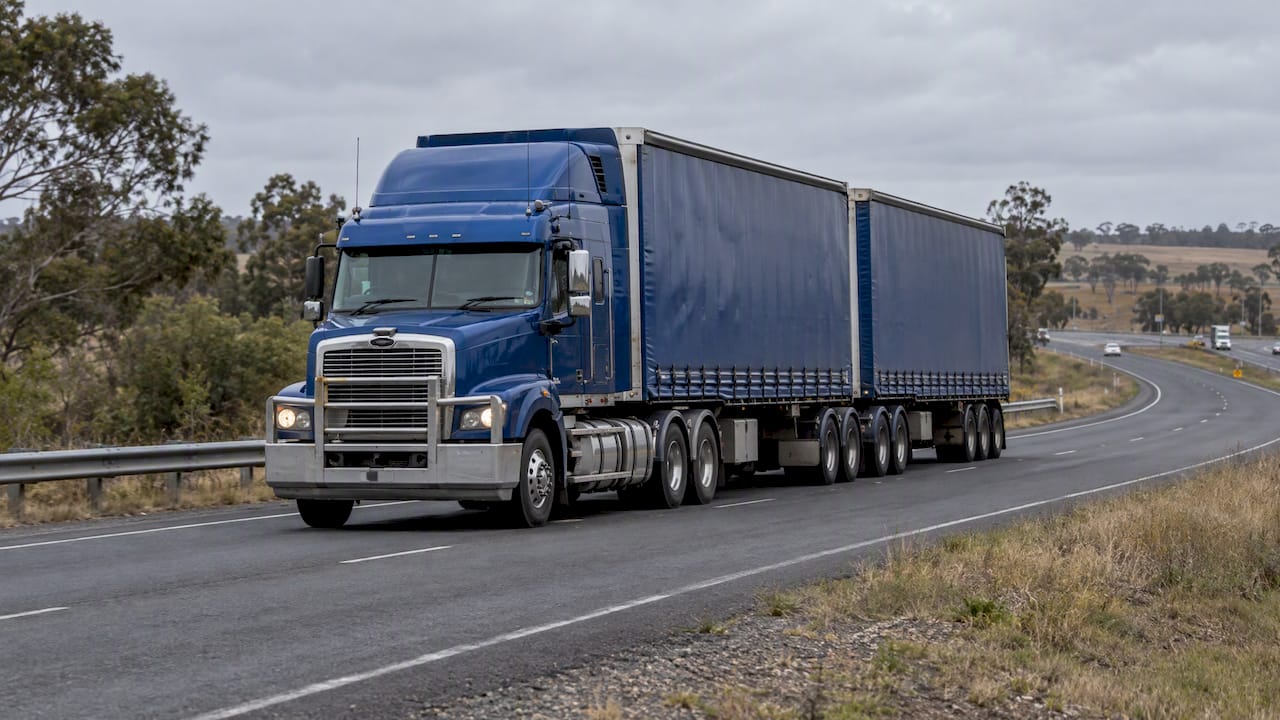
Most Class 2 B-doubles that meet the conditions in the National Class 2 B-double Authorisation Notice can run on approved networks without a permit. If your vehicle, route or combination falls outside those conditions, you need an access permit through NHVR Go, except in Western Australia and the Northern Territory, where you apply directly to the state or territory authority. Before you move a load, check three things: is your route on the approved network map, does your vehicle sit within the length, mass and axle spacing conditions, and does it use a tri-drive or tri-tri configuration that needs separate attention.
TL;DR:
- Most Class 2 B-doubles can operate on approved networks without permits if their vehicle configuration and route meet specific conditions, including length, mass, and axle spacing.
- Cross-border operators must plan routes based on the most restrictive state schedule and check network maps for each jurisdiction to ensure lawful access.
- Bridge assessments and geometric checks are often required for routes with tight turns, low clearances, or high mass, and should be arranged before departure to avoid delays.
- Permits are necessary when routes fall outside approved networks, vehicle exceeds mass or dimension limits, or non-standard configurations are involved; early application through NHVR Go is recommended.
- Compliance with vehicle standards, signage, and carrying proper documentation is essential, as roadside inspections will verify route, vehicle, and paperwork during each trip.
Table of Contents
- What the National Class 2 B-double Authorisation Notice covers
- Mass, axle spacing and dimension rules you must check
- Permits and the NHVR Go application process: step-by-step
- State and territory differences and where to apply directly
- Vehicle standards, signage and documentation to carry on each trip
- Route assessment, bridge checks and what road managers examine
- Operator checklist and permit application template
- Detailed safety requirements and operational restrictions for B-double vehicles
- Insurance and liability considerations for operating B-doubles
- Common penalties and enforcement actions for non-compliance
- FAQ
- Sources
- Getting the site and access planning right before the trucks arrive
- Primary sources: NHVR notices, legislation and state PBS guidance
What the National Class 2 B-double Authorisation Notice covers
The National Class 2 B-double Authorisation Notice 2026 (No.1) gives general access to eligible Class 2 B-doubles in the Australian Capital Territory, New South Wales, Queensland, South Australia, Tasmania and Victoria, provided the vehicle meets the Notice conditions and the schedule or map conditions set for each jurisdiction. “General access” means you can use the stated network without applying for a separate permit, as long as every condition in the Notice is satisfied, not just the mass and length figures.
Each participating jurisdiction attaches its own schedule to the Notice, and those schedules point to network maps showing exactly which roads carry B-double access. A vehicle that is technically compliant on mass and dimensions still has no lawful access if the road itself isn’t on the relevant map, so checking the map is a separate step from checking the vehicle.
Length bands matter here too. The baseline B-double length is 19 metres, with some schedules permitting combinations up to 25 or 26-metres where the vehicle and route meet extra conditions. Longer combinations, including the 27 metre configurations some operators chase, typically rely on a separate exemption notice covering the prime mover rather than the B-double Notice itself, which we cover further down.
Before you plan a route, work through this:
- Confirm your vehicle is registered and configured as an “eligible vehicle” under the Notice definitions for your home jurisdiction.
- Check the published network map for every jurisdiction your route crosses, not just the one where you’re based.
- Read the schedule attached to each jurisdiction, because conditions differ even where the base Notice is the same.
- Note any map annotations restricting access by time of day, vehicle mass or specific intersections.
Operators who run cross-border freight, say Sydney to Adelaide, often find one state’s schedule is more permissive than another’s on the same corridor. The practical answer is to plan to the most restrictive condition across the whole route, not the average.
Mass, axle spacing and dimension rules you must check
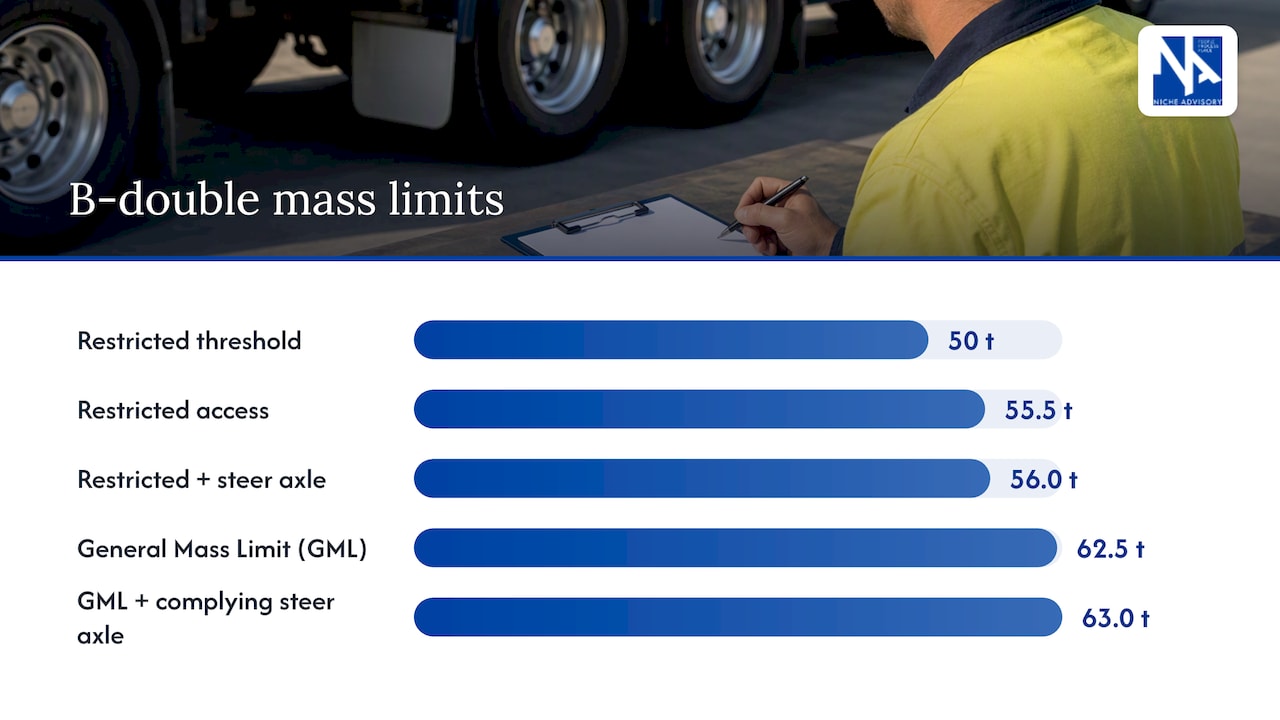
General Mass Limits, known as GML, set the baseline mass a B-double can carry based on its axle groups and the spacing between them. A 26 metre B-double can run up to 62.5 tonnes under GML, or 63.0 tonnes with a complying steer axle, provided axle spacing and other Notice conditions are met. These figures aren’t a simple function of length: the axle spacing tables in the Notice set the actual ceiling, and a vehicle that is short on spacing doesn’t get the full mass allowance even if it’s within the overall length band.
Mass bands shift the compliance category entirely. A B-double that exceeds 50 tonnes is classified as a Restricted Access Vehicle and moves into a different set of axle spacing mass limits under the Mass and Dimension Limits. Higher mass allowances up to 55.5 tonnes, or 56.0 tonnes with a complying steer axle, are available to vehicles that satisfy the restricted access conditions, but that reclassification also changes which roads and bridges you can use.
The X-Y rule governs axle spacing for tri-tri B-doubles, the combinations running tri-axle groups on both trailers. In practice, the rule sets a minimum spacing between axle groups (the X dimension) relative to the load each group carries, and a maximum overall spacing (the Y dimension) to keep the combination within its length band. A worked example: say a tri-tri B-double has a rear trailer axle group spaced at 1.2 metres between axles, within the X-Y envelope set by the Notice schedule. If the spacing drops below the minimum X value for the mass it’s carrying, the vehicle no longer qualifies for general access and needs either reconfiguration or a permit.
Jurisdictions don’t treat tri-axle and quad-axle groups the same way. According to NHVR guidance, tri-axle drive groups are not permitted under the Notice in the ACT, New South Wales, Queensland, Tasmania or Victoria, while South Australia allows a tri-axle prime mover under specified conditions. That difference alone catches out plenty of interstate operators who assume one state’s axle rules apply everywhere.
Tri-drive prime movers (three axles on the prime mover itself, rather than tandem) carry their own conditions. Where a prime mover’s axle group configuration exceeds what the Notice allows for general access, you need a permit even if the trailers themselves are standard. Before you commit a tri-drive unit to a route, run through this sequence:
- Confirm the prime mover’s axle configuration against the Notice’s general access definitions for your jurisdiction.
- Check the axle spacing tables against your actual loaded mass, not just the vehicle’s rated capacity.
- Identify whether any axle group exceeds 50 tonnes combined, which triggers restricted access classification.
- Cross-check the X-Y rule for any tri-tri trailer combination against the relevant state schedule.
- Where any check fails, apply for a permit before the vehicle moves, not after.
Getting any one of these checks wrong is the single most common reason a compliant-looking B-double gets pulled up at a weighbridge or denied entry to a route it has used before without issue.
Permits and the NHVR Go application process: step-by-step
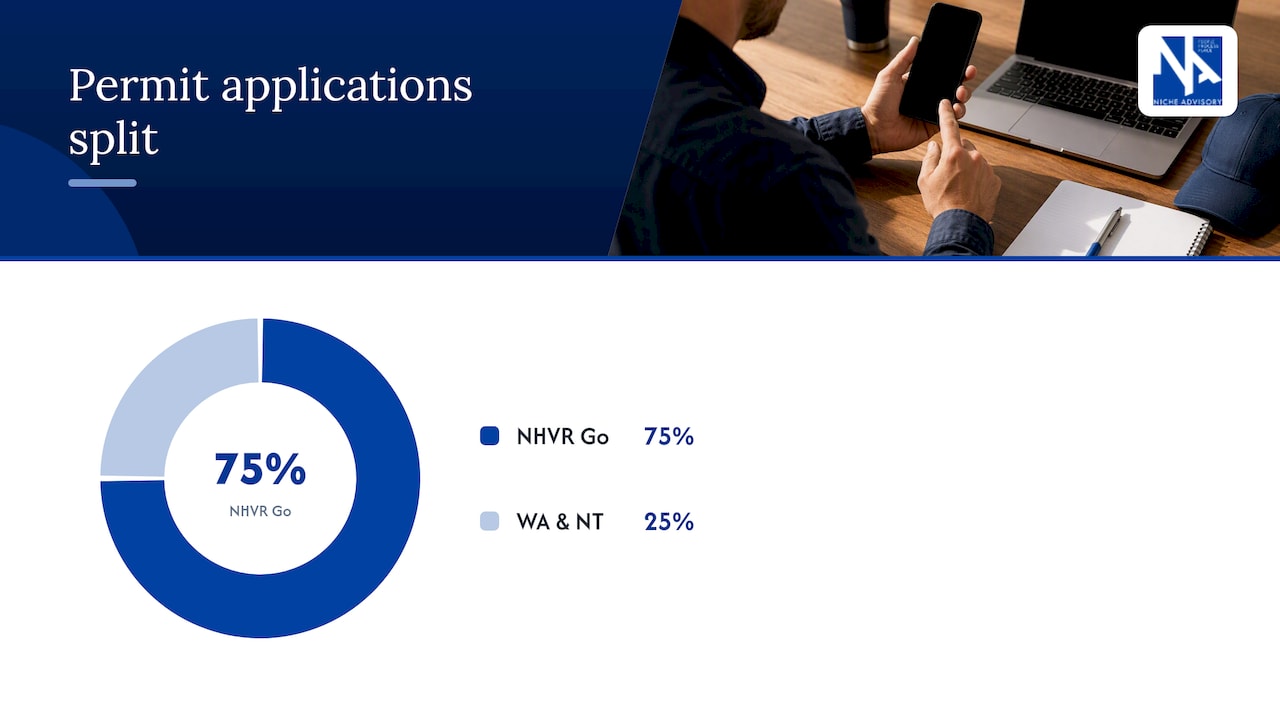
A permit is required whenever your intended route sits outside the approved network map, your vehicle exceeds the Notice’s mass, length or axle spacing conditions, or your combination (tri-drive, tri-tri, or anything outside standard configurations) isn’t covered by general access. NHVR processes most B-double permits for the ACT, New South Wales, Queensland, South Australia, Tasmania and Victoria through NHVR Go, while Western Australia and the Northern Territory require a direct application to the relevant state or territory road authority.
The practical flow through NHVR Go looks like this:
- Gather your vehicle’s registration details, Vehicle Approval or Performance Based Standards (PBS) certification, and axle spacing diagrams before you start the application.
- Map your exact route, including any sections that cross jurisdictional boundaries, and note any bridges, intersections or restricted zones along it.
- Submit the application through NHVR Go with full vehicle and route detail attached, rather than a general description.
- Expect the relevant road manager to review your route and respond with any additional conditions, which NHVR coordinates on your behalf.
Once submitted, NHVR’s own guidance is clear that operators shouldn’t assume general access applies: if your route isn’t on the approved network, you need the permit regardless of how compliant your vehicle is. Follow-up requests are common. A road manager might ask for a geometric assessment if your route includes tight intersections, a bridge check if your combination exceeds a gross mass threshold for a specific structure, or in rarer cases a physical trial run before final sign-off. The cost of these assessments typically falls to the applicant, which is worth factoring into your timeline and budget before you lodge.
Pro Tip: Lodge permit applications as early as possible for any route with non-gazetted sections. Bridge and geometric assessments routinely add weeks to approval times, and starting late is the most common cause of missed delivery windows.
Timelines vary by complexity. A straightforward route on an established network can clear in a matter of days. A route requiring a bridge assessment or a new geometric check can take considerably longer, particularly where multiple road managers are involved. If you operate internal compliance teams, consider using Service NSW’s heavy vehicle access permit guidance as a cross-check on NHVR Go timelines for New South Wales-specific routes.
State and territory differences and where to apply directly
B-double access rules aren’t uniform across the country, and the differences catch out operators running interstate freight more than any other single issue.
- Western Australia and the Northern Territory sit outside the NHVR Go system entirely for B-double permits: apply directly to the relevant state or territory road authority rather than through the national portal.
- South Australia permits a tri-axle prime mover under the Notice in specified conditions, an allowance that doesn’t extend to the ACT, New South Wales, Queensland, Tasmania or Victoria, where tri-axle drive groups are not permitted under general access.
- Queensland restricts quad-axle groups on state-controlled roads and applies its own X-Y dimension specifications, so a combination cleared for quad-axle use interstate may still need a Queensland-specific permit.
- Victoria runs PBS and gazetted networks where PBS-compliant vehicles may avoid bridge assessments, but vehicles exceeding certain gross combination mass thresholds still trigger a bridge assessment regardless of PBS status, which matters for livestock and container movements on rural routes.
The practical rule for any multi-state route is to consult the Specified Road Manager Network Requirements for every jurisdiction you’ll cross and plan to the most restrictive condition you find, rather than assuming the most permissive state’s rules carry through.
Vehicle standards, signage and documentation to carry on each trip
Compliance doesn’t stop at mass and route approval. Your vehicle itself has to meet the relevant Australian Design Rules, and your paperwork has to be ready for a roadside check at any point in the journey.
Prime movers used for extended-length B-double combinations, including the 27 metre configurations some operators run under a separate road train exemption notice, generally need to meet ADR 84 (UNECE R93 underrun protection) and UNECE R29 cab strength standards. This is a genuine equipment cost for operators converting a standard prime mover to run the longer combination, and it’s worth checking before you commit to a 27 metre job assuming your existing fleet qualifies.
Any B-double longer than 22 metres needs long vehicle signage, consistent with Vehicle Standards Guide VSG-19. That’s most B-doubles on the road, so this isn’t a marginal requirement, it’s a default one for the vehicle class.
Drivers should carry, as a minimum:
- Vehicle Approval or PBS certification documents matching the actual configuration on the road.
- A copy of any access permit, including the specific route and conditions it covers.
- Axle spacing diagrams, particularly for tri-tri or tri-drive combinations subject to the X-Y rule.
- Current registration papers and operator contact details for the vehicle and the load.
A roadside inspector checking a B-double against its permit conditions will look for all of this together: the right vehicle, on the right route, carrying the paperwork that proves it. Missing any one element can hold up a load even when the vehicle itself is fully compliant.
Route assessment, bridge checks and what road managers examine
Road managers request a geometric or structural assessment when your route includes a non-gazetted section, an unusual axle spacing configuration, or a combined mass that sits near a bridge’s rated limit. These aren’t arbitrary hurdles: they exist because a B-double’s turning path and axle loading behave differently from a standard rigid truck, and a road built for one doesn’t automatically handle the other.
Typical triggers and problems to check before you commit a route:
- Bridge assessments activate when gross combination mass approaches a structure’s rated capacity, and the scope and cost of the assessment is usually set by the relevant road authority and charged to the applicant.
- Tight turning circles at intersections and roundabouts commonly rule out routes that look fine on a map but fail in practice for a 26 metre combination.
- Overhead clearances, particularly under rail bridges or through older industrial precincts, catch out operators who haven’t checked clearance heights against their specific trailer configuration.
- Level crossings and steep approaches can both restrict access independently of mass or length, since they affect a B-double’s ground clearance and braking behaviour differently from shorter vehicles.
- Constrained suburban streets near depots and loading docks are a frequent source of permit refusals, especially on the final leg of a delivery route.
Pro Tip: A desktop route check is usually enough for a standard route on a gazetted network, but commission a physical trial run, and involve a PBS assessor, for any route with tight turns, low clearances or non-standard axle spacing. The cost of a trial is far lower than a failed delivery or a damaged structure.
If your business is weighing up whether a site’s access constraints make it workable at all for regular B-double deliveries, that’s a question worth raising early in any site selection or lease negotiation, not after the lease is signed. Our business relocation and commercial property guidance covers how we help operators factor site access into a property decision before it becomes a logistics problem.
Operator checklist and permit application template
A reliable pre-departure process catches most access problems before they reach the road. Run through this before every trip that isn’t on a route you’ve already cleared:
- Check the vehicle and route against the current Notice schedule and network map for every jurisdiction crossed.
- Confirm mass, length and axle spacing against the Notice’s conditions, not just the vehicle’s rated capacity.
- Verify signage is fitted correctly for any combination longer than 22 metres.
- Pack VA/PBS certificates, permit documents, axle diagrams and registration papers together in one folder.
- Brief the driver on any route-specific conditions attached to the permit, including time-of-day restrictions.
A permit application should include, at minimum, the vehicle’s full axle configuration and spacing, its GML or restricted access classification, the exact route with any non-gazetted sections flagged, and the intended load mass. Applications with incomplete route detail are the most common reason for delayed approvals.
| Checklist item | What to confirm |
|---|---|
| Network map | Route sits on the approved map for every jurisdiction crossed |
| Mass and axle spacing | Within GML or restricted access limits per the Notice |
| Signage | Long vehicle signage fitted for combinations over 22 metres |
| Documentation | VA/PBS certificates, permit, axle diagrams, registration on board |
| Bridge and geometric risk | Flagged and assessed before departure, not discovered on route |
For businesses managing the broader site, lease and fitout decisions that sit behind a logistics operation, including whether a warehouse or distribution site can actually accommodate the access needed, our corporate real estate advisory work covers site feasibility alongside the lease and design decisions that come with it.
Detailed safety requirements and operational restrictions for B-double vehicles
B-doubles carry operational restrictions beyond the mass and dimension rules already covered, largely because of how the combination behaves under braking, cornering and load shift compared with a single-trailer truck. Coupling and uncoupling procedures need to follow the sequence set out for each configuration, since an incorrectly coupled dolly or fifth wheel is a common cause of rollover incidents on B-doubles specifically.
Load restraint is scrutinised more closely on B-doubles than on rigid vehicles, given the combination’s higher centre of gravity and the way weight distributes across two trailers rather than one. Drivers need specific endorsement for B-double combinations, reflecting the different handling characteristics, particularly around reversing and lane changes where the rear trailer tracks differently from the lead unit.
Speed restrictions apply on some routes specifically because of a B-double’s longer stopping distance and wider turning path, and these restrictions are usually written into the permit or Notice schedule rather than being a blanket national rule. Fatigue management requirements that apply to all heavy vehicles are enforced particularly closely on B-double routes given the typically longer haul distances these combinations are used for.
Insurance and liability considerations for operating B-doubles
Operating a B-double outside its approved Notice conditions or permit, even unintentionally, can affect insurance cover. Most commercial heavy vehicle policies are written on the basis that the vehicle operates within its lawful access conditions, so a mass, route or configuration breach at the time of an incident can complicate a claim.
Liability exposure also extends to third parties, including road managers and bridge owners, where a non-compliant movement causes infrastructure damage. This is part of why road managers ask who’s paying for a bridge assessment before a permit is approved: the cost allocation at approval stage often reflects where liability would sit if something went wrong later.
Operators running B-doubles for third-party clients, rather than their own freight, should also check how liability is apportioned in the commercial contract if a permit condition or route restriction wasn’t properly communicated down the chain. Getting this right before a dispute arises is far cheaper than resolving it afterwards, a principle that applies as much to commercial leasing and make-good disputes as it does to transport contracts. Our dispute resolution services work through exactly this kind of contractual grey area for corporate tenants and operators.
Common penalties and enforcement actions for non-compliance
Running a B-double outside its Notice conditions or without the required permit exposes an operator to enforcement action under the Heavy Vehicle National Law, including infringement notices and, for more serious or repeated breaches, court-imposed penalties. Mass breaches specifically can attract penalties scaled to how far the vehicle exceeds its lawful limit, with higher-level breaches treated more seriously than minor overages.
Beyond financial penalties, non-compliant movements can trigger a Chain of Responsibility investigation, which looks beyond the driver to schedulers, consignors and anyone else in the supply chain who had the ability to prevent the breach. This is a meaningful shift from older enforcement models that focused on the driver alone, and it means transport managers and logistics coordinators carry direct exposure, not just the person behind the wheel.
Repeated or serious non-compliance can also affect an operator’s standing under the National Heavy Vehicle Accreditation Scheme, where applicable, and road managers can restrict or revoke network access for operators with a poor compliance history. The practical cost of a breach is rarely just the fine: it’s the time lost to investigation and the risk to ongoing access approvals.
FAQ
What is the maximum weight allowed for a B-double in Australia?
A compliant B-double’s maximum mass depends on its length and axle configuration under the Notice. A 26 metre B-double can run up to 62.5 tonnes under General Mass Limits, or 63.0 tonnes with a complying steer axle, while vehicles exceeding general access limits move into the restricted access category with different thresholds.
What is the 27 metre B-double rule?
A 27 metre B-double typically relies on a separate exemption notice covering the prime mover rather than the standard B-double Notice. According to NHVR, this generally requires the prime mover to meet ADR 84 (UNECE R93) underrun protection and UNECE R29 cab strength standards before the extended length is permitted.
Is a B-double a road train?
No. A B-double is a distinct combination type from a road train under Australian heavy vehicle regulations, with its own Notice, mass limits and network access rules. Road trains are covered under separate national notices with their own length and mass conditions.
Are B-triples allowed in Victoria?
B-triple access in Victoria depends on the specific combination’s Performance Based Standards assessment and whether the intended route sits on a gazetted or PBS-approved network. Operators should check Victoria’s PBS industry guidance and confirm directly with the relevant road authority before planning a B-triple movement, as gross combination mass thresholds can still trigger a bridge assessment even on an approved network.
Do I need a permit if my B-double route is entirely on an approved network?
No, if your vehicle meets the Notice conditions and your entire route sits on the approved network map for every jurisdiction crossed, you can generally operate under the Notice without a separate permit. The moment any section of the route falls outside the mapped network, a permit through NHVR Go becomes necessary, except in Western Australia and the Northern Territory where you apply directly to the state authority.
Sources
- National Class 2 B‑double Authorisation Notice 2026 (No.1) operator’s guide
- National Class 2 B‑double Authorisation Notice printable operator’s guide (NHVR PDF)
- PBS industry guide (Victoria) — Department of Transport
Getting the site and access planning right before the trucks arrive
Most B-double access problems that reach a road manager’s desk started months earlier, at the point a business chose a warehouse or distribution site without checking whether a B-double could actually get in and out of it. We work with corporate tenants and owner-occupiers on exactly this gap: aligning site selection, lease terms and fitout decisions with the operational reality of how goods move in and out, before the lease is signed rather than after a permit gets refused.
Because we act only for tenants and owner-occupiers, never landlords, our advice on a site’s suitability for heavy vehicle access isn’t influenced by others who might want to lease the building. This independence matters when a site looks right on paper but fails the first time a loaded B-double tries to reverse into the dock. Our workplace strategy and corporate real estate services cover site feasibility alongside the broader business fit, and our project and construction management team can carry that assessment through to the fitout itself, including dock design and yard layout.
If your business is weighing up a warehouse or distribution site and needs the access question answered before you commit to a lease, get in touch through Niche Advisory to talk through what a proper site feasibility review involves.
Primary sources: NHVR notices, legislation and state PBS guidance
For final confirmation before submitting a permit application or planning a route, consult the primary sources directly rather than relying on secondary summaries. The NHVR operator’s guides set out the exact Notice conditions, while state legislation and PBS guidance fill in jurisdiction-specific detail that the national Notice doesn’t cover on its own.