Five clause types decide whether a green lease actually works: Target NABERS ratings, separate digital metering, an Energy Management Plan (EMP), a Building Management Committee (BMC), and remedial and reporting provisions. Start by checking which Green Lease Schedule applies to the tenancy, or get tenant advice before signing anything that references NABERS or a GLS.
TL;DR:
- Larger tenancies, especially those occupying significant building shares, typically require fuller GLS schedules with Target NABERS obligations for landlords.
- Separately metered energy data access must be secured early, as it is essential for measuring building performance and producing required certificates.
- Remedial procedures for missed targets should involve a notice, a plan, and expert determination, rather than lease termination, to ensure manageable dispute resolution.
- Drafting the lease with clear definitions, cost-sharing arrangements, and realistic EMP timelines minimizes disputes and ensures clauses translate into actual performance.
- The applicable GLS depends on tenancy size, lease type, and mandatory compliance thresholds, with larger or higher proportion spaces generally subject to stricter landlord commitments.
Table of Contents
- Core clause types explained: what each one does
- Which Green Lease Schedule applies to your tenancy
- Drafting and negotiation checklist for green lease clauses
- Turning clauses into action: EMPs, BMCs and metering
- Common pitfalls and how remedies should work
- Practical tips from Niche Advisory for negotiating green lease clauses
- How we help with green lease negotiation and implementation
- FAQ
- Sources
Core clause types explained: what each one does
A green lease is really a bundle of separate obligations, and mixing them up causes most of the confusion we see in negotiations. Target NABERS usually sits with the landlord and sets a whole-building energy or water star rating goal; Tenancy NABERS sits with the tenant and measures energy use within the leased space itself. Common targets typically aim for high NABERS star ratings, often around 4.5 stars, and most schedules exclude GreenPower purchases from counting toward the rating, since the policy intent is to reward actual efficiency rather than offsets.
Separate digital metering is the plumbing that makes everything else measurable. Without tenancy-level metering and a clear data access right, neither party can produce the readings that NABERS or a Building Energy Efficiency Certificate (BEEC) require.
The remaining clauses govern process rather than numbers:
- An Energy Management Plan (EMP) sets baseline consumption, assigns responsibility for actions, and is usually reviewed annually.
- A Building Management Committee (BMC) brings landlord and tenant representatives together, typically meeting quarterly, to oversee performance against the EMP.
- Reporting and remedial clauses set how often data is shared and what happens when a target is missed.
These elements interact directly with disclosure law: once a BEEC is required under the Commercial Building Disclosure Program, the metering and reporting clauses in the lease need to be able to produce the certificate on time.
Which Green Lease Schedule applies to your tenancy
The Department of Finance’s GLS templates run from A1 through D2, and the right one depends on three things: the premises’ net lettable area (NLA), what proportion of the building that NLA represents, and whether the lease is net or gross. Work through it in this order:
- Confirm the tenancy size. Larger tenancies, and tenancies that occupy a significant share of a building, generally attract the fuller schedules with landlord Target NABERS obligations.
- Check the lease type. Net leases tend to place more direct cost and performance responsibility on the tenant than gross leases, where the landlord controls base building services.
- Match obligations to schedule. Some schedules mandate a BMC and formal reporting; others leave these optional, so confirm which version has been attached before assuming a BMC exists.
- Confirm mandatory status. Guidance notes tie GLS updates to the Net Zero in Government Operations Strategy, with mandatory GLS obligations applying from 1 January 2025 for larger leases, so check whether that threshold catches the premises in question.
Getting the schedule wrong at the outset tends to produce clauses that do not match the building’s actual services, which is where most disputes start.
Drafting and negotiation checklist for green lease clauses
Clear drafting prevents most of the disputes that follow. A negotiator working through a green lease schedule should check for the following before signing:
- Definitions and precedence. State plainly whether the GLS prevails over inconsistent base lease service clauses, since guidance notes flag this as a common compatibility gap.
- Limits on remedies. Cap financial exposure for missed targets rather than leaving liability open-ended.
- Remediation procedure. Set out remedial notice, remedial plan and expert determination as sequential steps, not alternatives a party can skip.
- Cost allocation. Decide upfront who pays for metering installation, who funds capital upgrades, and how staged works are shared through outgoings.
Fit-out and make-good clauses deserve particular attention. Negotiate reuse or recycling provisions for fit-out items rather than accepting a default disposal obligation, which wastes materials and adds unnecessary make-good cost; our guide to make-good negotiation covers this in more depth. Watch for red flags such as warranty misalignment between green clauses and base building equipment, and ambiguous enforcement triggers that leave both parties guessing about what counts as a breach.
Pro Tip: Ask for the Guidance Notes alongside the GLS template itself; the notes explain intent and remedial sequencing that the schedule’s plain text often leaves implicit.
Turning clauses into action: EMPs, BMCs and metering
Signing the clause is the easy part. Making it work takes a sequence of practical steps at commencement and through the term:
- Set the EMP baseline. Record actual consumption data, assign responsibilities for each action item, and set an annual review date with a standard reporting template.
- Establish the BMC properly. Agree terms of reference, quorum requirements and a clear escalation path to expert determination if the committee cannot resolve a dispute.
- Deliver metering on time. Confirm installation before or at lease commencement, verify readings, and document the data access rights needed for NABERS and BEEC purposes.
A static EMP that nobody revisits after year one is the single most common failure point we see; the clause only delivers results when the committee treats it as a living document.
Common pitfalls and how remedies should work
Most disputes trace back to the same handful of issues. Base lease service clauses sometimes contradict the GLS on who maintains plant and equipment, and warranty terms on base building equipment can conflict with upgrade obligations imposed by the green schedule. Our earlier look at lease code changes covers related risk allocation issues worth checking against any green clauses.
The biggest drafting mistake is treating a missed NABERS target as a lease default that could trigger termination. The GLS approach is proportionate for good reason:
- A remedial notice flags the shortfall first.
- A remedial plan sets out how and when it will be fixed.
- Expert determination resolves disagreement about the plan, rather than court action.
Staged targets, defined exemptions and liability caps all help manage risk where a building genuinely cannot meet a target straight away, and our dispute resolution experience consistently points to early, defined escalation paths as the difference between a manageable disagreement and a drawn-out fight.
Practical tips from Niche Advisory for negotiating green lease clauses
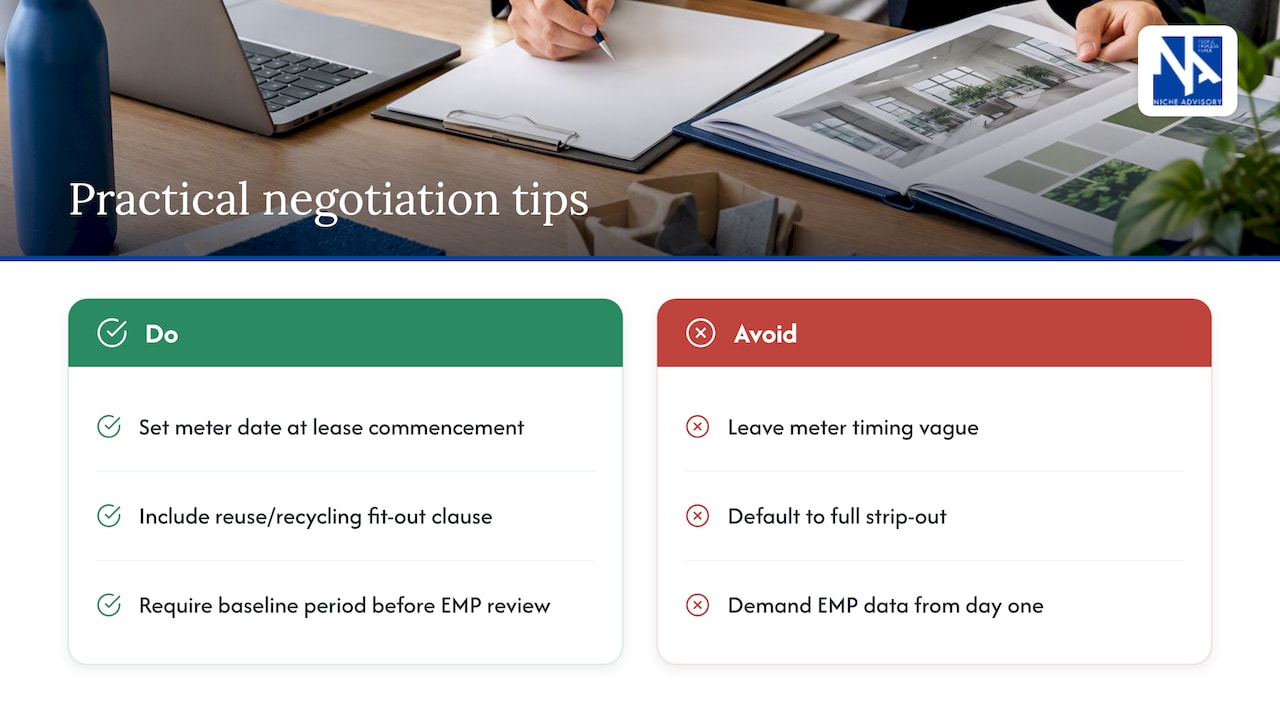
In Sydney and other Australian markets, we find three issues come up repeatedly when negotiating these schedules on behalf of tenants. Meter installation timing is often left vague, so we recommend a fixed date tied to lease commencement rather than “as soon as practicable.” Make-good clauses frequently default to full strip-out, when a reuse or recycling clause for fit-out items can avoid unnecessary cost for both parties, as explained in this practical guide on strip-out and demolition obligations. EMP delivery timelines also need to be realistic: a baseline period after commencement gives both sides workable data before the first review, rather than guessing at numbers from day one.
How we help with green lease negotiation and implementation
We act for tenants and owner-occupiers, never landlords, which means our advice on green lease clauses has no conflict with the building owner’s interests. Our corporate tenant advocacy service covers lease negotiation, make-good negotiation and dispute resolution, so a tenant facing a GLS for the first time has support reviewing cost allocation, metering obligations and remedial triggers before signing. Where implementation needs coordination between the EMP, fit-out and base building services, our project and construction management team manages the handover so the clauses translate into measurable building performance rather than paperwork that sits unused.
FAQ
What is considered a green lease?
A green lease is a commercial lease that includes clauses setting measurable sustainability obligations, typically a Target NABERS rating, separate metering, an Energy Management Plan and a Building Management Committee. The National Green Leasing Policy recommends these as the core elements, with optional clauses for water, waste and transport added depending on the building.
Which Green Lease Schedule applies to my tenancy?
The applicable schedule depends on the premises’ net lettable area, the proportion of the building it occupies, and whether the lease is net or gross. The Department of Finance’s GLS templates run from A1 to D2, with larger or higher-proportion tenancies generally attracting fuller landlord obligations.
Do I need a Building Energy Efficiency Certificate for my lease?
A current BEEC is generally required before advertising a lease or sale for most office areas of 1,000 square metres or more, under the Commercial Building Disclosure Program. The Building Energy Efficiency Disclosure Act 2010 sets the legal obligations and penalties attached to this requirement.
What happens if a landlord or tenant misses a NABERS target?
Green Lease Schedules generally treat a missed target as a trigger for a remedial notice and remedial plan rather than an immediate lease breach or termination right. Where the parties cannot agree on the remedial plan, the schedule typically escalates the matter to expert determination instead of court proceedings.
Can I get a 99-year lease in Australia?
Lease term length is a separate question from green lease obligations and depends on the type of property, the landlord’s title and state-specific leasing rules rather than on any green clause. A tenant considering a long-term lease should seek dedicated legal advice on title and tenure before focusing on sustainability clauses.
Sources
- Green Lease Schedules | Department of Finance
- Environment
- Disclosure affected buildings | Commercial Building Disclosure
- Building Energy Efficiency Disclosure Act 2010