
For an Australian corporate tenant, the lease term is the fixed occupancy period your lease guarantees, plus any options, breaks and hold-over arrangements that actually determine how long you can stay. The immediate action is to locate your option clauses, exercise windows and make-good obligations now, and loop in your legal adviser, tenant advisor and a quantity surveyor before any deadline creeps up on you.
TL;DR:
- Most lease options require exercise three to six months before expiry, so tenants should start rent and market research at least 12 months prior.
- Fit-out payback periods heavily influence lease length decisions; longer terms are better for recovering investment and securing incentives.
- Tenants should document their occupancy assumptions and decision reasoning to ensure clarity during renewals or reviews and adapt to business changes.
- Careful negotiation on break clauses and incentives is essential, especially regarding early exit costs and incentive repayment if exercising a break early.
- Legal advice should be sought well in advance of key deadlines, ideally more than six months before options or break rights are due, to preserve negotiating leverage.
Table of Contents
- What a lease term actually includes: fixed term, expiry and hold-over
- Choosing the right lease length: fit-out payback and the incentives trade-off
- Options to renew or extend: exercise windows and rent-review timing
- Break clauses and early-exit mechanics
- Make-good, security and likely end-of-term costs
- Negotiation checklist and timeline for Australian tenants
- Statutory safeguards in Australia: retail leases acts and the Property Law Act
- Defining and determining lease term in your own planning documents
- Judging which options you are genuinely likely to use
- Why your occupancy horizon matters for budgeting and capital planning
- Worked examples: fixed term, options and breaks in practice
- What to record about your occupancy assumptions
- When to bring in Niche Advisory for your lease term decisions
- Sources
- FAQ
What a lease term actually includes: fixed term, expiry and hold-over
Every commercial lease has a schedule page that records the hard facts: the commencement date, the fixed term (commonly 3, 5 or 10 years) and the expiry date. These three figures set your baseline occupancy, but they rarely tell the whole story. Most leases also include option clauses buried further into the document, and these can extend your actual tenure beyond the stated expiry.
If you stay in the premises after expiry without exercising an option or signing a new lease, you typically move into a hold-over arrangement, often a periodic tenancy on the old terms until either party gives notice. This can leave you paying higher hold-over rent with little security.
When reviewing a lease, check:
- The lease schedule for commencement date, fixed term length and expiry date
- The options clause, usually found near the end of the lease or in an annexure
- Any hold-over or “tenant at will” provisions and what rent applies during that period
- Break clause wording, if included, and where it sits relative to the options clause
Choosing the right lease length: fit-out payback and the incentives trade-off
Lease length should match your capital commitment, not just your operational comfort. The NSW Retail Tenancy Guide advises that leases should run long enough to recover your fit-out investment, and recommends negotiating options where a shorter initial term is unavoidable.
To set a minimum term, divide your total fit-out and relocation cost by your expected annual benefit (cost savings, productivity gains or simply the alternative cost of moving again). If payback lands at four years, a three-year initial term with no options is a poor fit.
Longer terms often buy better incentives, rent-free periods and fit-out contributions, because landlords amortise those costs across the lease. Shorter terms suit businesses expecting headcount changes, mergers or uncertain growth.
- Calculate fit-out payback before setting your target term
- Favour longer terms when incentives and stability matter more than flexibility
- Favour shorter terms with options when your business plan is uncertain
- Treat rent-free periods and fit-out contributions as a reduction in your effective term cost, not free money
Pro Tip: Model your effective annual rent after incentives, not the face rate: a shorter rent-free period on a longer term can still beat a bigger upfront incentive on a shorter one.
Options to renew or extend: exercise windows and rent-review timing
Options are where most tenants lose ground, not because the clause is unfair, but because the deadline passes unnoticed. Queensland Small Business Commissioner guidance notes that options commonly require exercise 3 to 6 months before the lease ends, and missing that window usually forfeits the right entirely, regardless of how long you have occupied the space.
Rent reviews on renewal typically follow one of a few methods, each with different cost implications:
- CPI-linked review, which tracks inflation and is the most predictable for budgeting
- Fixed percentage increase, agreed upfront and simple to forecast
- Current market rent, determined by an independent valuer and the most contested method
- A combination clause, often the higher or lower of CPI and a fixed percentage
Where market rent applies, tenants can request an early determination several months before the option deadline, though valuer costs are often shared between landlord and tenant and can be significant. Start your market research and internal budget review 6 to 12 months before expiry so you are not negotiating from a weak position with weeks left on the clock.
Break clauses and early-exit mechanics
A break clause lets you exit before the fixed term ends, but it almost always comes with preconditions. Common requirements include no outstanding rent or breaches at the break date, and strict compliance with the notice format and timing specified in the lease. Miss either and the break right can lapse.
Incentives and landlord contributions are frequently tied to the full term. If you exercise a break early, many leases require repayment of a proportion of that incentive, calculated on a straight-line basis for the unexpired period.
- Confirm exactly what preconditions must be met to validly exercise a break
- Check whether incentives are repayable on early exit and negotiate a declineing repayment schedule
- Insist on a defined notice form (in writing, to a named address) and a reasonable cure period for minor breaches
- Where possible, cap any break fee or require an independent quantity surveyor to assess disputed costs
Make-good, security and likely end-of-term costs
Make-good is where budgets blow out, often because tenants discover the obligation only when the lease is ending. The NSW Small Business Commissioner notes that make-good clauses typically require returning the premises to original condition, which can mean strip-out to base building, repainting, floor coverings removed and services reinstated.
Security is usually held as a bank guarantee or, in some jurisdictions, a cash bond lodged with the relevant state authority. Negotiate a step-down clause so the guarantee value reduces over the term as your payment history improves, and set a clear release mechanism at expiry.
- Commission a condition report at lease commencement, not at exit, so there is a baseline to argue from
- Quantify the make-good scope in the lease itself rather than leaving it as a general obligation
- Include a clause allowing an independent quantity surveyor to determine disputed costs
- Ask your building maintenance contractor for indicative strip-out costs early, not at the eleventh hour
Pro Tip: A documented condition report at the start of your lease is the single most effective protection against an inflated make-good bill at the end of it.
For practical delivery of strip-out and restoration works, a building maintenance provider can give you realistic cost ranges well before your make-good obligations crystallise.
Negotiation checklist and timeline for Australian tenants
Business Queensland makes the point plainly: everything in a lease is negotiable, and the smart approach is to set a confidential financial bottom line, then use negotiation to improve the whole package rather than fixating on headline rent.
Work through priorities in this order:
- Lease term and options, since these anchor everything else
- Rent review method, because it determines your cost trajectory
- Make-good scope and security, to cap your exit liability
- Assignment and sub-letting rights, for flexibility if your needs change
- Incentives, fit-out contributions and rent-free periods, negotiated last once the structure is set
Capture agreed commercial terms in a heads of agreement before lawyers draft the formal lease, then get quantity surveyor and legal input before anything is signed.
A realistic timeline: start planning 12 months before expiry, confirm your direction (renew, relocate or renegotiate) by 6 months out, and finalise documentation 1 to 3 months before the deadline.
Pro Tip: Never let your legal review start inside the final month before your option deadline. It almost always costs you negotiating leverage.
Statutory safeguards in Australia: retail leases acts and the Property Law Act
Retail leases legislation varies by state, but the protections follow a similar pattern across jurisdictions: mandatory disclosure statements before signing, defined notice periods for landlord decisions about renewal, and formal processes for appointing a valuer if a market rent review is disputed. Avant’s guidance outlines how these protections commonly cover disclosure, valuer appointment and lessor notice obligations.
Property Law Act provisions in each state also govern general commercial leasing matters, including how notices must be served and formalities around lease registration. Recent code changes have reshaped some of these protections, particularly around renewal rights and break clauses.
- Confirm whether your premises falls under retail leases legislation or general commercial law in your state
- Check the disclosure statement was provided at the correct stage of negotiation
- Note the notice period your landlord must give regarding renewal decisions
- Review how a market rent valuer is appointed if you and the landlord disagree
Defining and determining lease term in your own planning documents
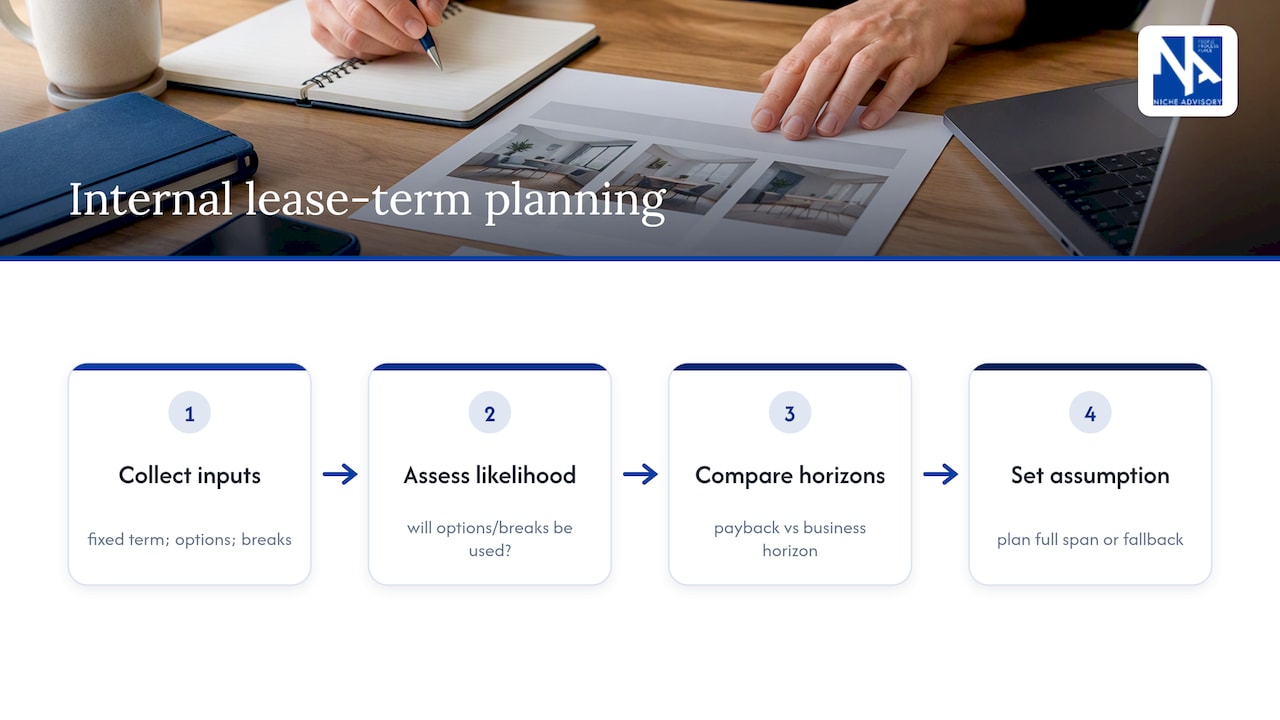
While this guide focuses on the commercial deal, it is worth being clear about how the phrase “lease term” gets used in your own internal paperwork, separate from the lease document itself. When your finance or facilities team models occupancy costs, they need the same core inputs you have already gathered: the non-cancellable fixed period, any renewal options you genuinely expect to exercise, and any break rights you might use.
A non-cancellable period is simply the stretch of the lease you cannot walk away from without penalty, the fixed term itself. Options and breaks sit outside that core period, and whether you build them into your planning assumptions depends on how likely you actually are to use them, not on what the lease merely permits.
From a tenant’s perspective, the practical discipline is this: do not assume you will exercise every option just because it exists, and do not assume you will walk at the first break date just because you can. Base your internal planning on your actual business trajectory, headcount forecasts and the fit-out payback period you calculated earlier. If your fit-out economics only make sense across ten years and your options realistically extend you that far, plan around the full span. If your business is likely to outgrow the space in four years regardless of a longer option, plan around the shorter horizon and treat the option as a fallback rather than a certainty.
Judging which options you are genuinely likely to use
Not every option clause in your lease deserves equal weight in your planning. The useful test is a practical one: given your current business trajectory, would exercising this option make commercial sense, or would declining it?
Factors that typically tip the judgment towards treating an option as a real part of your planning horizon include a fit-out payback period that extends beyond the initial fixed term, a favourable rent-review mechanism locked into the option (such as a capped CPI increase rather than open market rent), and a business plan that assumes stable or growing headcount at the same location.
Factors that point the other way include a pending merger, acquisition or restructuring that could change your space needs, a rent review on renewal that resets to full market rent with no cap, and a break clause available before the option deadline that gives you a cheaper exit if your plans change.
This is a judgment call specific to your business, not a formula. The discipline that matters is documenting the reasoning at the time you make the decision, particularly where your fit-out investment, headcount plans or market rent exposure are material to the outcome. Revisit that judgment whenever your business circumstances change materially, rather than only at the next option deadline.
Why your occupancy horizon matters for budgeting and capital planning
How long you genuinely plan to occupy a premises, factoring in the options and breaks you actually expect to use, drives two practical numbers every corporate tenant needs: your effective occupancy cost per year and your capital recovery timeline for fit-out spend.
If you treat only the fixed term as your planning horizon and ignore an option you are highly likely to exercise, you risk under-recovering your fit-out investment in your own internal budgeting and understating your real occupancy commitment to the business. Conversely, assuming you will exercise every available option when your business plan does not support that can leave you budgeting for a horizon you will not actually reach, skewing decisions about how much to invest in the fit-out itself.
The practical fix is to align your internal occupancy horizon with the same analysis you used to set your negotiating position: the fit-out payback calculation, your business growth plans and the realistic likelihood of exercising each option or break. That horizon then feeds directly into how much capital you are prepared to commit to design and construction, and how you time any future workplace strategy review.
Worked examples: fixed term, options and breaks in practice
Say a tenant signs a 5 year lease with a single 5 year option, and spends $400,000 on fit-out. Using the payback method described earlier, if the fit-out delivers $100,000 in annual value, payback lands at four years, comfortably inside the initial fixed term. The option becomes a genuine extension opportunity rather than a necessity, and the tenant can assess it closer to the five year mark based on how the business has actually performed.
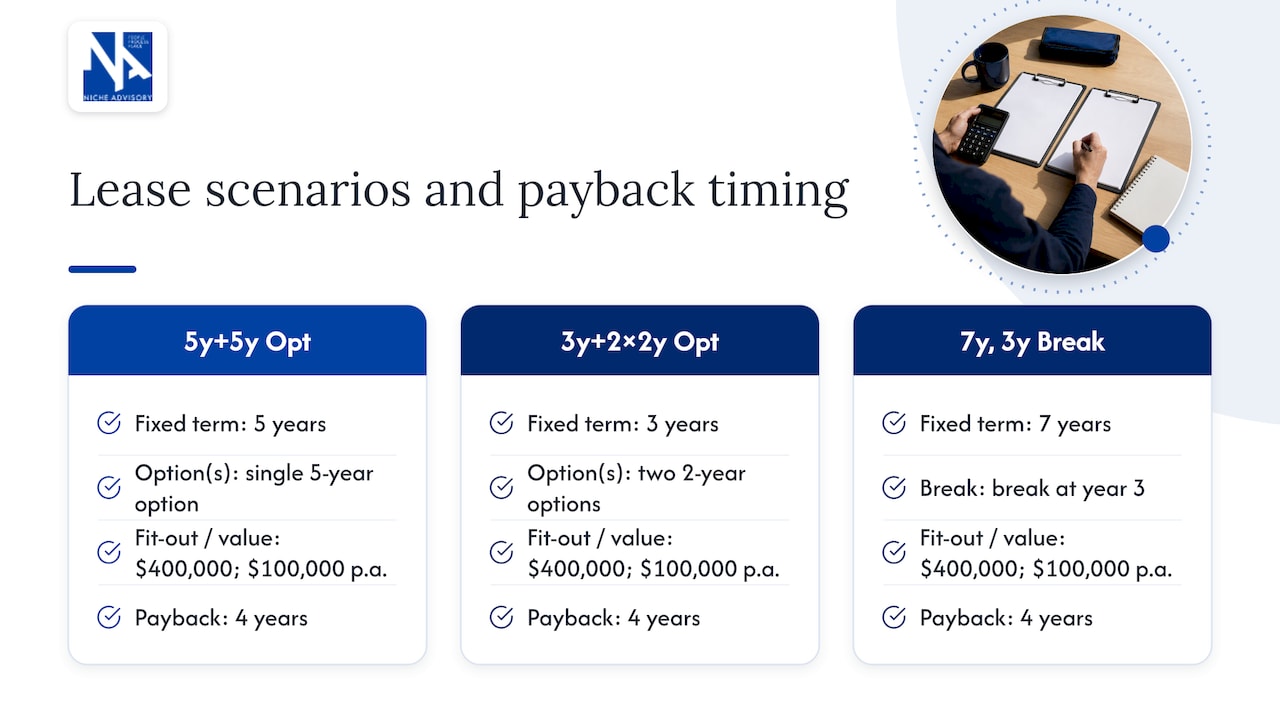
Contrast that with a tenant signing a 3 year lease with two 2 year options and the same $400,000 fit-out. If annual value remains $100,000, payback stretches to four years, beyond the initial fixed term. In this case, the first option is not optional in any practical sense: the tenant needs it to recover the fit-out investment, and that reality should shape how firmly they negotiate the option’s rent-review method at the outset, since a poor outcome on that review could erode the value the option was meant to protect.
A third scenario: a tenant with a 3 year break clause inside a 7 year term, where the business is expecting significant headcount growth within three years. Here the break is unlikely to be exercised, but the tenant should still negotiate favourable notice terms and incentive repayment caps on that break, in case growth plans change before the break date arrives.
What to record about your occupancy assumptions
Whatever horizon you land on for a given premises, the reasoning behind it is worth keeping on file alongside the lease itself, not just in a spreadsheet that gets overwritten each year. That record should note the fixed term and expiry date, which options exist and the exercise windows attached to them, which options or breaks your planning assumes you will use and why, and the fit-out payback period that informed the original term decision.
Keeping this documented matters for a few practical reasons beyond tidiness. It gives whoever manages the next renewal or review a clear record of the original thinking, rather than forcing them to reconstruct it from the lease document alone. It also means that if your business circumstances change, whoever is reassessing the occupancy horizon can see exactly which assumptions need revisiting, rather than treating every option decision as a fresh exercise with no history behind it.
This is a matter of good internal practice rather than a regulatory requirement for most corporate tenants, but it is the kind of discipline that saves real time and avoids repeated analysis when your options and renewal deadlines come around.
When to bring in Niche Advisory for your lease term decisions
Advice on term length, options and make-good should be built around your business outcome, not the deal that suits a landlord best. Our corporate tenant advocacy service covers lease negotiation end to end, while our make-good negotiation work focuses specifically on limiting your exit exposure.
The best trigger points to call us are before you sign a heads of agreement, 12 to 6 months before an option deadline, and before you exercise or waive a break clause. Each of these moments locks in a position that is expensive to unwind later.
- Services can include tenant advocacy and lease negotiation support, make-good negotiation and execution to cap end-of-term costs, and project and construction management if a move or fit-out follows a lease decision.
If you are approaching a renewal, an option deadline or a make-good obligation, a short scoping call with our corporate real estate team can clarify your position before you commit to anything.
Sources
- NSW Retail Tenancy Guide 2022
- Negotiating a business premises lease | Business Queensland
- Options to renew | QSBC
FAQ
What does “lease term” mean for a commercial tenant?
It means the fixed occupancy period stated in your lease schedule, from commencement to expiry, plus any options, breaks or hold-over arrangements that can extend or shorten your actual stay. Checking the options clause and exercise window is the first practical step for any tenant.
When should I exercise my option to renew?
Most options require exercise 3 to 6 months before the lease expires, and missing that window typically forfeits the right, according to Queensland Small Business Commissioner guidance. Start your market rent research and internal review 6 to 12 months out so you are ready well before the deadline.
How much should I budget for make-good at lease end?
Costs vary significantly depending on the scope required and the condition of the base building, but a condition report at lease start and a defined make-good clause are the best ways to avoid a disputed bill, as noted by the NSW Small Business Commissioner. Asking a quantity surveyor for an early estimate is worth doing well before the lease ends.
Is everything in a commercial lease negotiable?
Yes, Business Queensland guidance confirms that lease terms, rent review methods, make-good scope and incentives are all open to negotiation. The practical approach is to set a confidential bottom line and negotiate the whole package rather than focusing only on rent.
Can Niche Advisory help negotiate my lease term and options?
Yes, Niche Advisory’s corporate tenant advocacy service covers lease term negotiation, options strategy and make-good management, acting exclusively for tenants. Pricing for these engagements is available on request through our corporate tenant advocacy page.