Brisbane’s industrial vacancy sits in the mid single digits, with the Property Council reporting average vacancy around 4.5% by property count and 3.2% by floorspace across four study areas. That tightness keeps rents firm and incentives modest, which means tenants have less room to negotiate and investors are underwriting against a market with genuinely constrained supply.
TL;DR:
- Vacancy in Brisbane’s industrial market has fallen below 1% in some precincts, driven by high absorption and limited land availability.
- Most reports use a 3,000-square-metre minimum size threshold, which excludes smaller units that may influence market dynamics differently.
- The Logan Motorway Corridor remains the tightest area, with vacancy around 1%, supported by strong freight demand and limited serviced land.
- The primary constraint on new supply is the shortage of serviced, zoned land, not a lack of developer interest or capital.
- Low vacancy levels are likely to support rising rents and tighter lease terms, especially in precincts with genuine land constraints.
Table of Contents
- Current vacancy snapshot and what counts as vacant
- Where the tightest precincts sit and what moved them
- Why supply hasn’t kept pace with demand
- What tighter vacancy means for rents and investment decisions
- Local shortlist: Brisbane tenant advisory options
- Turning vacancy data into a leasing or investment decision
- How Niche Advisory supports Brisbane occupiers
- Sources
- FAQ
Current vacancy snapshot and what counts as vacant
Brisbane’s industrial vacancy has moved through a sharp cycle over the past few years. The Property Council’s “No room to grow” report shows vacancy was above 6% in late 2020, falling to below 1% in some precincts by mid 2023 as occupiers absorbed available stock faster than developers could replace it.
The methodology matters here. Most reports tracking Brisbane’s industrial market, including the Property Council’s series, apply a minimum building size threshold of 3,000 square metres and define a space as vacant only when it can be occupied within three months. That excludes smaller sheds and units that never make it into the headline figures, and it excludes stock that is technically empty but tied up in fitout, subdivision or delayed handover.
Three points worth holding onto:
- Vacancy bottomed below 1% in some precincts during 2023, among the tightest readings recorded in the series.
- The 3,000sqm+ convention is now the industry standard for comparing Brisbane against other capital cities.
- Absorption over 2019 to 2024 reached over one thousand hectares of industrial land, a scale that explains why supply struggled to keep pace.
Where the tightest precincts sit and what moved them
Vacancy is not uniform across Brisbane. The Logan Motorway Corridor has run with very low floorspace vacancy, around 1% level, according to the Property Council’s release on recent Brisbane conditions, making it one of the tightest logistics precincts in the country. TradeCoast, anchored around the port and airport, continues to attract occupiers who need proximity to freight infrastructure, while Brisbane’s southside and Brisbane North corridors show more mixed conditions depending on how much serviced land has recently come online.
Large occupier moves can shift a precinct’s vacancy reading in a single quarter. A major distribution centre signing for a purpose-built facility, or a manufacturer consolidating into a larger shed, removes meaningful floorspace from the available pool almost overnight in a market this size.
- Logan Motorway Corridor remains the standout for tightness, reflecting strong freight and logistics demand along that route.
- TradeCoast benefits from port and airport proximity, keeping demand steady even as broader conditions soften elsewhere.
- Precincts with imminent serviced land releases, particularly on Brisbane’s western fringe, are the ones most likely to see near-term vacancy relief.
Why supply hasn’t kept pace with demand
The core issue is not a shortage of developer appetite. It’s a shortage of land that is actually ready to build on. The Property Council’s report on constrained land supply ties Brisbane’s persistent tightness to a genuine shortfall of serviced, zoned industrial land rather than a lack of capital chasing projects.
- Absorption of roughly 1,084 hectares between 2019 and 2024 outstripped the rate at which new serviced land was brought to market.
- Planning approvals and infrastructure servicing, including roads, power and water connections, remain the main bottleneck slowing new supply, a constraint echoed in the Property Council’s industrial logistics outlook.
- Speculative completions can add short-term availability, but when they arrive without pre-committed tenants they tend to lift vacancy only briefly before absorption catches up.
Understanding this dynamic is close to understanding net absorption more broadly: the pace at which occupiers take up space relative to what’s delivered is what actually drives vacancy, not the headline pipeline figure alone. Anyone underwriting a Brisbane acquisition on the assumption that new supply will flood the market quickly should stress-test that assumption against how long serviced land has taken to reach the market historically.
What tighter vacancy means for rents and investment decisions
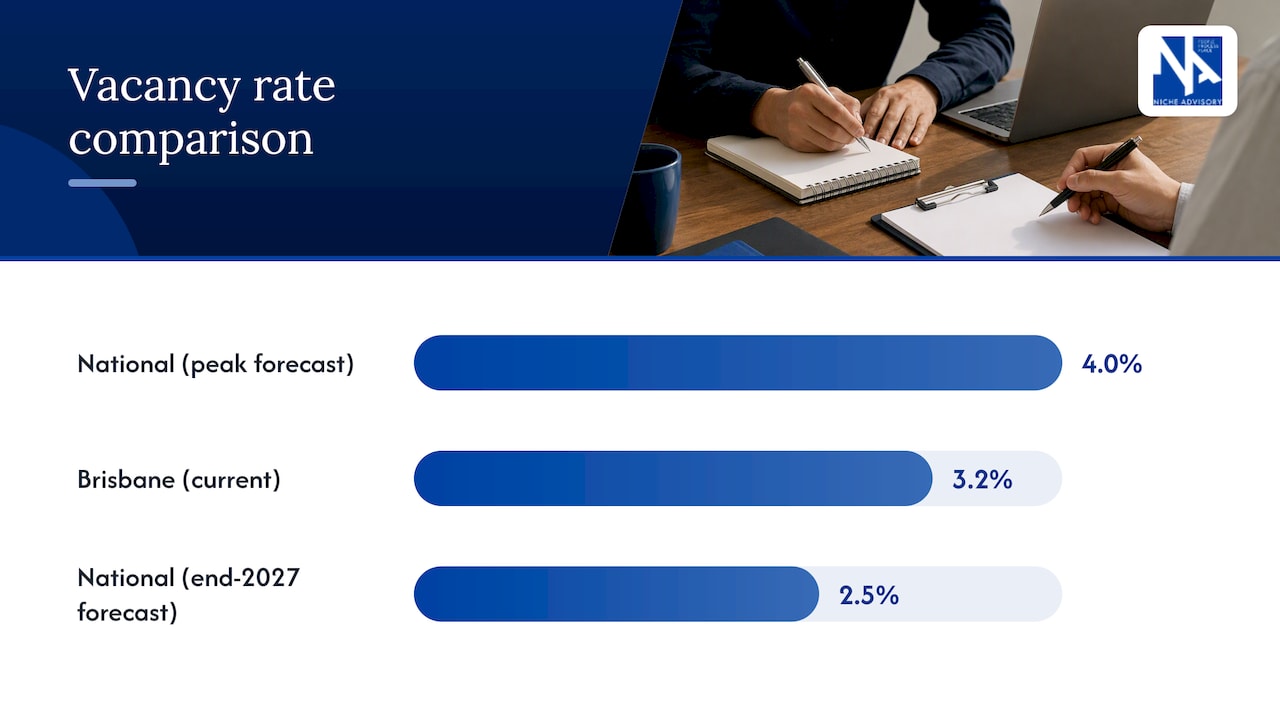
Tight vacancy has flowed through to rents, though not evenly across every precinct. Cushman & Wakefield’s national outlook, summarised by the Property Council, forecasts logistics and industrial vacancy nationally may peak near 4.0% before easing towards 2.5% by the end of 2027 as speculative supply drops and demand rebounds. For Brisbane specifically, the tightness already evident in precincts like Logan Motorway Corridor gives landlords the upper hand on incentives and face rents in the near term.
For tenants, this means less negotiating room than in a looser market, particularly for buildings above 3,000 square metres in tightly held corridors. For investors, sustained low vacancy supports rental growth assumptions and can justify tighter cap rates, provided the asset sits in a precinct with genuine land constraints rather than one due for a wave of speculative completions.
Signals worth tracking over the next two to three quarters:
- Movement in the 3,000sqm+ vacancy rate specifically, since that’s the benchmark most reports use.
- Any large pre-committed leases that could remove significant floorspace from a precinct.
- The pace of new serviced land releases, which determines whether current tightness persists.
Local shortlist: Brisbane tenant advisory options
Occupiers weighing up whether to search for industrial space alone or bring in representation have a handful of paths available. An independent corporate real estate advisory specializes in workplace strategy, tenant advocacy and project management for Brisbane occupiers.
| Provider | Google reviews | Core services | Brisbane focus |
|---|---|---|---|
| Niche Tenant Advisory | 4.5★ (8) | Tenant advocacy, workplace strategy, project management | Serves Brisbane and the surrounding area |
Self-managing a search works reasonably well when you have a clear brief, flexible timing and no complex lease terms to negotiate. It makes far less sense when you’re chasing a tight precinct like Logan Motorway Corridor under time pressure, where an advisor’s read on upcoming availability and comparable deal terms can be the difference between securing a site and missing it.
Turning vacancy data into a leasing or investment decision
Reading a vacancy report is one thing. Acting on it without getting burned on timing, size or lease terms is another.
- Check the data’s vintage first. A vacancy figure from two quarters ago may no longer reflect a precinct that’s since absorbed a large lease.
- Match your required building size against the 3,000sqm+ convention. Smaller occupiers often face a different, less visible market than the headline figures describe.
- Model rent sensitivity across a 24 to 36 month horizon, since incentives can shift quickly if a wave of completions lands without pre-commitments.
- Confirm the precinct’s servicing status. Land zoned for industrial use isn’t usable until power, water and road access are actually connected.
- Review lease due-diligence items early: rent review mechanisms, make-good obligations and option timelines all carry more weight in a tight market where landlords have less incentive to negotiate.
Pro Tip: Treat any headline vacancy figure as a starting point, not a decision. Cross-check it against precinct-level absorption and recent comparable leases before committing to a site or a valuation.
Understanding what tenants actually need before you start searching, as outlined in identifying business requirements, avoids wasted time chasing space that doesn’t fit. Complex disputes or make-good negotiations are best escalated to a professional advisor rather than handled informally.
How Niche Advisory supports Brisbane occupiers
An independent advisory firm provides tenant advocacy, corporate real estate advisory and project management for Brisbane occupiers navigating a tight industrial market. That independence matters most when vacancy is low and landlords hold more leverage than usual in lease negotiations.
- Tenant advocacy that represents your interests exclusively through site search, negotiation and lease execution.
- Workplace strategy that aligns your space decision with actual operational needs, not just available stock.
- Project and construction management to carry a fitout or relocation through to completion once terms are agreed.
A first engagement typically starts with a review of your current lease position and space requirements before scoping the search. Get in touch through Corporate Tenant Advocacy to discuss your next move in Brisbane’s industrial market.
Sources
Figures in this article draw on the Property Council’s “No room to grow” land supply report, its media release on logistics vacancy, and Cushman & Wakefield’s national outlook commentary. For general supply and demand mechanics, WealthStacker’s explainer offers useful background for investors.
- Logistics keeps lid on industrial vacancy (Property Council media release)
FAQ
What is the current industrial vacancy rate in Brisbane?
Brisbane’s industrial vacancy has averaged around 4.5% by property count and 3.2% by floorspace across recent study areas, according to the Property Council. Some precincts, including the Logan Motorway Corridor, have recorded floorspace vacancy as low as 1.3%.
How is industrial vacancy measured in Brisbane reports?
Most reports, including the Property Council’s series, apply a minimum size threshold of 3,000 square metres and count a space as vacant only if it can be occupied within three months. This convention excludes smaller sheds and units, which can behave differently to the headline figures.
Which Brisbane industrial precincts are tightest right now?
The Logan Motorway Corridor has recorded some of the lowest vacancy in Brisbane, alongside strong demand around TradeCoast near the port and airport. Precincts with new serviced land coming online tend to show more available stock than tightly held freight corridors.
How does low vacancy affect lease negotiations for tenants?
Low vacancy generally reduces a tenant’s negotiating leverage, particularly for buildings above 3,000 square metres in tightly held precincts, leading to firmer face rents and thinner incentives. Tenants in this position often benefit from independent representation to secure competitive terms.
Can I get help finding industrial space in Brisbane?
Niche Tenant Advisory provides independent tenant advocacy and workplace strategy support for occupiers searching for industrial space in Brisbane. You can start a conversation about your requirements through Corporate Tenant Advocacy.