A workplace strategy framework is a structured, five-stage process (discovery, analysis, design, implementation and governance) that aligns your people, space, technology and property decisions with business outcomes. It gives leaders a repeatable way to test assumptions before committing capital. The first move is simple: appoint an executive sponsor and commission a rapid discovery phase within the next fortnight.
TL;DR:
- The analysis stage is critical, as skipping utilization studies and designing based on opinions leads to underused and expensive space later.
- Implementing clear, measurable KPIs across employee experience, utilization, cost, and WHS is essential to track if the strategy aligns with actual outcomes and needs.
- Building lease flexibility and modeling attendance data prevents overcommitment to space that may become redundant in a hybrid work environment.
- Effective change management depends on manager training and early employee engagement to foster adoption and prevent resistance.
- Establishing a governance structure with clear ownership, review cadence, and escalation paths ensures the strategy remains aligned and adaptable over time.
Table of Contents
- How the framework pieces fit together
- The step-by-step process from discovery to governance
- People, policies and legal obligations you need to build in
- Metrics that actually tell you if the strategy is working
- Aligning the strategy with your property and lease decisions
- Technology that supports hybrid work without adding noise
- Building the business case and costing it properly
- Your first 90 days and what to ask an adviser
- Practitioner perspective: what good execution looks like
- Future-proofing your policy as work patterns keep shifting
- Getting people to actually adopt the new way of working
- Spotting and managing the risks before they cost you
- Keeping the timeline realistic from kickoff to review
- Making sure the strategy actually reflects your culture and goals
- Auditing how your space is actually being used today
- Making sure employees actually shape the strategy
- Who owns the strategy once it is live
- How we help you put this framework into practice
- FAQ
- Sources
How the framework pieces fit together
A workplace strategy framework works because its parts reinforce each other rather than operating as separate projects. Space decisions without workforce data lead to empty desks or overcrowded floors. Technology bought ahead of a clear operating model gets ignored. Governance without a baseline has nothing to measure against. The five stages exist to force that sequencing.
Here is the map most practitioners follow:
- Discovery: understand who works where, why, and what the business actually needs from its property and people.
- Analysis: test those assumptions against real utilisation, cost and risk data.
- Design: translate findings into space typologies, an operating model and a technology specification.
- Implementation: procure, communicate, train managers and run a measured pilot.
- Governance: track KPIs, set review gates and adjust as the organisation changes.
You would run the full framework when planning a fitout, reviewing a property portfolio ahead of a lease event, or resetting flexible work policy after a merger or restructure. A lighter version, discovery and analysis only, suits an annual policy refresh. The sequence matters more than the depth: skipping analysis to jump straight to design is the most common reason workplace projects underdeliver.
The step-by-step process from discovery to governance
Each stage has distinct owners, actions and a minimum deliverable. Treat this as the operational backbone of your programme.
- Discovery: map stakeholders across HR, IT, finance and facilities; agree the business outcomes the strategy must serve (cost, collaboration, talent attraction); segment the workforce by role and work pattern; scan existing policies for flexible work, WHS and travel. Deliverable: a one-page brief naming sponsors, outcomes and constraints.
- Analysis: run a space utilisation study using badge, sensor or manual observation data over at least two typical weeks; map activities against space types; conduct a psychosocial and physical risk scan for home and hybrid arrangements in line with Safe Work Australia’s good work design guidance; set baseline metrics for occupancy, cost per FTE and engagement. Deliverable: a baseline report with utilisation rates and risk flags.
- Design: define space typologies (focus, collaboration, social, quiet) based on actual activity data rather than assumption; confirm the operating model (which roles attend which days); write a technology specification covering booking, access and reporting; plan a pilot floor or team. Deliverable: a design brief and pilot plan.
- Implementation: procure fitout and technology, run manager and employee communications, train managers on leading distributed teams, and launch the pilot with a feedback loop. Deliverable: a pilot evaluation report after 8 to 12 weeks.
- Governance: build a KPI dashboard, set a review cadence, define decision gates (when to scale, pause or redesign) and name an escalation path for disputes or underperformance. Deliverable: a governance charter with named roles.
The most frequent failure point is between analysis and design: teams skip the utilisation study and design around opinion rather than evidence, which shows up later as expensive, underused space.
People, policies and legal obligations you need to build in
A workplace strategy only holds up if it reflects the legal and safety obligations that shape how people actually work. Under Fair Work Ombudsman guidance, an eligible employee can request flexible working arrangements and an employer must respond in writing within 21 days, with any refusal requiring reasonable business grounds. That timeline needs to sit inside your policy and manager training, not just your HR handbook.
Safe Work Australia expects WHS risk management to extend to home and hybrid arrangements, explicitly including psychosocial hazards such as isolation, workload and blurred boundaries.
Priorities for manager capability:
- Train managers to run remote performance conversations, not just monitor attendance.
- Build psychosocial risk detection into one-on-ones and team check-ins.
- Set clear expectations for in-office days tied to collaboration and development, not compliance.
Pro Tip: Run short, targeted manager capability sprints of three to six hours focused on measurement, remote conversations and psychosocial risk detection rather than a single annual training day.
Metrics that actually tell you if the strategy is working
The right KPIs connect workplace decisions to business outcomes rather than just desk counts. Four categories matter most:
- Employee experience: engagement survey scores, flexible work request approval rates, sentiment on collaboration.
- Utilisation: desk and meeting room occupancy by day and floor.
- Cost: cost per FTE, rent per square metre, fitout cost against budget.
- WHS: psychosocial incident reports, hazard scan completion rates.
Each category draws on a different data source: booking system logs and sensors feed utilisation, HR platforms feed engagement and flexible work data, finance systems feed cost per FTE, and incident reporting tools feed WHS metrics.
As of August 2025, 36% of employed people in Australia usually worked from home, and the rate reached 59% among managers and professionals. That gap between the general workforce and senior roles is worth tracking in your own utilisation data, since it shapes how much space you actually need on any given day.
Review operational metrics monthly, strategic KPIs quarterly, and tie a full portfolio review to lease milestones such as renewal or break options.
Aligning the strategy with your property and lease decisions
Workplace strategy and real estate decisions should move together, not in sequence. Hybrid attendance patterns change the headcount-to-space ratio you actually need, which affects whether you renew, downsize or consolidate across a portfolio.
- Model headcount-to-space ratios against your actual attendance data, not a flat assumption of five days a week.
- Build lease flexibility through shorter terms, break options or sublease clauses where the market allows it.
- Prioritise procurement that supports pilot-then-scale decisions rather than locking in a fixed footprint upfront.
Office markets have shown a flight to quality, with demand concentrating in premium stock while vacancy and cycles vary by city. That trend means a workplace strategy that ignores the property market risks locking into space that does not match where quality demand, and therefore future subletting value, is heading. This is the point to bring in tenant-side corporate real estate advisory, project management for fitout delivery, or tenant advocacy for lease negotiation, each producing a distinct output: a portfolio options paper, a delivered fitout, or a negotiated lease term.
Technology that supports hybrid work without adding noise
Workplace technology should answer a specific operational question, not just add a dashboard. Five functional categories cover most needs: desk and room booking, space utilisation analytics, collaboration tools, remote access and security, and WHS incident reporting.
When selecting a tool, weigh:
- Accuracy: does the data match a manual spot-check, or drift over time?
- Privacy: is location and usage data handled in line with your policy and employee expectations?
- Integration: does it connect cleanly with HR and finance systems, or create another silo?
- User experience: will people actually use it without a mandate?
Roll out any new tool as a pilot on one floor or team before committing to a full licence. By month six you should be able to show utilisation accuracy within an acceptable margin of your manual baseline and adoption rates that justify the licence cost, rather than a tool nobody opens after week two.
Building the business case and costing it properly
A credible business case separates one-off costs from ongoing ones and ties every benefit to a measurable proxy. Typical cost lines include capital expenditure on fitout, ongoing opex for space and technology licences, change management and training costs, and software subscriptions.
- List capex, opex, change management and licence costs separately so decision-makers see where the money goes.
- Quantify benefits using proxies such as rent per FTE, retention uplift, and reduced vacant desk costs.
- Model at least two scenarios: current attendance pattern and a higher-utilisation pilot outcome, to show sensitivity to your attendance assumptions.
Because space need is so sensitive to attendance assumptions, run the numbers through a space calculator before presenting a final figure to your board, and stress-test it against both a conservative and an optimistic hybrid scenario.
Your first 90 days and what to ask an adviser
Moving from plan to action in the first quarter sets the tone for everything after.
- Weeks 1 to 2: appoint an executive sponsor and confirm the business outcomes the strategy must serve.
- Weeks 3 to 6: gather baseline utilisation, cost and engagement data, and run stakeholder workshops across HR, IT and facilities.
- Weeks 7 to 10: select a pilot floor or team based on the data, not convenience.
- Weeks 11 to 13: launch the pilot, start collecting feedback, and set the first governance review date.
Before engaging an adviser, ask whether they act exclusively for tenants or also represent landlords, how they measure utilisation and success, what governance support they provide after delivery, and whether they can describe a comparable project outcome. Use pilot results, not instinct, as the trigger for scaling: a pilot that hits your utilisation and engagement targets within the evaluation window earns the case for a larger investment.
Practitioner perspective: what good execution looks like
Delivering a workplace strategy well means integrating people policy, WHS obligations and property decisions in one programme rather than three disconnected ones. We built our approach at Niche Advisory around that integration: workplace strategy, independent tenant advisory and project management under one engagement, so a design decision and a lease decision get tested against the same business outcomes.
A typical engagement moves from a discovery workshop through a utilisation study to a design brief, with project management carrying it through delivery and governance handed back to the client with a working dashboard.
Future-proofing your policy as work patterns keep shifting
Hybrid work is not a temporary adjustment, it is the baseline most organisations now plan around. With more than a third of employed people usually working from home, a workplace strategy built around a fixed five-day office assumption is already out of date before it launches.
Future-proofing means designing policy and space for a range of attendance patterns rather than a single number. That starts with flexible lease terms and modular fitouts that can absorb a 10 or 15 percentage point swing in attendance without a full refit. It also means writing policy in terms of outcomes and team rhythms rather than fixed days, since mandates tend to generate compliance rather than genuine engagement.
Build review points into your policy itself: a six-month check against utilisation data, and a trigger for reassessment if attendance patterns shift materially. Treat your technology stack the same way, favouring booking and analytics tools that can scale up or down rather than locking into a fixed-capacity system. The organisations managing this well tend to treat flexibility as a design constraint from the outset, not a concession made under pressure.
Getting people to actually adopt the new way of working
A workplace strategy fails at adoption more often than it fails at design. People resist change they were not consulted on, and they default to old habits when a new policy is not visibly reinforced by managers.
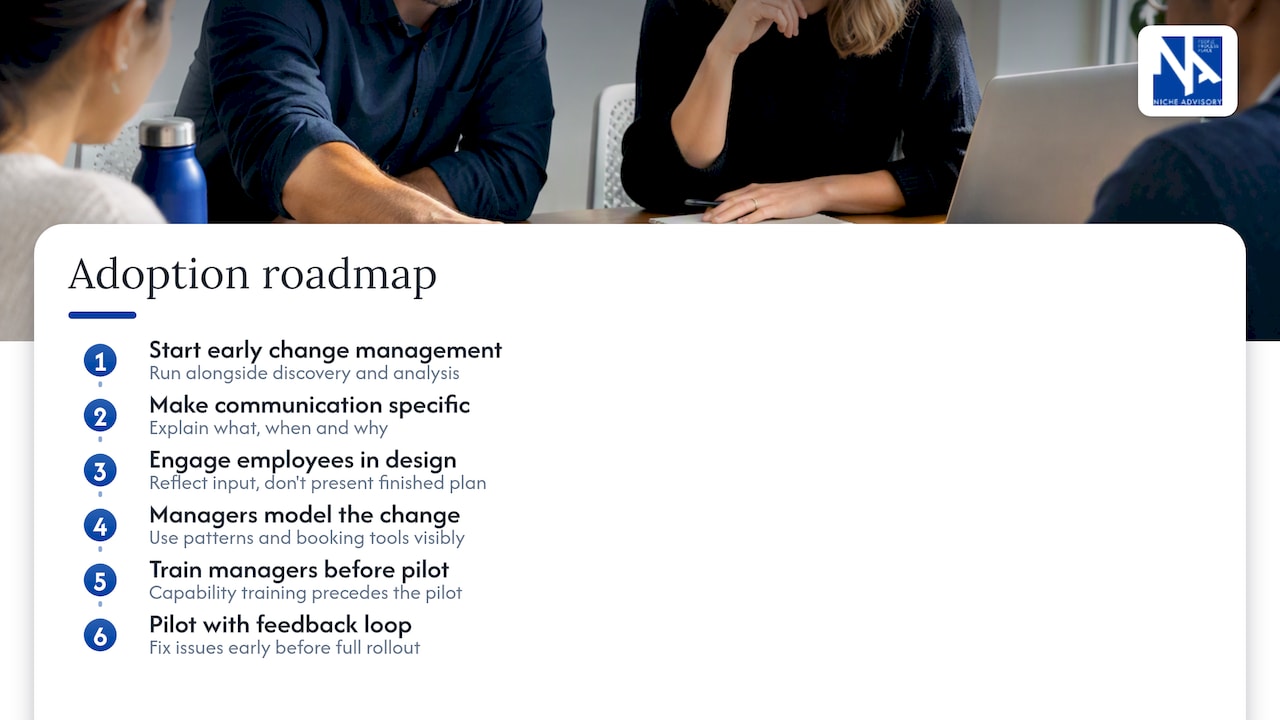
Effective change management starts well before implementation, running in parallel with discovery and analysis so employees see their input reflected in design decisions rather than presented with a finished plan. Communication needs to be specific: what is changing, when, and why, rather than a generic announcement about a new way of working.
Manager visibility matters more than any single communication. If managers do not model the new attendance pattern or actively use the new booking tools, teams will not either. Manager capability remains the linchpin of effective flexible work implementation, which means training needs to precede the pilot, not follow complaints about it.
Build in a feedback loop during the pilot phase so issues surface early and get fixed before a full rollout, rather than being discovered at scale. Recognise that adoption is gradual: measure it against realistic milestones at 30, 60 and 90 days rather than expecting full uptake from day one.
Spotting and managing the risks before they cost you
Workplace strategy carries a mix of financial, operational and people risks, and naming them early is cheaper than discovering them mid-project. Financially, the biggest risk is committing to space or technology based on assumption rather than utilisation data, which leads to stranded capacity or an undersized floor.
Operationally, a pilot that is not representative of the wider workforce (chosen for convenience rather than evidence) produces results that do not generalise, leading to a flawed scale-up decision. WHS and psychosocial risk is a distinct category: hybrid work introduces hazards such as isolation and blurred boundaries that need explicit controls, not just a policy statement.
People risk shows up as disengagement or attrition if employees feel a strategy was imposed rather than developed with their input. Mitigate each category with a specific control: utilisation data before any space commitment, a representative pilot group, a documented psychosocial risk assessment, and a genuine consultation process before policy is finalised. Build a simple risk register into your governance charter so these are tracked rather than left to surface informally.
Keeping the timeline realistic from kickoff to review
A full workplace strategy programme typically runs across four phases over six to twelve months, though the exact pace depends on portfolio size and lease timing. Discovery and analysis usually take four to eight weeks combined, since utilisation studies need at least a couple of weeks of real data to be credible.
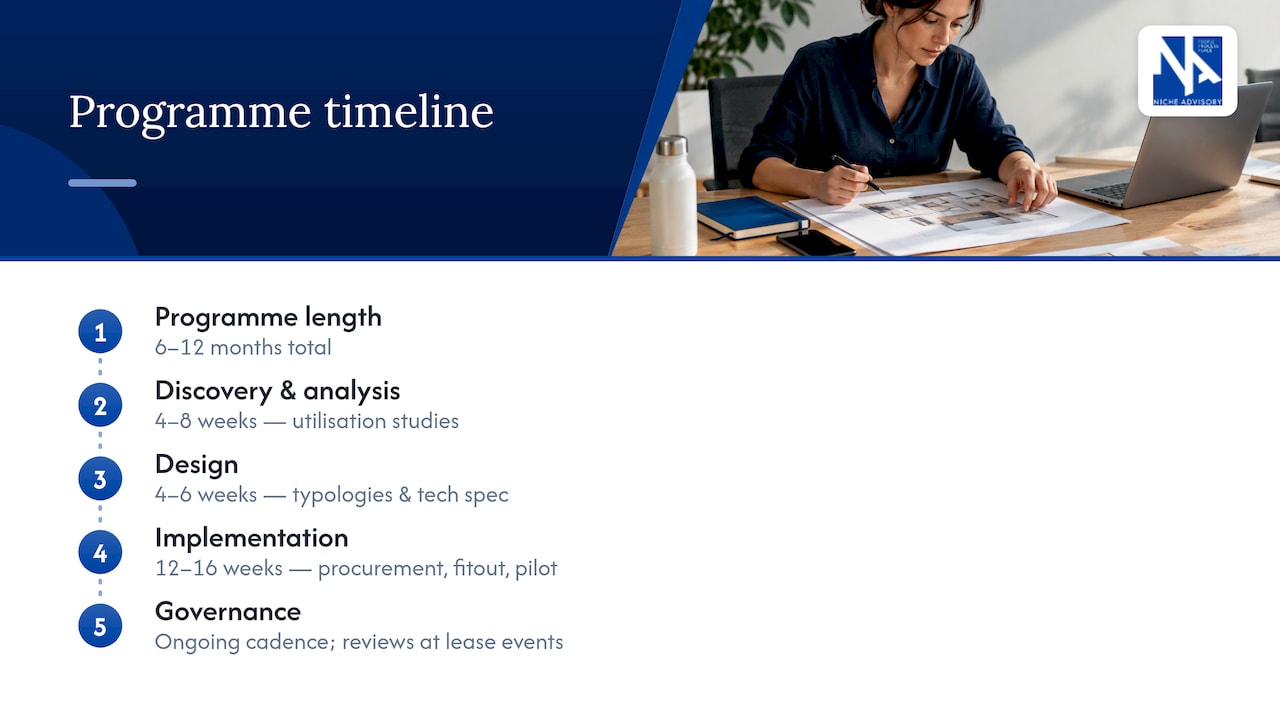
Design follows over four to six weeks, producing the space typologies, operating model and technology specification. Implementation, including procurement, fitout and a pilot, is the longest phase, often running twelve to sixteen weeks depending on whether a physical fitout is involved. Governance is not a phase that ends, it is the ongoing cadence that starts once the pilot is evaluated.
Tie major review gates to lease events rather than arbitrary dates: aligning a portfolio review with a lease expiry or break option avoids the common trap of finalising a workplace strategy just after a long lease has already been signed. A realistic roadmap also builds in a buffer, since stakeholder workshops and procurement timelines routinely run longer than first planned.
Making sure the strategy actually reflects your culture and goals
A workplace strategy that is not anchored to your organisation’s actual strategy and culture becomes an interior design exercise rather than a business lever. The discovery phase exists specifically to surface this: what is the business trying to achieve in the next two to three years, and how does the physical and policy environment need to support that.
A growth-focused organisation prioritising talent attraction will design differently to one focused on cost discipline ahead of a lease renewal. Culture matters just as much: a collaborative, in-person-heavy culture needs different space typologies and attendance expectations to a distributed, asynchronous one.
This alignment needs to be explicit in your governance charter, with the stated business outcomes revisited at each strategic review so the workplace strategy does not drift from what the organisation actually needs as priorities shift.
Auditing how your space is actually being used today
Before designing anything new, you need an honest picture of how current space gets used, not how it was intended to be used when it was fitted out five years ago. A proper audit combines quantitative and qualitative methods: badge or sensor data showing occupancy by floor and time of day, paired with direct observation and employee interviews about what the space supports well and where it falls short.
Run the utilisation study over at least two representative weeks, avoiding school holidays or unusually quiet periods that would skew the data. Map activities against space types: how much of the floor is used for focus work versus collaboration versus informal social interaction, and whether that matches how people say they actually work.
The audit should also surface underused assets, meeting rooms booked but rarely occupied, or desks assigned but empty most days, since these are often the easiest wins for a business case. This stage produces the baseline every later design decision gets measured against, so it is worth the extra week it takes to do properly rather than relying on a quick walk-through.
Making sure employees actually shape the strategy
A workplace strategy designed without employee input tends to solve problems leadership assumes exist rather than the ones people actually experience. Structured engagement, surveys, focus groups and workshops across different roles and locations, surfaces friction points that utilisation data alone cannot show, such as noise complaints or frustration with booking systems.
Engage a representative cross-section of the workforce, not just head office staff or the most vocal departments, since different roles often have very different space and flexibility needs. Share findings back with participants before finalising the design: this single step does more for adoption later than almost any communication campaign run after the fact.
Stakeholder engagement extends beyond employees to include IT, finance, facilities and WHS teams, each of whom holds constraints or requirements that need to be built into the design rather than discovered during implementation.
Who owns the strategy once it is live
A workplace strategy needs clear, named ownership once implementation is complete, otherwise it quietly reverts to whatever was in place before the programme started. A typical governance structure includes an executive sponsor accountable for outcomes, a working group spanning HR, IT, facilities and finance that meets on the agreed review cadence, and a decision-maker with authority to approve changes between formal reviews.
Define escalation paths for disputes, such as conflicting space requests between teams, before they arise, and set clear decision gates for when a pilot scales, pauses or gets redesigned. Document all of this in a governance charter so ownership survives staff turnover rather than depending on institutional memory.
Review the governance structure itself periodically. A model built for a single-site pilot often needs adjustment once a strategy scales across a multi-site portfolio, with roles and reporting lines that were workable at a small scale becoming a bottleneck at a larger one.
How we help you put this framework into practice
Running this framework well across discovery, analysis, design, implementation and governance takes time most internal teams do not have alongside their day jobs, and it benefits from an adviser who is not also trying to sell you a lease. Our recommendations are built around your outcomes rather than properties to fill.
- Workplace strategy engagements that cover discovery, utilisation analysis and design.
- Corporate tenant advocacy for lease negotiation once your space needs are clear.
- Project and construction management to carry a design through to delivery.
A typical first engagement runs as a discovery workshop followed by a utilisation study, giving you a baseline report and a design brief within weeks rather than months. If you are ready to start, get in touch about a workplace strategy engagement and we will scope the first phase around your timeline.
FAQ
What is a workplace strategy?
A workplace strategy is a structured plan that aligns your physical space, technology and people policies with your organisation’s business goals. It typically covers how space is used, how flexible work is managed, and how property decisions support both cost and performance targets.
What are the 7 C’s of strategic management?
The “7 C’s” is not a standardised or widely recognised framework in workplace or strategic management literature, and definitions vary depending on the source. Rather than relying on an unverified list, focus on the five-stage framework (discovery, analysis, design, implementation, governance) covered in this guide, which is grounded in practical workplace planning.
What are the 4 HR strategies?
Common HR strategy categories include workforce planning, talent acquisition, performance and development, and employee relations, though exact labels vary between organisations and consultancies. Within a workplace strategy, these connect most directly to flexible work policy design and manager capability building.
What are the 7 R’s of workforce planning?
As with the “7 C’s,” the “7 R’s of workforce planning” is not a single standardised framework, and different sources list different terms. For workplace strategy purposes, the more useful reference points are workforce segmentation, utilisation analysis and scenario modelling, each covered in the step-by-step process above.
How long does it take to implement a workplace strategy?
A full programme typically runs six to twelve months from discovery through to a governed, operating strategy, depending on portfolio size and whether a physical fitout is involved. Discovery and analysis alone can often be completed within four to eight weeks.
Sources
- Working arrangements, August 2025 | Australian Bureau of Statistics
- Flexibility in the workplace – Fair Work Ombudsman
- Good work design – Safe Work Australia
- State of the Service Report — Australian Public Service Commission (APS)
- Market rents moving higher across CBD office markets — Commo/market commentary