A NABERS office rating measures a building or tenancy’s real operational performance on a 1 to 6 star scale, used across Australia to benchmark efficiency, support disclosure through a Building Energy Efficiency Certificate, and access incentives such as NSW Energy Savings Certificates. Owners, managers and tenants use it to compare buildings, satisfy lease disclosure rules and find savings.
TL;DR:
- A NABERS rating relies on 12 months of actual operational data, making it a precise reflection of current building performance rather than design assumptions.
- Ratings cover energy, indoor environment, water, and waste, with energy and indoor environment being most relevant for cost savings and occupant wellbeing.
- A tenancy rating only assesses an occupied space, while a whole building rating combines landlord and tenant-controlled systems, influencing scope and data requirements.
- Certification involves a NABERS Accredited Assessor recording consumption, validating data, and lodging the rating, with costs split between a lodgement fee and assessor fee.
- Buildings of 1,000 square meters or larger must display a Building Energy Efficiency Certificate, which includes a NABERS energy star rating for marketing and disclosure.
Table of Contents
- What NABERS is and how the star rating works
- Office rating types: energy, indoor environment, water and waste
- Tenancy, base building and whole building explained
- How NABERS ratings are calculated and governed
- Preparing for a NABERS office rating: checklist, timeline and costs
- Regulatory and financial context in Australia
- Practical benefits: how owners, managers and tenants can use ratings
- How tenant advisers use NABERS outcomes
- How Niche Advisory supports NABERS preparation and follow-through
- FAQ
- Sources
What NABERS is and how the star rating works
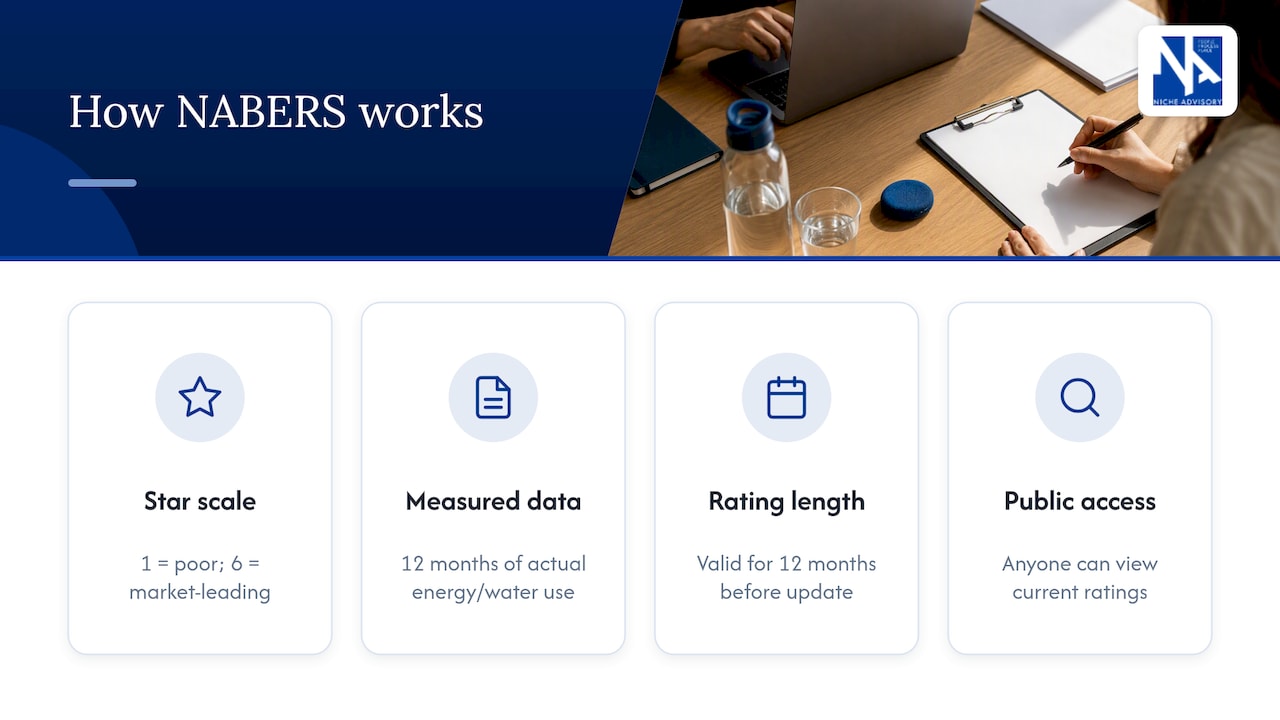
NABERS, the National Australian Built Environment Rating System, compares a building’s or tenancy’s actual operational performance against similar spaces, rather than its design specifications. A 1 star result signals poor performance against the benchmark, while 6 stars marks market-leading efficiency, and most well-managed Australian offices sit somewhere in the middle of that range.
The rating is built from 12 months of measured operational data, covering actual energy or water use, not modelled or theoretical estimates. That is what separates NABERS from design-stage green building tools: it reflects how a building actually runs once people are in it, with the heating, lifts, lighting and equipment switched on.
Because operations change, a NABERS rating is valid for twelve months before it needs updating. Anyone can find a current rating for a building before signing a lease or making a purchase decision, which makes it a useful due diligence step as much as a sustainability metric.
Office rating types: energy, indoor environment, water and waste
NABERS Energy is the rating most owners and tenants encounter first, and it can be assessed as a base building rating, a tenancy rating or a whole building rating depending on who controls the plant and metering. NABERS Indoor Environment looks at a different problem entirely: air quality, lighting quality, thermal comfort and acoustic quality, scored independently against benchmarks rather than bundled into the energy result. Water and waste ratings exist too, though offices use them less often than energy and indoor environment.
Each rating type serves a different objective:
- Energy ratings suit owners and tenants chasing cost reduction, disclosure compliance or ESC eligibility.
- Indoor Environment ratings suit organisations focused on occupant wellbeing, absenteeism or productivity, since they measure air quality, lighting, thermal comfort and acoustics directly.
- Water ratings suit buildings with high water costs or sustainability reporting commitments.
- Waste ratings suit owners managing waste contracts across a large portfolio.
A tenant negotiating a new lease typically prioritises energy and indoor environment, since both affect occupancy cost and staff experience. An owner preparing a building for sale usually needs the energy rating first, because that is the one tied to disclosure law.
Tenancy, base building and whole building explained
A tenancy rating covers only the space a business occupies: its lighting, equipment and the proportion of shared services it draws on. A base building rating covers the landlord-controlled plant, lifts and common areas. A whole building rating combines both into a single figure.
Tenancy ratings weigh area, occupancy hours and headcount, which is why accurate floor plans and rostering data matter as much as utility bills. Coordinating with the building manager pays off in practice:
- NABERS Co-assess lets a tenancy rating run alongside a base building rating, sharing data collection and assessor time.
- Tenant participation through Co-assess often reduces the tenant’s own administrative burden and cost, since much of the legwork is handled at building level.
- The most practical first step is simply asking the building manager whether a building-wide rating is already planned for the year.
How NABERS ratings are calculated and governed
NABERS ratings follow published rules, currently the Energy and Water for Offices Rules v5.2, which set out exactly how assessors measure, normalise and score a building’s data. Only a NABERS Accredited Assessor can lodge a rating, and NABERS runs its own audit and validation checks before certifying a result, which is what gives the star rating credibility with landlords, buyers and government agencies.
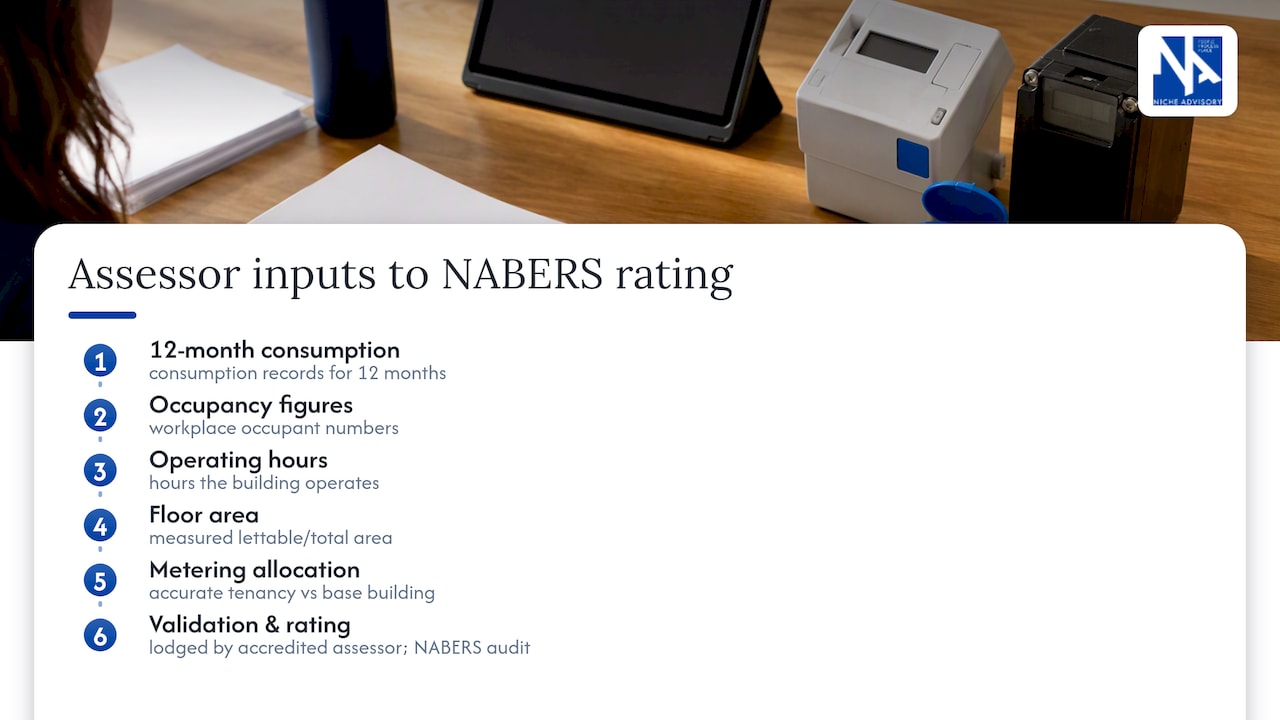
The inputs an assessor needs are straightforward but exacting: twelve months of consumption records, occupancy figures, operating hours, floor area and confirmation that metering is accurate and correctly allocated between tenancy and base building. Missing or inconsistent metering data is the most common reason a rating gets delayed.
Owners and tenants can check the current rules and the list of accredited assessors directly on the NABERS website before engaging anyone, which is worth doing given how often fee structures and rule versions are updated.
Preparing for a NABERS office rating: checklist, timeline and costs
A rating is a manageable project when it is sequenced properly.
- Scope and engage: decide whether you need a tenancy, base building or whole building rating, then request quotes from NABERS Accredited Assessors.
- Gather data: pull twelve months of utility bills, occupancy figures and operating hours, and confirm metering covers the right areas.
- Assess, lodge and certify: the assessor conducts a site visit, lodges the rating, and NABERS validates and issues the certificate.
Costs come in two parts: a lodgement fee paid to the NSW Government and a separate assessor fee set by the assessor you engage.
Pro Tip: Ask early whether your building already has a Co-assess arrangement in place, since joining an existing base building rating is usually faster and cheaper than lodging a standalone tenancy rating.
Regulatory and financial context in Australia
Most sellers, lessors and agents of office space of 1,000 square metres or larger must obtain a Building Energy Efficiency Certificate before advertising the property for sale or lease, under the Commercial Building Disclosure program. A BEEC includes a NABERS Energy star rating and a tenancy lighting assessment, and that star rating is what appears in listings and marketing material.
There is money on the other side of the ledger too. Under the NSW Energy Savings Scheme’s NABERS baseline method, a building that improves by 0.5 star or more can generate Energy Savings Certificates, with example income of $18,000 to $35,000 over three years for a 0.5 star improvement in an average NSW office. Official guidance sits on the Department of Industry, Science and Resources site and on NABERS’ own news pages.
Practical benefits: how owners, managers and tenants can use ratings
A NABERS rating is only useful once someone acts on it. Owners use the result to benchmark a building against its peers and prioritise capital works where the gap is widest, whether that is lighting upgrades or chiller replacement. A higher rating also carries weight in leasing and sale campaigns, particularly as sustainability credentials become a bigger factor in Sydney commercial property decisions.
For tenants, the rating informs fit-out and maintenance priorities, especially where indoor environment scores point to comfort problems affecting staff. Where an improvement clears the 0.5 star threshold, ESC income can partly offset the cost of the works that got it there. None of this requires guesswork: the rating itself tells you where the biggest gains sit.
How tenant advisers use NABERS outcomes
Tenant advisers use NABERS results as leverage in lease negotiations and make-good discussions, pointing to a poor indoor environment or energy score as grounds for landlord-funded upgrades or revised terms. Coordinating early with the building manager and assessor, rather than lodging a standalone tenancy rating, usually saves both time and fees.
Workplace strategy ties these outcomes back to the people using the space: a weak thermal comfort or air quality score often explains complaints that otherwise get put down to office design alone, and fixing it tends to show up in occupant satisfaction before it shows up on an energy bill.
How Niche Advisory supports NABERS preparation and follow-through
Some tenant advisory firms act exclusively for tenants and owner-occupiers, never landlords, which means the advice on what a NABERS result should trigger can stay independent of any landlord agenda.
- Corporate Tenant Advocacy for lease negotiations shaped by NABERS findings
- Workplace Strategy to turn indoor environment results into fit-out priorities
- Project & Construction Management to deliver the upgrades a rating identifies
FAQ
What is a good NABERS rating?
A good NABERS rating generally sits well ahead of an average building on the same benchmark. Buildings targeting ESC income or strong leasing appeal often aim for higher star ratings.
Is a NABERS rating mandatory?
A NABERS Energy rating becomes effectively mandatory when a seller, lessor or agent advertises office space of 1,000 square metres or larger for sale or lease, since a Building Energy Efficiency Certificate is required first. Outside that disclosure trigger, a rating is voluntary.
What is a NABERS energy rating?
A NABERS energy rating measures a building’s or tenancy’s actual energy consumption over 12 months and scores it from 1 to 6 stars against comparable buildings. It can be assessed as a base building, tenancy or whole building rating depending on who controls the plant and metering.
How long does a NABERS rating last?
A NABERS rating is valid for twelve months, since it reflects a specific 12-month period of measured operational data. Owners and tenants need to renew the assessment annually to keep an active, certified rating.
Sources
- Easy access to financial support using NABERS | NABERS
- Video: Commercial Building Disclosure Program explained | Department of Industry, Science and Resources