
A change champions network is a group of employees, spread across teams and floors, who help the formal change team carry a decision to the people it affects and bring their reactions back. In a workplace move, a lease exit, a fitout or a shift to hybrid work, it is the difference between a plan that is announced and a plan that is adopted. The network works best when it is designed alongside the property decision itself, not bolted on after the lease is signed. That is how we approach workplace change at Niche Advisory: strategy, tenant-side advice and delivery run as one program, so the people side is planned with the space.
TL;DR
- A change champions network is a group of respected employees who act as the bridge between leaders and staff, passing information down and feedback up.
- Champions persuade and model the change. Change agents are assigned to implement it. Executive sponsors authorise it. You need all three roles clear.
- Choose champions for trust and informal influence, not seniority or enthusiasm alone, and get their line managers on side before you ask for their time.
- Brief them early, meet them regularly, and measure the network against behaviours and business outcomes, not attendance.
- For property changes, start the network at the strategy stage, before the lease or fitout decisions are locked in.
Table of Contents
- What a change champions network is
- Why a network matters in a property change
- When to start: before the lease is signed
- How to choose your champions
- What you ask champions to do
- Briefing and supporting the network
- Measuring whether the network is working
- Common mistakes in workplace change networks
- Where we fit
- FAQ
- Sources
What a change champions network is
ProjectManager.com describes a change champion network as a group of employees who together bridge management and staff during a change: they spread information about the plan, explain the benefits, model new ways of working, take questions and feed staff sentiment back to management. It is typically used when the organisation or the change is too big for one champion.
For a tenant, that usually means a relocation to a new building, a consolidation of floors, an office or warehouse fitout, or a move to hybrid work that changes how much space you need and how it is used. Each of these changes how hundreds of people get to work, where they sit and how they collaborate. A lease decision made at executive level lands on people who were not in the room.
Champion, change agent and executive sponsor
The labels get mixed up, and muddled roles produce muddled expectations. A practical split:
| Role | Where they sit | What they do |
|---|---|---|
| Executive sponsor | Senior leadership | Authorises the change, states the vision, signals public support |
| Change agent | Often mid to upper level | Is assigned responsibility for implementing parts of the change |
| Change champion | Inside teams, any level | Believes in the change, explains it to peers, surfaces resistance, models new behaviour |
ProjectManager.com notes that champions typically lack the authority to make the change happen, whereas agents are assigned implementation work. That is not a weakness. It is the reason peers trust them: they are colleagues, not management messengers. Do not ask champions to enforce, and do not ask them to fix problems that belong to the project team.
Why a network matters in a property change
Employees need to hear about significant change from two places. They need someone senior to explain why it matters, and someone close to them to put it in the context of their own day. A champions network supplies the second voice at scale.
The gap it fills is large in Australia. In a 2025 survey of Australian employees by Staffbase and YouGov, only 18% felt well informed about the reasons behind recent company changes, while 41% felt not really or not at all informed. Among those who felt well informed, 92% were satisfied with their job, against 39% of those who felt not at all informed. The same study found 24% of employees often or almost always feel left out of important change information.
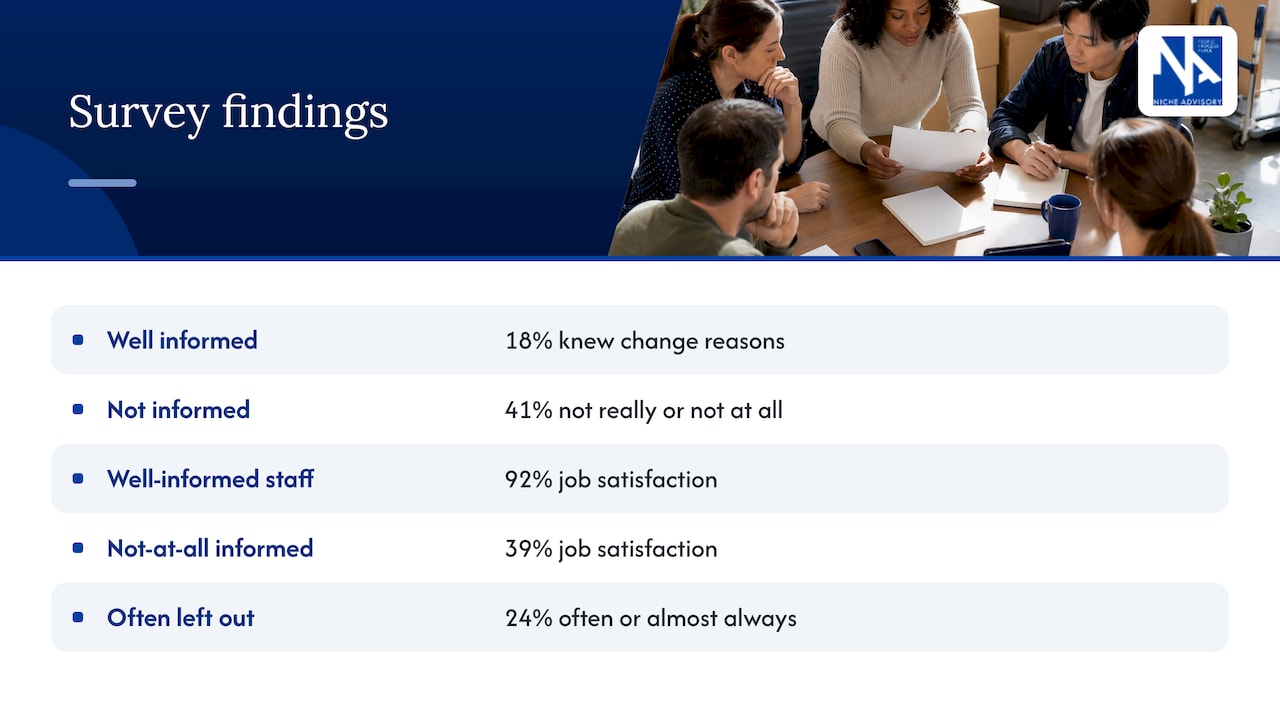
A workplace move is exactly the kind of change where those numbers bite. People hear about a new address, a smaller floorplate or a desk-sharing model through the grapevine long before a formal announcement, and fill the silence with worst cases. Champions shorten that silence.
A network also gives you an early warning system. The UN System Staff College’s 2020 study of five change agent networks found that networks act as two-way intermediaries, distributing leadership messages and gathering feedback from staff who would not otherwise speak up. For a move, that feedback is concrete: commute concerns, parking, noise, storage, where a team’s work really happens.
When to start: before the lease is signed
Most organisations convene champions when the move is announced. By then the main trade-offs, such as location, floor area, layout and the hybrid model, are fixed. Champions can only explain decisions, not shape them.
The better sequence runs the network in step with the property program:
- Strategy stage. A small group of champions tests assumptions about how teams work, how often they attend and what they need from space. This is where workplace strategy and a change impact assessment tell you which teams will feel the change most.
- Search and negotiation. Champions are briefed on criteria and timing, so leaders can say something true when staff ask where the business is heading.
- Design and fitout. Champions review layouts and settings with their teams, so the design reflects real work patterns.
- Pre-move and move. The network carries practical information: dates, transport, new ways of booking space.
- Settling in. Champions model new behaviours and report what is not working while it can still be fixed.
We plan the people side this way because our service runs from workplace strategy through to project and construction management. Champions then have something real to talk about at every stage. Our guide to workplace change management covers how this protects the budget, and the relocation communication plan sets out who to tell, when and how.
How to choose your champions
Pick for trust, not title
The common mistake is to nominate high performers or the most enthusiastic people. PwC Strategy&’s Australian Global Culture Survey report warns against treating change champions or high-potential employees as authentic informal leaders. Genuine informal leaders understand how work really gets done and can anticipate whether an initiative will be embraced or resisted. The report describes three types: exemplars, networkers and pride builders.
The same report found a perception gap: 59% of leaders believed how people act is consistent with the stated culture, against only 26% of employees. That is the gap your champions will see first, and why picking people your peers actually listen to matters.
Find them with more than a nomination form
PwC Strategy& recommends identifying informal leaders through social network analysis, interviews, focus groups and employee pulse surveys. For most mid-sized tenants, a simpler version works: ask staff, in a short survey, who they go to when they want to know what is really happening, and look at who comes up in more than one team.
A workable mix of selection criteria:
- Credibility with peers, whatever their level.
- Reach across the footprint: every floor, site, shift and function, including warehouse and field teams if they are affected.
- Good communication skills and the willingness to give honest feedback.
- Experience of previous changes in the business.
- Spare capacity, agreed with their manager.
Combine nomination with volunteers
A Cranfield University guide to building champion networks cautions that a top-down cascade can lose credibility if the change message does not reflect the organisation’s real culture, and suggests that volunteers can complement nominations. In practice: have leaders nominate, open the door to volunteers, then check the combined list for gaps in sites, age groups, tenure and functions.
How big should it be?
There is no fixed ratio in the research. Size the network so that every employee has a champion in their own team or within easy reach. A single-floor business may need five or six. A multi-site business with a warehouse and head office will need champions embedded in each location.
What you ask champions to do
Write the role down. A short, specific description prevents it expanding into an unpaid second job. Core responsibilities tend to be:
- Translate leadership messages into what they mean for their team.
- Listen and log questions and concerns, then pass them to the project team.
- Model the new behaviour, such as booking desks or using new collaboration areas.
- Flag resistance and confusion early.
- Report honestly on how the change is landing.
Two-way communication is the thread through all of these. The principle is the same in any property setting, as this piece on communication in property management shows: people who feel heard are easier to work with, and problems surface sooner.
Champions are not spokespeople for decisions they had no part in. Give them answers to the hard questions in advance, and a clear route for questions you cannot yet answer. “We don’t know yet, and here is when we will” is a legitimate message when it is true.
Get line managers on side first
The UN System Staff College study found that all change agents need line manager support to be effective. It recommends speaking to managers as a group from the start, being specific about the time commitment, involving them in choosing and releasing staff, and addressing worries such as workload or feeling caught in the middle. During a move, when teams are already stretched with packing and handover, this is where networks stall.
A reasonable starting commitment is a regular, short meeting plus a small amount of time in the week for conversations with peers, agreed with each manager in writing.
Briefing and supporting the network
Champions are only as useful as the information they hold. Build a simple rhythm:
- Kick-off briefing. The executive sponsor explains the why, and the project team explains the what and the timeline.
- Standing check-in. A short regular meeting, with a fixed agenda: what you are hearing, what is coming, what to say.
- Ready-to-use material. FAQs, one-page summaries and floorplans, so champions are not improvising.
- A feedback loop that visibly closes. When a champion raises an issue, tell them what happened. Nothing kills a network faster than feedback that vanishes.
- Lessons-learned session. After the change, review both the project and how well the network worked.
The Staffbase study found email or memos from management, immediate supervisors and the intranet were the top three channels for change communication in Australia. Champions work alongside those channels, not instead of them: the formal message lands by email, and the champion helps it make sense in a team huddle.
If the network starts to lose energy, look at the cause before the people. Usual culprits are unclear role boundaries, no manager backing and no sign that feedback changes anything. The UN study found that demonstrable evidence of impact is what sustains senior sponsorship, and sponsorship is what sustains the network. Show leaders what champions have surfaced and what changed because of it.
Measuring whether the network is working
Attendance at champion meetings tells you little. Agree what success looks like at the start, and revisit it. The UN study notes there is no single agreed method for measuring network impact and lists measures used across the entities it studied, from staff feeling they have a voice to improvements in communication and uptake of new working arrangements. It stresses agreeing and revisiting measures with senior sponsors and network members.
The NSW Public Sector Commission’s guidelines for employee networks suggest success measures should be realistic, verifiable through employee feedback and data, and aligned to organisational priorities, for example through surveys. PwC Strategy& recommends measuring across progress, behavioural indicators and business outcomes and reviewing how they relate: if behaviours shift but outcomes do not, revisit the behaviours.
For a workplace change, a practical scorecard might include:
| Area | Example measure |
|---|---|
| Awareness | Share of staff who can explain why the move is happening, from a short pulse survey |
| Readiness | Questions logged by champions and the share resolved before move day |
| Behaviour | Desk-booking or collaboration-space use against what the design assumed |
| Business outcome | Space utilisation, and the occupancy cost per person against the plan |
Pilot with one or two teams first. It tests your messages and builds the credibility the wider rollout will need.
Common mistakes in workplace change networks
- Starting too late, after decisions are locked and champions can only defend them.
- Treating champions as a broadcast channel. If information flows only down, you have a distribution list, not a network.
- Leaving out operational sites. Warehouse, depot and shift workers are often the last to hear about changes that affect them most.
- Overloading the best people. Champions who carry the change on top of a full job burn out. Agree time with managers.
- No exit. Say how long the network runs and when it stands down.
Where we fit
A champions network needs something solid to carry: a clear business case for the space, a lease and fitout program that matches how people work, and a delivery team that keeps its commitments. We act exclusively for tenants and owner-occupiers, never landlords, and we integrate workplace strategy with execution across corporate real estate. For leaders weighing a move, a renewal or a hybrid redesign, that means the network is planned together with the workplace strategy, the tenant advocacy and the project and construction management, not run as a separate exercise. To talk through a specific move, start at Niche Advisory.
For companies from the UK, the US or Singapore setting up in Australia, the same principle applies: bring your local champions in during the strategy stage, so the space reflects how your Australian team works.
FAQ
What is the difference between a change champion and a change agent?
A champion believes in the change, promotes it among peers and gives feedback, but generally has no authority to make it happen. A change agent is assigned responsibility for implementing parts of the change and is judged on delivery. Many organisations use the terms loosely, so define each role in writing.
How many change champions do we need for an office move?
There is no fixed number. Aim for at least one champion in or near every team, and make sure each site, floor and shift is covered. A small single-site business may need only a handful, while a multi-site business needs champions in each location.
Should champions be volunteers or nominated?
Use both. Nomination lets leaders fill gaps and pick credible people, while volunteers bring genuine motivation. Check the final group against who staff actually trust, not just who is senior or keen.
How long should the network run?
From the strategy stage until staff have settled into the new way of working, then a lessons-learned review. Stand it down formally so champions know their commitment has an end.
Sources
- Change Champion: Key Roles & Responsibilities, ProjectManager.com
- 2025 Employee Communication Impact Study, Australia, Staffbase and YouGov
- Change Agent Networks in the UN System, UN System Staff College
- Global Culture Survey, Australia, PwC Strategy&
- Corporate Responsibility Champions Network: A How to Guide, Cranfield University
- PSC Guidelines for Employee Networks, NSW Public Sector Commission