Lease due diligence is the work a tenant does before signing a commercial lease to confirm what the premises are, what the lease commits the business to, and what the space will cost over the whole term. In Australia it should start before the heads of agreement is signed, and it works best when someone who acts only for tenants reads the lease against your business plan, not just against the law. That is how we approach it at Niche Advisory: we act exclusively for tenants and owner-occupiers, never landlords, so the advice you get is independent of whoever owns the building.
TL;DR
- Start before you sign the heads of agreement. Once it is signed, the landlord’s solicitor drafts the lease on those terms and pushing back is treated as renegotiation.
- Review every document, not only the lease: the offer, agent emails, disclosure statement, incentive deed, fit-out licence and any guarantee.
- Inspect the premises, record their condition and confirm zoning with the council. Landlords generally give no warranty that a building suits your purpose.
- Model total occupancy cost across the full term, including outgoings, rent reviews, fit-out and make-good.
- Settle defects and risky clauses as conditions of the lease before you commit, not after you move in.
Table of Contents
- What lease due diligence covers, and when to start
- Gather every document, not just the lease
- Inspect and verify the property
- Read the clauses that carry the cost
- Work out the real occupancy cost
- Red flags that call for negotiation
- State rules that shape the process
- If due diligence turns up a problem
- How we run lease due diligence for tenants
- FAQ
- Sources
What lease due diligence covers, and when to start
Due diligence is a structured check across four questions: is the property fit for what you need, who is the landlord and what can they actually grant, what does the lease oblige you to do, and what will it cost. A Legal 500 lease review checklist groups the work into eight areas: parties and premises, legal framework, occupancy costs, use and fit-out, repair and make-good, guarantees and indemnities, renewal and exit, and default and disruption.
Timing matters more than most tenants expect. The heads of agreement (a short document recording the agreed commercial terms before the formal lease is drafted) is where the deal is really made. Thornton King notes that the most common tenant mistake is engaging a lawyer only after the heads of agreement is signed, by which point the lease is drafted to match it. Ask your solicitor, before you sign anything, whether preliminary documents are binding, whether any deposit is refundable and whether legal review is a condition of proceeding.
The due diligence period is usually a negotiated window written into the heads of agreement. The Lease Lawyers guide to commercial leasing says this window gives your trades access to inspect the premises, and that planning should cover fit-out, building applications, fire safety requirements, reports and permits. Build that time in. A two-week window is rarely enough to commission a building report, get quotes and model the numbers.
Gather every document, not just the lease
Tenants often review only the formal lease. The promises that matter are frequently elsewhere. Legal 500 recommends sending your adviser the offer, heads of agreement, agent’s emails, draft lease, disclosure statement, incentive deed, fit-out licence, any guarantee and any incorporated rules.
The reason is conflict between documents. Legal 500 gives a clear example: a six-month rent concession promised in an email is of little comfort if the executed incentive deed makes it repayable on a broadly defined default. Check which document prevails when they disagree, and whether the incentive survives an assignment or an option term.
A checklist is only as good as the follow-up. Every unanswered question, such as a missing outgoings budget or an unsigned condition report, needs an owner and a date.
Inspect and verify the property
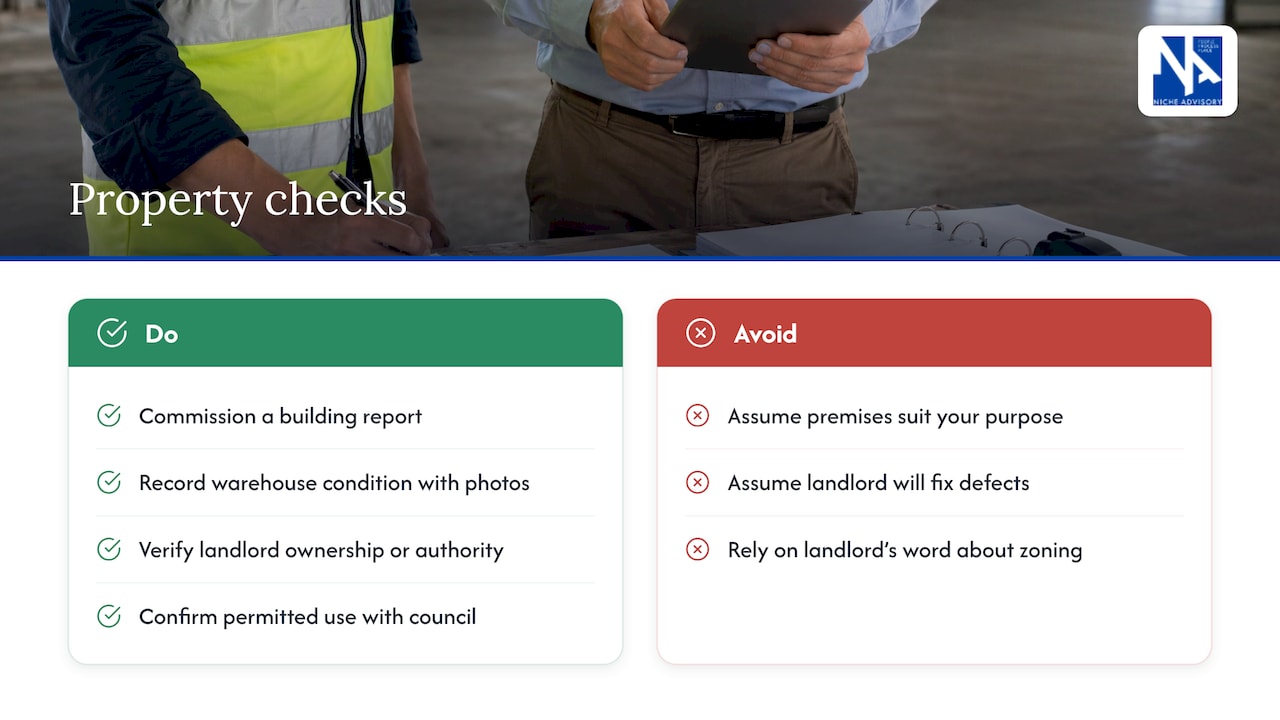
The law gives office and warehouse tenants less protection than many expect. The Western Australian Small Business Development Corporation’s leasing guide states that there is generally no landlord warranty that premises are fit for your purpose, and no obligation to fix the building unless the lease says so. Once you sign, you pay rent and outgoings regardless of suitability.
So the inspection is where you protect yourself.
Physical condition. Have a building surveyor or builder report on structure, roof, services and plant such as air-conditioning and fire sprinklers. The same guide advises making landlord remediation a condition of the lease. For a warehouse, record roller doors, lighting, loading areas, floor slab and any racking or equipment that is supposedly included. Sprintlaw’s warehouse leasing article recommends a condition report with photos at commencement so that later arguments about fair wear and tear versus damage can be resolved on evidence.
Power, services and fire safety. Confirm electrical capacity, data access, lifts and fire systems against your own load and headcount, not the building average. If you will occupy a site with industrial history, also read our guide to environmental due diligence for leased premises. For warehouses, our piece on industrial lease negotiation and site risk covers what to test before you commit.
Landlord authority. Rasak Legal’s checklist says to verify that the landlord owns the property or has authority to lease it, and notes a sublease cannot give you greater rights than the head tenant holds. Victorian guidance also asks whether the landlord’s mortgagee has approved the lease, because otherwise the lender may not be bound by it.
Zoning and approvals. Do not take the landlord’s word that your use is permitted. The Queensland Small Business Commissioner explains that every council has different planning laws and each building has specific permitted uses, and that a tenant is usually responsible for having council approval before operating. The South Australian commission’s guide adds a call to the council about development plans and health or environmental requirements, and a signed condition report covering utilities and metering.
Read the clauses that carry the cost
Baystone Legal’s tenant page lists the headings that matter: rent and reviews, outgoings, term and options, permitted use, fit-out and make-good, assignment and subletting, guarantees and security. Here is where each one tends to bite.
Term and liability. Commercial leases are usually three to five years, and Business Tasmania points out that you remain legally responsible for rent for the whole term even if the business fails. For a longer commitment, the accounting treatment also matters. We explain how to match lease term to fit-out payback under AASB 16.
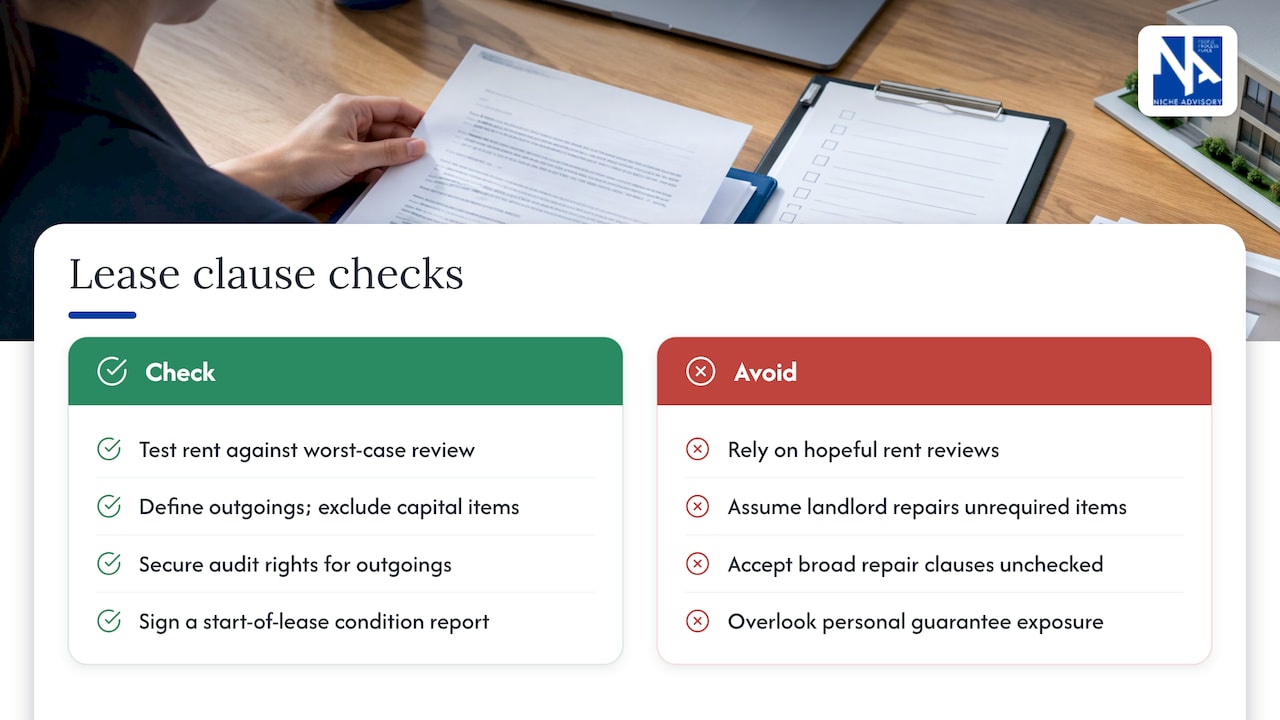
Rent reviews. Fixed, CPI and market reviews have very different long-term profiles. Blackstone Commercial Lawyers notes that market reviews in particular carry more uncertainty. Test the rent against a worst-case review, not the hopeful one.
Outgoings. These are the operating costs a landlord passes on, and they swing depending on how they are estimated and reconciled. In the ACT, the Leases (Commercial and Retail) Act 2001 requires written estimates before each accounting period and an auditor’s report after it. Elsewhere you rely on what the lease says, so look for a defined list, no capital items and audit rights. See our guide on stopping outgoings adding 20 to 50 per cent to rent.
Repair obligations. The South Australian guide warns that a repair obligation not being yours does not make it the landlord’s: assume the landlord will do nothing the lease does not require. Rasak Legal adds that a broad good-repair clause can leave a tenant carrying pre-existing defects or major capital replacements. A signed condition report at the start is your defence.
Make-good. This means returning the premises to their original condition at lease end, which Business Tasmania says may include painting, carpet cleaning, damage repair and ensuring fixtures work. It is a real cost that arrives when you are leaving. Our pages on Sydney makegood obligations and negotiations show how it is usually dealt with.
Guarantees and security. Check personal guarantee exposure and who holds the bond. The Queensland factsheet lists both among its key pre-lease questions.
Retail or commercial? Which rules protect you depends on the classification. Most office and warehouse leases are commercial, with fewer statutory protections, but borderline uses exist. Our four checks for retail versus commercial leases help you work out which side you are on.
Work out the real occupancy cost
Headline rent is a fraction of what you will pay. Catton Roderick’s Queensland checklist tells tenants to add base rent, outgoings, GST, insurance, energy, fit-out, end-of-lease make-good, bank guarantee and legal costs, then project each year including after each review. Its example: $30,000 a year rising 4% fixed reaches about $35,100 in year five, roughly $162,500 in base rent over five years, before outgoings and GST.
The WA guide suggests a total occupancy cost table over at least five years, benchmarking commencing rent plus outgoings per square metre, and checking whether fit-out can be spread across the term.
A simple cash test also helps. Fair Lane Finance’s checklist says to test delayed opening, cost overruns and weaker revenue, and to find the lowest cash point rather than relying on an annual forecast. For a business moving offices, add the one-off costs: design, permits, cabling, relocation, dual-running of two premises and reinstatement.
If your portfolio spans several leases, the same logic scales. Our lease audit process walks through reviewing existing leases for dates, options and exposure.
Red flags that call for negotiation
Prosper Law’s red flags article lists the usual suspects:
- ratchet-only rent reviews that can rise but never fall
- uncapped CPI increases or hybrid review methods
- make-good clauses with wide good-repair wording and no cap or time limit
- undefined outgoings that pass on capital costs, with admin fee mark-ups and no audit rights
- short relocation notice with no similar premises or reimbursement
- personal guarantees, and absolute landlord discretion over assignment
We cover a longer set in 12 commercial lease clauses to check before you sign. The Sydney market has its own patterns, set out in common risk factors for Sydney tenants.
The WA negotiation guide offers a useful discipline: sort each concern into unacceptable, negotiable or desirable before you talk to the landlord. Know your walk-away points. The same guide says that if you remain uneasy after negotiating, it may be sensible to say no.
Incentives are part of this negotiation too. Rent-free periods and fit-out contributions are worth more when tied to the right term and documented in the incentive deed, which is why we set out nine steps for landlord incentive negotiation.
State rules that shape the process
Leasing law is state and territory law, so check yours. A few points from official and legal sources:
- Queensland. For retail shop leases, the lessor must give a prospective lessee a draft lease and disclosure statement at least seven days before the lease is entered into, and a lessee who is not a major lessee must give the lessor financial and legal advice reports, under the Retail Shop Leases Act 1994. Clayton Utz reports that the Property Law Act 2023 commenced on 1 August 2025, implying standard terms in commercial leases unless excluded, in its retail leases comparative analysis.
- South Australia. The same analysis reports that the prescribed rental threshold for exclusion from the retail leases Act rose to $420,000 ex GST from 1 July 2025.
- Victoria and Western Australia. Retail landlords must provide a disclosure statement and related documents under their state Acts, and the WA guide says not to sign until you have received everything in full and considered it with legal and financial advice.
- ACT. Discretionary rent review clauses are void, and each review date must be stated in the lease.
Office and warehouse tenants outside these retail regimes lean harder on the lease itself. Our explainer on the new code for commercial leases covers how the code sits alongside them. For anything binding, a solicitor in your state is the person to confirm the position. Queensland’s official guidance, for example, treats independent legal and financial advice as part of the process.
If you are a UK, US or Singapore company entering Australia, expect lease structures, outgoings and make-good to differ from home. Australian leases commonly pass operating costs to the tenant and expect reinstatement at the end, so build those into your budget from the first offer.
If due diligence turns up a problem
A defect or a bad clause is not a reason to panic. It is leverage, provided you find it before you sign. The WA guide says that if the building is in an unacceptable condition, ask the landlord to remedy the defects as a condition of the lease before you enter into it, and calculate whether repairs and alterations make the lease unfeasible.
In practice:
- Put the issue in writing with the report or photos that support it.
- Decide whether it is a price issue, a works issue or a clause issue.
- Ask for the fix in the lease or heads of agreement: landlord’s works, a rent abatement, a capped make-good, an amended repair clause.
- Keep alternatives open. A landlord negotiates differently when you have another building on your shortlist.
- If the answer is no and the exposure is material, walk away.
A digital signing process can speed up execution once terms are agreed, and you can read how digital lease signing in Australia works. Speed at the end should never shorten the diligence at the start.
How we run lease due diligence for tenants
We act exclusively for tenants and owner-occupiers, never landlords, and our advice is fully independent. Because we combine workplace strategy with execution, the lease is tested against how your business will actually use the space, from headcount and hybrid patterns to fit-out. Our services cover corporate tenant advocacy, property search and lease negotiation, project and construction management, make-good negotiation and dispute resolution between tenants and landlords. We have been applying this approach across sectors for over 12 years. If you are weighing a lease now, talk to our corporate real estate team before the heads of agreement is signed.
FAQ
When should lease due diligence start?
Before you sign the heads of agreement, and ideally before you pay any non-refundable amount. After signing, the lease is drafted to match the agreed terms and changes are treated as renegotiation. Allow enough time for legal, financial and technical review.
Do I need a building report for an office or warehouse?
It is strongly advisable. Landlords generally give no warranty that premises suit your purpose and are not obliged to repair unless the lease says so, according to the WA Small Business Development Corporation. A report on structure and plant gives you something specific to negotiate with.
What documents should I review besides the lease?
The offer, heads of agreement, agent’s emails, disclosure statement, incentive deed, fit-out licence, any guarantee and incorporated rules. Check that promises made in emails match what the signed documents say.
What costs do tenants most often miss?
Outgoings, GST, make-good at lease end, fit-out, bank guarantee, legal fees and the effect of rent reviews across the term. Project each year of the lease rather than relying on the starting rent.
Sources
- Commercial Lease Review Checklist, Legal 500
- Negotiating commercial terms before you sign, Thornton King
- Guide to Commercial Leasing, Lease Lawyers
- Leasing business premises guide, WA Small Business Development Corporation
- Warehouse leasing legal considerations, Sprintlaw
- Commercial Lease Due Diligence Checklist, Rasak Legal
- Understand lease agreements, Business Victoria
- Tips when entering a commercial lease, Queensland Small Business Commissioner
- Retail and commercial leases guide, Small Business Commission SA
- Commercial Lease Advice for Tenants, Baystone Legal
- Commercial leases, Business Tasmania
- What to check before signing a commercial lease, Blackstone Commercial Lawyers
- Leases (Commercial and Retail) Act 2001, ACT Legislation Register
- Commercial Lease Laws QLD, Catton Roderick
- Commercial Lease Due Diligence Checklist, Fair Lane Finance
- Red Flags to Look For in Commercial Leases, Prosper Law
- Retail Shop Leases Act 1994, Queensland Legislation
- Retail Leases Comparative Analysis, Clayton Utz
- Digital Lease Signing in Australia