A building rules induction is the briefing every person on an Australian fitout site must complete before work starts: the building’s own rules, hazards and emergency procedures, plus the permits for any higher-risk task. As a tenant, you carry the programme risk if it is missed, so the induction, permit and approval steps belong in your fitout plan from day one. Because we act only for tenants and owner-occupiers, never landlords, we plan these steps from your side of the lease.
TL;DR
- Anyone entering an active construction zone, including visitors and subcontractors, should receive a workplace-specific induction before work starts, according to Safe Work Australia.
- Landlords usually add their own online and onsite inductions, licences, insurances, safe work method statements and a security bond to the generic safety requirements.
- Higher-risk tasks such as hot works, fire system shutdowns, roof access and work at heights typically need a permit to work approved before the task begins.
- Allocate responsibility for approvals, fees and certificates in the building contract, and request the landlord’s fitout guidelines before design is finished.
- In Sydney, the building owner, the certifier and the City of Sydney (for public space works) can each affect your timeline.
Table of Contents
- What a building rules induction is
- Who needs to complete one
- What the induction covers
- What landlords add in an office tower or centre
- Permits to work
- Approvals before you start
- Fitout approvals in Sydney
- A practical sequence for tenants
- Where we fit
- FAQ
- Sources
What a building rules induction is
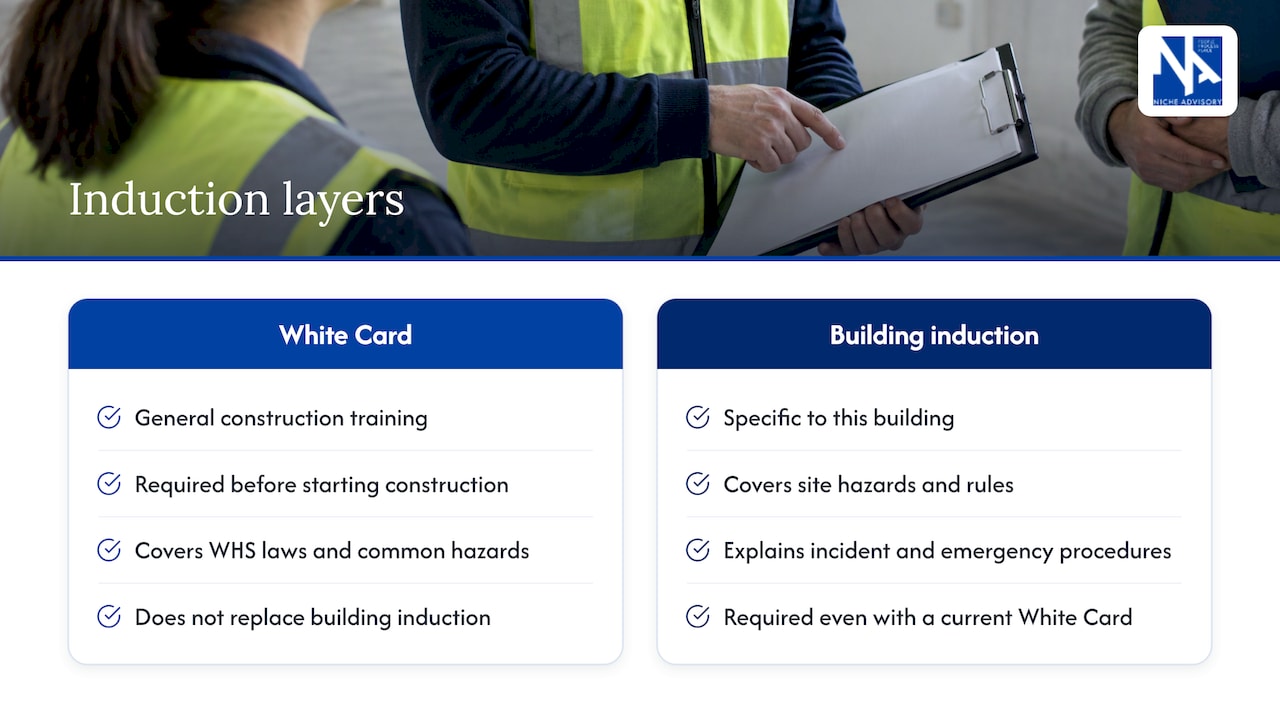
There are two layers, and tenants often confuse them.
The first is general construction induction training, which leads to the White Card. Safe Work Australia explains that anyone carrying out construction work must complete it. SafeWork NSW’s construction work code of practice says this training covers basic knowledge of construction work, the WHS laws that apply, common hazards and how the risks are controlled, and that workers must complete it before starting.
The second is the workplace-specific induction, often called the site or building induction. It tells people about the hazards at this particular building, how risks are controlled, site rules such as PPE, how to report incidents and what to do in an emergency. This is the one building managers mean when they refer to “building rules”.
The White Card does not replace the second layer. A tradesperson with a current White Card still needs the building’s induction.
Who needs to complete one
Safe Work Australia says workers and other people at the workplace, including visitors, should be inducted before work starts or before they enter an operational construction zone. For a tenant this typically means:
- your head contractor and its site supervisor
- every subcontractor, including electricians, cabling crews, mechanical and fire trades
- consultants who attend site, such as your project manager, designer and certifier
- your own staff if they visit during works
In Queensland, WorkSafe Queensland states that a person must have a site-specific induction before starting construction work (other than housing construction). The principal contractor must make each person aware of the WHS management plan and site rules, and should keep a record of who was inducted and when. Other states apply their own WHS regimes, so confirm the requirement with your contractor for your jurisdiction.
What the induction covers
Safe Work Australia recommends covering workplace-specific hazards and controls, site rules, safety documents and plans, incident-reporting contacts, emergency and evacuation procedures, and the workplace layout. Delivery can be on-the-job, toolbox talks, videos, booklets, web-based programs or classroom sessions. Where possible, keep a record of names, content, trainer and date, and get an acknowledgement from each participant.
Detail scales with the job. WorkSafe Victoria’s construction handbook notes that it varies with site size, the number and variety of trades, and how much the site changes as work progresses. It also says that where several employers are present, the one controlling the site must give contractors enough information to meet their own induction obligations.
For a fitout inside a multi-tenant tower, that controlling party is usually the building owner’s management team. That is why you will often face two inductions: the building’s and your contractor’s.
What landlords add in an office tower or centre
Landlord fitout guidelines sit on top of the legal minimum. As one published example, the Pacific Werribee and Craigieburn fitout guidelines require the tenant to complete the landlord’s online and onsite inductions, provide licences, company insurances and site-specific Safe Work Method Statements, and lodge a security bond before works start. The tenant’s contractor inducts its own subcontractors, while the landlord’s team manages contractor inductions and authorises site-specific permits.
Office buildings follow a similar pattern even though the wording differs. The practical consequences:
- Lead time. Insurance certificates, licences and SWMS must be lodged and accepted before the first trade steps on site. A missing document can hold up a start date.
- Cost. Bonds and building management attendance are real line items. Our office fitout cost benchmarks show how to budget for them.
- Lease terms. The lease usually obliges you to follow the building’s rules. Read the fitout clauses before you sign, not after.
Permits to work
A permit to work is a written authorisation for a specific high-risk task, issued before it starts. The building controls the process because these tasks can affect other occupants and base building systems.
The University of Sydney’s contractor handbook (October 2025) is a useful illustration of the typical list. It requires a permit before commencement for asbestos removal, confined spaces, dust works, electrical shutdowns, excavation deeper than 150mm, fire systems interruption, hot works, lifting, gas isolation, roof access, traffic and pedestrian management, and work at heights with a fall risk over 2m. No work starts until the permit is approved. It is a university’s rulebook rather than a commercial tower’s, but the task categories are the ones office buildings commonly control.
For an office fitout, the tasks that most often need a permit are:
- Fire system isolations when sprinklers or detectors are moved for new ceilings or partitions.
- Hot works, such as welding or cutting.
- Work in ceiling and riser spaces that touches base building services.
- After-hours noisy or dusty works that affect neighbours.
- Lift, loading dock and hoist bookings.
Build the permit lead time into the programme and ask the building manager how many business days’ notice they need. Fire isolations in particular are often scheduled weeks ahead.
Approvals before you start
Inductions and permits manage the site. Approvals decide whether you may build at all. Typically they cover:
- Landlord consent to your design, finishes and services changes.
- Building approval or certification, usually needed for structural changes, new or altered walls and partitions, ceilings, and upgraded amenities, as one Australian builder explains.
- Licensed trade certificates for electrical, plumbing, fire and mechanical work, which licensed professionals issue on completion.
- Final inspection and occupancy sign-off before you move in.
The Queensland Government’s fitout guideline lists the same stack for its own agencies: building-owner approval for every fitout, whether in owned or leased space, plus Building Act approval, with the designer responsible for the legislative compliance of the design. The names of the bodies differ by state, but the sequence does not.
Who is responsible for what
Do not assume. A published guide to fitout scope clauses (August 2026) advises that the contract should say who prepares approval drawings, who deals with the landlord or building manager, who pays authority fees, who obtains certificates and who arranges inspections. It also lists the building rules and site-induction requirements among the usual contract documents, so they are binding on your builder.
This is where an independent, tenant-side project manager earns the fee. Our client-side project manager guide sets out the role, and our piece on construction contract types explains how the contract allocates these risks.
Fitout approvals in Sydney
Sydney adds a few local layers.
- The building owner sets the induction, permit and after-hours rules for the tower.
- The certifier assesses the work against the Building Code and issues the required certificates.
- The City of Sydney grants approvals for works in public spaces, including hoisting over public roads, temporary works and road openings. Its code of practice also covers induction services for construction employees and contractors, and work outside approved consent hours is considered only in exceptional circumstances.
- Fire safety obligations have been changing. The NSW Government’s building fire safety reforms page says that from 13 February 2026 building owners must maintain essential fire safety measures to AS 1851-2012 and use the standard NSW fire safety schedule template. Certification of newly installed measures by accredited practitioners was deferred to 13 February 2029. Check that page for the current position before you finalise your fire services scope.
If you are relocating to Sydney from overseas, expect these steps to be less familiar than the equivalents in the UK, the US or Singapore. Our Sydney tenant advisory page explains how we support tenants there.
A practical sequence for tenants
- Request the landlord’s fitout guidelines during lease negotiation. Rules about inductions, bonds, working hours and permits affect cost and programme, so they are best known before you commit.
- Confirm approvals in the contract. Name who lodges, who pays and who holds each certificate.
- Submit contractor documents early. Licences, insurances, SWMS and subcontractor lists take the longest to clear.
- Book inductions for every trade. Make the head contractor responsible for inducting its subcontractors and for keeping the records.
- Schedule permit-to-work tasks into the programme. Fire isolations, hot works and after-hours works need dates agreed with building management.
- Keep a document trail. Induction records, permits and certificates are the evidence you need at practical completion and, later, at make-good. Our guide to construction document control shows where to start.
Where we fit
We act exclusively for tenants and owner-occupiers, never landlords, and our project and construction management service covers fitout delivery from the tenant’s side. If you want the building rules, approvals and programme managed alongside the lease negotiation and design, talk to us through our corporate tenant advocacy service.
FAQ
What does a site induction mean on a fitout?
It is a briefing on the hazards, rules and emergency procedures of the specific building, given before work begins. It is separate from the White Card, which is general construction induction training.
Do visitors and consultants need to be inducted?
Safe Work Australia says visitors should be inducted before entering an operational construction zone. Treat your designer, project manager and certifier the same way when they attend site.
What is a permit to work on an office fitout?
It is a written approval for a specific high-risk task, such as hot works, fire system isolation or roof access. The building manager typically issues it, and the task cannot start until it is approved.
Who is responsible for fitout approvals?
It depends on the contract and the lease. The designer documents the works, a certifier assesses compliance and the landlord consents, so allocate each submission, fee and certificate in writing before works start.
Sources
- Safe Work Australia: Workplace induction for construction workplaces
- SafeWork NSW: Construction work code of practice
- WorkSafe Queensland: Site specific induction
- WorkSafe Victoria: Working safely in the general construction industry
- Pacific Werribee and Craigieburn fitout guidelines
- University of Sydney contractor handbook
- Queensland Government: Fitout process and framework
- Fitout permits: who applies and what is needed
- Scope of work clauses for office fitouts
- City of Sydney: Construction permits and approvals
- NSW Government: Reforms to building fire safety regulation