A tenant improvement allowance (TIA) is a pre-agreed sum a landlord contributes towards the fit-out of your leased premises, usually stated per square metre or as a lump sum. In Australia it is also called a fit-out contribution, fit-out allowance or tenant incentive allowance. It is one lease incentive among several, it is rarely free money, and its real value depends on what it covers, when it is paid, who owns the fit-out and what you owe if you leave early. A tenant-only adviser can negotiate those terms alongside the rent, so the allowance is not traded away for a worse deal elsewhere in the lease.
TL;DR
- A TIA is a landlord contribution to your fit-out, expressed per square metre or as a lump sum, and it is one of several possible lease incentives.
- Most allowances are paid by reimbursement after the work is done, so you fund the build first and carry any shortfall above the allowance.
- Clawback, payment timing and ownership of the fit-out decide what the allowance is worth, and all of it must be written into the lease or incentive deed.
- Tax and accounting treatment (ATO capital works rules and AASB 16) depends on who pays for, manages and owns the fit-out, so settle that before signing.
- Compare an allowance against the full cost of the lease, including rent, outgoings and make-good, not on its own.
Table of Contents
- What a tenant improvement allowance is
- How the allowance is calculated
- What the allowance can and cannot cover
- How the allowance is recorded in the lease
- How you are paid
- Tax and accounting: who owns the fit-out matters
- Negotiating a better allowance
- Where a tenant-only adviser fits
- Common mistakes to avoid
- FAQ
- Sources
What a tenant improvement allowance is
The term comes from the United States, which is why Google results for it are mostly American. Australian leases rarely use the phrase in the document itself. You will see a “fit-out contribution”, “landlord’s contribution” or “incentive” in the heads of agreement (the short, usually non-binding summary of deal terms agreed before the lease is drawn up) and then in the lease or a separate incentive deed.
If you are a UK, US or Singapore company moving into Australian office space, the concept is the same as at home, but the paperwork, the tax treatment and the reimbursement mechanics are local. Treat the numbers in any overseas guide as a reference point only.
How it differs from other lease incentives
A lease incentive is the broader category: any benefit offered to get you to sign. Common Australian examples include rent-free periods, fit-out contributions, rental discounts, lump-sum cash payments on signing (often to cover relocation costs) and early termination options.
The NSW Government’s Retail Tenancy Guide lists the usual lessor incentives as a rent-free period, a rent reduction over part or all of the term, a contribution to the fit-out, the lessor paying outgoings, or a combination. It is written for retail leases, but the same menu of incentives turns up in office and industrial negotiations. It also makes a point worth remembering: side arrangements are often confidential, so the true or effective rent may not be obvious when you compare leases.
The practical difference between a TIA and a rent-free period is cash flow and tax. A rent-free period lowers what you pay in rent. A fit-out contribution is money towards a specific capital cost, and a cash fit-out incentive is extinguished on payment, with rent running from day one.
How the allowance is calculated
Most allowances are set as a rate per square metre of net lettable area, multiplied by the area you lease, or agreed as a fixed lump sum. The rate depends on the market, the building, the lease term and how badly the landlord wants the space filled. Longer terms and weaker markets, such as buildings with higher vacancy, generally support larger contributions, because the landlord is buying the certainty of a longer income stream.
A simple illustration (hypothetical figures, not a quote):
| Item | Amount |
|---|---|
| Leased area | 600 sqm |
| Agreed allowance | $300/sqm |
| Total allowance | $180,000 |
| Your fit-out quote | $240,000 |
| Shortfall you fund | $60,000 |
The allowance almost never covers the whole build. Before you negotiate its size, get a realistic budget for the work. Our office fitout cost benchmarks by city are a good starting point, because an allowance that looks generous against a rough guess can look thin against a real quote.
What the allowance can and cannot cover
What counts as an “eligible” cost is a negotiated term, not a given. In general:
- Usually covered: internal walls and partitions, electrical and lighting, air-conditioning changes, flooring, painting, ceilings and doors. Plumbing is sometimes included.
- Sometimes covered: design drawings, engineering, permits, project management and legal or consultant fees. If you want these included, the lease has to say so.
- Commonly excluded: loose furniture, computers and business equipment, branding and signage, moving costs, stock and some data or audio-visual systems, because they can be removed or benefit only your business.
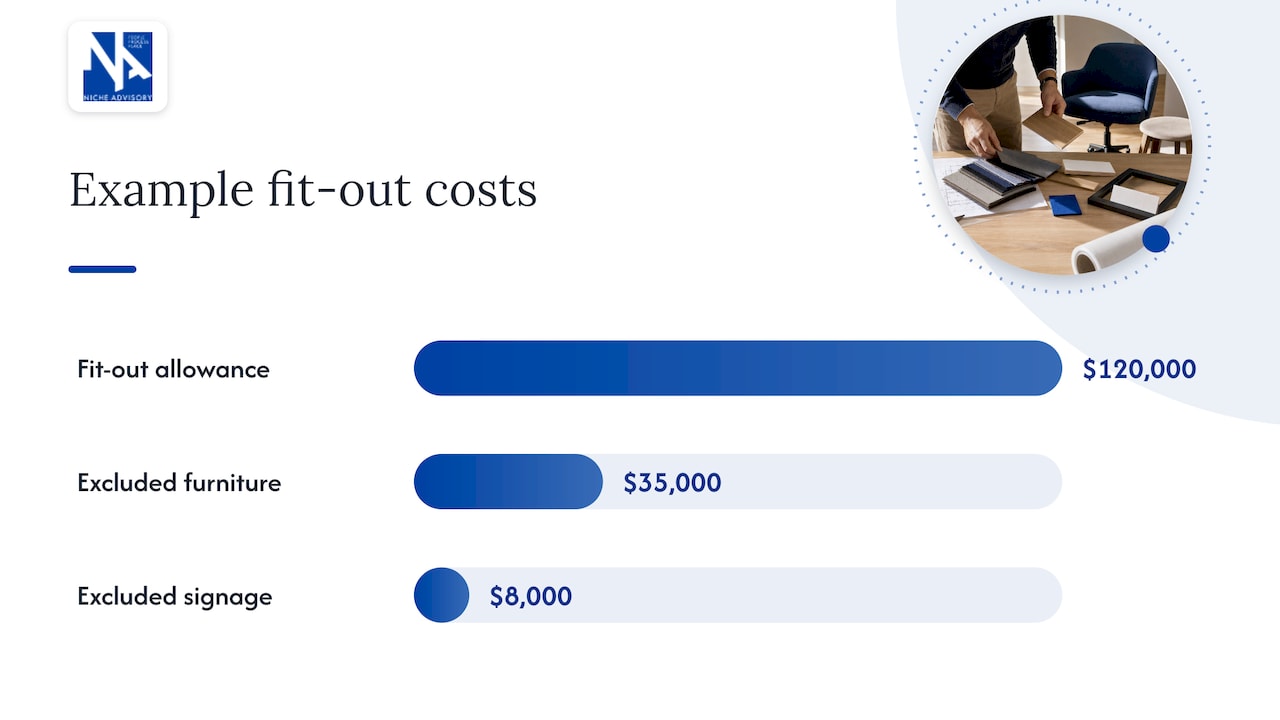
A Melbourne office example shows how this plays out: a $120,000 allowance covering partitions, electrical and lighting, air-conditioning, carpet and paint, but not $35,000 of loose furniture or $8,000 of signage. In industrial premises the same logic applies to tenant-specific works, such as building an office inside a warehouse, racking or operational upgrades, which can be nominated as eligible in the agreement.
Where a tenant gets caught is the cost categories. If your design team’s fees, project management and statutory approvals are outside the eligible list, a large slice of your real budget sits outside the allowance. Define the list before you sign, not when the first invoice is rejected.
How the allowance is recorded in the lease
Incentives are not free money, and they are generally recorded in the lease as a schedule, deed or annexure that sets out how and when they apply and any conditions. The Western Australian Small Business Development Corporation’s leasing guide lists the landlord’s fit-out contribution and an extended fit-out period before the lease commences among the items a tenant can bargain for. It warns that every concession obtained should be included in and form part of the lease.
In practice, check these points in the heads of agreement and again in the draft lease:
- The amount or rate, and whether it is GST-inclusive or exclusive.
- The list of eligible costs.
- When it is paid, and what evidence the landlord needs.
- Early access to fit out before rent starts. Lease lawyers commonly note that fit-out contributions and early access are negotiated into Australian leases, and that the documents should secure the time and access you need to finish the works.
- Whether the landlord insists on its preferred fit-out provider, and what that does to your price and control.
- What happens to the allowance if you assign the lease or sublet.
If the premises could be classed as retail rather than commercial, different statutory protections can apply. Our guide to telling a retail lease from a commercial one covers the checks.
How you are paid
The usual arrangement is reimbursement. Many Australian allowances are paid after you pay the builder and submit paid invoices, proof of completion, certificates and contractor details. Some landlords pay in instalments. Another model is for the parties to pre-agree the contribution value and have the landlord carry out the works up to that value.
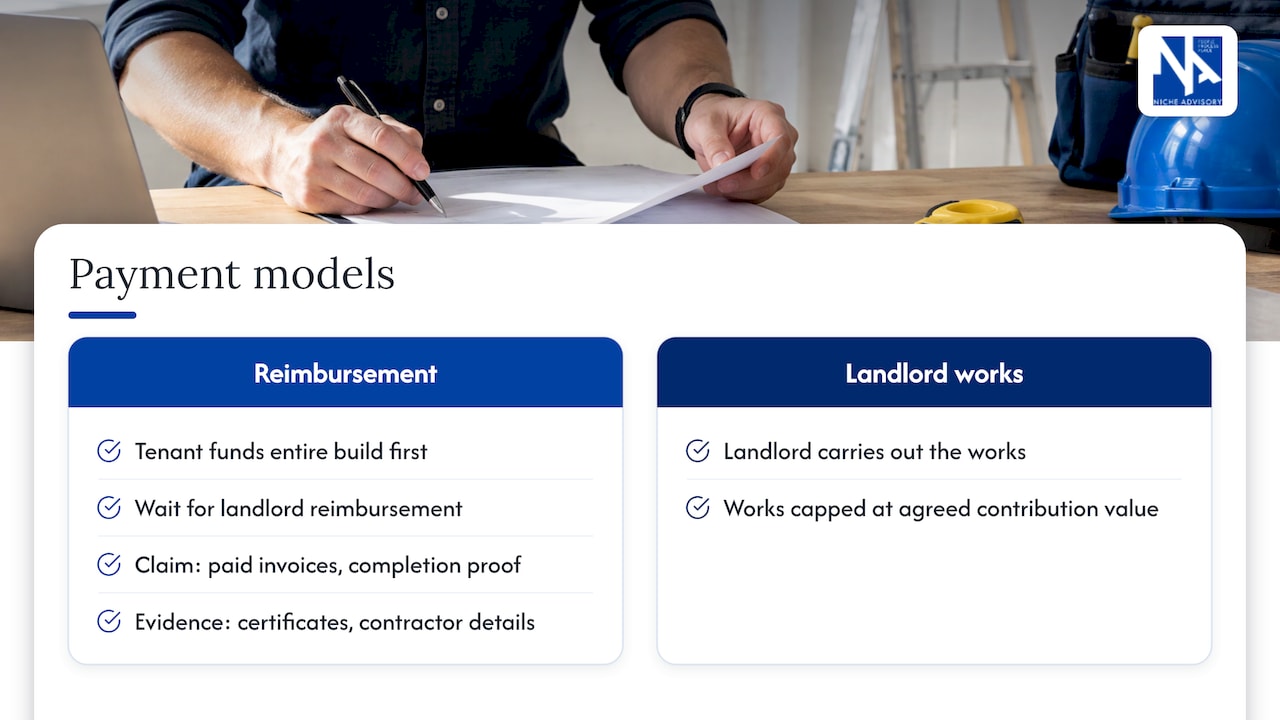
The cash-flow consequence is the one that surprises people. You fund the whole build up front, then wait for the landlord to reimburse. Build that gap into your budget, and ask for a defined payment window (for example, a fixed number of days from a compliant claim) rather than “after completion”.
Clawback and early exit
The common conditions on an allowance, according to one Australian legal guide, include:
- clawback if you end the lease early or default, sometimes pro-rata and sometimes in full;
- continuous trading requirements, particularly in retail;
- payment only after invoices are provided, or after opening for trade;
- no transfer of the incentive if the lease is assigned.
On clawback, a law firm’s guidance says provisions requiring a tenant to refund the whole of an incentive may be unenforceable as penalties. For fit-out allowances, a refund proportionate to the unexpired lease term on termination for tenant default is considered reasonable, and the incentive deed should give you the chance to fix a default before the landlord suspends or cancels the incentive. Take your own legal advice on enforceability. For your commercial position, aim for a pro-rata clawback that reduces over the term, with a cure period written in.
If you think you may need to leave before the term ends, read options for exiting a commercial lease before you accept an allowance with a heavy clawback.
Tax and accounting: who owns the fit-out matters
The tax result turns on who pays for the fit-out, who manages the works, who owns the improvements and what happens at lease end. Confirm the treatment with your accountant before signing, because it differs by structure. The broad picture from published Australian guidance:
- Landlord keeps ownership and pays the builder directly. In a worked example from an accounting firm, a landlord paying $500,000 straight to a builder and retaining ownership means no assessable income and no depreciation for the tenant.
- Tenant receives cash and owns the fit-out. The same source’s example has a $150,000 contribution counted as assessable income, offset by capital works deductions of 2.5% a year or depreciation on eligible assets. BDO’s tax team gives the same general position: a cash contribution is generally taxable where the tenant owns the fit-out, and not taxable where the landlord owns it, in which case the tenant cannot claim depreciation on it.
- Capital works rate. The ATO says leasehold improvements, including shop fitouts, are capital works claimed at the statutory rate of 2.5% or 4%, not over the effective life or the lease term. A balancing deduction may be available if the works are destroyed at the end of the lease.
The same BDO guidance recommends that the incentive deed state the GST treatment and that tax invoices flow at each milestone, so credits and liabilities line up.
AASB 16 and your balance sheet
If your accounts follow AASB 16, the Department of Finance’s lease incentives guidance explains that a fit-out reimbursement counts as a lease incentive where the spend was promised in the lease contract as a condition of entering it, and you primarily benefit from it and recognise it as a fit-out asset. Such incentives are deducted from the initial value of the right-of-use asset. That guidance is written for Commonwealth entities, but the standard is the same one private-sector finance teams apply. Our note on matching lease term to fit-out payback under AASB 16 shows how term length changes the picture.
Negotiating a better allowance
The size of the allowance is only one lever. A larger contribution can come with higher face rent, shorter term flexibility or a heavy make-good obligation. Sprintlaw’s advice is to map base rent for each year including increases, outgoings, one-off incentives and make-good costs at the end, because a rent-free period can be offset by higher rent or a heavy make-good later. The best incentive is the one that cuts risk and protects cash flow over the whole term.
A workable approach:
- Budget the real fit-out first. Know what you need before you ask for a number.
- Run a competitive process. Landlords price incentives against alternatives, so shortlist several buildings, not one.
- Compare on effective rent. Convert face rent, incentives, outgoings and make-good into one annual cost per square metre. Our guide to outgoings in a lease shows how much they can add.
- Ask for the shape, not only the size. Early access, a defined payment window, a broad eligible-cost list, pro-rata clawback and a say over who builds.
- Check the end of the lease. Read the make-good obligations before you accept the incentive, since removing the fit-out can cost more than the contribution saved.
- Get it in writing. Anything not in the lease or deed is not enforceable in practice.
If you are renewing rather than moving, ask for an allowance as part of the renewal. The lease re-negotiation process and lease restructuring pages explain where that leverage comes from.
Where a tenant-only adviser fits
Niche Advisory acts exclusively for tenants and owner-occupiers, never landlords, and gives independent advice. Our Corporate Tenant Advocacy service covers property search, lease negotiation, renewals and make-good negotiation, and we also provide workplace strategy, design and fitout, and project and construction management. That matters for an allowance because the negotiation (how much, how paid, what is eligible) and the delivery (what the build actually costs, and what it claims) are connected. When one team handles both, the allowance is negotiated against a budget that reflects the real project. For the usual path from brief to keys, see our 9 to 12 month tenant representation plan.
Common mistakes to avoid
- Accepting a headline per-square-metre rate without checking the eligible-cost list.
- Forgetting that the allowance is usually reimbursed, so cash must be available first.
- Signing a full clawback with no cure period.
- Ignoring the tax position until after the fit-out is built.
- Comparing incentives without comparing outgoings, rent reviews and make-good.
- Leaving verbal promises out of the lease.
FAQ
Is a tenant incentive allowance the same as a tenant improvement allowance?
In everyday use, yes: both usually mean the landlord’s contribution towards fit-out. Strictly, “incentive” is the wider term and can also include rent-free periods, rent reductions and cash payments. Check the wording in your heads of agreement to see exactly what is being offered.
Is a TIA taxable in Australia?
It depends on who owns the fit-out. Published guidance indicates a cash contribution is generally assessable where the tenant owns the improvements, and not where the landlord owns them and pays the builder directly. The ATO’s capital works rules then govern the deductions. Ask your accountant to model the structure before you sign.
Do I get the allowance if I spend less than it?
Not automatically. Many allowances are reimbursements capped at the amount you actually spend on eligible works, so unspent allowance is typically lost unless the lease provides otherwise. If you want the option of taking it as rent relief or a payment, negotiate that in advance.
What happens if my fit-out costs more than the allowance?
You fund the difference. A $120,000 allowance against $155,000 of works leaves $35,000 for you to pay. Setting a realistic budget before the negotiation is the best protection.
Can I get an allowance on a lease renewal?
Yes, it can be negotiated, particularly where you are committing to a longer term or the landlord wants to avoid vacancy. Make the request early in the renewal process, not after terms are settled.
Sources
- Understanding lease incentives in Australian commercial real estate, Properties & Pathways
- NSW Retail Tenancy Guide 2022
- Guide to leasing: lease terms, rent reviews and tenant incentives, Centuria
- What Is a Tenant Improvement Allowance and How Does It Work in Australia
- Leasing business premises: A commercial and practical guide, WA Small Business Development Corporation
- Guide to Commercial Leasing, Lease Lawyers
- Lease Incentives & Fitout Contributions, Marino Law
- Rent Incentives in Australian Commercial Leases, Sprintlaw
- Lease incentives, things to watch out for, Legal 500
- Lease incentives and capital works explained, BDO
- Leases, Lease Incentives, and Fit-Outs, Hoffman Kelly
- Capital works deductions, Australian Taxation Office
- Lease incentives, Department of Finance