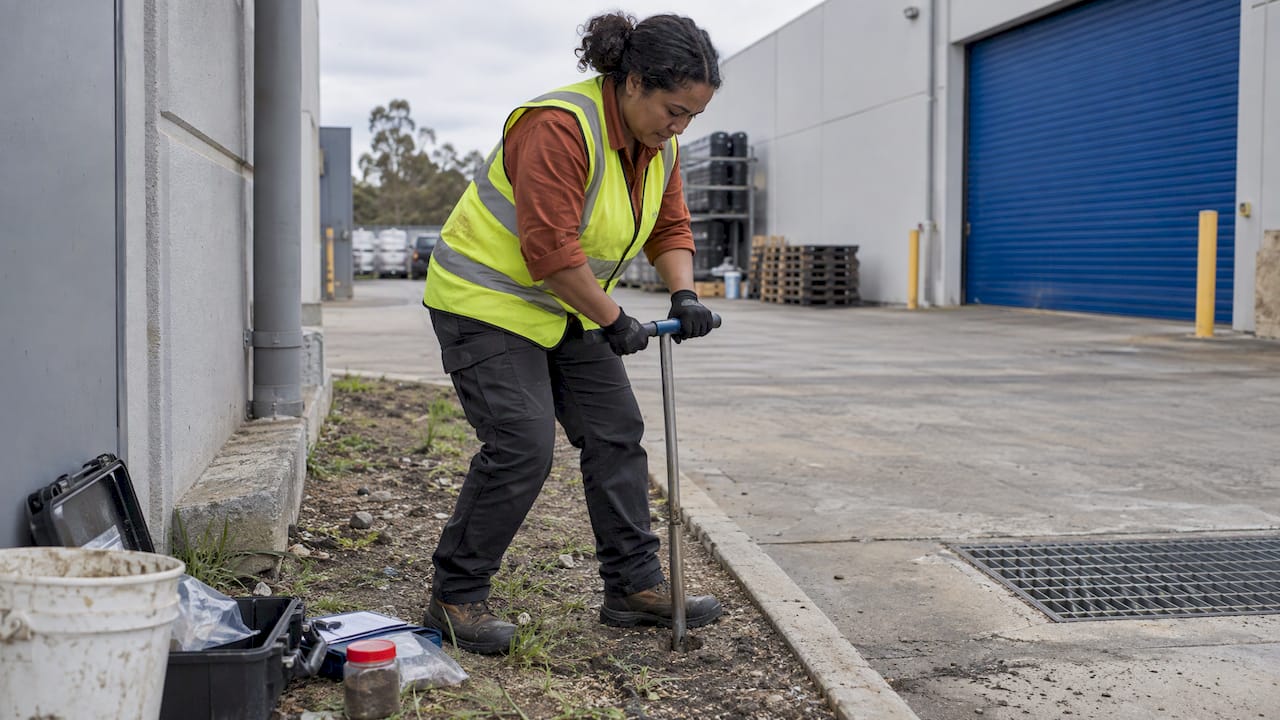
Environmental due diligence is the investigation of a site’s history, records and condition before you commit to it, so you know whether contamination could become your cost, your liability or your delay. For a tenant or owner-occupier in Australia, the right time is before the lease or contract becomes unconditional, and the right outcome is a lease that allocates any environmental risk in writing. We act only for tenants and owner-occupiers, and we negotiate the lease side of that outcome: the conditions, the make-good wording and the dispute pathway.
TL;DR
- Start with a desktop review of site history and contamination registers, and escalate to soil or groundwater sampling only if the review points to risk.
- Do it before the lease or contract is unconditional. After signing, your leverage and your options shrink.
- Liability rules differ by state. In Victoria, a person in management or control of land can carry a duty even if they did not cause the contamination.
- A lease should state the baseline condition of the site, who pays for what, and what happens if contamination is found.
- Industrial and warehouse sites, and anything involving fuel, chemicals or dangerous goods, deserve the most scrutiny.
Table of Contents
- What environmental due diligence means for a tenant
- When to carry it out
- What to check before you sign
- Who is responsible: it depends on the state
- Worked example: a warehouse lease in outer Western Sydney
- Building the findings into the lease
- What to do if the assessment finds contamination
- Why the timing and the independence matter
- How we fit into the process
- A practical sequence for the next lease
- FAQ
- Sources
What environmental due diligence means for a tenant
Most guidance on this topic is written for buyers of land. If you lease an office or a warehouse, the same logic applies, but your questions are different. You are not only asking “what is this site worth?” You are asking whether you could be treated as the responsible party, whether the site is safe for your staff and stock, and whether a finding midway through your term could force a move or a clean-up bill.
The work usually runs in stages. The national framework, the National Environment Protection (Assessment of Site Contamination) Measure 1999, sets out how site contamination is assessed in stages across Australia, and each state and territory applies it through its own regulator and guidelines.
In plain terms the stages are:
- Desktop review. A search of historical land use, aerial photographs, titles, council records and regulator registers.
- Preliminary site investigation (PSI). A consultant inspects the site and decides whether the desktop findings suggest contamination is likely.
- Detailed site investigation (DSI). Soil, groundwater or soil-gas sampling to measure what is actually there.
- Risk assessment and remediation. If contamination is confirmed, a plan to manage the risk or clean it up, followed by validation that it worked.
The Western Australian guideline on assessing and managing contaminated sites covers this whole sequence, from the preliminary investigation through risk assessment, remediation, validation and ongoing management. South Australia describes a tiered approach in which a detailed investigation and a site-specific risk assessment inform a remediation options assessment where harm to people or the environment needs to be prevented.
The assessment itself is carried out by a qualified environmental consultant. Your job as the tenant is to commission it at the right time, read it against the lease terms, and make sure the lease reflects what it finds.
When to carry it out
The short answer is during the due diligence or conditional period, before you are bound. Once the lease is signed, your negotiating position changes: you can no longer walk away over a finding, and you may already be in occupation, with fitout spend committed.
Situations where environmental due diligence is most worthwhile for a tenant:
- Leasing a warehouse, factory, workshop or yard. Past industrial uses are the most common source of contamination. Fuel storage, chemical handling, metal work and dry cleaning all leave traces.
- Taking a long lease with a fitout. The longer your term and the larger your capital outlay, the more a late discovery costs.
- Changing the use of the premises. Under the Western Australian rules, an owner or occupier who changes or proposes to change the land’s use can become a responsible person, and the cleanup standard can rise with the new use. The WA fact sheet on buying and selling contaminated sites sets this out.
- Storing dangerous goods. If your operations involve flammable or hazardous materials, site risk and approvals interact. Our guide to dangerous goods storage for Australian tenants explains how delays arise.
- Moving into a former industrial building converted to offices. The conversion may have changed the look of the site, not its history.
For a standard multi-storey CBD office tower, a full sampling program is rarely warranted. A desktop check of the registers and the building’s history is often proportionate. The scale of the work should follow the scale of the risk.
What to check before you sign
The Western Australian Government’s guidance gives a practical checklist for anyone dealing with a property. It recommends searching the contaminated sites database, checking the certificate of title for memorials, investigating the property’s history through local government records, historic titles and aerial photographs, considering neighbouring properties, and engaging an environmental consultant for a preliminary investigation where needed (WA Government, October 2024). The specific forms and databases are WA’s, but the questions travel to every state.
Translated into a tenant’s checklist:
| What to check | Why it matters | Where it comes from |
|---|---|---|
| Regulator contamination registers | Shows whether the site or a neighbour is already classified or listed | State EPA or department registers |
| Title notations and memorials | Can record restrictions on use linked to contamination | Certificate of title |
| Historical land use | Former service stations, factories, tanneries or landfills signal risk | Council records, historic titles, aerial photos |
| Neighbouring sites | Contamination can migrate through groundwater | Registers and desktop review |
| Existing environmental reports | A prior report may already define the baseline | Landlord, via a written request |
| Approvals and licences | Shows what activities have been permitted on site | Council and regulator records |
| Tanks, bunds and storage areas | Visible signs of past or present chemical and fuel handling | Site inspection |
Ask the landlord in writing whether any environmental reports exist, whether the site is listed on any register, and whether any notices have been received. The answers, and any refusal to answer, belong in your file before heads of agreement are signed.
Who is responsible: it depends on the state
This is the part most tenants underestimate. Responsibility for contamination is a state and territory matter, and the rules are not uniform.
Victoria. The EPA’s guide for business on potentially contaminated land states that the duty to manage contaminated land applies to people in management or control of land, even if they did not cause the contamination. They must minimise risks to human health and the environment so far as reasonably practicable once they know, or should reasonably be expected to know, the land is potentially contaminated. The response must be proportionate to the nature of the contamination and the harm it could cause. The guide lists steps including identifying and investigating contamination, maintaining risk-minimising measures, and providing information to potential purchasers and tenants.
Two 2025 Victorian Civil and Administrative Tribunal decisions, summarised in Ashurst’s Australian environment and planning year in review for 2025, confirm that the EPA can issue clean-up notices to the polluter, the current occupier or the current owner, without needing the recipient to have known about or caused the contamination. Recipients can seek to recover costs from whoever caused or contributed to it. That recovery right is only as good as your lease and your records.
Western Australia. Under the Contaminated Sites Act 2003, a person may be responsible for remediation if they caused or contributed to the contamination, if they are an owner or occupier who has changed or proposes to change the land use, or if they own the site. The WA fact sheet above also explains that the responsible person must make the land safe for its current or zoned use, and that extra clean-up costs fall on the party moving to a higher-standard use. The February 2025 WA guideline adds that responsibility can be shared among parties and that transferring responsibility on a sale or lease needs written consent from the regulator’s committee, supported by the draft contract and evidence that the parties understand the contamination, the scope, the timeframe and the costs.
Queensland. The state’s contaminated land buying and selling guidance says an owner must give written notice before selling land listed on the Environmental Management Register or the Contaminated Land Register. From 1 August 2025 that disclosure forms part of the Seller Disclosure Statement under the Property Law Act 2023. For leased land on the Contaminated Land Register, the owner must notify the lessee within 20 business days and any prospective lessee before the lease is entered into. A lessee who was not told can terminate within 10 business days of learning of the listing.
New South Wales and elsewhere. NSW applies the national framework through its EPA guidelines, and its penalty regime was strengthened by the Environment Protection Legislation Amendment (Stronger Regulation and Penalties) Act 2024, assented to on 3 April 2024, with the relevant schedule commencing on 1 July 2024. If you lease in New South Wales, South Australia, Tasmania, the ACT or the Northern Territory, confirm the current regulator guidance for that jurisdiction before relying on any other state’s rules.
The takeaway for a tenant: the question is never only “did we cause it?” In several states, simply occupying or controlling the land can place obligations on you. That is why the baseline matters.
Worked example: a warehouse lease in outer Western Sydney
This is an illustrative scenario, not a real client case.
A logistics business plans a five-year lease of a 4,000 square metre warehouse with a hardstand and a former workshop on the site. The landlord says the building has “always been a warehouse”. A desktop review shows an earlier occupant ran a vehicle repair business with underground fuel tanks. The consultant recommends a preliminary investigation and, based on what it finds, targeted soil and groundwater sampling.
The tenant now has three choices, and each is far better made before signing:
- Proceed with a documented baseline. The sampling results are attached to the lease as the condition of the site at commencement, so any later contamination is presumed not to be the tenant’s.
- Negotiate the risk. The landlord agrees to remediate before commencement, or to carry the cost of any pre-existing contamination, with a rent abatement or termination right if works delay occupation.
- Walk away. The tenant moves to another site while it still can.
If the tenant had signed first and sampled later, only the first path would be left, on much worse terms.
Building the findings into the lease
An environmental report is only useful if the lease uses it. These are the clauses to settle with the landlord, and the points where independent tenant-side negotiation matters most:
- Baseline condition. Record the site condition at commencement, ideally with the report attached, so later contamination can be distinguished from existing contamination.
- Responsibility for pre-existing contamination. Make clear that the tenant is not liable for contamination it did not cause, and that the landlord must deal with notices relating to it.
- Notification duties. Agree who tells the regulator, and who bears the cost of any required investigation.
- Termination and rent relief. If contamination is found during the term and prevents or restricts your use, what are your rights?
- Make-good. Reinstatement obligations at lease end should not extend to remediating contamination you did not cause. Our team handles make-good negotiation and execution for tenants.
- Exit testing. Agreeing an end-of-lease assessment against the baseline protects you from being blamed for earlier conditions.
- Dispute pathway. Decide in advance how a disagreement over the source of contamination will be resolved.
Industrial leases carry the most of this risk, and our piece on negotiating industrial leases and checking site risk goes through the clauses in more detail.
What to do if the assessment finds contamination
A finding is not automatically a deal-breaker. It is information you can price and allocate. The sensible response depends on severity and on how you intend to use the site.
- Get the consultant to explain the risk in terms of your use. Contamination that is a problem for a childcare centre may be manageable in a warehouse with a sealed slab.
- Check the register position and disclosure duties. In Western Australia, owners of sites classified as contaminated with remediation required, contaminated with restricted use, or remediated for restricted use must provide a Form 6 disclosure at least 14 days before a transaction completes. The WA fact sheet says failure to disclose is an offence with a maximum penalty of $125,000 and a possible maximum daily penalty of $25,000.
- Decide whether to renegotiate, defer or exit. Remediation by the landlord before commencement, a longer rent-free period, a termination right or a different site are all legitimate outcomes.
- Record everything. Reports, correspondence and the baseline are your evidence if a regulator or landlord later questions responsibility.
- Escalate early if there is a disagreement. A dispute over who caused contamination is best handled with a clear paper trail. We provide dispute resolution services between tenants and landlords.
If a regulator has issued a notice, or you suspect a legal liability, speak to a lawyer who specialises in environmental or property law, and to the relevant state EPA or department. Environmental consultants and lawyers cover technical and legal advice. We run the tenant-side process around them.
Why the timing and the independence matter
Environmental due diligence competes with everything else in a lease transaction for time: a sampling program can take weeks, and a landlord wants the deal signed. Tenants who leave it until the end often end up waiving it or accepting a thin clause to hit a commencement date.
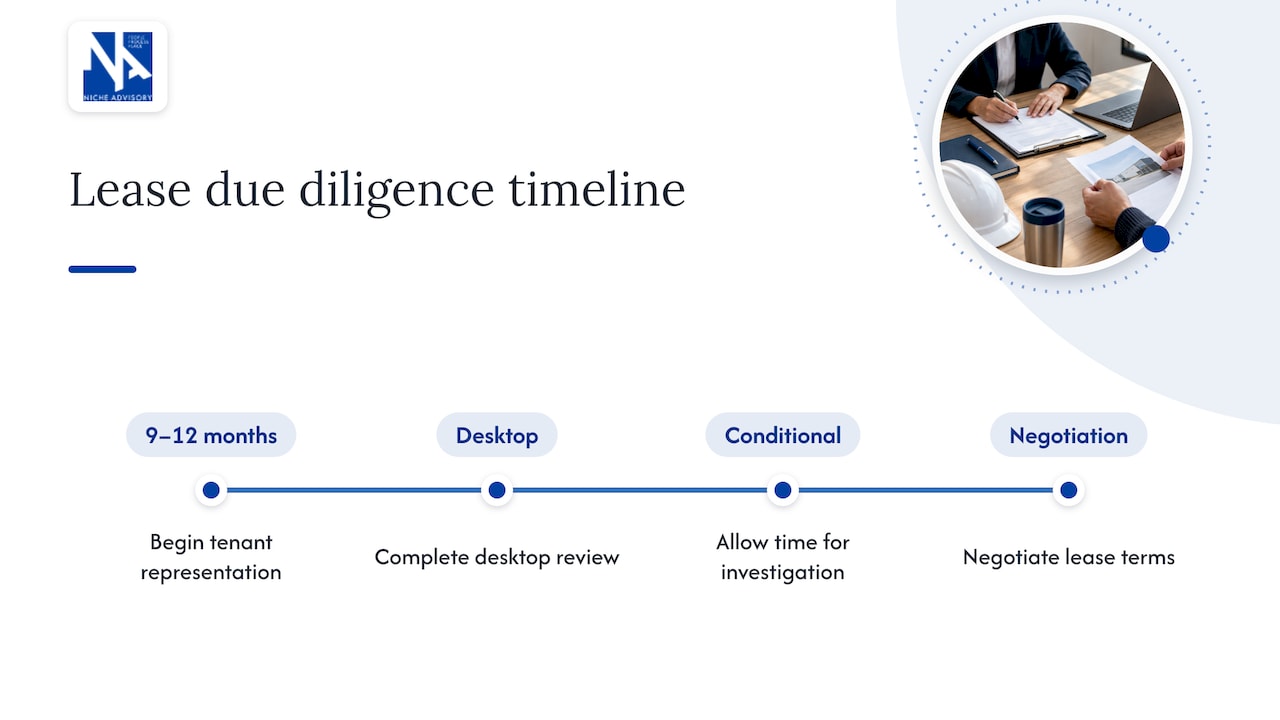
A planned timeline avoids that. A tenant representation plan that begins 9 to 12 months before expiry, as set out in our tenant representation guide, leaves room for the desktop review, the conditional period and the negotiation. For a lease you are already in, a review of the environmental position and the make-good terms belongs in the renewal planning.
Independence matters because the party who benefits from a clean report is often the party selling the lease. Niche Advisory acts exclusively for tenants and owner-occupiers, never landlords, so the terms we negotiate are built around your risk and your business goals.
How we fit into the process
We do not replace the environmental consultant, who carries out the technical investigation. What we do is run the real estate side so the findings turn into lease terms: corporate tenant advocacy covers property search and lease negotiation, and our wider corporate real estate services include lease renewal and review, make-good negotiation and project management of the fitout. We have worked with organisations across sectors for over 12 years, in Sydney, Melbourne, Brisbane, Adelaide and other markets. If you are weighing a site now, talk to us before you sign so the due diligence period is written into the deal.
For companies from the UK, US or Singapore entering Australia, the point is sharper: the regime is state-based, the terminology differs from home, and the lease conventions are local. Local tenant representation in Sydney, Melbourne or Brisbane helps you ask the right questions on day one.
A practical sequence for the next lease
- Define your use and the sensitivity of the site before you shortlist.
- Request existing environmental reports and register information in writing from the landlord.
- Commission a desktop review for every shortlisted industrial site.
- Build a due diligence condition into the heads of agreement, with enough days to complete the work.
- Escalate to a preliminary and detailed investigation only where the desktop points to risk.
- Attach the baseline to the lease and negotiate the allocation of pre-existing contamination.
- Align the make-good and exit clauses with that baseline.
- Keep the records for the life of the lease.
FAQ
What is the difference between environmental due diligence and a site contamination assessment?
Environmental due diligence is the overall process of reviewing a site’s environmental risk before a transaction. A site contamination assessment is the technical part within it, moving from a preliminary investigation to detailed sampling. The first decides whether you proceed; the second supplies the evidence.
Do I need environmental due diligence for an office lease?
Usually a light version is enough: a check of the registers, the building’s history and any existing reports. A full sampling program is mostly for industrial, warehouse or former-industrial sites. The scale should match the risk of the site and your use.
Can a tenant be liable for contamination it did not cause?
In some states, yes. Victoria’s EPA says the duty to manage contaminated land applies to people in management or control of land even if they did not cause the contamination. That is why a documented baseline and lease allocation of pre-existing contamination are valuable.
When should the assessment happen?
Before the lease or contract is unconditional, during the due diligence or conditional period. At that point you can still renegotiate, ask the landlord to remediate or walk away.
Who pays for the assessment?
The tenant commonly pays for its own pre-lease investigation, though cost-sharing or landlord contribution can be negotiated for higher-risk sites. Responsibility for any remediation depends on the state’s law and on the lease terms agreed.
Sources
- National Environment Protection (Assessment of Site Contamination) Measure 1999
- WA Government: Assessment and management of contaminated sites guideline
- SA EPA: Guidelines for the assessment and remediation of site contamination
- WA Government: Buying and selling contaminated sites fact sheet
- EPA Victoria: Potentially contaminated land, a guide for business
- Ashurst: Australian Environment and Planning Year in Review 2025
- WA Government: Identification, reporting and classification of contaminated sites guideline
- Queensland Government: Buying and selling contaminated land
- Environment Protection Legislation Amendment (Stronger Regulation and Penalties) Act 2024 (NSW)