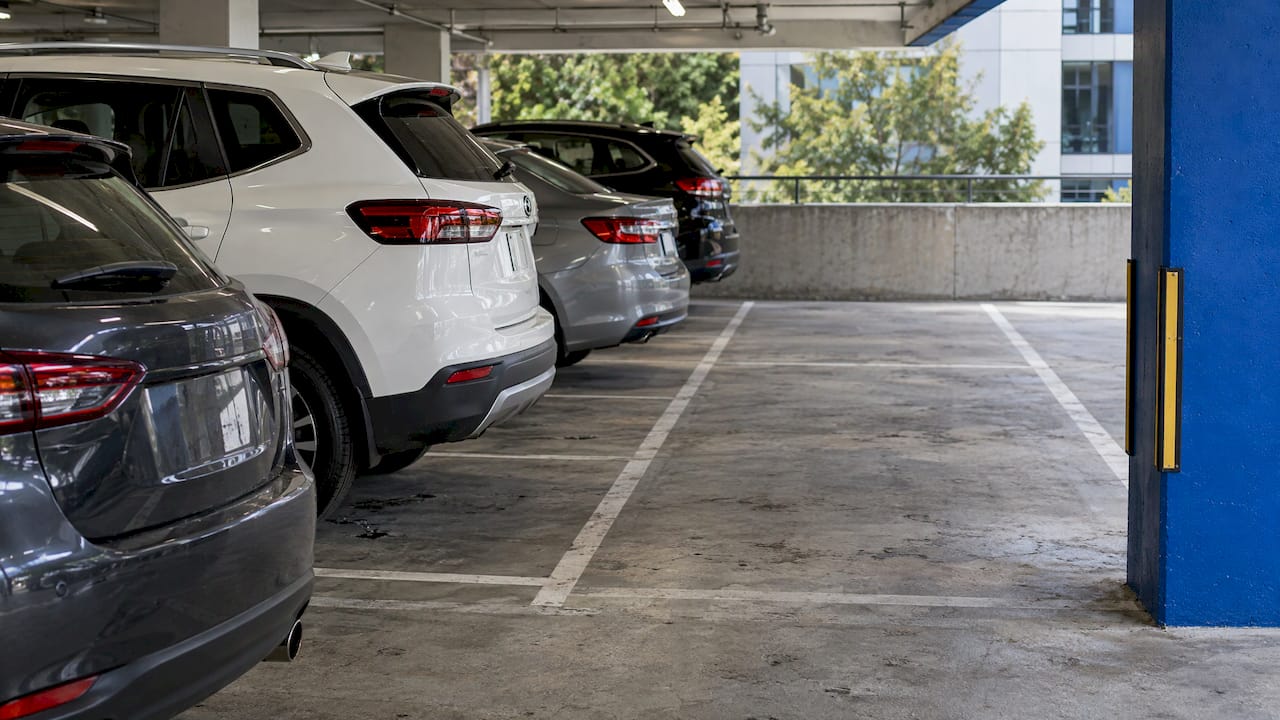
A good office parking allocation policy starts with the bays your lease gives you, not with a booking tool. Count the bays you hold, separate reserved bays from a shared pool, set priority tiers, publish simple booking and no-show rules, and review them against real use. Because the number of bays is fixed in your lease, the strongest policies are built together with the lease terms behind them. That is where Niche Advisory, which acts only for tenants and owner-occupiers, can help with the lease side of the equation.
TL;DR
- Start with an audit: how many bays your lease gives you, what each is for, and how many staff actually drive on which days.
- Split bays into reserved (accessibility, safety, operational needs) and a shared pool for everyone else.
- Write tiers, booking windows and no-show rules down, and publish them so the policy is transparent.
- Check your lease: bay numbers, charges, release rights and what happens at renewal decide how much your policy can do.
- Review use every quarter and, when demand and supply keep diverging, fix it in the lease rather than in the policy.
Table of Contents
- Why the policy is only half the problem
- Step 1: Audit your bays and your demand
- Step 2: Decide who is entitled to what
- Step 3: Choose an allocation method for the pool
- Step 4: Write the rules people will actually follow
- Step 5: Measure and review
- Understanding the car parking ratio behind your bays
- What to check in your car parking clauses
- When the policy cannot fix the shortage
- How Niche Advisory can help
- A short template to adapt
- FAQ
- Sources
Why the policy is only half the problem
Most parking disputes at work are not really about fairness. They are about scarcity. If you hold 20 bays and 45 people want to drive on Tuesday, no allocation method makes everyone happy. A policy can make the shortage predictable and defensible. Only the lease can change the number of bays.
That is why this article treats the policy and the lease together. The policy decides who gets a bay on a given day. The lease decides how many bays exist, what they cost, whether you can hand some back and what you can do at renewal.
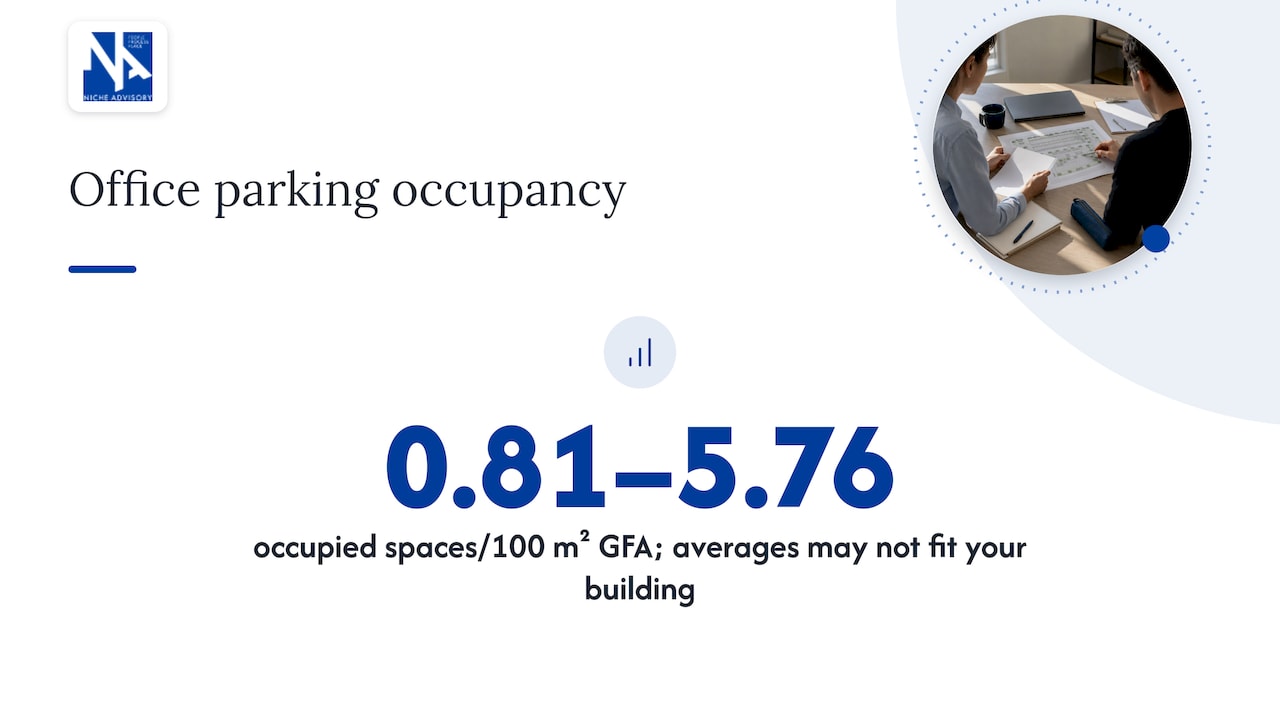
Buildings are also not built to a single standard. Planning rates differ by council, and the rate that applied when your building was approved may bear little relation to how your team works today. Austroads’ guide to parking management notes that studies of general office buildings have found between 0.81 and 5.76 spaces occupied per 100 m² of gross floor area. It also cautions that standards built on averages leave some buildings with too much parking and others with too little. Your own attendance data will tell you more than any average.
Step 1: Audit your bays and your demand
Before you write a rule, build the facts.
- List every bay. Number, location, and current use: reserved for a person, a role, visitors, accessible, a pool bay, or unused. Check this against the lease plan and any parking licence, because what you think you hold and what the documents say are sometimes different.
- Count people, not headcount. Separate staff who drive, staff who use public transport and fully remote staff. A policy sized to total headcount will always look short.
- Find your peak. In hybrid workplaces, attendance tends to cluster midweek. Look at swipe-card or desk-booking data for the busiest day and the quietest, then compare it with the number of bays. The gap on your peak day is the size of your real problem.
- Note shifts and after-hours work. Staff who start early or finish late have different safety and transport needs from nine-to-five staff.
A simple illustration: a team of 60 holds 18 bays. Roughly 35 people drive on at least one day, and 28 of them come in on Tuesday and Wednesday. Peak demand is 28 against 18 bays, so about 10 people each peak day need another way in. On Monday and Friday the same bays may sit half empty. A fixed assignment of 18 bays to 18 named people would leave most of the team without a bay and many bays idle on quiet days.
Step 2: Decide who is entitled to what
Split the bays into two groups before anyone books anything.
Reserved bays
These are not up for competition. Typical categories:
- Accessibility needs. Plan for these first. Local planning controls treat accessible parking as a fixed share of provision: for example, the Inner West Council DCP requires at least 20% of car parking provided to be accessible and built to AS 2890.6, close to accessible entrances or lifts. Your own policy should ensure that people who need these bays can always get one.
- Safety. Some staff face higher risk travelling at certain times. Queensland Health’s staff parking guideline prioritises parking for staff whose safety is at escalated risk, for example access to appropriately lit and located parking for those starting or finishing shifts between 6.00pm and 6.00am. That is a useful model for any employer with early or late shifts.
- Operational needs. Roles that carry equipment, attend client sites during the day or are on call.
- Visitors and clients. A few bays held for guests, signed clearly.
The shared pool
Everything else goes into a pool that nobody owns. Pooling means the same bays serve more people, because a bay left empty by someone working from home is available to someone who is in.
One caution on seniority. Some large employers do allocate by availability and seniority: the NBN Co car parking policy, for instance, states that allocations are based on availability and seniority and are at the company’s absolute discretion. That is a legitimate choice for that organisation, but in a hybrid team it tends to give the bays to people who are in the office least. If you want the policy seen as fair, make the tiers about need and attendance, and say so.
Step 3: Choose an allocation method for the pool
There are four workable methods. Pick the one that matches the gap between demand and supply you found in the audit.
| Method | How it works | Best when | Watch out for |
|---|---|---|---|
| First come, first served | Bays are taken on arrival | Demand is usually below supply | Rewards early arrivers and penalises anyone with school drop-offs or late shifts |
| Booking in advance | Staff reserve the days they will be in | Demand exceeds supply on peak days | Needs a clear booking window and a cancellation rule |
| Weekly rotation | A fixed group rotates through the bays | The same small group competes for limited bays | Rigid if attendance patterns change |
| Credits or points | Each person gets the same monthly allowance | Scarcity is chronic across the whole team | Needs someone to administer it |
Most mid-sized tenants end up with a hybrid: reserved bays for defined needs, and a bookable pool for the rest. Fixed assignment of bays to named individuals is the worst fit for hybrid work, because the bay sits empty on every day its holder is at home.
Step 4: Write the rules people will actually follow
The policy should fit on two pages. Cover these points:
- Purpose and scope. Who the policy applies to and which premises.
- Bay categories. Reserved, visitor, accessible, pool.
- Priority tiers. A common order is accessibility first, then safety and operational roles, then staff with long or poorly serviced commutes, then carpoolers, then everyone else. State the order in the policy so nobody has to guess.
- Booking window. For example, bookings open a set number of days ahead. Check that the timing does not repeatedly exclude staff on different shifts or part-time days.
- Cancellation and no-shows. A bay released early goes to the next person. A short list of consequences for repeated no-shows, such as losing booking rights for a period, keeps the pool honest.
- Exceptions. One named person decides, in writing, and records why.
- Costs. If you pass the cost of bays on to staff, say how. The Queensland Health guideline commits, where fees apply, to considering fair and affordable fees. Whatever approach you take, check the tax and payroll treatment of any fee or benefit with your accountant before you roll it out.
- Review date. A fixed quarterly check.
Keep the language plain. A policy that needs an HR meeting to interpret will be ignored.
Step 5: Measure and review
A policy that is never reviewed drifts away from how people work. Each quarter, look at four numbers:
- Utilisation. What share of bays were actually used, compared with what was booked?
- Complaints. How many parking issues reached HR or facilities?
- Demand pressure. Do bookings fill the moment the window opens, or are bays left over?
- Exceptions. Which categories of staff keep asking for one?
If bookings sell out within minutes and the complaints keep coming, the policy is working as designed and the shortage is structural. That is the signal to look at the lease.
Understanding the car parking ratio behind your bays
Your allocation starts from a number someone else set: the ratio of bays to floor area. There are two ways to see it.
Planning rates are what a council required or allowed when the building was approved. The arithmetic is the rate multiplied by the measure, usually gross floor area. Rates vary widely across Australia:
- The City of Ryde DCP 2014 sets one space per 40 m² of GFA for office and business premises outside the Macquarie Park Corridor. Within the corridor, new floor space is capped at one space per 60 m² or one per 100 m², depending on the mapped area.
- Camden Council’s DCP requires one space per 40 m² of GFA for office and business premises.
- In the City of Bayswater, Western Australia, the local planning scheme sets a minimum of one bay per 50 m² of net lettable area for offices, including one long-term employee bay per 200 m² and one short-term visitor bay per 750 m².
- In the Sydney local government area, the City of Sydney’s parking rates update describes maximum rates for smaller office developments of one per 175 sqm, one per 125 sqm or one per 75 sqm, depending on public transport accessibility.
The pattern: central buildings are limited by maximums, while suburban buildings were often built under minimums. The same business can therefore find itself with generous parking in Macquarie Park or Parramatta and almost none in the Sydney CBD. Provision standards also change how bays are categorised in the first place, as parking provision standards in commercial buildings show.
Your working ratio is simpler and more useful for the policy: bays divided by the people who actually drive on your peak day. Add bays per 100 m² of your leased area if you want to compare buildings. Use the working ratio to decide whether a policy change is enough or whether you need more bays.
What to check in your car parking clauses
The lease is where the policy’s limits are set. When you review a lease or negotiate a renewal, read the parking terms as closely as the rent.
- Document type. Is parking a schedule to the lease or a separate licence? A separate licence can have different term, termination and charging provisions from the lease itself.
- Bay numbers on day one. How many bays do you hold, and are they allocated and numbered or simply a right to a number of unallocated bays?
- Charges. Parking is generally charged separately from rent, per bay, with outgoings and GST treatment spelled out. Ask how and when charges can be reviewed.
- Release rights. Can you hand back unused bays mid-term without penalty? In a hybrid workplace this is often worth more than the rent-free period.
- Right to take bays back. If you release bays and your headcount grows, do you have a first right to reclaim them?
- Access. Hours of access, security, lighting, visitor and loading arrangements, and how EV charging would be handled.
- Lease plan. Check the bays shown on the plan match what you are given.
- Make-good. If you have installed anything in your bays, such as charging points or signage, check the make-good obligation at the end of the lease.
Industrial and warehouse tenants have their own concerns: truck access, marshalling space, staff parking relative to loading docks and site risk. Our guide to negotiating industrial leases covers what tenants should look for before they sign.
The broader rules for how leases are negotiated in Australia are also changing at state level. Our summary of the new code for commercial leases is a good starting point for understanding your position before you open negotiations. For legal interpretation of any specific clause, have your lawyer review the lease.
When the policy cannot fix the shortage
There are three situations where tinkering with allocation rules stops working:
- Persistent excess demand. Bookings sell out every peak day, and the working ratio is well below what your staff need to commute.
- Persistent surplus. You are paying for bays that sit empty because staff moved to public transport or hybrid patterns changed.
- A move or renewal is coming. The most leverage you will have on bay numbers, charges and release rights is at renewal or relocation.
In each case the solution is a lease conversation. Surplus bays can be released or sublet if the lease allows. Shortages can be addressed by negotiating more bays, an option over adjoining bays, or a different building. When a business is choosing between premises, the parking ratio is one input alongside rent, incentives, transport links and the workplace strategy itself. Our piece on getting your hybrid workplace strategy right on the lease side explains how attendance patterns should shape the terms you ask for.
How Niche Advisory can help
Niche Advisory acts exclusively for tenants and owner-occupiers, never landlords, and gives independent advice. Our services include workplace strategy, property search and lease negotiation, lease renewal and review, and make-good negotiation. If your parking audit shows that the bays in your lease no longer match how your people work, corporate tenant advocacy is where that gets tested: bay numbers, charges and release rights are negotiated as part of the wider lease terms, alongside your business goals. We have worked with clients across sectors for over 12 years. You can also start from our tenant representation planning guide to see how a 9 to 12 month lease process runs.
A short template to adapt
You can adapt this outline for your own policy:
- Purpose. To allocate limited on-site parking fairly and transparently.
- Bays. [Number] bays: [number] accessible, [number] reserved for operational and safety needs, [number] visitor, [number] shared pool.
- Eligibility for reserved bays. Staff with documented accessibility needs, staff starting or finishing outside daylight hours, and roles named by the leadership team.
- Pool allocation. Book up to [number] days ahead through [system]. Cancel by [time] on the previous working day. Unused bookings release at [time].
- Priority order if demand exceeds supply. Accessibility, safety, operational, long or poorly serviced commutes, carpools, others.
- No-shows. Two unreleased no-shows in a month suspend booking for two weeks.
- Exceptions. Decided by [role], recorded in writing.
- Review. Quarterly, using utilisation, complaints, demand pressure and exception data.
Get legal or HR advice before you apply any rule that affects pay, benefits or employment conditions.
FAQ
What is a parking allocation policy?
It is a written set of rules that says who can use which parking bays at your workplace, how they get them and what happens when they do not use them. A good one covers reserved bays, a shared pool, priority order, booking and cancellation rules, and a review date.
What is a fair way to allocate limited office parking?
Separate bays for accessibility, safety and operational needs, then allocate the rest through a shared pool with advance booking and a clear no-show rule. Avoid fixed assignment, which leaves bays empty on days the holder is at home, and avoid pure first come, first served when demand regularly exceeds supply.
How many car parking bays does an office need?
There is no single answer. Councils set different planning rates, from one space per 40 m² in some NSW areas to lower maximums in central business districts, and real demand depends on how many staff drive on your busiest day. Divide your bays by peak-day drivers and compare that with the bays your lease provides.
What should I check in the car parking clauses of a lease?
Check whether parking sits in the lease or a separate licence, how many bays you hold on day one, what each bay costs and how that can change, whether you can release unused bays and reclaim them later, and what access and make-good terms apply. Have your lawyer review the final wording.
Sources
- Provision of staff parking guideline, Queensland Health
- Car Parking Policy, NBN Co
- Guide to Traffic Management Part 11: Parking, Austroads
- Transport, Access and Parking, Inner West Council DCP
- Development Control Plan 2014, City of Ryde
- Off street car parking rates, Camden Council DCP
- Bayswater Scheme Text, City of Bayswater
- Attachment B3 Parking Rates Update, City of Sydney