
A client-side project manager is the person who protects the owner’s or tenant’s interests on a building or fitout project. They are accountable for cost, time, quality and scope, they do not hold the construction contract, and they do not build anything. If you are about to commission an office fitout, a warehouse upgrade or a relocation, this role is the difference between steering the project and hoping the builder steers it well.
This guide explains what the role covers from brief to handover, how it differs from a builder’s project manager and a client representative, how to set their authority, and how to prequalify and review contractors.
TL;DR
- A client-side project manager represents the owner across the whole project, including design, and sits on your side of the contract, not the builder’s.
- Their work runs from the brief and execution plan through site inspections, contract administration, final account and defects.
- Write down their authority at appointment: what they can approve, instruct and sign off, and what comes back to you.
- Prequalify contractors on capability and financial standing, then check insurances at tender and award, and review performance on a set rhythm.
- Workplace work is where a tenant-only, independent adviser adds the most: lease, design and delivery decisions stay aligned.
Table of Contents
- What a client-side project manager actually does
- Client-side project manager, builder’s project manager and client representative
- Responsibilities from brief to handover
- Appointing a project manager and defining their authority
- Contractor prequalification: what it is and what to check
- Reviewing contractor performance during and after the project
- Skills, qualifications and experience to look for
- When the project is a tenant’s fitout or relocation
- FAQ
- Sources
What a client-side project manager actually does
Think of the role as the owner’s professional agent. One Australian explainer on construction project managers describes the client-side manager as representing the client’s interests across the entire project, design phase included, and typically not holding the construction contract or self-performing trade work on site.
In practice that means four jobs:
- Define the outcome. Turn a business need into a brief, budget and program the project team can price and deliver against.
- Build the team. Help select designers, consultants and the builder, and set the rules of engagement.
- Control delivery. Track cost, time, quality and scope, manage variations and report to you in plain terms.
- Close out. Run practical completion, defects, the final account and handover so you take possession of a building that works.
The duties listed for the occupation in Australia are consistent with this: developing project plans, schedules, budgets and risk registers, coordinating contractors and consultants, monitoring progress, quality, safety and cost, and managing client relationships, variations and reporting.
The role is well established in Australia. Government agencies, developers, infrastructure owners and mining companies commonly engage owner’s representative and programme management services from large property and project consultancies. Smaller firms, from a 300 square metre office to a distribution warehouse, face the same decisions with far less in-house experience, which is why many tenants bring in an independent adviser for the project.
Client-side project manager, builder’s project manager and client representative
The titles blur, so separate them by who they answer to and what they hold.
| Role | Answers to | Holds the construction contract? | Main focus |
|---|---|---|---|
| Client-side project manager | Owner or tenant | No | Cost, time, quality and scope for the client, from brief to handover |
| Builder’s project manager (head contractor) | The builder | Yes, through the builder | Delivering the physical build and managing subcontractors |
| Client representative | Owner or tenant, as named in the contract | No | Exercising the client’s contractual powers and giving directions or approvals |
A general contractor, also called a head contractor or builder in Australia, holds the construction contract directly and is responsible for delivering the build, including the subcontractors. Their project manager is paid to deliver that contract profitably.
A client representative is a contractual position: the person named to act for the principal. On a small project the client-side project manager often fills it. On larger ones the principal may name a senior executive and let the project manager run the day-to-day. What matters is that one name is written down and everyone knows it.
Responsibilities from brief to handover
Professional standard scopes give a useful map. The RICS project manager services schedule, written for England and Wales, is a good checklist even though Australian contracts differ in detail. Its stages show the appointed project manager arranging project meeting procedures, producing a project execution plan that sets out the roles of client and professional team, and preparing tools for handover and defects administration. During construction it adds regular site inspections, managing the building contract, administering approvals and test certificates, and then agreeing the final account and managing defects and handover.
Translated into an Australian tenant project, the sequence looks like this.
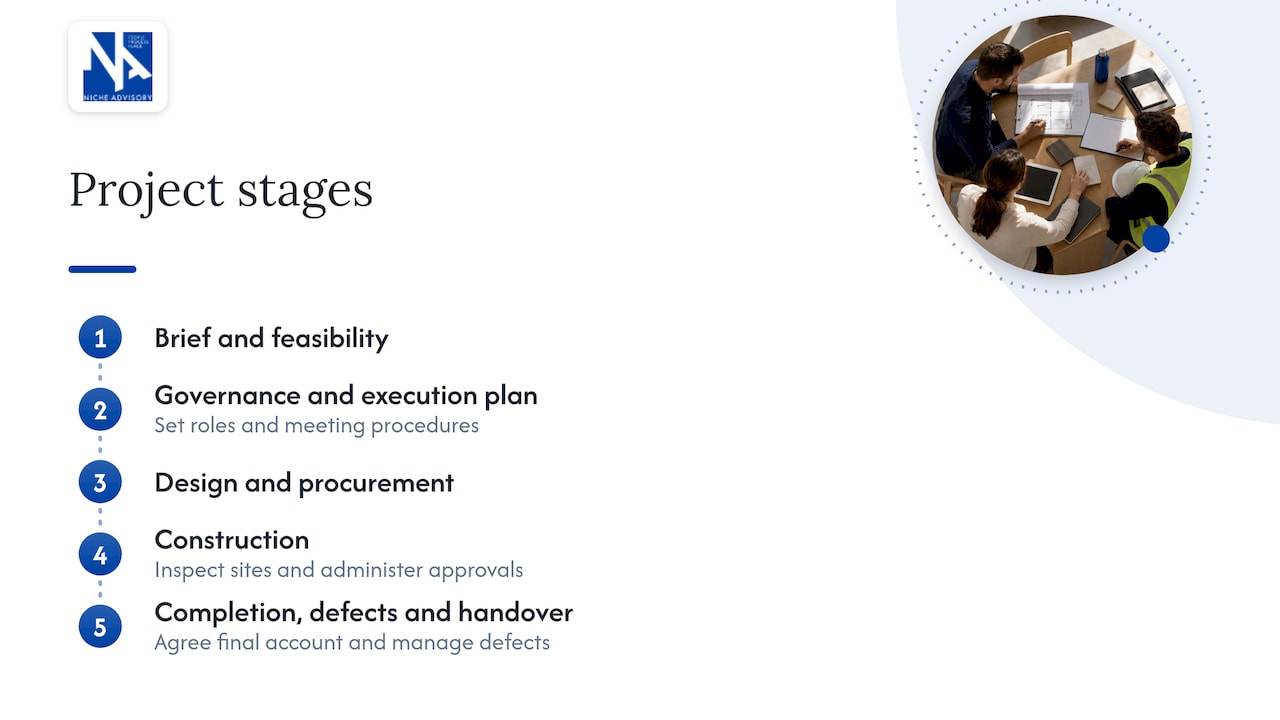
1. Brief and feasibility
The manager tests what you actually need: headcount, how people work, adjacency, growth, lease term and budget. Good briefs are specific. The ACA and Consult Australia paper on being a model client says clients should supply well-structured, accurate briefs with reasonable review and response times, which lowers the cost of bidding for everyone.
The brief also covers things owners forget until late: base building approvals, landlord consent, and wayfinding. Even something as practical as designing property signage belongs in the early scope and budget, not in the last fortnight.
2. Governance and execution plan
Before design starts, the team needs a plan: who decides what, how fast, and who is told. ACIF’s guide to getting it right up front argues that many delivery problems are reduced by getting the front end right, meaning project initiation, delivery team procurement, planning and governance, then monitoring performance against target outcomes. Our own piece on governance and RACI for construction sets out a 30/60/90 day approach.
3. Design and procurement
The manager coordinates consultants, controls design changes while they are cheap, and recommends a procurement method. The method drives variation risk, so it is worth reading how procurement methods and NCC rules affect fitout variations. When tenders arrive, a structured comparison matters; see how to run a builder tender evaluation you can defend.
4. Construction
Regular site inspections, progress claims checked against work done, variation pricing, program tracking and a clear reporting line to you. On safety, the manager may coordinate information, reporting and interfaces, but that does not remove or replace the work health and safety duties held by each business involved, known as PCBUs. Keep that clear in your own risk thinking: your project manager helps, but your business still has duties.
5. Completion, defects and handover
Practical completion is where leverage is greatest, because retention and the final payment are still in play. A practical completion defects checklist for owners helps you walk the premises with the right documents. Handover also includes manuals, test certificates, warranties and the final account.
For tenants there is a lease-end counterpart: make-good. Independent defect, dilapidation and make-good reports give you a record to negotiate from.
Appointing a project manager and defining their authority
An appointment fails less on skill than on unclear authority. Decide and document:
- Who is the client’s nominated person under the construction contract, and who is their delegate when they are away.
- Financial limits: the value of variations they can approve alone, and what must come to you.
- Instruction powers: whether they can direct the builder, issue notices and certify payments.
- Reporting rhythm: monthly cost report, program update and risk register, in a format you can read in ten minutes.
- Conflicts: who else advises on lease, design and delivery, and whether those people are independent of the builder and landlord.
Public-sector guidance shows the principle clearly. Buy NSW says the principal and contractor must nominate authorised persons who have the skills, knowledge, experience and authority to fulfil their roles, and that delegations to commit public money have limits. Private owners do not face the same statute, but the logic carries over: a representative with no real authority slows decisions, and one with unlimited authority exposes you.
The ACA’s relationship contracting paper also lists client representative powers and duties among the fundamental issues to agree between clients and prequalified contractors. Agree them before the contract is signed, not during the first dispute.
Contractor prequalification: what it is and what to check
Prequalification narrows the field to contractors who can plausibly do the work before anyone spends time on a full tender. The NSW Government’s guidance on its construction prequalification scheme says the purpose is to reduce time, cost and risk by engaging suppliers that are legitimate entities with sound financial track records and demonstrated expertise, capacity and capability for specific work categories.
A private client can borrow the structure:
- Set criteria first. Project size, sector experience, financial standing, safety record, team availability.
- Ask for evidence. Recent comparable projects, referees, company details and financial information.
- Shortlist. The ACA model describes seeking bids from a short list of competent, equipped tenderers, which makes evaluation efficient and cuts wasted tender preparation across the industry.
- Check insurances at the right time. The NSW guidance notes suppliers need not show insurance at prequalification, but agencies should ask for proof of public liability, workers compensation and professional indemnity cover as required at tender and contract award.
Keep tender processes fair too. The model client paper asks for clear, consistent and transparent tender processes and evaluation criteria. Contractors price more sharply when they trust the process.
Reviewing contractor performance during and after the project
Performance review works when it is routine, not a reaction to trouble. Buy NSW says reporting should be open, proactive and objective, with performance discussed at regular formal contract meetings and issues addressed promptly. For NSW government contracts of $500,000 or more, formal contractor performance reports are due quarterly, at completion and defects-liability milestones, when a critical aspect is unsatisfactory, and at termination.
A private owner can adopt a lighter version:
- Monthly scorecard against the contract: program, quality, safety, cost control, communication and responsiveness to defects.
- Written evaluation before final payment. Queensland’s procurement guide says the project manager must complete a written report evaluating performance against the specification before final payment, and that reports should be kept on a central register so they inform future decisions.
- Safety supervision. A council’s contractor procedure shows the pattern: evaluate and select, manage, supervise and monitor, then review performance with a completed review report. Its contract managers check compliance with site rules, safe work method statements and the WHS Act and Regulation, and keep records of visits and discussions.
- Simple progress signals. ACIF suggests short, regular site meetings focused on target outcomes, and watching the volume and tone of RFIs and correspondence, which often flag trouble early.
- Post-occupancy feedback. Buy NSW also describes capturing the satisfaction of major stakeholders after completion and occupancy, which tells you whether the building delivers what the brief promised.
For larger or contentious projects, the ACA model describes an independent project review or audit of cost, time, quality, safety, environmental and reporting performance against contract requirements.
Skills, qualifications and experience to look for
There is no single licence that makes someone a client-side project manager, so judge the track record. Useful benchmarks:
- Education. For the Construction Project Manager occupation, VETASSESS expects a qualification comparable to an AQF Bachelor degree or higher in a highly relevant field, such as construction project management, building technology or science, or civil engineering, plus recent relevant employment.
- Site access and licensing. A Construction Induction Card is needed to work on site, and a Building Project Management Services Licence is available through the Australian Business Licence and Information Service for independent construction project managers, as noted on the same assessment page. Licensing rules differ by state, so confirm what applies to your project.
- Core skills. Planning and scheduling, cost management and contract administration, WHS awareness, and clear stakeholder communication, as listed for the occupation.
- Sector fit. Ask for projects like yours. A warehouse with heavy services and an office fitout against a landlord’s base building approvals are different challenges.
- Independence. A manager with no stake in which builder, designer or landlord you pick is easier to trust.
When the project is a tenant’s fitout or relocation
Most businesses reading this are not building towers. They are leaving, renewing or fitting out leased space, and the property decision, the design and the build all affect each other. A lease with the wrong incentive or make-good clause can undo the savings from a well-run fitout.
Niche Advisory acts exclusively for tenants and owner-occupiers, never landlords, and gives independent advice that links workplace strategy to execution. We have worked across sectors for over 12 years. Our project and construction management service puts a client-side manager on your side of the table, and it sits alongside corporate tenant advocacy for the lease. If you want to see what the engagement involves for a workplace project, read our guide to office fitout project management, or contact us through our site to discuss your premises.
FAQ
What is the difference between a client-side project manager and a builder’s project manager?
The client-side manager works for the owner or tenant and does not hold the construction contract. The builder’s manager works for the head contractor, who holds the contract and delivers the build. The first protects your cost, program, quality and scope. The second delivers the contract.
When should I appoint a client-side project manager?
As early as the brief and feasibility stage, before designers and the builder are chosen. The biggest decisions on scope, budget, procurement method and governance are made then. Appointing later still helps, but fewer options remain open.
Does a project manager take over my work health and safety duties?
No. A project manager may coordinate safety information, reporting and interfaces between participants, but each business involved in the project keeps its own duties as a PCBU. Check your obligations with your WHS adviser or the regulator in your state.
How often should I review contractor performance?
Monthly is a sensible rhythm for most private projects, with a written evaluation at practical completion and before final payment. Government guidance uses quarterly reports for larger contracts, plus reviews at milestones and whenever a critical issue arises.
Do I need to prequalify contractors for a small project?
A light version helps at any size: set criteria, check comparable projects, referees and financial standing, then invite a short list. Ask for insurance certificates at tender and award stage so the evidence is current when you sign.
Sources
- What Does a Construction Project Manager Do? (Quotor)
- 133111 Construction Project Manager (ANZSCO)
- Construction Project Manager Jobs in Australia
- Project Manager Services (RICS, May 2022)
- Model client (ACA-CA)
- Guide to Successful Project and Asset Delivery (ACIF)
- Construction procurement guide: contract management (Buy NSW)
- Relationship Contracting (ACA, 1999)
- NSW prequalification scheme agency guidelines (SCM0256)
- Construction procurement guide: performance management (Buy NSW)
- Engaging and managing contractors and consultants (Queensland Government)
- Contractor WHS Management Procedure (Castlereagh Macquarie County Council)
- Construction Project Manager Skills Assessment (VETASSESS)