
A commercial lease audit checks what your landlord charges you against what your signed lease allows. The process runs in six stages: set the scope, gather every document, abstract the lease, rebuild the rent and outgoings, log each variance, then raise findings with the landlord. Most of the value comes from the abstract and the outgoings test, because that is where errors usually sit.
This guide is written for tenants who occupy leasehold office or industrial space in Australia. It covers what to collect, what to check, which state rules help you and when to bring in independent advice.
TL;DR
- A commercial lease audit tests landlord billing (rent, reviews, outgoings) against the executed lease. A lease accounting audit tests how the lease is recorded in your financial statements. They are different jobs.
- Start with the full document set, then build a lease abstract. Every later check refers back to it.
- Outgoings are the highest-risk area. Test the method (shares, caps, exclusions, capital items) as well as the arithmetic.
- Retail leases in most states give you statutory rights to estimates, annual statements and sometimes an audit. Office and industrial leases usually rely on what your contract says.
- A flagged line is a reason to request records, not proof of an overcharge. Record every finding, with an owner and a deadline.
Table of Contents
- What a commercial lease audit is, and what it is not
- Step 1: Set the scope and check your audit rights
- Step 2: Gather the documents
- Step 3: Abstract the lease
- Step 4: Rebuild the rent from the lease
- Step 5: Test the outgoings
- Step 6: Log every variance
- Lease audit checklist
- When to bring in independent advice
- How Niche Advisory can help
- FAQ
- Sources
What a commercial lease audit is, and what it is not
The phrase “lease audit” covers two quite different exercises, and the search results mix them up.
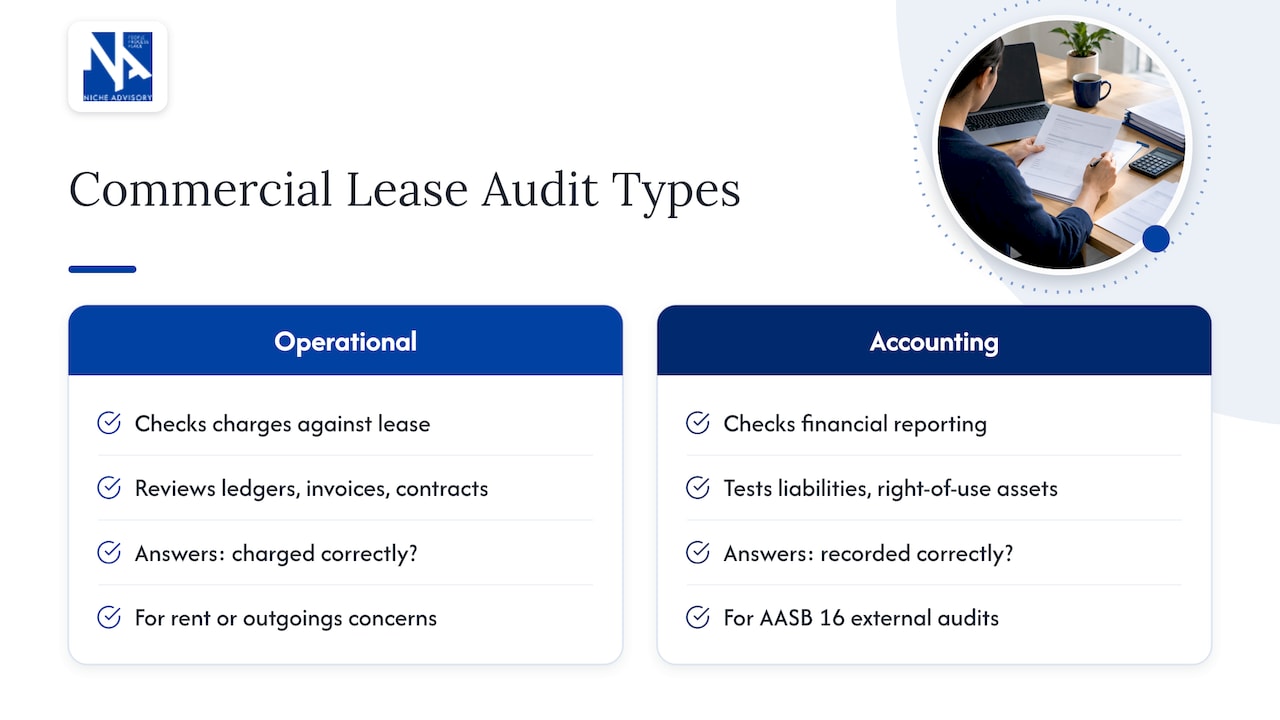
A commercial lease audit is an operational check. Baker Tilly describes it as an examination of expense ledgers, invoices, contracts, calculations and lease language to see whether charges match the lease. The question it answers is: did the landlord charge us correctly?
A lease accounting audit is a financial-reporting check. MRI Software explains that it tests whether lease liabilities, right-of-use assets and disclosures are complete and correctly measured under the applicable accounting standards. The question there is: did we record the lease correctly?
If your finance team is preparing for an external audit under AASB 16, you need the second. If you suspect you are paying too much for rent or outgoings, or you want to be sure before a renewal, you need the first. This article is about the first. The two do share an input: an accurate lease abstract. For the accounting side of lease terms, see our guide to matching lease term to fitout payback under AASB 16.
Step 1: Set the scope and check your audit rights
Before you pull a single invoice, decide what you are testing and how far back.
A sensible scope for most tenants is:
- the current and previous two financial years of outgoings,
- the rent schedule since commencement, including every review and increase,
- any incentive, rent-free period or abatement and how it has been applied,
- make-good and reinstatement obligations that will fall due at expiry.
Then read the lease for an audit or inspection clause. Nolo notes that an audit-right clause may specify who performs the audit, who pays, what can be examined and how errors are resolved, and that leases often set a deadline of 30 to 180 days after the reconciliation statement. That guidance is from the United States, but the point carries over: a short window can run from the day you receive the statement, so diarise it.
If your lease has no audit clause, you can still ask for supporting records. A clause makes the request enforceable. Without one, you are relying on statute (for retail leases) or on a reasonable, documented request.
Step 2: Gather the documents
An audit is only as good as the paper behind it. The documents to collect are, in the words of one commercial lease audit checklist: the executed lease and all amendments, side letters, work and commencement documents, assignments, guarantees, security documents, reconciliations, budgets, invoices, ledgers, payment records and prior correspondence.
In practice, build a folder with these items:
- The signed lease, every variation, and the disclosure statement if you received one.
- Any heads of agreement, side letters or emails that changed commercial terms.
- Landlord outgoings estimates and year-end statements for each period.
- Rent invoices, your own payment records and bank statements.
- Any guarantee or bank guarantee details and security deposit records.
- Condition reports and records of repairs and works, which matter for maintenance and make-good. If you have no tidy system, a guide on how to document repair work on business property shows what a useful record looks like.
Gaps matter as much as documents. If the landlord’s statement refers to a side letter you have never seen, write that down. It goes on the document-gap list you will produce at the end.
Step 3: Abstract the lease
Lease abstraction is the process of pulling the operative terms out of the lease into one structured summary. It is the step most tenants skip and the one that makes every other check faster, because you stop re-reading a 90-page document each time a question comes up.
A solid abstract records, according to CRE Terminal: parties, premises, area, commencement and expiry, options and notice dates, base rent and increases, incentives, the expense-recovery method, tenant share, base year or expense stop, caps, exclusions, gross-up rules, security, use, transfer rights and credit or security terms.
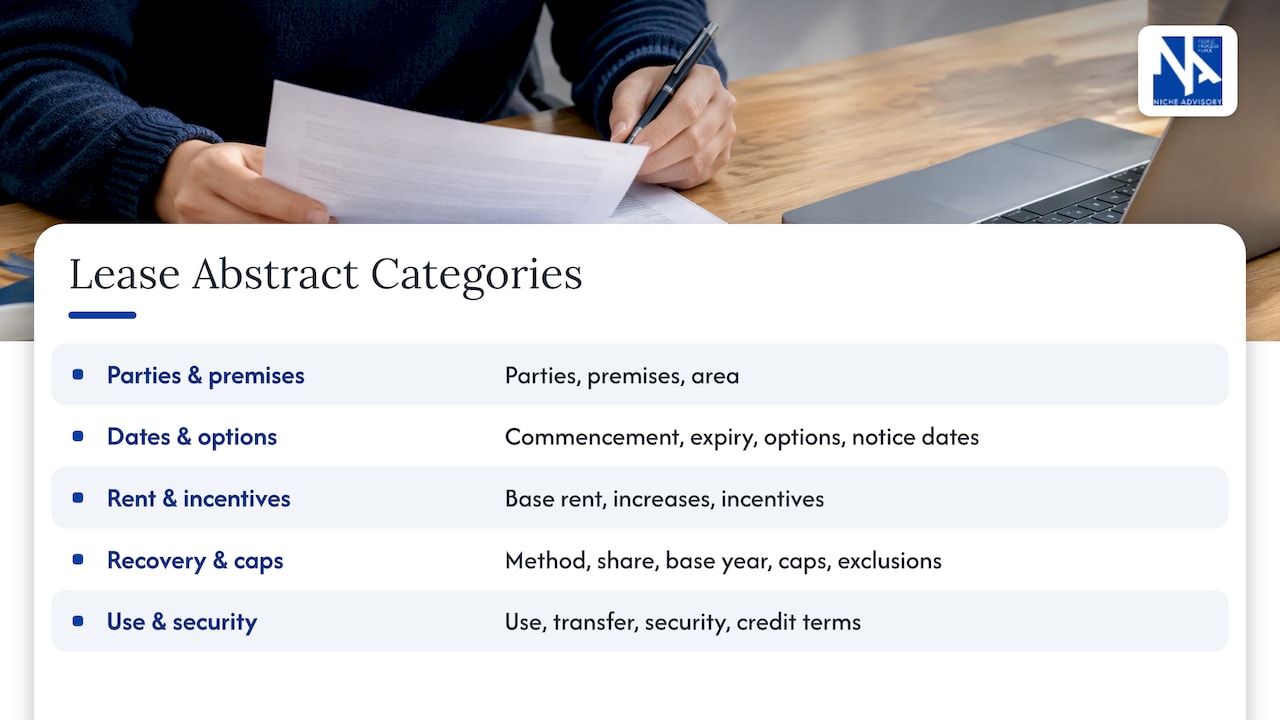
The same source flags expense recovery as a high-risk abstraction category, noting that a 5% cap recorded without its methodology is incomplete. A cap on what? Total outgoings, or a controllable subset? Cumulative or compounding? Those details decide whether the cap protects you.
Extra items for industrial and warehouse leases
For industrial premises, abstract the use restrictions, hazardous materials provisions, environmental indemnities, storage rack heights and floor loading, as one practitioner guide to lease abstracts lists them. These clauses often carry the largest end-of-lease exposure, and they are easy to overlook when you are focused on rent.
Extra items for Australian leases
Business Victoria advises tenants to confirm the rent-review method, responsibility for rates, taxes, insurance and other outgoings, maintenance responsibilities, permitted use, assignment rights, options and the consequences of early termination. Add each as a line in your abstract, with the clause number beside it so you can cite it later.
Step 4: Rebuild the rent from the lease
Do not start from the landlord’s rent roll or the invoice. Start from the lease and rebuild.
The checklist approach is to rebuild the rent schedule from the controlling documents and compare it with invoices, the ledger and payments, checking commencement, rent-free periods, abatements, fixed increases and contingent rent. Work through it in this order:
- Commencement date. Is rent being charged from the date the lease says, or from an earlier date?
- Base rent and area. Does the area used in the charge match the area in the lease?
- Fixed increases. Is the percentage right and applied on the right anniversary?
- Market or CPI reviews. Was the correct method used, was proper notice given, and did the review date fall where the lease says?
- Rent-free periods and abatements. Were they applied in full, and did they affect later increases only if the lease says so?
- GST. Is it applied consistently to every charge that attracts it?
Check incentives properly
Incentives are where good deals quietly go wrong. Legal 500’s Australian lease review checklist says to distinguish genuine rent-free time from deferred payment, confirm when outgoings start, check whether the concession affects future increases, and model any early-exit clawback or repayment. If you negotiated a fitout contribution or rent-free period, confirm it was delivered as documented. Our guide to negotiating landlord incentives explains how those packages are usually structured.
Step 5: Test the outgoings
Outgoings are where most overcharges hide, because they change every year and the landlord controls the data.
The NSW Small Business Commissioner lists typical outgoings as rates, water, insurance, cleaning, security, utilities, pest control, emergency services levies, and management and audit fees, and says the lease and disclosure statement should identify them. Headline rent is therefore not the full cost, and that is why outgoings need their own test. We cover the commercial impact in how outgoings can add 20 to 50% to rent.
What to test
- Is the item recoverable at all? Compare each line in the statement with the outgoings definition and the exclusions in your lease.
- Is it capital? Structural or roof works, plant replacement and similar items are common disputes. Review targets, as one audit guide lists them, include capital expenditure, structural or roof works, financing costs, leasing commissions, insurance recoveries, duplicated charges, management or administration fees, improper gross-up, incorrect vacancy allocation and costs reimbursed by other tenants.
- Is your share right? Check the denominator. Is your area divided by the correct lettable area of the building or the complex, and has it changed since the lease was signed?
- Is the cap applied properly? Use the methodology in your abstract.
- Is the same cost charged twice? Look for duplicates between management fees, cleaning and building services.
- Does the line trace to an invoice? Ask for the underlying supplier invoices for any item that has moved sharply year on year.
The practical risk often sits in method, not arithmetic: denominators, vacancy, gross-up, capital classification and caps. A statement can add up perfectly and still be wrong.
State rules that help you request records
Whether you have statutory rights depends on the type of lease and the state. According to a summary of Australian outgoings law, retail leases can attract state or territory rules on disclosure, estimates, annual statements, audit and disputes, while non-retail commercial leases are governed by the contract you signed. Many office and warehouse tenants are in the second group, which makes your lease wording even more important.
For retail leases, the Clayton Utz comparative summary on estimates shows how the rules differ:
| Jurisdiction | What the summary says |
|---|---|
| Queensland | Annual estimate required one month before the period, and an audited annual statement within three months after it. Itemisation generally must prevent any listed amount exceeding 5% of total outgoings, subject to stated exceptions |
| ACT and NSW | Estimate and statement requirements apply |
| Tasmania | Tenant may request estimates, actual-expenditure statements and an audit |
| Northern Territory | The Act addresses estimates and expenditure statements |
In NSW, the Small Business Commissioner explains that an estimate may precede the new financial year and an audited statement may follow within three months after year end, and that outgoings not disclosed might not be payable, depending on the law and the facts. For the Victorian position, the Victorian Small Business Commission states that a retail tenant is not liable to pay outgoings unless they are detailed in the lease. The Northern Territory’s Business Tenancies (Fair Dealings) Act 2003 covers recovery of outgoings, estimates, expenditure statements and adjustments to contributions.
These are summaries of rules that change. Confirm the current provision for your state and lease type with your solicitor before you rely on it.
Step 6: Log every variance
Keep findings in one register from day one. The final deliverable of a lease audit, as the checklist guidance puts it, should include a current lease abstract with clause citations, a variance log, a document-gap list and a critical-date register, with each open item assigned an owner and a deadline.
A workable variance log has these columns:
| Column | Example entry |
|---|---|
| Item | Management fee, FY2025 statement |
| Lease reference | Clause number and wording |
| Amount charged | Figure on the statement |
| Amount expected | What the lease supports |
| Evidence held | Invoice, statement, payment record |
| Status | Query raised, records requested, resolved |
| Owner and deadline | Named person and date |
Be careful with the word “overcharge”. A flagged item is a reason to request records, not proof of an error. SaveOnLease’s checklist cautions that source documents are needed before concluding a charge is wrong. Write the first letter to the landlord as a request for information, not an accusation. It keeps the relationship workable and gets you the documents faster.
The critical-date register is the quiet payoff. Option notice windows, review dates, make-good deadlines and audit-request deadlines all belong in one calendar. Missing an option date can cost more than any single outgoings error.
Lease audit checklist
Use this as a one-page summary of the six steps.
- [ ] Scope set: periods covered, items covered, audit clause read
- [ ] Full document set collected, gaps listed
- [ ] Lease abstract built with clause references
- [ ] Rent schedule rebuilt from the lease and compared with invoices and payments
- [ ] Incentives and rent-free periods confirmed as delivered
- [ ] Outgoings tested for recoverability, capital items, share, caps and duplicates
- [ ] State or territory rules checked if the lease is a retail lease
- [ ] Variance log complete, each item with an owner and deadline
- [ ] Critical dates diarised
- [ ] Landlord queries issued as requests for records
When to bring in independent advice
You can run steps 1 to 3 in-house. Bring in help when:
- The amounts are material. Outgoings that run well above what the lease suggests justify an independent review.
- The lease method is unclear. Caps, gross-up and base-year mechanisms are easy to misread.
- A legal question arises. Whether an item is recoverable, whether a notice was valid, or whether a statutory protection applies is a question for your solicitor.
- Accounting treatment is affected. If a finding changes rent or term, tell your accountant, because it can change your lease accounting under AASB 16.
- A renewal or relocation is close. Audit findings are leverage, and they are worth most before you negotiate.
Our commercial lease negotiation checklist and the tenant representation plan show how audit findings feed into a renewal or relocation.
How Niche Advisory can help
We act only for tenants and owner-occupiers, never landlords, so our advice on your lease is independent of the other side. Our lease administration and make-good services support the ongoing monitoring of rent reviews, option dates and reinstatement obligations. If an audit turns into a disagreement with your landlord, our dispute resolution services are set up to help, and our corporate tenant advocacy team can take the findings into a renewal negotiation.
FAQ
How often should we audit our commercial lease?
At a minimum, review outgoings each year when the landlord’s statement arrives, and run a full audit before any renewal, option exercise or relocation. If your lease sets a short window to query a statement, treat that window as the deadline for the annual check.
What is the difference between lease abstraction and a lease audit?
Abstraction extracts the key terms into a structured summary. A lease audit then uses that summary to test what you are actually being charged. Abstraction is the first half of the audit, not a substitute for it.
Do I have a right to see the landlord’s outgoings records?
It depends on your lease and its type. Retail leases in several states carry statutory estimate, statement and sometimes audit rights, while non-retail leases usually depend on the contract. Read your audit clause first, then ask your solicitor about your state.
Who should perform a lease audit?
A tenant-side property advisor, an accountant or a solicitor can each do part of it. Choose by the question: billing and method need property expertise, legal entitlement needs a solicitor, and financial reporting needs your accountant.
Sources
- Lease audits FAQs, Baker Tilly
- Lease Audit Guide, MRI Software
- What is a Lease Audit?, Nolo
- Commercial Lease Audit Checklist for Tenants and Owners
- Office Lease Abstracting and Audit, CRE Terminal
- How to create a comprehensive lease abstract
- Understand lease agreements, Business Victoria
- Commercial Lease Review Checklist, Legal 500
- Understanding the costs of leasing, NSW Small Business Commissioner
- How to Audit CAM Charges on a Commercial Lease, REAL
- Australian Commercial Lease Outgoings: Tenant Audit Guide
- Estimates of outgoings, Clayton Utz
- Outgoings: other charges under a lease, Victorian Small Business Commission
- Business Tenancies (Fair Dealings) Act 2003 (NT), AustLII
- Tenant-First CAM Audit Checklist, SaveOnLease