Workplace personas are semi-fictional profiles that represent groups of employees who work in similar ways. Each one describes how that group works, what it needs from the office and what frustrates it. They are built from data and interviews with real employees, so they tell you far more than age, role or location can. Used well, they turn a vague question (“what should our office be?”) into a practical one (“what does each group of our people need from it, and how much of that do we need to lease?”).
This guide explains what personas are, how to build and check them, and how to carry them into hybrid policy, lease decisions and fitout. It is written for Australian business leaders, HR managers and facilities managers who occupy leased space.
TL;DR
- A workplace persona is a research-based profile of a group of employees with shared goals, motivations and pain points. It is not a job title or a demographic bracket.
- Build personas from interviews, observation, surveys and internal data, then validate them with the employees they describe.
- Keep the set small. Most organisations are better served by a handful of personas than by a long list nobody remembers.
- Personas matter most when they feed real decisions: hybrid policy, floor plan, desk ratios and how much space a lease should cover.
- Collect only the personal information you need, and tell employees what you collect and why.
Table of Contents
- What workplace personas are, and what they are not
- Examples of workplace personas
- How to build workplace personas
- Privacy: collect what you need and say why
- Turning personas into hybrid policy and space decisions
- Measuring whether persona-based decisions work
- Common mistakes to avoid
- From personas to a lease and fitout plan
- FAQ
- Sources
What workplace personas are, and what they are not
A persona describes a type of person at work, not an individual. Personas are distinct employee groups with shared goals, motivations and pain points, drawn from experience data, demographic information and analytics. A persona usually gets a name, a short description of a typical week, the tasks they do, the tools and spaces they rely on, and what gets in their way.
Three contrasts make the idea clearer.
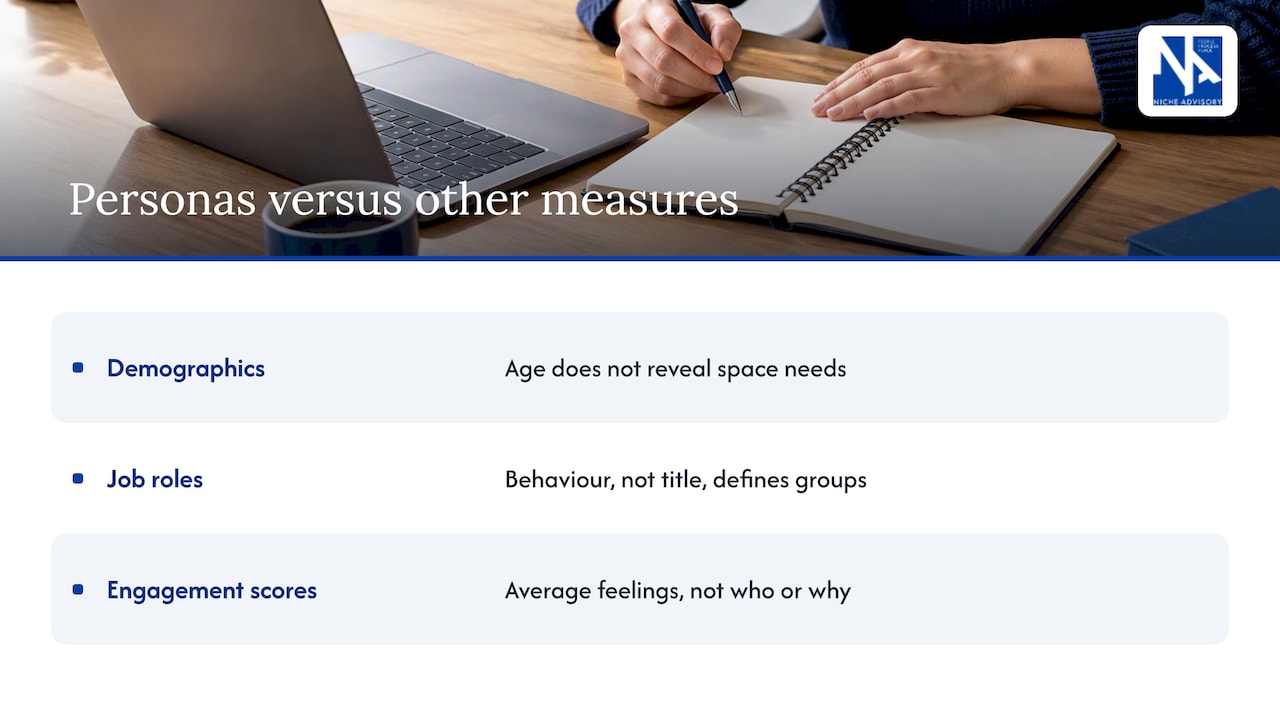
Personas versus demographics. Demographics tell you that 40% of staff are under 35. They do not tell you who needs quiet focus time, who spends the day on client calls, or who comes in only to collaborate. Two people with the same age and title can need very different spaces.
Personas versus job roles. A common mistake is to assume personas should mirror the org chart. Step Two, an Australian intranet consultancy, warns against personas that follow organisational structure or job role and against generic profiles that gloss over real differences in need. Behaviour, not title, is what separates one persona from another. A finance analyst and a designer may share a persona if they both need long stretches of uninterrupted work.
Personas versus engagement scores. An engagement survey tells you how people feel on average. A persona tells you which group feels it and why. Personas give the numbers a face, which makes it easier to decide what to change.
Examples of workplace personas
There is no standard list. Every organisation’s personas should come from its own people. Still, examples help you see the shape of the output.
Some frameworks sort people by wellbeing. Gallagher’s Australian workforce research, for instance, groups employees as Thrivers, Survivors and Strugglers so employers can tailor wellbeing and benefits. That is useful for HR programs, but it says little about space.
For property and workplace decisions, work-style personas are more practical. These are illustrative groups, not a finding about any particular company:
| Persona | How they work | What they need from the office |
|---|---|---|
| The Anchor | In the office most days, often client-facing or operational | A reliable personal or team desk, good meeting rooms, easy access to equipment |
| The Collaborator | In two or three days a week, mostly for workshops and team work | Bookable team zones, whiteboard walls, quality video-conferencing |
| The Deep Worker | Splits time, does analysis, writing or design | Quiet zones, phone booths, low-distraction desks, good acoustics |
| The Connector | Moves between sites, clients and home | Hot-desks, lockers, fast check-in, a welcoming place to host |
| The Remote Regular | Mostly at home, visits for key moments | Event and team-day space, a predictable way to book a desk |
Notice what is absent: no department names. The same persona can span sales, legal and operations. That is the point.
How to build workplace personas
The method is research first, writing second. Organisations can develop personas using interviews, workplace observation, surveys and internal sources such as IT planning documents and HR discussions. Here is a sequence that works for a mid-sized organisation.
1. Define the decision the personas will serve
Start with the question you need answered. Are you deciding how many desks to lease at renewal? Writing a hybrid policy? Planning a fitout? The decision sets the questions you ask. A persona set for a lease renewal needs attendance patterns and space-use data. One for an intranet redesign needs information habits.
2. Gather the data you already have
Before you ask anyone anything, collect what exists:
- Badge, Wi-Fi or desk-booking data showing when and where people work.
- Room booking records, to see which meeting spaces are overbooked and which sit empty.
- Floor plans and building capacities, so people-data can be compared with supply.
- Engagement and exit survey results.
- IT records on devices, software and remote access.
This mix of people-data and facilities-data is what makes personas useful for property decisions. Dynamic personas can combine employee requirements with facilities data such as floor plans and building capacities to inform hybrid policies and office and technology choices.
3. Talk to people and watch how they work
Data tells you what people do. Interviews tell you why. Aim for a spread of roles, seniority, locations and working patterns, including people who rarely come in. Ask about a recent typical week, what they do on office days and what they do at home, what stops them getting work done, and what they would change first.
Observation adds a layer that interviews miss. Walk the floor at different times. Note where people choose to sit, which rooms get avoided and where informal conversations happen.
If you want a structured look at research methods for understanding employee needs and work patterns, the thinking behind architectural design for commercial renovation shows how user needs are carried into a physical design brief.
4. Cluster and draft
Look for patterns across interviews and data: similar tasks, similar rhythms, similar frustrations. Group people by behaviour and need. Draft each persona on one page: a name, a short story, goals, pain points, a typical week and what they need from the workplace. Resist adding every detail you heard. A persona is a summary built to be remembered.
5. Co-create and validate
This step separates useful personas from fiction. Step Two’s James Robertson stresses that personas must be co-created with stakeholders and validated by employees so they act as true stand-ins for real users, and warns against building them only from executive assumptions or broad industry trends.
In practice, take the drafts back to a cross-section of staff and ask: “Do you recognise yourself or a colleague here? What is wrong or missing?” Revise until people say “that is me”.
6. Keep the set small
More personas is not better. One Australian guide to intranet personas suggests four to seven is ideal depending on organisation size, and that more can become a distraction. That guidance is about intranets, but the logic carries to workplace design: a set you cannot recall in a meeting will not shape decisions.
Privacy: collect what you need and say why
Persona research involves personal information, so handle it carefully. The Fair Work Ombudsman’s workplace privacy guide says that employers should limit personal information collection to what is necessary for business functions and tell employees what they collect and why.
In practice:
- Tell staff what the research is for before you start.
- Prefer aggregated or de-identified space-use data over tracking named individuals.
- Do not collect more than the decision needs.
- If you are unsure how your obligations apply to a particular tool, such as badge analytics or sensors, check with your legal adviser or the Office of the Australian Information Commissioner before rolling it out.
Transparency also helps the research itself. People give more honest answers when they know how the information will be used.
Turning personas into hybrid policy and space decisions
Personas earn their keep when they change a decision. Here is where they help most for tenants.
Hybrid policy
A single rule such as “three days in the office” treats the Anchor and the Remote Regular the same. Personas let you set expectations by purpose: team days for Collaborators, flexible attendance for Deep Workers, defined anchor days for Connectors. The aim is to give people a reason to attend that matches what the office offers.
It also helps to see the gap between preference and policy. A 2023 survey of Australian knowledge workers found 51% identify hybrid work as their preferred workspace, and employees are over 2.5 times more likely than their senior leaders to work full-time in the office. If leaders are designing for their own habits, personas built from employee research will show where that diverges from how most staff work.
Any change to working arrangements also has a legal side. Under the Fair Work Act, eligible employees can request changes to working arrangements, and the Fair Work Commission has dealt with disputes over such requests. In one 2026 matter, the Commission found a request invalid under section 65 and did not reach reasonable business grounds. For anything affecting individual employees, speak to an employment lawyer or HR adviser before you change policy.
Desk ratios and floor plans
Personas feed directly into how many work points you need and what kind. Shared-desk arrangements are now common even in government. Commonwealth entities’ office occupancy reports show that hybrid, shared work-point arrangements grew from 23.7% in 2023 to 38.9% in 2025.
At a single-agency level, the Australian Electoral Commission proposed a new fitout with 1,046 work points for up to 1,308 staff, an 8:10 ratio, to support flexible working and efficient use of space. Your right ratio will differ. It depends on your personas, how their attendance overlaps, and which days peak. That is exactly what persona and utilisation data show.
The mix matters as much as the count. Five personas with different needs call for a mix of settings: team neighbourhoods, focus rooms, phone booths, social areas and bookable desks, not rows of identical workstations.
Lease size, term and flexibility
For a tenant, the most expensive error is paying for space the personas show you will not use, or locking into a footprint that no longer fits. Personas, combined with utilisation data, give you a defensible number to take into a lease renewal, relocation or negotiation.
We cover the lease side in more depth in our pieces on getting your hybrid workplace strategy right on the lease side and how a flexible workspace strategy protects you from wasted rent. If your portfolio has several leases, the personas can also show which sites are working and which are not.
Employee experience and productivity
Personas help teams design experiences that support, engage and retain employees and show where workplace investment may be needed. The Australian Human Resources Institute makes a related point: personas help HR keep the unique needs of different employees front of mind when creating or updating initiatives.
Be careful about assuming location is the lever. Australian research from the University of Sydney found that hybrid workers had the highest motivation, but long working hours harmed their wellbeing and performance, and work location was not the key reason for poor job performance. The lesson for persona work: look at workload and working hours, not only where people sit. For a practical approach to the office side, see our guide to fixing office employee experience for Australian HR.
Measuring whether persona-based decisions work
Set success measures before you change anything. Useful indicators include:
- Retention and voluntary turnover for the groups you targeted.
- Productivity or output measures that make sense for each persona.
- Engagement and satisfaction, including eNPS and an employee satisfaction index, as tracked by many organisations when assessing workplace policies.
- Space data: peak and average occupancy, room booking rates, and the share of desks never used.
- Short pulse questions by persona, such as “Can you do your best work on your office days?”
Review results by persona rather than in aggregate. An improvement for Collaborators can hide a decline for Deep Workers.
When to update personas
Treat personas as a living tool. Revisit them when something material changes: a new hybrid policy, a merger, a move, a significant hiring wave, new technology, or a lease event. A good habit is to check them against fresh utilisation data at least once a year, and to refresh them with new interviews before any major property commitment. People can also move between personas over time as roles, life stages and teams change, so personas describe patterns of work rather than fixed labels on individuals.
Common mistakes to avoid
- Building from assumptions. Personas written in a leadership workshop without employee input reflect leadership. Interview and validate.
- Following the org chart. Group by behaviour and need, not department.
- Being generic. If a persona could describe anyone, it will change nothing. Include specific tasks, frustrations and spaces.
- Too many personas. Keep the set memorable.
- Stopping at the document. A beautiful persona deck with no link to the floor plan, policy or lease is decoration. Tie each persona to a decision.
- Labelling individuals. Personas describe groups. Do not use them to pigeonhole a named person.
- Ignoring privacy. Collect only what is necessary and be open about it.
From personas to a lease and fitout plan
Personas are the start of a property decision, not the end. Once you know who needs what, the next steps are to size the footprint, test options against your lease timeline, and plan the move or fitout.
This is where we work with tenants. Niche Advisory acts exclusively for tenants and owner-occupiers, never landlords, and combines workplace strategy with independent advice and delivery. That includes corporate tenant advocacy for search, lease negotiation and renewal, plus design and project management. If you are working out what your people need before a renewal or relocation, a conversation with our team can help you turn persona findings into a space brief and a negotiating position. You can also read our guide on stopping office fitout delays with three early moves.
FAQ
What is a workplace persona?
A workplace persona is a semi-fictional profile that represents a group of employees with similar goals, behaviours and needs. It is built from interviews, observation and data about real people. Organisations use it to design policies, spaces and services around how groups actually work.
How many workplace personas should we create?
Fewer than you think. Guidance for intranet personas suggests four to seven depending on organisation size, and the same principle applies to workplace design: if people cannot remember the set, they will not use it. Start with the smallest set that explains the real differences in how your people work.
How do workplace personas differ from customer personas?
The method is similar, but the subject is your own workforce. Customer personas help you sell. Workplace personas help you design the work environment, hybrid policies and employee experience. Because they involve employees’ personal information, privacy and transparency matter more.
Can personas tell us how much office space we need?
They are one input. Personas show what kinds of space different groups need and how often. Combined with attendance and booking data, they help you estimate work points and the mix of settings. Your final number should also reflect peak days, growth plans and lease flexibility.
How often should we update our personas?
Review them at least annually, and refresh them with new research before major decisions such as a lease renewal, relocation or fitout. Update sooner if your hybrid policy, team structure or technology changes significantly.
Sources
- 3 reasons employee personas are a must-have tool, Envoy
- Persona Development, HUB International
- 2025 Workforce Trends Report, Gallagher Australia
- Employee personas and how to create them, Step Two
- The Importance of Dynamic Personas in your Hybrid Work Strategy, WWT
- Crafting Intranet Personas for Enhanced Employee Experiences, Propelle
- Workplace privacy best practice guide, Fair Work Ombudsman
- The Future of Digital Work: Australia, Data#3
- Kellie Fitzpatrick v University of New South Wales, Fair Work Commission
- Australian Government Office Occupancy Reports, Department of Finance
- Australian Electoral Commission fitout proposal, Parliament of Australia
- Why develop an employee persona?, AHRI
- Hybrid work and job performance, University of Sydney
- Redefining employee personas for the flexible workplace, Flexa