Make good costs depend on your lease, not on a standard price list. One engineering firm puts the average for Australian CBD offices at around $450 per square metre across all trades, but your own figure is set by what the lease says you must hand back, the condition you received and the work your fit-out needs. The sections below explain how the bill is built, what to budget and what to do 6 to 12 months before expiry.
TL;DR
- Make good is a contractual obligation. Your lease and its related documents decide what you owe, so read them before you estimate anything.
- One published figure for Australian CBD offices is around $450 per square metre across all trades, with mechanical services at $30 to $80 per square metre. Treat it as a rough marker, not a quote.
- Size, condition and fit-out complexity move the cost most. A condition report from the start of the lease is your best evidence.
- Start the conversation with your landlord 6 to 12 months before expiry. Too little time usually means a cash settlement.
- Budget for the work early. Incomplete make good can lead to bond withholding and claims for loss, including rent.
Table of Contents
- What make good means in a commercial lease
- What work a make good usually covers
- What drives the cost up or down
- Cost figures to use as a starting point
- Make good costs in different states
- What happens if you do not finish the work
- A timeline that keeps costs under control
- Documents to gather before you talk to the landlord
- Ways to reduce what you pay
- How make good appears in your accounts
- Where we can help
- FAQ
- Sources
What make good means in a commercial lease
Make good is the process, at the end of a commercial lease, in which the tenant hands the premises back in the condition the lease requires. RICS describes it as a contractual process that commonly involves removing tenant fixtures and repairing or redecorating the space. The key word is contractual. There is no universal definition of “original condition”, so the answer sits in your lease and any documents attached to it.
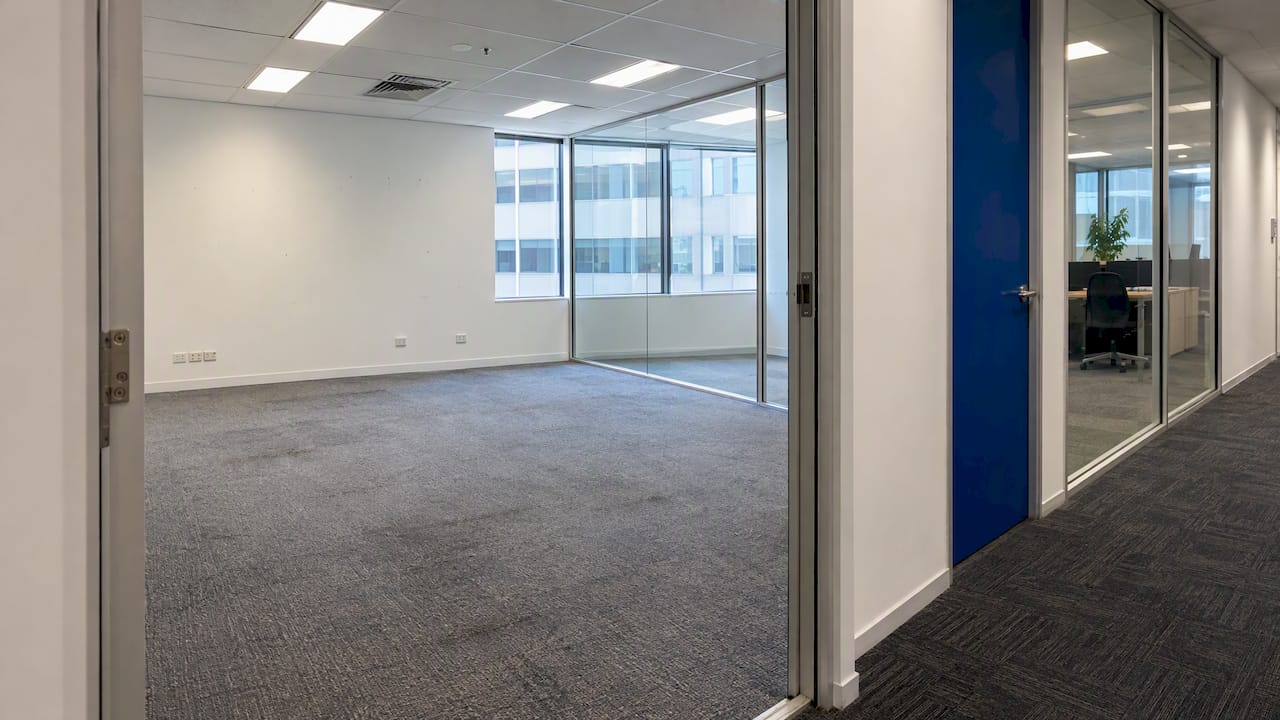
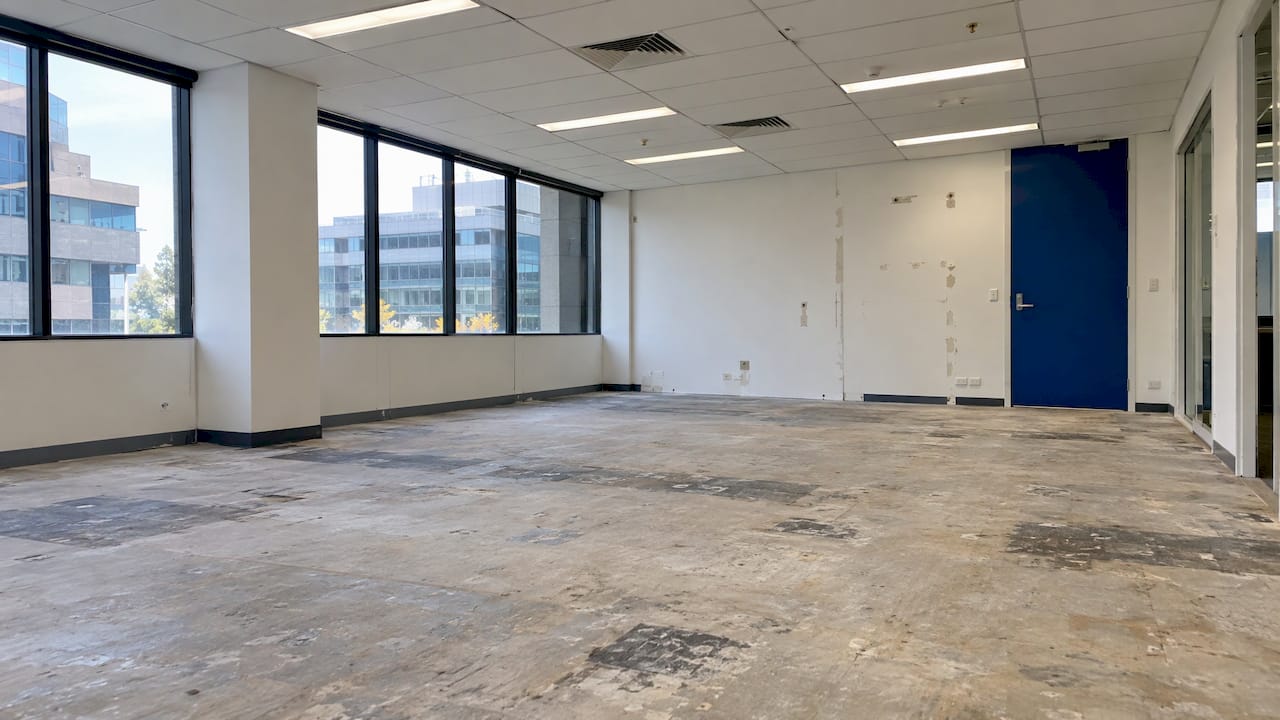
That is why two tenants with identical floor areas can face very different bills. One may need to strip out partitions, joinery and ceiling finishes and return to a bare shell. Another may only need to repair damage and clean. The lease wording, alteration consents and what the landlord approved at the start of the tenancy all feed into the answer.
The same logic applies to industrial and warehouse premises, although the work looks different: removing racking, mezzanines, office pods or added services, repairing floors and walls, and reinstating anything altered.
What work a make good usually covers
The Queensland Small Business Commissioner lists the work commonly seen in make-good obligations. It is a useful checklist whichever state you are in, because most commercial leases draw on the same categories.
| Work item | What it typically involves |
|---|---|
| Repairing damage | Fixing damage the tenant caused during the lease |
| Removing tenant additions | Taking out installed fixtures, partitions, joinery, flooring and ceiling finishes |
| Restoring layout | Returning the floor to an open plan where the space was handed over that way |
| Services reinstatement | Returning air-conditioning, fire and hydraulic services to their original state |
| Cleaning | Final cleaning of the premises |
Not every item will apply to you. What matters is which of them your lease actually names, and whether the landlord will insist on them or accept the space as is.
What drives the cost up or down
RICS says scope and cost vary with premises size, condition and fit-out complexity. In practice, five things do most of the work.
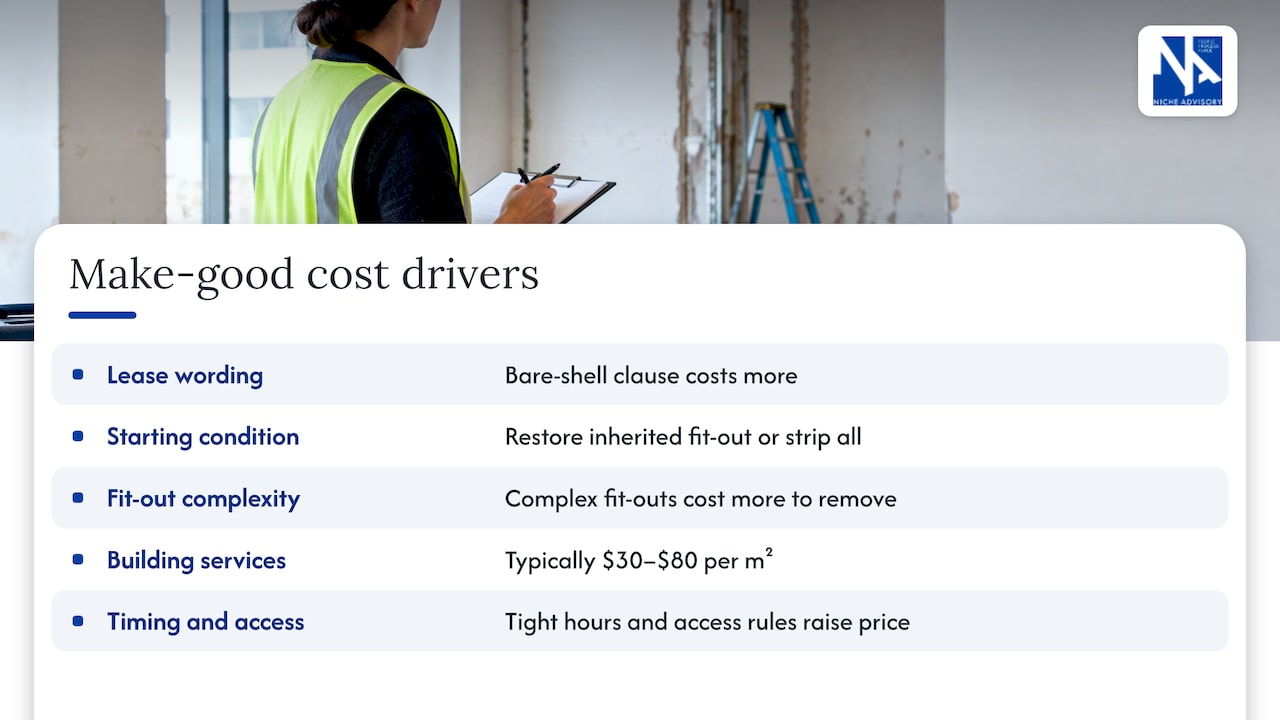
The lease wording. A clause requiring return to bare shell is far more expensive than one requiring repair of damage and fair wear and tear. Vague wording is expensive in a different way: it invites argument.
The condition at the start. If you moved into a space that already had partitions, carpet and a ceiling grid, the question is whether you must restore what was there or strip everything. A dated, photographed condition report settles much of this. Our own guidance on why you need a condition report for a new commercial lease explains what to capture.
The size and complexity of your fit-out. Glazed meeting rooms, raised floors, bespoke joinery, server rooms, kitchens and added cabling all cost more to remove than open desks on carpet.
Building services. Ceiling-mounted air-conditioning, sprinklers and lighting are often among the larger line items because changes touch the base building. A CCC Engineering article states that mechanical services typically run at $30 to $80 per square metre.
Timing and access. Tight hours, lift bookings, building rules and a short run to expiry can all increase the price. Works that overrun can also trigger holding-over rent.
Cost figures to use as a starting point
The figure you will see most often in the market is an average, and it should be read as one. The same CCC Engineering article claims that Australian CBD office make good averages around $450 per square metre across all trades. It comes from a company blog, so use it as a ballpark for early budgeting rather than a basis for negotiation.
Here is how that ballpark works in a simple, illustrative example. Say you occupy 500 square metres in a CBD office.
- At $450 per square metre, the all-trades figure is $225,000.
- The mechanical services portion, at $30 to $80 per square metre, would be $15,000 to $40,000 of that.
Those numbers are arithmetic on a published average, not a quote for any building. A suburban office with a light fit-out and a lease that only asks for repair and cleaning could land far below it. A heavily built-out floor with a bare-shell requirement could land above it.
How professionals estimate the number
RICS says make-good value is generally based on the cost of the works needed to comply with the lease. A claim can alternatively assess the reduction in the premises’ value caused by non-compliance. For costing, RICS recommends one of the following:
- Current recognised price books, adjusted for state or region.
- Recent comparable tender prices.
- Competitive tendering against a full specification.
- A cost consultant.
The practical lesson is that a number backed by a specification and competitive quotes carries more weight in a negotiation than a per-square-metre rule of thumb. The NSW Small Business Commissioner suggests considering an independent certified quantity surveyor to determine costs.
Make good costs in different states
Make good is mostly contract law, but the default rules and guidance differ by state, and that can affect your starting position.
Queensland. The Queensland Small Business Commissioner says the Property Law Act 2023, Schedule 1, section 3 generally requires return in the same or better condition as at commencement. That is subject to reasonable wear and tear, specified disasters and risks insured by the lessor. The parties can exclude or alter those standard terms under section 139, so a clear negotiated clause can replace the default. The Commissioner’s view is that tenants should not assume wear-and-tear protection answers the make-good question. Read the factsheet before relying on any default.
New South Wales. The NSW Retail Tenancy Guide 2022 says make-good provisions typically require an empty and neutral state, sometimes base-building or bare-shell condition and redecoration. Retail leases may provide for binding cost determination by an independent certified quantity surveyor nominated through the AIQS or another industry body. Office and industrial leases are not retail leases, so check which regime applies to you. Our overview of Sydney commercial lease make good obligations covers how this plays out for Sydney tenants.
Other states. Victoria, South Australia and the rest apply their own legislation and lease practice. The principle holds everywhere: the lease you signed decides, and local rules fill gaps.
What happens if you do not finish the work
Most leases allow either physical make good or a negotiated cash settlement. The Queensland Small Business Commissioner notes that failing to complete on time may lead to additional rent or penalties.
The NSW Small Business Commissioner advises tenants to allocate funds for the required work. It warns that incomplete make good can expose a tenant to bond withholding and to claims for loss or damages, including rent. RICS adds that a landlord’s schedule may include professional fees and loss of rent where works are not completed during the lease term.
In plain terms, running out of time rarely makes the obligation disappear. It usually turns it into a financial claim, and a claim made by the landlord’s consultant tends to be higher than a tender you ran yourself.
A timeline that keeps costs under control
RICS recommends starting dialogue 6 to 12 months before expiry where needed. That gives you time to assess obligations and either complete the works or agree a monetary settlement. Where time is insufficient, the lessee is usually obliged to settle financially.
A workable sequence looks like this:
- 12 months out: Gather the lease documents and the condition report. Decide whether you are renewing, relocating or exiting, because that changes everything. If you might stay, a renewal can sometimes avoid or defer the obligation. See our notes on lease re-negotiation.
- 9 to 12 months out: Get an independent view of your obligations and a specification of the work.
- 6 to 9 months out: Open discussions with the landlord on scope. Ask what they will actually require given their plans for the space.
- 4 to 6 months out: Tender the work, or agree a cash figure with evidence behind it.
- Final months: Complete the work, inspect with the landlord and agree a handback certificate in writing.
A landlord who intends to refurbish the floor, or re-let it to a tenant who wants your fit-out, may not want the work done at all. That conversation only happens if you start it early.
Documents to gather before you talk to the landlord
RICS lists what a proper review should look at. Collect the following:
- The complete lease and its plans, plus any variations.
- Alteration licences or consents for work you carried out.
- Side letters and any agreements about handback.
- The schedule of condition and photos from the start of the tenancy.
- Fixture schedules and relevant approvals.
- The specific repair, redecoration, removal and reinstatement clauses.
The Queensland Small Business Commissioner identifies the recurring causes of disputes: inadequate evidence of the starting condition, vague clauses, disagreement about the quality of workmanship, and removal of additions that another party values. Most of them are answered by paperwork you can assemble now. If you did not get a condition report at the start, our guide to the importance of an office condition report explains how to reconstruct one and why it matters for your next lease.
When the landlord sends a claim, RICS says the schedule should identify each allegedly breached lease clause, describe the breach and the remedial work, and state the associated costs. If a claim does not do that, ask for it to be reissued before you negotiate on numbers.
Ways to reduce what you pay
There is no trick to cutting a make-good bill, only a set of habits that keep it honest.
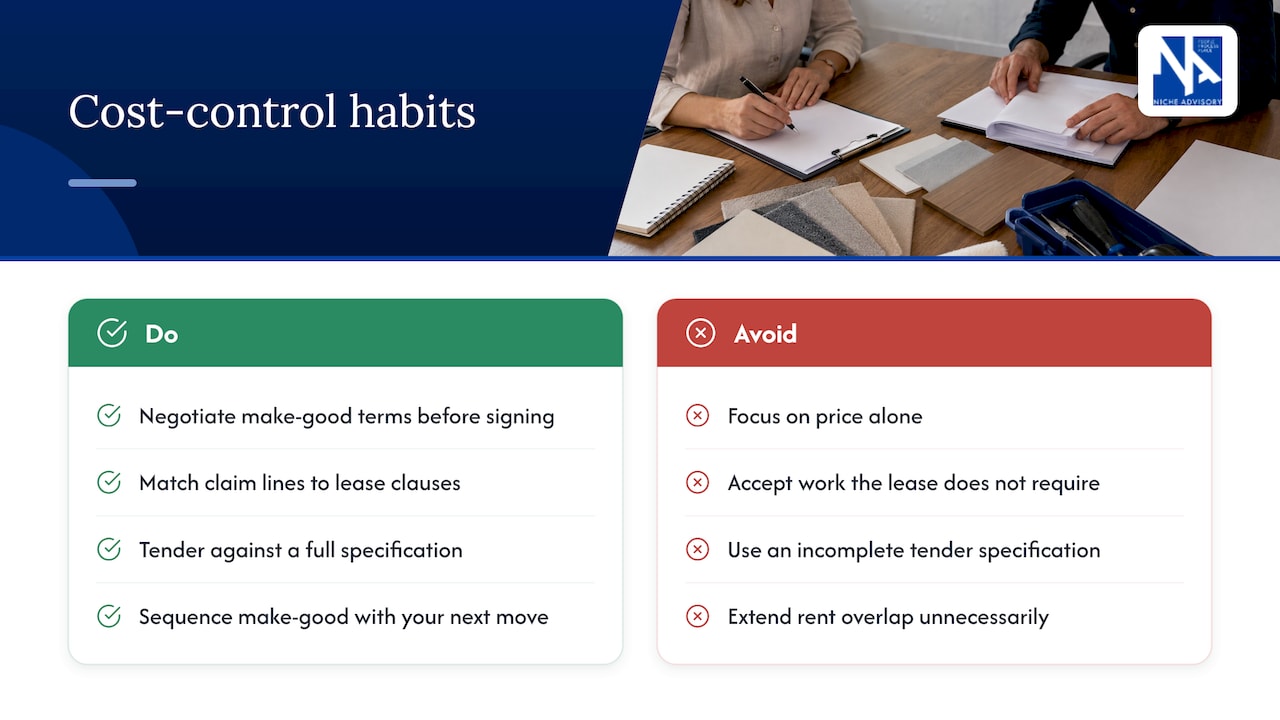
Negotiate it before you sign. The NSW Small Business Commissioner recommends agreeing make-good provisions before signing and documenting the commencement condition in a condition report. That is the cheapest point to win the argument. A clause that excludes existing base-building items, or limits reinstatement to what you installed, can save tens of thousands of dollars.
Challenge the scope, not just the price. Many claims include items the lease does not require or work the landlord will never carry out. Match every line to a clause.
Tender the work. Competitive quotes against a full specification give you a defensible number. Insist that the specification matches the lease and nothing more.
Consider a cash settlement. If the landlord is going to rebuild the space anyway, a negotiated payment can cost less than stripping out and restoring. It also removes the risk of overrun at the end of the lease.
Plan the exit with the next move. If you are relocating, sequence the make good with the move so you are not paying rent on two floors for longer than needed. Where you want out early, lease surrender is another route to discuss.
Keep fit-out and lease term in step. The longer the term, the longer you have to recover the cost of a fit-out, and the make-good liability should be part of that calculation. Our piece on matching lease term to fit-out payback under AASB 16 shows how to think it through.
How make good appears in your accounts
Make good is also a financial reporting matter, not just a project cost. The Department of Finance states that under AASB 116, make-good costs can form part of the cost of property, plant and equipment when the obligation is incurred on acquisition or through use. On initial implementation of AASB 16, a lessee should recognise an AASB 137 provision for expected lease-end make-good costs, with a matching leasehold-improvements asset that includes the capitalised make-good costs. That guidance is written for Commonwealth entities, but it shows the treatment your finance team will want to review.
If you are weighing how to pay for a fit-out or restoration, read about leasehold improvement financing options alongside your accountant’s advice. Cash flow is easier to manage when the make-good provision is in your forecasts from the first year, not the last.
Where we can help
We act only for tenants and owner-occupiers, never landlords, so our advice on make good is independent of the party claiming it. Our corporate tenant advocacy work covers lease review, negotiation and make-good negotiation. For works that need to happen, our project and construction management team can run the process. If a landlord’s claim is already in dispute, see our dispute resolution services. To talk through your lease, start at Niche Advisory.
FAQ
How much does a make good cost per square metre in Australia?
There is no fixed rate. One engineering firm’s published figure for Australian CBD offices averages around $450 per square metre across all trades, with mechanical services at $30 to $80 per square metre. Your cost depends on your lease wording, the starting condition and your fit-out, so get a specification and quotes before you budget.
Are end of lease costs the same as make good costs?
Not quite. Make good is the cost of returning the premises as the lease requires. End of lease costs can also include holding-over rent, professional fees, cleaning, removal of your equipment and, where works are incomplete, claims for lost rent. Check your lease for each.
Can I pay cash instead of doing the make good work?
Often yes, if your lease permits it or the landlord agrees. The Queensland Small Business Commissioner says leases may allow physical make good or a negotiated cash settlement. Agree the figure in writing, with a scope that matches the lease clauses.
When should I start planning my make good?
RICS recommends starting dialogue with the landlord 6 to 12 months before expiry where needed. That allows time to assess obligations and either do the work or settle. Leaving it later usually pushes you toward a financial settlement on the landlord’s terms.
Does reasonable wear and tear protect me?
Not automatically. In Queensland, the default rule is subject to reasonable wear and tear, but the parties can replace it with their own terms. The Queensland Small Business Commissioner cautions that a clear negotiated clause overrides the default, so read your lease wording first.
Sources
- RICS, Make good Australia, 3rd edition (October 2023)
- Queensland Small Business Commissioner, Make good factsheet
- NSW Small Business Commissioner, Make good and retail leases
- NSW Small Business Commissioner, Understanding the costs of leasing
- NSW Retail Tenancy Guide 2022
- Department of Finance, Make Good
- CCC Engineering, Make good HVAC obligations in commercial leases
- Leasehold improvement financing options for tenants