A right of first refusal (ROFR) in a commercial lease gives a tenant the first chance to take space, usually neighbouring space, on the same terms the landlord is ready to accept from someone else. In Australia the phrase has no fixed legal meaning. A court reads the words of your particular clause, so what you actually get depends on the drafting: what triggers it, what space it covers, how much time you have and what happens if you stay silent.
This guide explains how a ROFR works in practice, how it differs from a right of first offer (ROFO) and from an option to renew, and what a tenant should push for before signing.
TL;DR
- A ROFR is triggered when the landlord has a third-party offer it is prepared to accept. You then get the chance to match it.
- A ROFO works earlier: the landlord offers you the space on its own terms before going to market.
- An option to renew is a different right. It extends your existing premises, not your access to other space.
- Australian courts treat “right of first refusal” as a label, not a defined term. Drafting of trigger, space, notice and timeframe decides everything.
- Response windows are short, often days, and silence usually means the right is lost. Route every notice to a named person.
Table of Contents
- What a right of first refusal means in an Australian commercial lease
- When is a ROFR triggered?
- How the process works: notice, response and matching
- ROFR vs ROFO: the difference that matters
- ROFR vs option to renew
- Do state laws change any of this?
- What to check and negotiate in a ROFR clause
- Getting the clause reviewed before you sign
- How Niche Advisory can help
- FAQ
- Sources
What a right of first refusal means in an Australian commercial lease
In a commercial lease, a ROFR usually sits inside an expansion clause. The landlord agrees that if it decides to lease a defined area (the floor above, the adjoining suite, the next warehouse bay) it will first give you the opportunity to lease it. Practical Law’s Australian standard clause describes a tenant expansion right based on a right of first refusal, where the tenant matches the terms the landlord is prepared to accept from a third party.
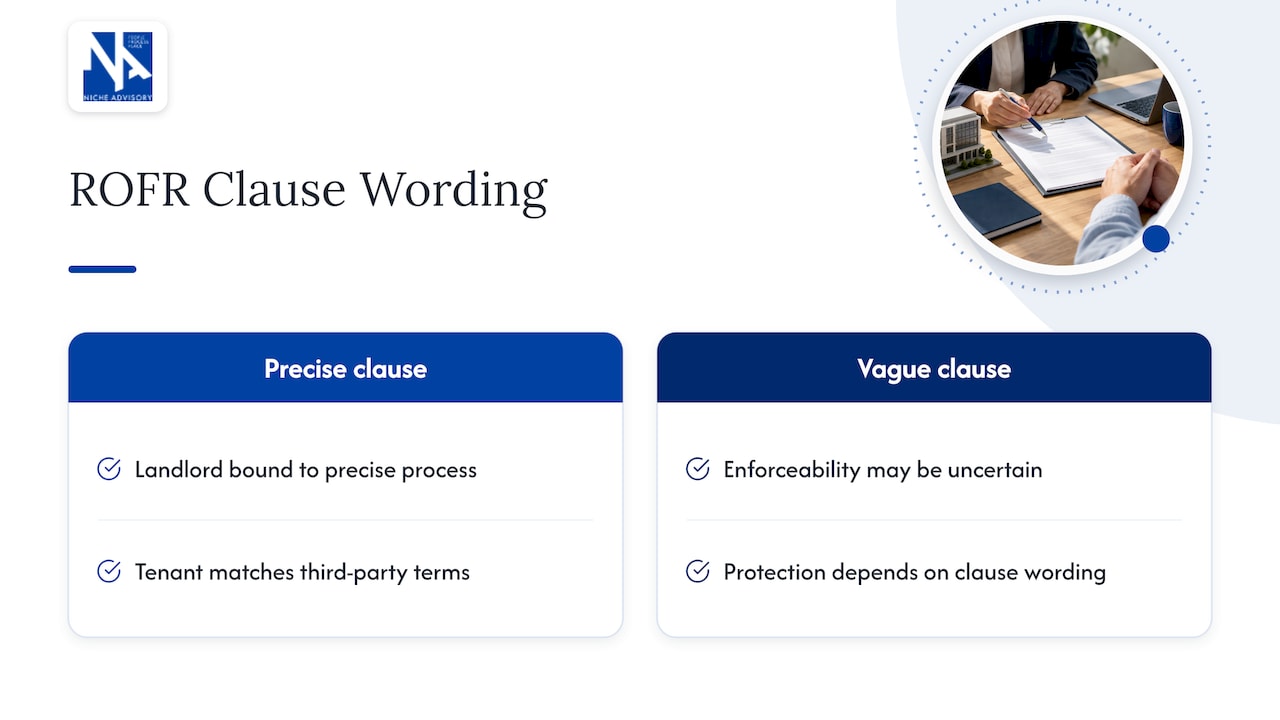
The less obvious point is that the name carries no guaranteed meaning. In NWA Realty Pty Ltd v Christou [2019] NSWSC 1364, the court’s analysis turned on the construction of the clause rather than on any settled definition of the term. Two leases that both say “right of first refusal” can give very different protection. One might bind the landlord to a precise process. Another might be so vague that a court will not treat it as an enforceable obligation.
For a business owner, the practical lesson is simple. Never rely on the heading. Read the operative words.
What can a ROFR cover?
Most commonly it covers one of three things:
- Expansion space in the same building, centre or industrial estate.
- A purchase right over the property, which matters for owner-occupiers and for tenants of smaller industrial buildings. This article focuses on the lease version.
- A re-letting right over your own premises if the landlord intends to lease them to someone else at the end of your term.
The third is rare, and is not the same thing as an option to renew, which we cover below.
When is a ROFR triggered?
The usual trigger is a genuine offer from a third party that the landlord is prepared to accept. A ROFR is not engaged by the landlord simply deciding to lease the space. Until an acceptable offer exists, the clause sits dormant.
This is where disputes start. Phrases like “if the landlord proposes to lease”, “receives an offer it is willing to accept” and “intends to let” are not interchangeable. A narrow trigger lets a landlord negotiate at length with a prospective tenant and only call the clause into play at the last moment. A broader trigger gives you earlier visibility.
Ask three questions of any trigger wording:
- Is it tied to an offer, a proposal, or a decision to market the space?
- Does it capture informal offers, heads of agreement and letters of intent, or only a signed lease?
- Does it apply to related-party deals, such as a lease to a company associated with the landlord?
How the process works: notice, response and matching
A typical sequence looks like this:
- The landlord receives an offer it would accept for the defined space.
- The landlord sends you a written notice setting out the key terms: rent, term, incentives, area and any special conditions.
- You have a fixed period to accept those terms.
- If you accept, you lease the space on the terms in the notice. If you decline or stay silent, the landlord is generally free to proceed with the third party on those terms.
The response window is the part tenants underestimate. Commercial ROFR windows commonly run from 5 to 15 days, and failing to respond in time usually acts as a waiver. That figure comes from a practitioner commentary, not a rule: the number in your lease is the only one that matters. Whatever the lease says, treat it as a hard deadline.
A worked example
Say you lease 400 square metres on level 3 of a Parramatta building, and your lease gives you a ROFR over level 4. The landlord receives an offer for level 4 at a stated rent and term, and sends you a notice. You have ten business days under the clause. In that time you need to confirm the space suits your headcount plan, test whether the rent is in line with the market, get internal approval for the commitment, and arrange fitout costings. If your finance sign-off takes three weeks, the right is effectively worthless.
The defence is procedural. Route a ROFR notice to a specific person the moment it arrives rather than assuming someone will deal with it. Nominate that person in your own lease diary, and confirm the notice address in the lease matches where your mail and email actually go.
Matching terms means all the terms
A ROFR usually obliges you to take the space on the terms the third party offered. That can include incentives, rent-free periods and a lease term that does not align with your existing lease. Check the clause for whether the expansion space co-terminates with your main lease, because mismatched expiry dates leave you with an awkward portfolio. Our guide on matching lease term to fitout payback under AASB 16 explains why term length affects both cost and accounting.
ROFR vs ROFO: the difference that matters
Searchers often type “ROFR vs ROFO” because the two sound alike and behave quite differently.
| Right of first refusal (ROFR) | Right of first offer (ROFO) | |
|---|---|---|
| When it bites | After the landlord has a third-party offer it would accept | Before the landlord goes to market |
| Whose terms | The third party’s terms, which you match | The landlord’s proposed terms |
| Your information | You see a real, tested market price | You see the landlord’s asking position |
| Landlord’s freedom | Limited at the final stage | Limited from the start |
| Typical tenant risk | Short deadline, little time to prepare | Paying more than the market would have required |
The general distinction is that a ROFR requires the owner to offer the same deal before accepting a third-party offer, while a ROFO lets the holder make an offer before the owner negotiates with third parties. Practical Law publishes a separate Australian standard clause for a tenant expansion right based on a right of first offer, under which the landlord must offer the space to the tenant before marketing it to a third party.
Which is better for a tenant? Neither always wins:
- A ROFR gives you price certainty, because the market has already set the price. But it arrives with a clock, and landlords sometimes build in so many conditions that the third-party offer is hard to match.
- A ROFO gives you earlier access and time to plan, but the landlord sets the opening price, and you may have no evidence the price is fair.
If you are likely to need space within the next two or three years, a ROFO with a market-rent mechanism can be the cleaner outcome. If your growth is uncertain, a ROFR costs less to give up and still protects you from losing the space to a competitor.
ROFR vs option to renew
This is the question most tenants should ask first, and one many mix up. They protect different things.
- A right of first refusal is about access to space you do not yet occupy, or about a landlord deal with someone else.
- An option to renew (also called a lease renewal option) lets you extend your own premises for a further term.
A lease can contain both. A tenant can hold an option to renew its current floor and a ROFR or ROFO over the adjoining suite. They run on independent triggers and independent timetables, so diarise them separately.
How an option to renew works
The Queensland Small Business Commissioner explains that an option lets a tenant renew for an additional term, usually on the same terms except for rent, which is reviewed under the lease mechanism. Options typically have to be exercised three to six months before the lease ends, and the option is not mandatory for the tenant.
Three practical points follow:
- Exercise on time, in the form required. Most options require written notice to a specified address within a specified window. Late or defective notice can lose the option.
- Check the rent mechanism. An option “at market rent” is only as good as the process for determining market, including who appoints the valuer. See our notes on lease re-negotiation.
- Check conditions. Many options are conditional on no continuing breach. In Queensland, a landlord must give a breach notice within 10 business days after the tenant exercises an option, and the tenant then has one month from receiving the notice to apply to court for relief.
What if you have no option?
Without an option, you generally have no right to stay. Government leasing guidelines make the point that the default at expiry is a competitive market process, not an automatic renewal. A ROFR will not rescue you here unless it has been drafted to cover your own premises. If your lease is approaching expiry without an option, start the conversation early. Our overview of options for exiting a commercial lease covers the alternatives.
Do state laws change any of this?
Retail and commercial leasing is regulated state by state, and the rules depend heavily on whether your premises are a retail shop lease. If you are unsure which regime applies, our four checks for retail versus commercial leases is the place to start. Office and industrial tenants usually sit outside retail legislation, which makes the lease document itself even more important.
Where retail legislation does apply, it can add protections around options. Examples from the regulators:
- Queensland: where a retail lease has no option, the Retail Shop Leases Act 1994 (s 46AA) requires the lessor to tell the tenant in writing whether it intends to renew, at least 6 months before expiry for leases longer than a year, or 3 months for shorter leases.
- Victoria: retail landlords must give the prescribed option, rent, review, cooling-off and disclosure-change notice at least 3 months before the option ceases to be valid. If they do not, the option date extends by 3 months from the notice.
- South Australia: retail shop leases must generally total at least 5 years, including renewal options, subject to exceptions. Where the lease provides for a current market rent review, the tenant can request an early rent determination.
These are protections for retail tenants in those states. They do not turn a ROFR in an office lease into something more than its drafting says. For the broader framework, see our breakdown of the new code for commercial leases.
What to check and negotiate in a ROFR clause
Because a court will look to the words and not the label, the clause is only as strong as its precision. Define the trigger, the scope of space and the mechanism for setting terms, and avoid vague language a court might not read as a binding obligation. Use this checklist.
- Trigger. Is it a received offer, a proposal, or a decision to market? Prefer the earliest trigger you can get.
- Space. Identify the area by plan, not description. Specify whether it includes space that becomes vacant later.
- Notice. Require written notice with all material terms, delivered to a stated address, with a copy to your adviser.
- Response time. Ask for a window long enough for approvals and fitout planning. Ten business days is a more realistic starting point than five.
- Terms to match. State that incentives travel with the offer, and that you can require evidence of the third-party offer.
- Silence. Decide what happens if you decline. Does the right revive if the landlord later changes terms materially, or if the deal falls through? It should.
- Assignment. Clarify whether the right is personal to you or passes to an assignee or a related company.
- Duration and priority. Does it last the whole term and any options? Does it rank ahead of other tenants’ rights over the same space?
- Interaction with other clauses. Check it sits properly with the option to renew, any relocation clause and the make-good provisions. Our guide to makegood obligations shows how expansion space can bring its own end-of-lease costs.
Much of the real cost of an expansion is in the fitout and outgoings, not the headline rent. Review how outgoings can add 20 to 50 per cent to rent before you commit to matching any third-party terms. For industrial tenants, site risk checks matter just as much when taking additional warehouse bays.
Getting the clause reviewed before you sign
A ROFR is cheap to ask for at the start of a lease and very hard to add later. If you want help with the legal wording, a commercial leasing lawyer should draft or review the clause. A leasing enquiry with a retail and commercial lease law firm is one way to get the document checked, while the commercial position (what space you will need, what rent is fair, how long to commit) is where an independent adviser earns the fee.
How Niche Advisory can help
We act only for tenants and owner-occupiers, never landlords. That means our advice on a ROFR, ROFO or option to renew is about your business plan: how much space you will need, when, and what you should pay for it. Our corporate tenant advocacy team handles property search, lease negotiation and renewals, and our workplace strategy work tests how much space a hybrid team needs before you lock in expansion rights. If you want a second set of eyes on a lease before you sign or renew, talk to us through Niche Advisory. For a longer checklist, read our commercial lease negotiation guide and the common risk factors for tenants.
FAQ
Is a right of first refusal the same as an option to renew?
No. A right of first refusal gives you a first chance at space, usually when the landlord has a third-party offer. An option to renew extends your current premises for another term. Options are usually exercised three to six months before expiry. A lease can contain both.
Can a landlord ignore a right of first refusal?
A properly drafted clause binds the landlord, and a breach can lead to a dispute or a claim. But enforceability depends on the wording, because the term has no fixed technical meaning in Australia. If you think the landlord has bypassed your right, get legal advice quickly, before the third-party lease is signed.
What happens if I miss the response deadline?
Usually the right is treated as waived for that deal, and the landlord can proceed with the third party on the specified terms. Some leases revive the right if the terms change materially. Check yours, and diarise the notice address and the response period.
Is ROFR or ROFO better for a growing business?
A ROFO gives earlier access, and a ROFR gives price certainty from a real offer. If you expect to need space soon, push for a ROFO with a market-rent mechanism. If growth is uncertain, a ROFR is a low-cost safeguard.
Sources
- NWA Realty Pty Ltd v Christou [2019] NSWSC 1364
- Right of first refusal in a commercial lease and ROFR vs ROFO
- What Is A Right of First Refusal? Sprintlaw Australia
- Tenant expansion right: right of first refusal, Practical Law
- Tenant expansion right: right of first offer, Practical Law
- Options to renew, Queensland Small Business Commissioner
- Queensland’s new Property Law Act, Queensland Small Business Commissioner
- Options and renewals for retail leases, Victorian Small Business Commission
- Retail & Commercial Leasing Guide, South Australian Small Business Commissioner
- Property Leasing Guidelines, NSW Government