
A good return to office policy does four things. It says why people are being asked to come in, sets clear attendance expectations by team, explains how exceptions and flexible work requests are handled under Australian law, and commits to a review date. It also needs an office that is ready for the people it is calling back. Most mandates stumble on that last point, because the desks, meeting rooms and lease were sized for a different way of working.
This guide is for Australian business owners, HR leaders and facilities managers who have to write, rewrite or defend a policy. It covers the legal ground, the content of the policy, the property side that is often forgotten, and how to tell whether it is working.
TL;DR
- Start with the work, not a number of days. Tie attendance to what the office is for: collaboration, onboarding, client work and connection.
- Under the Fair Work Act, eligible employees can make formal flexible work requests. You must discuss them, try to reach agreement and answer in writing within 21 days.
- Consult before you announce. Policies built with staff are easier to keep than mandates handed down.
- Check the office before you set the rule. Seat counts, meeting rooms, booking systems, technology and your lease terms decide whether the policy is workable.
- Set baseline measures (attendance, turnover, engagement) and a review date, then adjust.
Table of Contents
- What a return to office policy is for
- The Australian legal frame
- What the policy should cover
- From policy to roadmap: a workplace strategy approach
- The property question most policies skip
- Where Niche Advisory fits
- Measuring whether the policy works
- A short checklist before you publish
- FAQ
- Sources
What a return to office policy is for
A return to office (RTO) policy tells employees who have been working remotely when and how often they are expected at the employer’s premises. Employers usually introduce one to rebuild collaboration, connection and innovation. Those are legitimate aims, but they are outcomes, and a rule about days in the office is only one way to reach them.
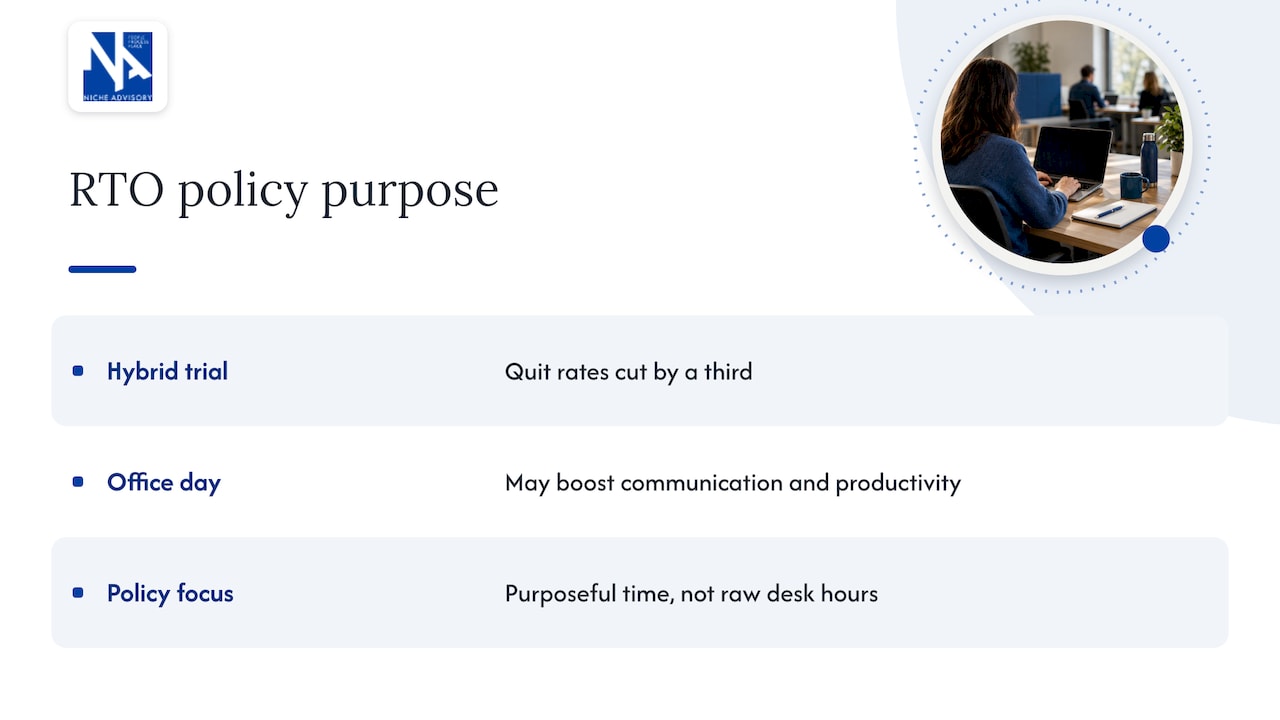
The evidence on mandates is mixed, which is why the purpose statement matters. In a randomised trial at a technology company, hybrid work improved job satisfaction and cut quit rates by a third without affecting performance grades or promotions. Other research suggests that even one coordinated office day a month can strengthen communication and productivity. Academic commentary argues that a systems view of management that prioritises talent and human outcomes works better than rigid location rules.
The practical reading: the value is in purposeful, coordinated time together, not in raw hours at a desk. Your policy should say what the office is for in your business, in a sentence a team leader could repeat.
The Australian legal frame
Policy writing in Australia sits on top of employment contracts, awards, enterprise agreements and the Fair Work Act. Get advice from an employment lawyer or your industry association before finalising anything that changes contractual terms. A few points shape almost every policy.
Flexible work requests
The Fair Work Ombudsman’s guidance says employers must discuss a formal request, genuinely try to agree on alternatives before refusing, and respond in writing within 21 days. A refusal must rest on reasonable business grounds. Eligibility is not universal: for example, an employee returning from parental leave can request flexibility if they are responsible for the care of a school-age-or-younger child and have 12 months’ service.
Your RTO policy should therefore not read as the last word. It needs a visible route for individual requests and a named person who handles them.
Working from home clauses in awards
The ground is moving. The Fair Work Commission has changed the Clerks Private Sector Award so employees can request, or record, working from home arrangements. According to the Fair Work Ombudsman, the new rules apply from the first full pay period starting on or after 26 October 2026, and a request is a protected workplace right. If any of your staff are covered by that award, check how the clause interacts with your attendance rules. Other awards and agreements may differ, so confirm which instrument covers each group.
There is also continuing public debate about enshrining a right to work from home in law. Build a review date into the policy so you can respond when the rules change.
Public sector settings
If you supply government, it helps to know the baseline. NSW Government Circular C2024-03 sets the default as principally working in an approved workplace, while agencies must still have flexible-work policies that meet reasonable employee requests. The ACT Public Service policy asks decision makers to weigh the employee’s reason, the role, team priorities, customer needs, health and safety, technology, privacy and security. That list is a handy checklist for private employers too.
What the policy should cover
Keep it short enough that people read it. Two to three pages, plus an FAQ for managers, is usually enough. Cover these elements.
- Purpose. Why the office matters for your business now, in plain words.
- Scope. Who the policy applies to, and which roles are exempt because the work is location-specific or remote by contract.
- Attendance expectations. Expressed by team or type of work, not only as a company-wide number. The Medibank CEO has argued the office should be used according to the work being done, with teams setting operating rhythms rather than a single universal frequency. Some employers will still choose fixed anchor days. Either approach works if it is explicit.
- Core collaboration days or events. If you want everyone together, name when and why.
- Flexible work requests and exceptions. How to apply, who decides, the 21-day response time and how reasons are recorded.
- Equipment and security. What the employer provides for each location. Employers can support flexible work with portable devices, secure access to systems, messaging and video-call software.
- Health and safety. Responsibilities apply at home and in the office.
- Review. When the policy will be reviewed and what data will be used.
Consult before you announce
The Mental Health Commission says mentally healthy hybrid work needs clear parameters developed in consultation with staff, with agency over where and how tasks are done. Large organisations do this at scale. The Attorney-General’s Department ran a 12-month consultation and co-design process with staff, diversity networks and unions before a proposed fit-out. A mid-sized company does not need twelve months, but a few weeks of workshops and a manager briefing before launch will save months of resistance.
The Australian HR Institute makes the same point about leadership: hybrid models succeed when leaders move from command and control to trust, coaching and team involvement. A policy is only as good as the managers applying it, so train them.
Weigh the retention risk
Tightening attendance can cost you people. Australian business and IT leaders surveyed by Telstra expect remote work to fall from 40 per cent of employees to 32 per cent in two years, and warn that employees forced back for more days may become demotivated, with talent at risk in a tight labour market. Treat that as a reason to model the impact on your key roles before you set the number, not a reason to avoid the decision.
From policy to roadmap: a workplace strategy approach
A policy is a document. A strategy is the plan that makes it work. If you are asking how to turn an RTO policy into a workplace strategy roadmap, the Workplace Gender Equality Agency’s guidance offers a sound skeleton: a clear vision, executive support, an action plan with timelines and responsibilities, and a cycle of piloting, testing, learning and adjusting. It also frames staged targets, moving from limited to basic flexibility within one year and to embedded flexibility within three.
A workable roadmap for an Australian business looks like this:
| Phase | Timing | What happens |
|---|---|---|
| Baseline | Weeks 1 to 4 | Measure actual attendance, desk use, turnover, engagement and lease commitments |
| Consult and design | Weeks 4 to 8 | Workshops with teams, draft policy, manager guidance, legal check |
| Pilot | Months 3 to 5 | Run with two or three teams, adjust booking, layout and rules |
| Roll out | Months 6 to 7 | Launch with training, updated space and technology |
| Review | Every 6 to 12 months | Compare against baseline, revise policy and space |
The timings are a planning guide, not a standard. A single-site business with 40 staff can move faster than a multi-state group. Our first 90 days workplace strategy framework sets out how we approach the opening phase.
The property question most policies skip
The piece that separates a policy that works from one that frustrates everyone is the building. WGEA’s guidance, drawing on Savills, says to assess current office flexibility alongside real estate obligations: lease term, invested capital, market demand and dependence on the landlord. In other words, what you can do with space depends on your lease.
Know how much of your office is actually used
An Australian study of 5,644 surveys across 157 office buildings found that only 27% of workers spent more than 30 hours a week at the workplace, and one in four spent fewer than 10. The strongest predictors of productivity and workplace health were privacy and disruption. Many offices fitted out for five-day attendance now have rows of underused desks and too few quiet rooms.
Before you set a rule, count. Badge data, desk sensors or a simple two-week manual audit will show peak days, average occupancy and which spaces sit empty. If a mandate would take you to 90 per cent occupancy on Tuesdays and 30 per cent on Fridays, the policy and the floor plan need to be designed together.
Right-size, don’t just fill
If attendance settles below capacity, you have a choice: push people back to fill the space, or change the space. The Attorney-General’s Department’s proposed consolidation would cut its footprint by 6,817 m² and lift its occupancy-to-capacity ratio to 76 per cent, with shared meeting facilities, breakout spaces and amenities. That is a government example, but the logic applies to any tenant: fewer, better-used square metres.
For leaseholders, timing matters. Lease expiry, break options and make-good obligations decide how and when you can reduce or reconfigure space. Our guides on rightsizing office space with data, space rationalisation in Sydney office design and getting a hybrid strategy right on the lease side walk through the options. For market context, see the latest Australian office market data and our view on flexible office strategy and lease choices.
Make the office worth the commute
People come in for reasons: seeing colleagues, learning, client work, focus space that home does not offer. Suncorp’s Leesman review of its Brisbane Heritage Lanes workplace found that 95% of employees said it supported creative collaboration, 93% said it supported learning from others and 87% said it contributed to workplace community, with 65% using a hybrid model. The office was designed for connection, events and hybrid meetings, not rows of individual desks.
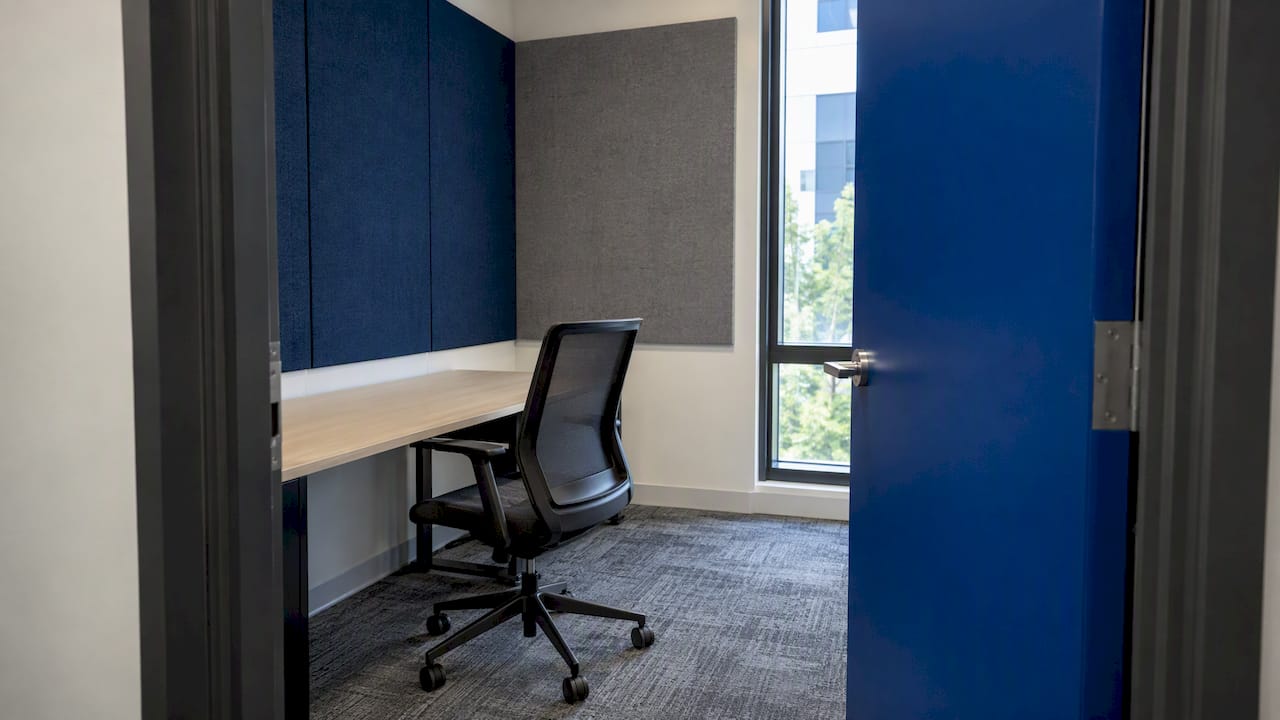
The Australian study above recommends quiet, private spaces and better acoustics, with employee control over environmental settings. If your office is noisy and your staff do their best focused work at home, a mandate will feel punitive.
Handle hot-desking with care
Shared desks are the usual way to match seats to attendance, but they are a common source of grievances. Academic research finds hot-desking often meets dissatisfaction over desk availability, privacy and conflict unless supported by robust booking systems and clear etiquette, and that missing governance can create legal exposure around bullying or privacy. Decide on booking rules, clean-desk expectations and team zones before you remove assigned seats. Our piece on the resurgence of hot-desking in Sydney offices covers what has worked locally.
Get the technology right
A mandate raises expectations. People who commute in to sit on video calls with colleagues elsewhere will notice poor audio, unreliable Wi-Fi and meeting rooms that do not connect. The Mental Health Commission cautions that enabling technology must be introduced with care to avoid frustration and protect employee privacy. Check room booking, video conferencing, desk booking and secure access before launch. Be open about any occupancy tracking you use and why.
Where Niche Advisory fits
We act only for tenants and owner-occupiers, never landlords, so our advice on your office is independent of whoever owns the building. We connect workplace strategy with the property decisions that follow: lease review and renewal, tenant advocacy, design and fitout, project management and make-good. If your RTO policy has exposed a mismatch between your people and your premises, you can talk to us about your workplace and we will start from your attendance data and your lease. We work with Australian tenants across Sydney, Melbourne, Brisbane, Adelaide, Newcastle and the Gold Coast.
If you are planning a change to your space, our notes on workplace change management that protects budgets and improving the office employee experience are a good next read.
Measuring whether the policy works
Set the measures before launch, or you will argue about anecdotes later. The South Australian Healthy Workplaces guidance recommends you gather baseline data, consult workers, monitor implementation, compare results with the baseline and recommend improvements, using measures such as absenteeism, turnover, engagement, satisfaction, participation, observations and focus groups.
A practical scorecard for an RTO policy:
- Attendance by team and day, against what the policy intends.
- Desk and room utilisation, to see whether space matches demand.
- Voluntary turnover, especially in critical roles.
- Engagement and satisfaction pulse results, asked the same way each time.
- Flexible work requests, how many, how many approved, and the reasons for refusal.
- Occupancy cost per attending person, which links the policy back to the lease.
Thrive at Work advises measuring the same indicators regularly, for example annually or every six months, to identify trends, and using employee-perception data to test whether changes are plausibly connected to the intervention. The Australian Government’s guide adds that unexpected results should be investigated with deeper qualitative or additional data rather than assumed to explain themselves. If turnover rises after a mandate, ask people why before you decide what caused it.
Revise when the data says so, and in any case at the scheduled review. Also revisit the policy whenever your lease position changes, a major award or law changes, or the business moves into a new phase.
A short checklist before you publish
- Can you explain the purpose in two sentences?
- Have affected staff and managers been consulted?
- Has an employment adviser checked it against your awards, agreements and contracts?
- Does the process for flexible work requests meet the 21-day written response requirement?
- Does the office have the seats, meeting rooms, quiet space and technology to match the attendance you expect?
- Do you know your lease dates, break options and make-good obligations?
- Are baseline measures captured and a review date set?
FAQ
Can an employer require staff to return to the office in Australia?
Often yes, if the employment contract, award, agreement or a lawful and reasonable direction sets the office as the workplace. The picture changes where an arrangement has been formally varied, or an employee has a protected right to request flexibility. Check each group’s contract and industrial instrument, and take advice from an employment lawyer before a mandate.
How long does an employer have to respond to a flexible work request?
For eligible requests under the Fair Work Act, the employer must respond in writing within 21 days. Before refusing, the employer must discuss the request and genuinely try to agree on alternatives, and any refusal must be on reasonable business grounds.
How many days a week should a return to office policy require?
There is no right number for every business. Some employers set fixed anchor days, others let teams set their own rhythm based on the work. Start from your purpose and your occupancy data, pilot with a few teams, and review after a set period.
Should we reduce office space if staff come in fewer days?
Possibly, but the answer depends on your lease. Look at expiry, break options, make-good costs and how attendance is actually spread across the week. A data-led review will show whether to rightsize, reconfigure or keep the space as is.
Sources
- Return to Office: Is It a Good Idea for Companies? (Built In)
- Hybrid working from home improves retention without damaging performance (Nature)
- The Value of One Office Day a Month (CEPR)
- Should employees be required to return to the office? (PMC)
- Flexible working arrangements best practice guide (Fair Work Ombudsman)
- Flexible work after parental leave (Fair Work Ombudsman)
- New working from home rules in the Clerks Award (Fair Work Ombudsman)
- Parliament of Victoria, Ministers statements: working from home
- C2024-03 NSW Government Sector workplace presence
- ACT Public Service Flexible Working Arrangements Policy
- Why mandating a return to the office is good for some but not for us (Medibank)
- Designing Mentally Healthy Hybrid Work (Mental Health Commission)
- Proposed Fit-out of Existing Leased Premises, Barton (Parliament of Australia)
- Hybrid and Flexible Working Practices in Australian Workplaces (AHRI)
- Technology evolution is powering employee and customer satisfaction (Telstra)
- Building a workplace flexibility strategy (WGEA)
- Office design isn’t keeping up with post-COVID work styles (The Conversation)
- Suncorp’s Heritage Lanes is named Brisbane’s top workplace
- Navigating the Dual Realities: hot-desking (AIS eLibrary)
- Healthy Workplaces SA: Monitor and evaluate
- Measuring mentally healthy workplaces (Mental Health Commission)
- Tracking and analysing data (Thrive at Work)