
A holdover clause says what happens when your fixed lease term ends and you are still in the premises. In most Australian commercial leases it lets you stay on a month-to-month basis, on the existing terms, until either side gives notice. That sounds comfortable. In practice it is the weakest position a tenant can negotiate from, because you have no certainty of tenure, no fixed rent and a landlord who can set the pace.
This guide explains how holdover clauses work, what they cost, where the risks sit, and how landlord entry and inspection rights fit in. It is general information, not legal advice. Before you rely on any clause in your own lease, have a commercial property solicitor read it.
TL;DR
- A holdover (or “holding over”) clause usually creates a monthly tenancy after the fixed term ends, which either party can end on notice.
- The existing lease terms generally keep applying, so rent, outgoings, repair and insurance obligations carry on unless a new written agreement varies them.
- Any holdover rent premium or “penalty” comes from your lease wording. Read the clause well before expiry, not after.
- Landlord access rights are set mainly by the lease and your state or territory law, so check the entry and notice provisions before and during any holdover.
- The best protection is an early renewal strategy, ideally started 12 to 18 months before expiry.
Table of Contents
- What a holdover clause actually does
- What happens to rent and other terms during a holdover
- The holdover penalty: where it comes from
- Holdover tenancy risks
- Landlord entry and inspection rights
- Your pre-expiry checklist
- How we help tenants avoid a weak holdover
- Negotiating out of a holdover
- FAQ
- Sources
What a holdover clause actually does
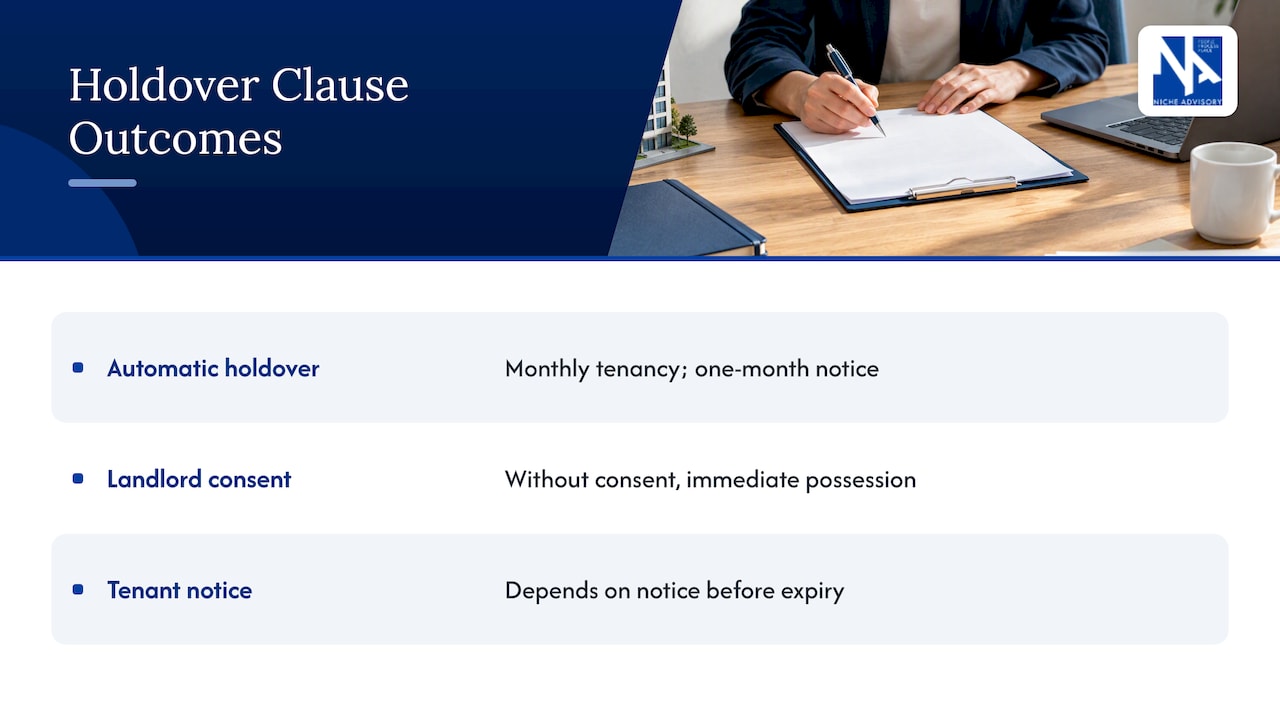
A lease is a fixed-term contract. When the term ends and no option has been exercised, the tenant has no automatic right to stay. A holdover clause fills that gap by setting the terms on which a tenant who remains in possession is treated.
The NSW Small Business Commissioner explains that most leases give the tenant the chance to hold over month to month after the fixed term, and that either party can end or change the arrangement with one month’s notice. Holding over gives you time to negotiate a new fixed-term lease or to find another location.
Legal commentary on Australian security of tenure says much the same. A holding-over clause may allow occupation under a monthly tenancy terminable by either party on one month’s notice. If the landlord has not consented to your continued occupation, the landlord is entitled to immediate possession.
That last point matters. Whether you have a right to hold over at all depends on the wording. Some clauses give the right automatically. Others make it depend on the landlord’s consent, or on you giving notice before expiry.
Holdover is not the same as a renewal
Holding over is a stopgap. A renewal under an option, or a new lease, gives you a defined term and a defined rent. A holdover gives you neither. If you are weighing an extension against a fresh lease, our guide to lease renewal versus extension sets out what changes and what does not.
What happens to rent and other terms during a holdover
The NSW Small Business Commissioner’s guidance is that the existing lease terms generally continue to apply during a holdover, including obligations for rent, maintenance and other payments, unless a new written agreement varies them.
In practice, that means you will usually keep paying:
- base rent, at the last passing rate or at whatever rate the holdover clause specifies;
- outgoings such as council rates, water and building insurance contributions;
- repairs, maintenance and compliance costs that the lease puts on you;
- any other charges, such as car-parking licence fees.
Insurance does not pause either. Public liability and contents cover need to stay in place, and it is worth understanding how insurance requirements for commercial real estate work in general so a lapse during a messy renewal does not leave you exposed.
Your security deposit or bank guarantee also needs attention. Check whether the guarantee has an expiry date that falls before your holdover ends, because the landlord may require a replacement.
The holdover penalty: where it comes from
People search for “holdover penalty”, but few Australian leases use the word. What you more often see is a holdover rent that is higher than the passing rent, sometimes expressed as a percentage uplift, or a clause that lets the landlord reset rent to market on the day the term ends.
We will not quote a typical percentage, because there is no standard one. The figure is whatever the lease says, and it is negotiated at signing. That is why the clause deserves attention in year one of a lease, not in the last month.
When you read the clause, check these points:
- Rent basis. Is it the last passing rent, a stated premium, or market rent as determined by the landlord?
- Who decides market rent. If it is set by the landlord alone, you have no check on the number. A valuer-determination process is fairer.
- Review mechanism. Does rent keep rising on the lease’s usual annual review during the holdover?
- Notice to end. Is it one month, 30 days, or something longer or shorter? The NSW guidance notes that the lease often allows either party to end the holdover with written notice, usually 30 days.
- Consent. Does the landlord have to agree to the holdover, or does it arise automatically?
A premium that looks modest becomes expensive if the holdover runs for six months because renewal talks stall. Model the cost over a realistic period, not one month.
Holdover tenancy risks
The real risks are less about the rent figure and more about leverage.
1. Short notice to leave
On a monthly tenancy, the landlord can end your occupation with one month’s notice. A business with a fitout, cabling, a server room and 80 staff cannot relocate in 30 days. A landlord who knows that holds the stronger hand in rent negotiations. Our article on the risks tenants face under commercial leases covers how timing weakens a tenant’s position.
2. Rent pressure
If you are holding over while you “negotiate”, the landlord has little reason to hurry. Every month of delay can come with a higher holdover rent, and your alternatives narrow as time passes.
3. Unclear status
If the landlord does not agree to your continued occupation, the position is much worse: the landlord is entitled to immediate possession. Rent accepted after expiry, informal emails and ongoing talks can blur whether a new arrangement has been created. Never assume. Ask for the holdover position to be confirmed in writing.
4. Make-good and handback complications
Holding over does not cancel your reinstatement obligations. If you plan to leave, you still need to deliver the premises in the condition the lease requires, and the make-good scope and timing may be disputed when notice is short. Starting that work early avoids paying holdover rent while contractors finish. Our make-good negotiation and execution service exists for exactly this.
5. Retail-specific rules
If your premises are retail, state retail leasing legislation may apply and change the picture. In Victoria, the Retail Leases Act 2003 provides that a tenant who continues in possession of retail premises after the lease expires is taken to continue for the purposes of the Act while the tenant remains in possession.
In NSW, for retail leases without an option, the landlord must give written notice at least six months, but not more than twelve months, before expiry saying whether a new lease will be offered or the tenant must vacate, as set out in the NSW Retail Tenancy Guide. That does not apply to ordinary office and industrial leases, which sit outside retail legislation. If you are unsure which regime covers you, ask your solicitor.
Landlord entry and inspection rights
Holding over raises a practical question: what can the landlord do on site while you are in a month-to-month arrangement? Often they want to bring prospective tenants through, or valuers, or make arrangements for the next occupant.
Commercial landlord obligations in Australia come from the lease, state and territory leasing laws and general legal principles, and the lease usually sets out how and when the landlord may access the property. Most commercial leases also promise that tenants can occupy without unreasonable interruption by the landlord.
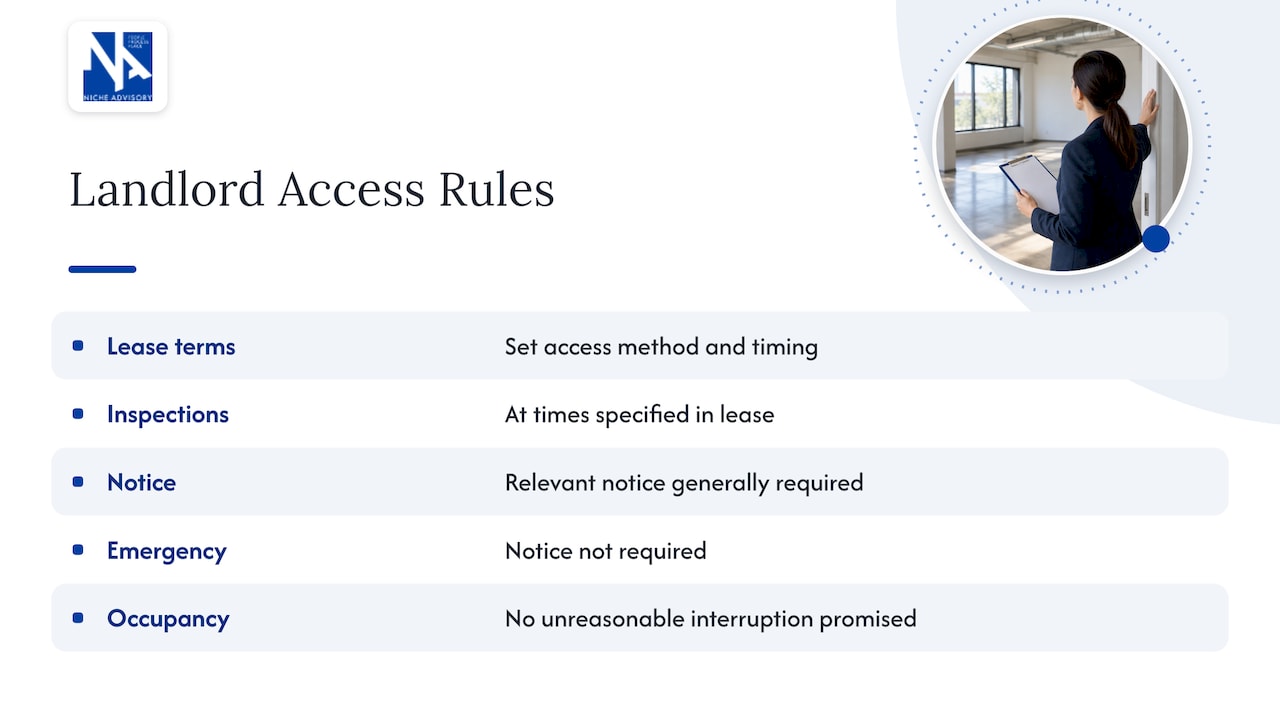
On inspections, landlords generally have the right to inspect at the times set out in the lease, on giving the relevant notice, and in an emergency notice is not required, according to one industrial leasing guide.
What to check in the access clause
- How much notice is required for routine inspections, and whether it must be in writing.
- How often inspections may happen and at what times of day.
- Whether the landlord may bring prospective tenants or buyers through, and whether that right grows in the last months of the term.
- What counts as an emergency.
- Any obligation on the landlord to minimise disruption and make good any damage.
If a landlord wants to carry out building works, those must be clearly authorised in the lease. Tenants should check the authorised works, disruption limits, access grounds and notice requirements before agreeing to anything.
Do the rules differ by state?
Yes, they can. Leasing legislation is state and territory based, and the retail regimes differ, so the baseline protections and notice rules are not identical in NSW, Victoria, Queensland, South Australia and elsewhere. For ordinary office and warehouse leases, the lease document usually does most of the work, which is why a precise reading of your own entry clause matters more than a general rule. Confirm the position for your state with a solicitor.
When access disputes escalate
Disputes about re-entry and breach notices do end up in tribunals. In Reliable Choice Pty Ltd v Samsal Pty Ltd, VCAT restrained a landlord from re-entering in reliance on its breach notice, subject to conditions that included the tenant continuing to pay rent and outgoings. The lesson is practical: keep paying what the lease requires while a dispute is live, because that is often what keeps a tribunal on your side.
Your pre-expiry checklist
The cheapest holdover is the one you plan for. Work through this list well before the end date.
- Find the expiry date and any option notice window. Option windows are strict, and missing one can end your renewal right. See the risks of exercising a commercial lease option before you act on one.
- Read the holdover clause. Rent basis, notice, consent and whether it arises automatically.
- Read the access and make-good clauses. Know your handback obligations and cost exposure.
- Decide your real preference. Stay, renegotiate, relocate or consolidate. Our piece on assessing your options at the end of a lease helps frame the choice.
- Start early. Our guide on when to start your lease renewal strategy explains the timeline. Starting 12 to 18 months out gives you a credible alternative, and a credible alternative is what moves rent.
- Get any holdover or extension in writing. An email chain is a weak basis for a business-critical premises.
- Check the accounting effect. Short extensions and holdovers can interact with lease accounting, which we cover in matching lease term to fitout payback under AASB 16.
Worked example
Imagine a 60-person professional services firm in a Parramatta office whose lease ends on a Friday. Renewal talks started eight weeks earlier, the landlord has not committed to terms, and the firm stays on. Under a typical clause the firm is now on a monthly tenancy. The landlord could give one month’s notice, and the firm would then need new premises, a design, a fitout and a move, which realistically takes far longer than a month. The firm’s bargaining position has shifted without anyone signing anything.
Now imagine the same firm began 15 months out. It shortlisted alternatives, priced a fitout, and went to the landlord with a real option to leave. The holdover, if it happens at all, is a short administrative bridge rather than a pressure point.
How we help tenants avoid a weak holdover
Niche Advisory acts exclusively for tenants and owner-occupiers, never landlords, so our advice on a holdover or renewal is independent of the other side’s interests. Where a lease is approaching expiry, we can help with lease re-negotiation, set out a realistic timeline, test your alternatives through our corporate tenant advocacy work, and manage any relocation, fitout or make-good that follows. If a disagreement with a landlord has already started, our dispute resolution services are available. We operate across Sydney, Melbourne, Brisbane, Adelaide, Newcastle and the Gold Coast.
To talk through your own lease, start at Niche Advisory.
Negotiating out of a holdover
If you are already holding over, the aim is to convert an open-ended arrangement into something defined.
- Ask for a short, fixed extension with a stated rent, rather than staying month to month. A three or six month extension at a known rate gives certainty.
- Separate the holdover rent from the new lease rent. Agree what you pay now without conceding the market rent for the new term.
- Keep your alternatives live. Do not stop assessing other buildings because talks are “going well”.
- Document everything. Confirm in writing that continued occupation is on the existing terms and does not waive your rights.
- Understand the process. Our article on the process of a lease re-negotiation walks through the stages, and the new code for commercial leases explains recent changes in the rules for tenants.
- Know your exit routes. See our guide to options for exiting a commercial lease if staying is no longer the plan.
FAQ
What is a holdover clause in a commercial lease?
It is the lease provision that sets the terms if you stay on after the fixed term ends. In most Australian leases it creates a month-to-month tenancy that either party can end on notice, usually one month, on the existing lease terms. The exact wording, including rent and consent, is in your lease.
Can a landlord increase rent during a holdover?
Only if the lease allows it. Some clauses set a premium or a market-rent reset, while others continue the last passing rent. Check the clause and any rent review provisions, and confirm any change in writing before you pay a different amount.
Can a landlord enter my premises while I am holding over?
Yes, but within the lease. Landlords generally may inspect at the times and on the notice the lease sets out, and in an emergency no notice is needed. Most leases also protect you from unreasonable interruption, so check the access clause and any state or territory rules that apply.
How long can I hold over?
There is usually no fixed limit, but a monthly tenancy can be ended by either side on notice, commonly one month or 30 days. If the landlord has not consented to your stay, they may be entitled to immediate possession. Treat holdover as a short bridge, not a plan.
Sources
- Lease hold overs and renewals, NSW Small Business Commissioner
- Security of tenure in Australia, DLA Piper Real World
- Retail Leases Act 2003 (Vic)
- NSW Retail Tenancy Guide 2022
- Landlord obligations under commercial leases, Sprintlaw
- Industrial landlord rights and responsibilities, uTenant
- Landlord’s works and quiet enjoyment, Bartier Perry
- Reliable Choice Pty Ltd v Samsal Pty Ltd, VCAT