
A personal guarantee on a commercial lease does not lapse when the lease ends, and it is not released just because you ask. It is released when the document says so, when the landlord agrees in writing, or, in limited cases, when the law or the facts give you grounds. This guide covers each path for directors and business owners who lease offices or warehouses in Australia.
The word “guarantee” covers two different instruments, and they are released differently. A personal guarantee is a promise by an individual, usually a director, to cover the company’s lease obligations. A bank guarantee is an instrument issued by your bank in the landlord’s favour, secured against your cash or facilities. We deal with both below.
TL;DR
- A personal guarantee in a commercial lease is usually a continuing obligation. It ends only when its terms say so, when the landlord signs a deed of release, or when the obligations it covers are fully met.
- Company liquidation or resigning as a director does not automatically free a guarantor, and the liability can reach make good costs, outgoings and enforcement costs.
- A bank guarantee is released only on the landlord’s formal written instruction to the bank. Reaching the lease end date does nothing by itself.
- The best time to win a release is before you sign: negotiate a cap, a step-down, a sunset date and a clear release trigger.
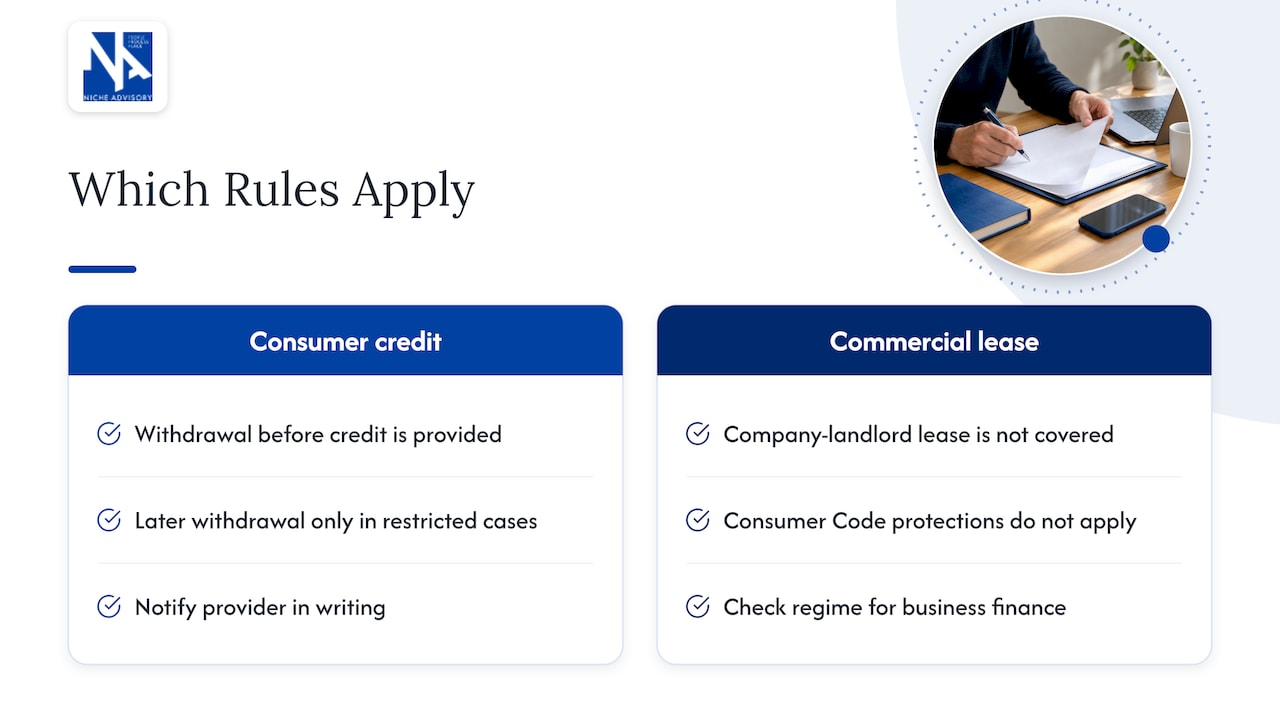
- The consumer rules on withdrawing as guarantor (National Consumer Credit Code) apply to consumer credit, not to a typical commercial lease.
Table of Contents
- What you are actually releasing
- When a personal guarantee is released
- Why the consumer rules rarely help a tenant
- Releasing a bank guarantee at the end of a lease
- Negotiate the release before you sign
- What to say in a release request
- Where we fit
- Quick reference: personal versus bank guarantee
- FAQ
- Sources
What you are actually releasing
In a commercial lease, a landlord often asks the directors of a tenant company to stand behind it. The tenant company is a separate legal entity, so without a guarantee the landlord can only pursue the company. With one, the landlord can pursue you personally, including your home or other assets.
A Mondaq article by a Queensland lawyer makes a point worth remembering: a director is not personally liable for a company tenant’s lease just because they hold office or sign for the company. Liability usually arises because they also sign a guarantee, an indemnity, or both. The same article notes that the liability can extend beyond unpaid rent to outgoings, interest, make good costs and enforcement expenses, and can persist after a director resigns or the business is sold.
That is why the first job is to read the document you signed. Look for:
- The parties and the capacity you signed in. Did you sign as director only, or also as guarantor in your own name?
- Guarantee and indemnity wording. An indemnity can survive even where a guarantee would fail, so read for both.
- Whether it is a continuing guarantee. Guidance on personal guarantees in Australia generally treats them as continuing obligations with no time limit unless the document sets one.
- The release clause, if any. Some leases set a date, a rent-paid history or a security deposit swap as the trigger.
- Whether it is a deed. This matters for enforceability, covered below.
When a personal guarantee is released
1. The obligations are fully met
The plain route is performance. When the tenant has paid everything owing and met every lease obligation, including make good, there is nothing left to guarantee. One Australian guide notes that, generally speaking, there is no need to request a deed of release once the obligation to pay under the guarantee has been met in full. We have not been able to verify that page directly, so treat that as general commentary and not a rule for your lease.
In practice, we still advise tenants to ask for a written confirmation from the landlord. It costs little, and it closes the file. Without it, a dispute about a make good item two years later can land on your personal doorstep.
2. The landlord agrees to release you
This is the most common negotiated outcome. A landlord may agree to release a guarantor when:
- the tenant company has a track record of paying on time;
- the company provides replacement security, such as a bank guarantee or a larger cash bond;
- the lease is assigned to a new tenant with a stronger covenant, and the incoming tenant or its guarantor steps in;
- the lease is renewed on new terms with the guarantee dropped or capped.
The release should be a deed signed by the landlord, naming the lease, the guarantor and the date from which liability ends. Be clear about the difference between release from future liability and release from past liability. A landlord will usually only release the first. Accrued claims, such as arrears or damage that already exists, tend to stay with you unless you negotiate otherwise.
3. The lease is varied or the structure changes
A guarantor can sometimes argue for release where the underlying contract has been substantially altered without their consent. The South Australian Law Handbook lists examples such as extending the term or the creditor failing to protect security. It also warns that many guarantee contracts are drafted to keep the guarantor liable even when such changes occur.
So do not assume a rent review, an extension option or a variation frees you. Most modern guarantees say that it does not. If a landlord has changed the deal and you were not told, take the documents to a lawyer before you act.
4. There are grounds to challenge the guarantee
The same handbook identifies other grounds for challenging a guarantee: duress, undue influence, fraud, or being misled about your liability or the nature of the document. It also recommends independent legal advice in these situations. These are legal arguments, not negotiating tools. They need evidence, and they need a solicitor.
One technical point from the handbook is useful if you are about to sign: a guarantee provided after the lease or loan is granted may be unenforceable for lack of consideration unless it is a deed. That cuts both ways. A landlord who asks you to add a guarantee mid-term will usually insist on a deed, and you should know why.
5. Insolvency does not release you
Many directors assume that putting the company into liquidation ends the problem. It does not. No Borders Group and other practitioners make the point that liquidation does not automatically release a personal guarantor. A guarantee exists precisely so the landlord has recourse when the company cannot pay. If you are in this position, speak to a solicitor or a registered insolvency practitioner before you take any step.
Why the consumer rules rarely help a tenant
Search results for this topic often mix in consumer credit material. In Australia, under the National Consumer Credit Code, a guarantor can generally withdraw before credit is provided, and after that only in restricted situations, such as where the final credit contract differs materially from what was disclosed. Withdrawal is by written notice to the credit provider. The Act itself sets out guarantor withdrawal and disclosure provisions, and ASIC publishes the prescribed forms, including Credit Form 8 (disclosure about a guarantee) and Credit Form 9 (information statement).
These protections are written for consumer credit contracts. A lease between a company and a commercial landlord is not that. If your guarantee supports a business loan or an equipment finance deal, check which regime applies with a lawyer before you rely on any of this. For what going guarantor means in plain terms, Moneysmart is a sound starting point, including its warning that a lender can pursue a guarantor’s own property.
Releasing a bank guarantee at the end of a lease
Most of our tenants meet a bank guarantee, not a personal one, at lease exit. Landlords commonly require one as security, often sized as a few months of rent and outgoings. Sprintlaw’s guide to bank guarantees for commercial leases lists amounts such as 3 to 6 months’ rent as a typical range and warns that tenants often assume the guarantee comes back automatically. It does not.
How the bank handles a release
The bank acts on the beneficiary’s instructions, not yours. Sprintlaw’s procedure guide says release needs formal written authorisation from the beneficiary, and that a tenant’s informal email is rarely enough. Typically the bank wants the original guarantee returned, or a release letter on the landlord’s letterhead.
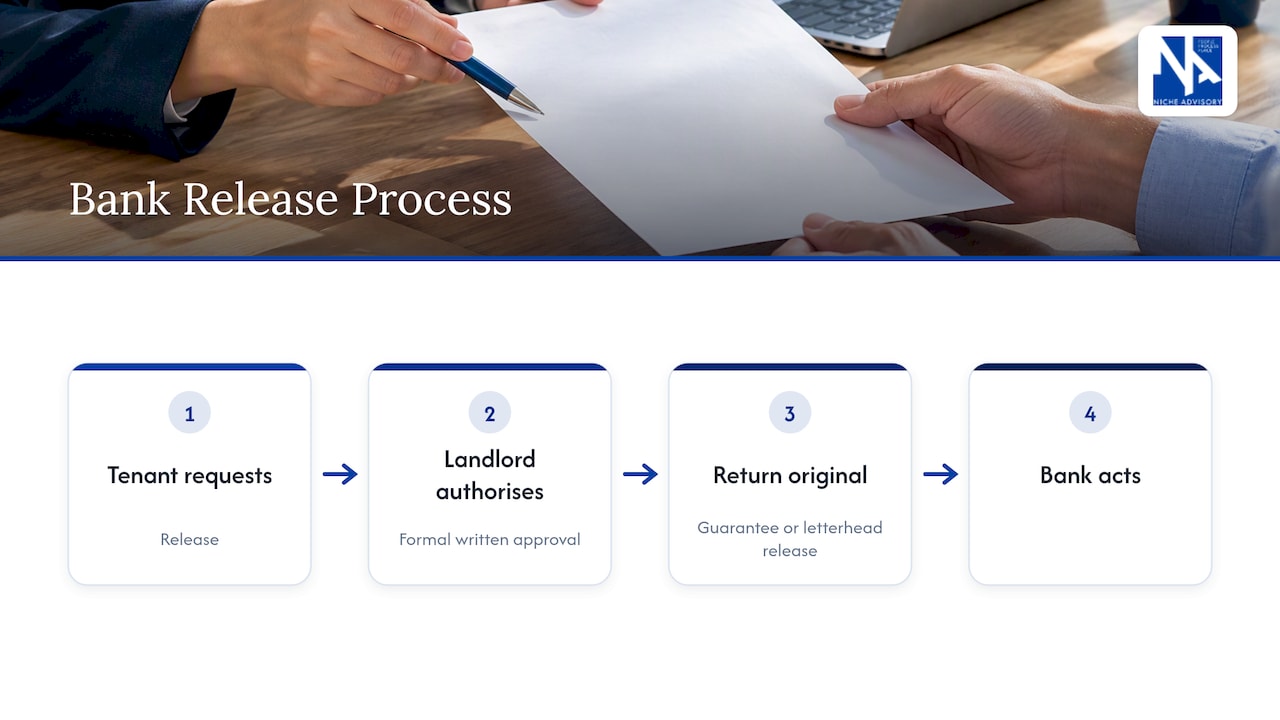
CommBank’s favouree fact sheet also shows how the instrument works from the landlord’s side: the bank cannot change terms unless the client contacts it directly. If the original paper guarantee is lost, cancellation is not necessarily blocked, but the landlord’s correspondence must state that the instrument is lost or misplaced and will be returned if found, with no further claims made.
A practical sequence for lease exit
- Diarise the release terms six months out. Find the clause that sets the release trigger. It might be expiry, practical completion of make good, or a certificate from the landlord.
- Settle make good early. Landlords hold the guarantee until make good is signed off. Our page on Sydney commercial lease makegood obligations and negotiations explains how scope disputes arise and how to narrow them.
- Request an exit inspection and a written sign-off. Ask for a list of any items still outstanding, with costs, so you can resolve each one.
- Pay what is genuinely owing. Final outgoings, reconciliations and cleaning are the usual holdups. Sprintlaw’s guide notes inspections and finalising outstanding financial obligations typically come before the landlord signs.
- Send a written release request. Address it to the landlord or managing agent, name the guarantee by number and amount, and ask them to instruct the bank.
- Chase the bank side. Confirm the bank has received the landlord’s instruction and that your facility or cash security is freed.
Worked example
A company in Parramatta finishes a five-year office lease. The lease holds a bank guarantee for the equivalent of four months’ rent and outgoings. The tenant hands back the keys on the expiry date and assumes the cash backing will be freed within a fortnight. Three months later, nothing has moved: the landlord says the carpet and ceiling grid are not to standard, and no sign-off has been given. The tenant’s cash stays locked against the facility. Had the tenant started the make good conversation six months earlier, agreed scope in writing and asked for the sign-off, the release would have been a paperwork step. This is a composite scenario for illustration, not a client case.
Negotiate the release before you sign
The strongest leverage you will ever have is before the lease starts. Once you are in occupation, the landlord has little reason to improve your position. At lease negotiation, ask for:
- A cap. Limit the guarantor’s exposure to a stated dollar figure or a number of months of rent, not an open-ended promise.
- A step-down or sunset. Reduce the guarantee after, say, 24 months of clean payment history, or end it at a fixed date.
- A substitute option. Allow the guarantee to be swapped for a bank guarantee or cash bond at any time.
- A release on assignment or sale. If you sell the business, the outgoing guarantor should be released once the incoming tenant provides security.
- Clear release conditions. Specific dates and inspection sign-offs. Practitioners at Sprintlaw observe that unclear release terms are a main cause of delay and dispute.
- Exclusion of make good from the personal guarantee, or a separate cap for it, where the scope is uncertain.
- Fixed form. Insist on a deed and read every schedule, because the guarantee may incorporate lease terms you have not seen.
Our article on the new code for commercial leases in Australia breaks down the protections that may sit around your lease, and which tenants they cover. Whether any code or statute applies depends on the lease type, the state and your tenancy size, so check it against your own lease. Industrial tenants face their own risks in negotiation, which we cover in negotiating industrial leases and site risk.
A lease term that suits your fitout payback also reduces how long your guarantee is exposed. See matching lease term to fitout payback under AASB 16 for the thinking.
What to say in a release request
Keep it short, specific and in writing. A workable structure:
- Identify the lease: premises, parties, date, and your role as guarantor.
- State the basis for release: lease expiry, make good complete, assignment completed, or replacement security provided.
- Attach evidence: inspection report, make good sign-off, payment confirmations, new tenant’s security.
- Ask for a deed of release, or for written instruction to the bank for a bank guarantee.
- Set a reasonable response date.
A lawyer should review any deed of release before you sign. The words “release” and “discharge” can both be limited by what they exclude.
Where we fit
We act exclusively for tenants and owner-occupiers, never landlords, so a release request or a lease negotiation gets advice from the tenant’s side only. Our corporate tenant advocacy work covers lease negotiation, renewals and reviews, make good negotiation and exits, all areas where guarantee terms are set or released. Where a landlord disputes make good or withholds security, our dispute resolution services page explains how we help tenants and landlords reach a resolution. If you want a view on a lease before you sign, our tenant advisory team in Sydney can review it, and you can reach us through Niche Advisory.
We are real estate advisers, not a law firm. Whether you are bound by a guarantee, and whether a deed of release is sound, are legal questions. We work alongside your solicitor on them.
Quick reference: personal versus bank guarantee
| Personal guarantee | Bank guarantee | |
|---|---|---|
| Who gives it | An individual, often a director | The tenant’s bank, on the tenant’s behalf |
| What backs it | Your personal assets | Cash or a facility held by the bank |
| Typical release | Landlord’s deed of release, or full performance | Landlord’s written instruction to the bank |
| Automatic on lease end | No | No |
| Main delay | Open-ended wording, unresolved make good | Make good sign-off, outstanding charges |
| Best fix | Cap, sunset and release clause up front | Early make good and a written release request |
FAQ
Can a personal guarantor be removed from a commercial lease?
Yes, if the landlord agrees. The usual routes are a deed of release, replacement security such as a bank guarantee, or an assignment to a new tenant the landlord accepts. Without the landlord’s agreement, you generally stay bound according to the guarantee’s terms.
Does resigning as a director release me from a personal guarantee?
Not by itself. The guarantee is a separate promise you made in your own name, and the liability can persist after resignation or sale of the business. Ask the landlord for a deed of release as part of any exit.
Does the guarantee end automatically when the lease ends?
Not necessarily. Obligations such as make good, final outgoings and damage may survive expiry, and the guarantee covers them. Get written confirmation that all obligations are satisfied, and for a bank guarantee, written instruction from the landlord to the bank.
Can I withdraw as guarantor under the consumer credit rules?
Only in consumer credit situations. Those rules let a guarantor withdraw before credit is provided and restrict withdrawal afterwards. They are unlikely to apply to a standard commercial lease, so speak to a solicitor about your specific document.
Sources
- Personal Guarantees In Commercial Leases: Risks For Directors (Mondaq)
- Bank Guarantees for Commercial Leases (Sprintlaw)
- How to Release A Bank Guarantee in Australia (Sprintlaw)
- Guarantees (South Australian Law Handbook)
- Bank Guarantee: Favouree Fact Sheet (CommBank)
- Consumer credit and guarantees (Legal Aid Queensland)
- National Consumer Credit Protection Act 2009 (Federal Register of Legislation)
- Credit Form 8: Disclosure about guarantee (ASIC)
- Credit Form 9: Information statement (ASIC)
- Going guarantor on a loan (Moneysmart)