A good furniture procurement strategy answers five questions before anyone asks for a quote. What do we already own and can reuse? What standard must every item meet? How will it perform when the floor plan changes? Who carries the risk if it fails or has to be removed at lease end? And what does it cost over its whole life, not on the day of purchase? Tenants who settle these questions first buy less, buy better and avoid arguments at make-good.
This guide is written for business owners, facilities managers and executives who lease offices or warehouses in Australia and are about to fit out, relocate or refresh. It covers the audit, the standards program, WHS, sustainability evidence, supplier briefs and the link between furniture and your lease.
TL;DR
- Audit what you own before you buy anything. Reuse is usually the cheapest and lowest-carbon option.
- Judge value over the whole life of the furniture, not the lowest unit price on three quotes.
- Write a short furniture standard (ergonomics, certifications, modularity) and hold every supplier to it.
- Treat furniture as a WHS decision: trial chairs and desks with real staff, and involve your health and safety representative early.
- Tie the strategy to your lease: modular, reconfigurable, certified product reduces churn costs and make-good disputes.
Table of Contents
- Why furniture needs its own strategy
- Step 1: Audit what you already own
- Step 2: Write a furniture standard
- Step 3: Treat furniture as a WHS decision
- Step 4: Plan for churn, not just day one
- Step 5: Verify sustainability, don’t just accept claims
- Step 6: Choose how you buy
- Step 7: Write a fitout project charter that includes furniture
- Connect furniture to your lease
- How we help
- A simple worked example
- FAQ
- Sources
Why furniture needs its own strategy
Furniture is often the last line in a fitout budget and the first to be squeezed. It is also the part your staff touch for eight hours a day, and the part you will move, store, resell or dispose of when the lease ends.
A common failure pattern is simple: the team collects three quotes, picks the lowest price per unit and considers the job done. The result is a mismatch between product and use, short-lived items and no plan for changes in headcount. The Commonwealth rules take a different view. The Commonwealth Procurement Rules 2025 make value for money the core test, and it is not limited to the lowest purchase price. Officials are expected to look at whole-of-life costs such as maintenance, operating costs and end-of-life disposal. Those rules bind government buyers, not private tenants, but the logic is sound for any business spending real money on workplace assets.
If you are also working out how much the whole project will cost, our office fitout cost benchmarks by city put furniture in the context of the full budget.
Step 1: Audit what you already own
Before you brief a single supplier, count, photograph and grade your existing furniture. Note condition, age, dimensions, whether it is adjustable and whether it suits the new floor plate.
The Australian Government’s sustainability ideas for furniture guidance points to the University of Melbourne, which diverted 838 tonnes of waste and saved an estimated $20 million in retail replacement value between 2012 and 2022 through repurposing furniture. A university is much larger than a typical tenant, but the principle scales down. If half your task chairs are sound and adjustable, replacing them for visual consistency is an expensive choice.
The South Australian Government goes further in its environmentally sustainable design specifications for office accommodation: preference must be given to reuse, and buying new furniture requires written justification for why reuse is not feasible. You do not need that rule, but borrowing the discipline is useful. A one-line justification beside each new purchase line stops spend creeping.
Your audit should end with three piles:
- Keep and reuse in the new space.
- Refurbish or reconfigure (reupholster, replace worksurfaces, add height adjustment).
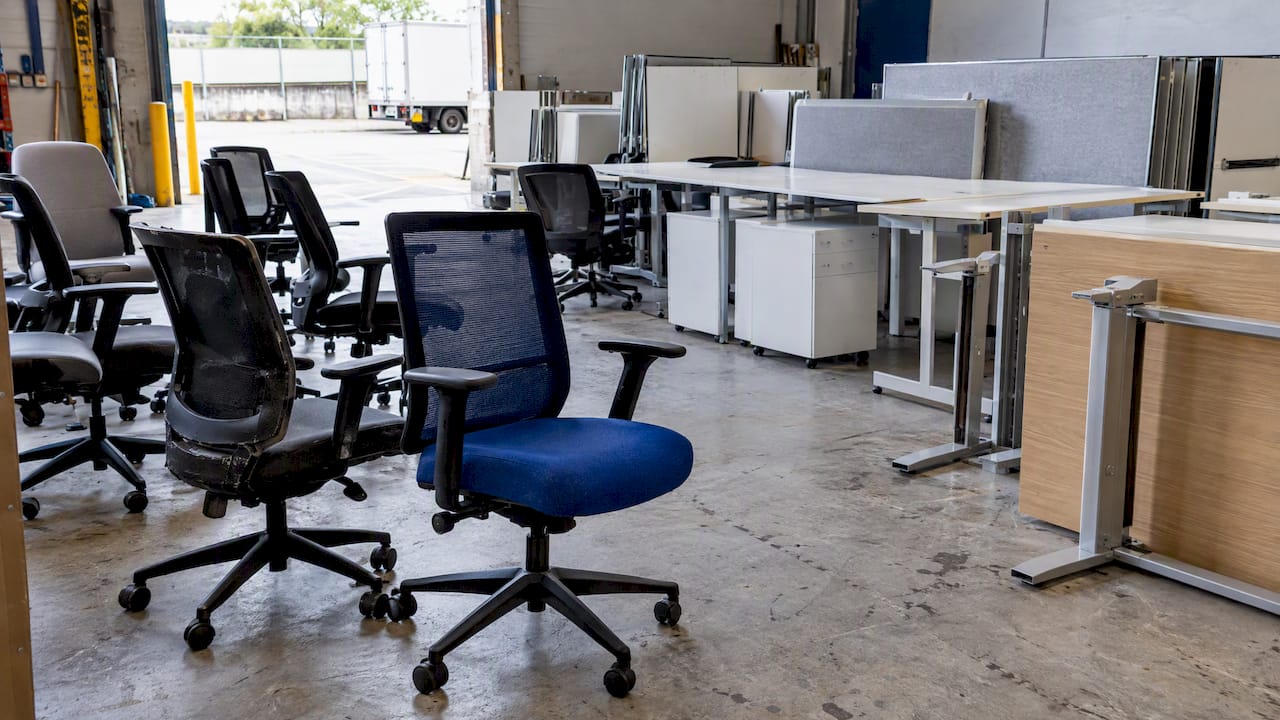
- Retire, with a decision on resale, donation or recycling and who will manage it.
The audit also feeds your space plan. If you are rightsizing at the same time, see how data-first rightsizing reduces office space by 20 to 40 per cent, because a smaller floor plate changes the quantity and type of furniture you need.
Step 2: Write a furniture standard
A furniture standards program is a short document that says what is acceptable in your workplace and why. It keeps purchases consistent across floors, sites and years, and it gives suppliers a clear brief. Large institutions publish theirs: RMIT’s furniture standards set out the requirements for selection, procurement and installation across its facilities. You can do the same in two to four pages.
A workable standard for a mid-sized tenant covers:
| Section | What to specify |
|---|---|
| Task seating | Adjustability range, base type, trial requirement, warranty |
| Workstations | Height-adjustable options, minimum worksurface for the task, cable management |
| Collaboration and meeting | Modular, stackable or mobile where space is flexible |
| Storage | Footprint targets that match your document and equipment policy |
| Sustainability | Third-party certification, recycled content, design for disassembly |
| Delivery and installation | After-hours access, building loading dock rules, defect period |
| End of life | Take-back, resale or reuse commitments |
Keep the standard to what you will actually enforce. A shorter list that every supplier meets beats a long one nobody checks.
Step 3: Treat furniture as a WHS decision
Under Australian work health and safety laws, a business must make sure the equipment people use is suitable for the task. Safe Work Australia’s model code of practice on hazardous manual tasks advises identifying hazards and the control measures needed before you purchase equipment, including workstations. It describes workstations that are flexible, large enough for the task and easily adjustable, with features such as swivel chairs with five-point bases and lumbar support.
In practice:
- Trial before you commit. Put two or three shortlisted chairs and desks in front of people of different heights and working styles for a week. Do not choose from a showroom visit alone.
- Involve your health and safety representative early, not at handover. They will spot issues like fixed-height desks that force some staff into poor postures.
- Prioritise adjustability over a fixed idea of the average person. The code’s guidance is built on accommodating physical variability.
- Document the decision. A short record of what you trialled and why you chose it is useful if a worker later raises a discomfort or injury concern.
The requirements differ by state and by business, and your obligations depend on your circumstances. For specific cases, such as staff with an existing injury or a warehouse mezzanine office, speak with your WHS adviser or an occupational therapist rather than relying on a general standard. Our guide to office wellness rooms under Australian WHS rules covers a related part of the same duty of care.
Step 4: Plan for churn, not just day one
Your headcount, hybrid pattern and teams will change within the term of the lease. The most resilient furniture strategies assume that, then choose product that can be moved and reconfigured across different floor plans. That protects you from repeated capital expenditure and reduces construction downtime in a move or lease change.
Practical tests for churn resilience:
- Can a workstation be reconfigured without specialist tradespeople?
- Are components standard enough to buy in two years’ time?
- Can meeting tables and lounge pieces move between floors?
- Would the same items work if you take less space at renewal?
Hybrid work makes this concrete. If you run hot-desking or a lower desk ratio, the mix shifts from fixed desks toward lockers, shared benches, focus booths and team tables. Our pieces on flexible office strategy and lease choices and the resurgence of hot-desking in Sydney offices show how this plays out before you order furniture.
Step 5: Verify sustainability, don’t just accept claims
Furniture and fitout are resource-intensive. The Green Building Council of Australia describes a shift toward circular fitouts, with the Green Star Fitouts rating tool encouraging design for reuse and reconfiguration to cut the carbon impact of frequent strip-outs and make-good works.
The risk for buyers is greenwashing. The government’s furniture guidance recommends relying on third-party certified ecolabels, such as GECA or Global GreenTag, rather than a manufacturer’s own claim. GECA’s circular fitout toolkit also points to design for disassembly, modularity, and ecolabels like AFRDI Green Tick as ways to verify claims and avoid later make-good disputes and landfill fees.
Put that into your supplier brief as questions:
- Which products carry a current third-party certification, and can you show the certificate?
- Can the item be disassembled, and are spare parts available?
- What is your take-back or resale offer at end of life?
- What is the warranty on high-use items like chairs and sit-stand mechanisms?
For a wider view of circular fitout thinking, this overview of office fit-out best practices from a UK commercial furniture site is a useful reference, though UK standards and suppliers differ from Australian ones. For how to write reuse and NABERS expectations into briefs, see our guide on sustainable office fitout supplier briefs.
A note on government thresholds
If you supply to government or fit out premises for a government tenant, check the Environmentally Sustainable Procurement Policy. From 1 July 2025 it requires reporting on environmental sustainability measures for furniture, fittings and equipment procurements worth $1 million or more. Private tenants are not bound, but a large corporate fitout may be asked to report in a similar way by a head office or investor.
Step 6: Choose how you buy
There are three broad routes, and the right one depends on scale and skills in-house.
| Route | Best for | Watch for |
|---|---|---|
| Direct from one supplier | Small refresh, tight timeline | Limited price tension, narrow range |
| Competitive tender against your standard | Mid to large fitouts, multi-site programs | Time to prepare; needs a clear specification |
| Bundled in a builder’s or designer’s package | Single accountable party | Furniture margins and scope can be hidden in the lump sum |
How furniture sits in the contract matters. If it is inside a design and construct package, you need visibility of the furniture allowance and the standard it must meet. If you tender separately, you need clear interfaces with the builder for delivery access, power and data. Our article on design and construct versus design and tender explains the trade-offs, and what to expect from office fitout project management shows who should coordinate the interfaces.
Whichever route you choose, compare quotes on the same basis: identical specification, delivery and installation, defect liability, warranty, and end-of-life terms. A lower unit price that leaves out installation or after-hours delivery is not lower.
Step 7: Write a fitout project charter that includes furniture
A fitout project charter is a one-to-two page agreement on what the project is for, who decides and what limits apply. Furniture should have a clear place in it. Include:
- Objectives: the business outcomes (for example, support a 3-day hybrid pattern), not just “new furniture”.
- Budget and contingency for furniture, including installation, storage and disposal of old items.
- Decision rights: who signs off the furniture standard, the trial result and the final order.
- Timeline: lead times with a buffer, since furniture delivery is a critical-path item for practical completion and move-in.
- Risks: supplier delays, damaged goods, building access limits.
- Reuse and disposal commitments consistent with your audit.
Good governance keeps these decisions visible. Our guide on governance and RACI for construction projects can help you assign them, and workplace change management covers how to bring staff along when furniture and layouts change.
Connect furniture to your lease
This is the part many procurement guides skip. Furniture is movable, but fitout items fixed to the premises, and the way you finish and remove them, can affect your end-of-lease obligations. Your lease will say what you must reinstate, and make-good can be a significant cost.
Before you commit to built-in joinery, fixed screens or bespoke items, check your lease make-good clause. Freestanding, modular and demountable furniture is usually simpler to remove, resell or move to the next premises. Items designed for disassembly are less likely to become a dispute. If you are weighing a renewal or relocation, align the furniture plan with the lease timeline so you do not buy assets you will leave behind in two years.
How we help
Niche Advisory acts only for tenants and owner-occupiers, never landlords. We can help you set the workplace strategy that determines what furniture you need, run the design and project management of the fitout, and manage make-good negotiation and lease matters so furniture decisions line up with your lease. Start with our workplace strategy service, or see how we handle project and construction management. If you are comparing cities, we also cover tenant advisory in Sydney, Melbourne and Adelaide.
A simple worked example
Imagine a 60-person Parramatta business moving into a smaller floor with a hybrid pattern averaging three office days a week. The numbers here are illustrative, not a benchmark.
- Audit: 60 task chairs, of which 38 are adjustable and in good condition. 60 fixed-height desks, 20 of which are less than five years old.
- Standard: adjustable seating with a trial requirement; at least a third of workstations sit-stand; certified products preferred; modular meeting tables.
- Decide: reuse the 38 chairs, buy 12 new chairs after a trial, retire the rest. Reduce desks to a 0.7 ratio with lockers and team tables.
- Tender: two or three suppliers quote the same specification, including delivery, installation and end-of-life terms.
- Lease check: keep joinery freestanding where possible so it can be removed without make-good disputes.
The point is the sequence. Each step reduces what the next one has to buy.
FAQ
What is a furniture procurement strategy?
It is the plan for what you will buy, to what standard, from whom and on what terms. A strong one starts with an audit of existing assets, sets a furniture standard, assesses whole-of-life cost and covers delivery and end of life.
Should we buy new or reuse existing furniture?
Audit first. Government guidance on sustainable furniture procurement supports reuse where items are in good condition, and the University of Melbourne example shows the savings possible at scale. Buy new where the item is unsuitable, unsafe for the task or cannot be adapted.
How do we check a supplier’s sustainability claims?
Ask for third-party certification such as GECA, Global GreenTag or AFRDI Green Tick, and ask to see the certificate. Government guidance warns that a manufacturer’s own claim is not enough on its own.
Is office furniture a WHS issue?
Yes. Safe Work Australia’s guidance says to identify hazards and controls before purchasing equipment such as workstations. Trial products with staff and involve your health and safety representative. For specific injuries or conditions, consult your WHS adviser or an occupational therapist.
Does furniture affect make-good?
It can. Fixed or bespoke items may need removal and reinstatement under your lease, while modular and demountable pieces are easier to take with you or resell. Check the make-good clause before you commit.
Sources
- Commonwealth Procurement Rules 2025
- Sustainability ideas for furniture, DCCEEW
- Environmentally sustainable design specifications, SA Government
- RMIT Furniture Standards
- Model Code of Practice: Hazardous manual tasks, Safe Work Australia
- First Green Star Fitouts project, GBCA
- A new toolkit to embed circularity into office fitouts, GECA
- Environmentally Sustainable Procurement Policy, DCCEEW