
Real estate strategy alignment means your premises, leases and fitouts are chosen to serve what the business is trying to do, rather than the other way around. In practice it comes down to three things: a clear view of how your people work, a lease portfolio with the flexibility to follow your plans, and a decision process in which the property team and the executive team use the same facts. If your next lease decision starts with “what space is available?” instead of “what does the business need in three to five years?”, you are not aligned yet.
TL;DR
- Alignment starts with business strategy (growth, hiring, service model, risk appetite), then turns it into space, location, lease term and budget requirements.
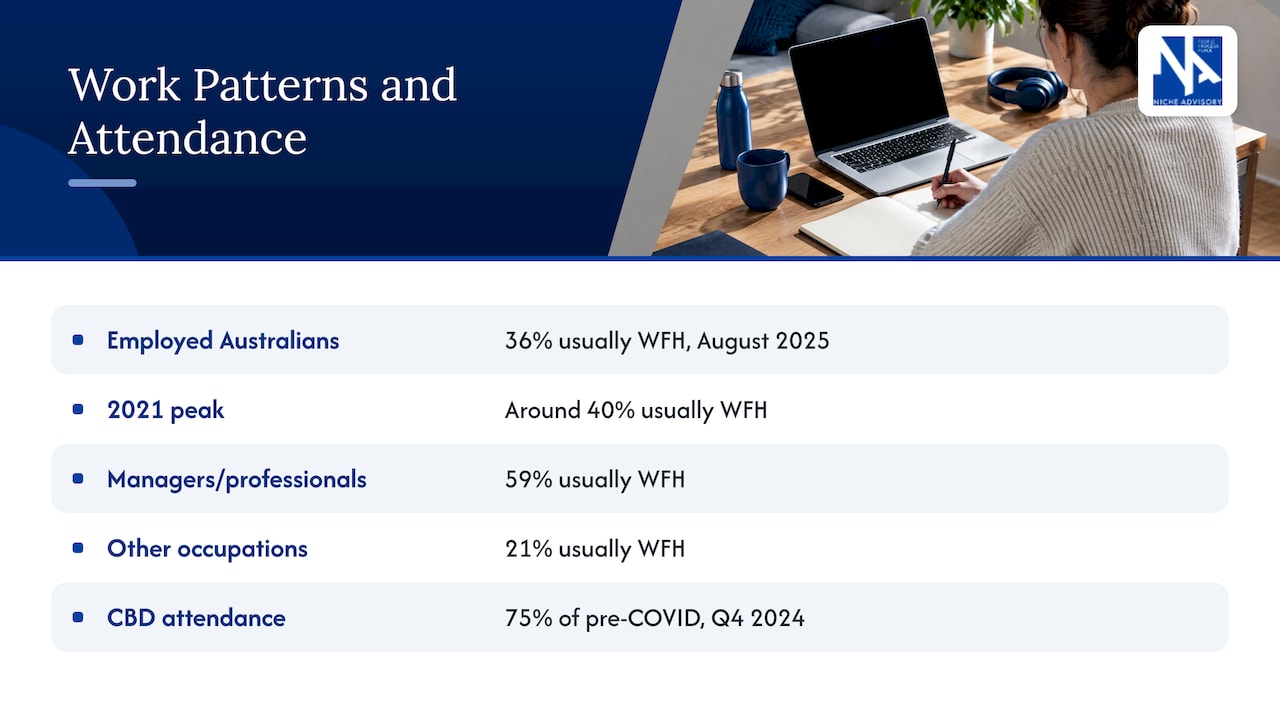
- Hybrid work is now structural: 36% of employed Australians usually work from home, so headcount-based space planning no longer works.
- Lease terms, make-good clauses and fitout costs are where misalignment becomes expensive. Negotiate them against your strategy, in writing, before you sign.
- Review alignment on a schedule (at least before every lease event), and use an adviser who acts only for tenants so the advice isn’t tied to a landlord’s agenda.
Table of Contents
- What alignment actually means
- Why the old planning assumptions fail
- A practical approach: from strategy to a property brief
- Lease levers that keep property aligned
- Aligning different stakeholders
- Common misalignments and how to fix them
- Industrial and warehouse premises
- How Niche Advisory helps
- FAQ
- Sources
What alignment actually means
Academic work on corporate real estate (CRE) treats alignment as the fit between organisational strategy and the way property is sourced, used and managed. The idea is simple. The hard part is that business strategy and property decisions run on different clocks. A strategy can change in a quarter. A five or ten year lease cannot.
Alignment is therefore less about a document and more about three connections:
- Strategy to space requirements. Growth plans, customer-facing needs, culture goals and cost targets become specific demands: how many people on site on a peak day, what kinds of spaces, which locations, how much room to grow or shrink.
- Space requirements to lease structure. Term, options, expansion and contraction rights, incentives, make-good and sublease rights are set to match how confident you are in those requirements.
- Lease structure back to strategy. Someone checks regularly whether the portfolio still supports the plan, and acts well before a lease expiry forces the issue.
Most misalignment we see in tenants of leasehold office and industrial premises is not dramatic. It is a renewal signed because the deadline was close, a fitout designed for the headcount of two years ago, or a warehouse lease that ties up capital a business needs for growth elsewhere.
Why the old planning assumptions fail
Attendance is no longer a given
The ABS reports that 36% of employed Australians usually worked from home as of August 2025, down from the 2021 peak of around 40% but well above pre-pandemic levels. The split matters more than the headline: 59% of managers and professionals usually work from home, against 21% of other occupations. A business with a mostly professional workforce and a business with a mostly operational workforce are planning for entirely different buildings.
On the other side, office use has been recovering. Property Council reporting on CBRE data found that CBD office attendance averaged 75 per cent of pre-COVID levels in the final quarter of 2024, with Brisbane leading. So the right planning assumption is neither “everyone is home” nor “everyone is back”. It is a range, and your own data should set where in that range you sit.
Productivity depends on the task, not the slogan
The Australian Public Service Commission’s review of flexible work in a state service context points to the same lesson: in some team structures, working from home lifted per-worker productivity by around 25%, while teams relying on complex, multi-system workflows or physical collaboration saw delays, with some review times about 25% longer. This is one agency’s experience and not a universal rule, but it supports a useful principle. Don’t set a policy for the whole company. Map the work, team by team, and give each the setting where that work performs best.
The market is rewarding quality
The Property Council’s August 2025 market report put the national CBD office vacancy rate at 14.3% as of July 2025. Within that figure, prime grades were absorbing space while lower grades saw occupied stock decline, a “flight to quality” as businesses use better buildings to draw people back. For a tenant, this cuts both ways. Weak buildings may offer attractive rents and incentives, but may not support the attendance and talent goals in your strategy. Strong buildings cost more, but may let you occupy fewer square metres.
For local detail, our own market updates track conditions by city, including Sydney CBD, Brisbane CBD and the wider Australian office market.
A practical approach: from strategy to a property brief
This is the sequence we work through with executives, HR leaders and facilities managers. You can run the first steps internally.
Step 1: Write down the business drivers
Get the leadership team to answer in plain language:
- What headcount and mix of roles do we expect in 12, 36 and 60 months?
- Where are our customers, talent and suppliers?
- Which capital are we protecting or deploying (for fitouts, equipment, acquisitions)?
- What does the workplace need to do for culture, collaboration, client experience or compliance?
- How certain are we about each answer?
The last question is the one most people skip, and it drives lease structure. High certainty supports a longer term. Low certainty argues for flexibility, even at a premium.
Step 2: Measure how space is actually used
Utilisation data (badge swipes, sensors, desk booking logs, or even a structured week of manual counts) replaces opinion. Look at peak day versus average day, meeting room size versus actual group size, and which teams need what. This is the core of workplace strategy, and our piece on the benefits of a workplace strategy explains what you should expect from it. If you want a time-boxed starting point, see our first 90 days framework.
Step 3: Translate into a property brief
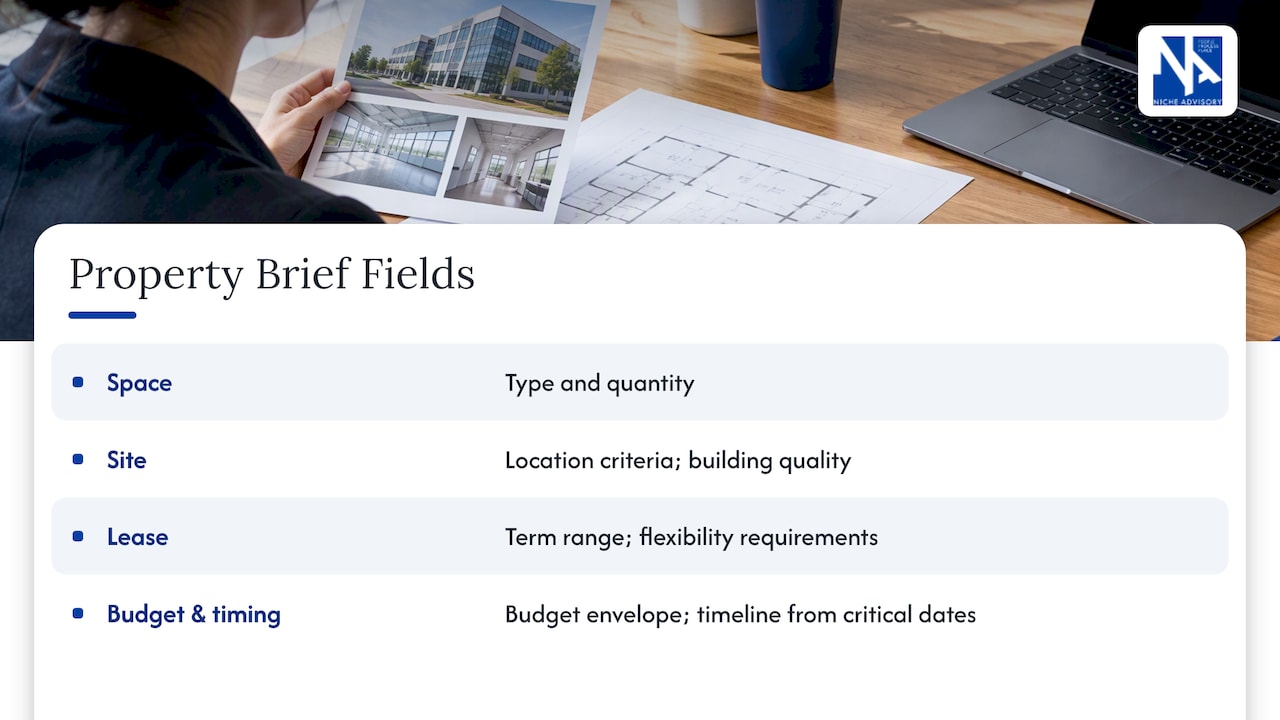
A good brief states space type and quantity, location criteria, building quality, term range, flexibility requirements, budget envelope (rent, incentives, fitout, make-good) and a timeline working backwards from your critical dates. It should be short enough that every executive can read it, and specific enough that an agent can’t read their own agenda into it.
Step 4: Test options against the strategy, not just the rent
Compare options on total occupancy cost over the term, including fitout, incentives, make-good and the cost of disruption, and then against the strategic criteria from Step 1. Lowest face rent frequently loses once you account for fitout and exit costs.
Step 5: Negotiate the lease to preserve the strategy
This is where alignment is won or lost. The sections below cover the main levers.
Lease levers that keep property aligned
Term, options and flexibility
If your strategy has uncertainty built in, the lease should too. Useful tools include shorter initial terms with options, expansion and contraction rights, sublease and assignment rights, and break clauses (all negotiable, none automatic).
Flex space has also moved from fringe to mainstream. Colliers analysis cited by the Property Council found flex office space recorded its strongest growth since 2020, up 4.9 per cent year on year, with hybrid-flex making up half of flex offerings nationally. A common pattern is a core-and-flex portfolio: a stable conventional lease for core operations, plus flexible memberships or enterprise suites for peaks, projects or testing a new city without a five to ten year commitment. We explore the trade-offs in our guide to flexible office strategy and in this Sydney-focused look at flexible space.
Fitout costs and landlord’s works
Fitout is often the largest one-off cost in a relocation or renewal. The NSW Small Business Commissioner advises tenants to agree in writing the maximum cost of any landlord’s works, to avoid budget blowouts. That guidance is written for small business and retail tenants, but the principle carries over to office and industrial premises: fix the number before you sign, not after. The same page notes that a refurbishment clause needs enough detail on the nature, extent and timing of the work, or it may be unenforceable in many jurisdictions.
Alignment angle: design the fitout for the workplace strategy you’ve validated, not the one you inherited. Our articles on office fitout project management and procurement models cover how to keep scope and cost under control.
Make-good: the exit cost you set on day one
Make-good is the obligation to return the premises to an agreed condition at lease end. The Queensland Small Business Commissioner explains that the clause sets what the tenant must return the property to, and that in Queensland the Property Law Act 2023 includes standard terms for commercial leases. Rules differ between states, so check the one that governs your lease.
The Victorian Small Business Commission stresses that ambiguity is behind many end-of-lease disputes, and recommends inspecting the premises with the landlord or agent well before expiry and recording everything in writing. Two further points from that guidance are worth acting on:
- Make-good, redecoration and refurbishment clauses are different obligations. Know which ones your lease contains and when each is triggered.
- If you take over an existing lease, you may inherit the previous tenant’s obligations, so clarify this in the transfer documents.
For strategy, the question is whether a base-building return, or leaving the fitout in place, fits your plans. Settle it at the start, because the answer changes how much you should spend on the fitout. Our guide to Sydney make-good obligations and negotiations goes deeper, and our dispute resolution team steps in when a landlord’s claim looks out of line with the lease.
Aligning different stakeholders
Alignment fails most often in the room, not in the lease. A few patterns to watch:
| Stakeholder | What they typically want | Question that aligns them |
|---|---|---|
| CEO / board | Growth, cost control, risk limits | What property decisions are reversible, and at what cost? |
| CFO | Predictable occupancy cost, capital discipline | What is the total cost over the term, including exit? |
| HR / people | Attraction, retention, culture | What does the workplace need to offer for people to choose to come in? |
| Facilities / operations | Reliability, compliance, service levels | What do operations need that a headline rent number hides? |
| Team leaders | Fit for their actual work | Which tasks need to happen together, and which don’t? |
Our notes on employee experience in the office, evidence-backed workplace productivity priorities and workplace change management help with the people side, which is where a well-aligned plan often stalls.
Common misalignments and how to fix them
- Renewing by default. The lease expires, the landlord offers terms, and the business accepts. Fix: start 18 to 24 months before expiry for office premises of any size, and test relocation as a real option, not a bargaining prop.
- Space sized on headcount. Fix: size on peak-day attendance and work type, then validate with utilisation data.
- One policy for all teams. Fix: define work settings by task, as the APSC example suggests.
- Ignoring exit costs. Fix: model make-good and reinstatement in the business case from day one.
- Portfolio never reviewed. Executives with several leases often have terms that no longer match the plan. Fix: a portfolio review that maps every lease against business needs and critical dates, looking for savings and flexibility.
- Advice from the other side. Landlord-aligned agents are paid when deals close on their principal’s terms. Fix: use advisers who act only for tenants.
Industrial and warehouse premises
Alignment isn’t only an office question. For warehouse and industrial tenants, the strategic variables are different: proximity to customers and ports, clearspan height and power, expansion room, and how leasing capital compares with other uses. The same discipline applies. Define what supply chain and growth plans require, test the portfolio against it, and negotiate terms (including make-good, which on industrial sites can be substantial) to suit. For owner-occupiers, the choice between leasing and owning is part of the strategy as well, which is why acquisitions and divestitures belong in the same conversation.
How Niche Advisory helps
We act exclusively for tenants and owner-occupiers, never landlords, and we have worked across sectors for over 12 years. Our approach connects workplace strategy with execution: workplace strategy to define what you need, corporate tenant advocacy for search and lease negotiation, and design and project and construction management to deliver the space. You can see how this fits together under corporate real estate, or talk to us about a tenant advisory engagement in Sydney, Melbourne or Adelaide. If you are an overseas company planning to occupy space in Australia, the same process applies, and it matters even more when you don’t know the local market.
FAQ
What is real estate strategy alignment?
It is the practice of making property decisions (location, size, lease terms, fitout, exit) follow from business strategy rather than from available stock or deadlines. It also includes checking regularly that the portfolio still matches the plan.
How do I know if my property portfolio is misaligned?
Warning signs include space that sits empty on most days, leases expiring with no plan, fitouts that no longer suit how teams work, and executives who can’t say what the portfolio costs in total. A utilisation study and a lease-by-lease review will show the gaps quickly.
When should I start planning before a lease expires?
For office premises of any scale, 18 to 24 months is a sensible starting point, because relocation, design and fitout take time and your negotiating position weakens as the deadline nears. Check your lease for notice dates on options, as these can come earlier than you expect.
Do I need an independent adviser, or can my agent do this?
An agent paid by a landlord, or by a building you are viewing, has a different incentive to yours. An adviser who acts only for tenants can compare options without a stake in the outcome. Ask any adviser who they act for, and how they are paid.
Sources
- Working arrangements, August 2025, Australian Bureau of Statistics
- Return to office gathers pace, Property Council Australia
- Flexible, Australian Public Service Commission
- New supply prompts small increase in office vacancy, Property Council Australia
- Flex office space records strongest growth since 2020, Property Council Australia
- Fit-outs: who pays? NSW Small Business Commissioner
- Make good, Queensland Small Business Commissioner
- Preparing for end of lease, Victorian Small Business Commission