
Neither method is better in every case. A fixed increase is cheaper for the tenant when inflation runs above the fixed rate, and CPI is cheaper when inflation runs below it. The right choice depends on where you think inflation is heading over your lease term, how much certainty your budget needs, and whether your premises are covered by retail leasing legislation. That last point can override what you negotiated.
This guide is for tenants of leasehold offices, warehouses and industrial premises. It covers how each method works, what the numbers look like at today’s inflation rate, and the drafting traps that cause disputes.
TL;DR
- A fixed increase locks in a percentage (commonly 2% to 4%) so you can budget years ahead. CPI ties rent to inflation, so your cost moves with the economy.
- The ABS reports that CPI rose 4.0% in the 12 months to August 2026, up from 3.5% in July. A fixed 3% would currently beat CPI. A fixed 4% would roughly match it.
- A lease that just says “CPI” invites a dispute. Name the ABS series, the city index and the exact quarters.
- Caps and collars on CPI can be struck out in retail leases. In Victoria, a tribunal has found a CPI cap void, which pushed the rent to a market review.
- Check whether your lease is retail or commercial before you negotiate the review clause.
Table of Contents
- How a fixed increase works
- How a CPI review works
- What the numbers look like today
- Fixed increase vs CPI: comparing the criteria
- The part most tenants miss: drafting the CPI clause
- Caps, collars and ratchets
- Retail or commercial: the check that comes first
- How to choose: a practical framework
- Common mistakes tenants make
- How we help tenants with rent review mechanics
- FAQ
- Sources
How a fixed increase works
A fixed review applies the percentage written into the lease, whatever happens to prices. If your base rent is $200,000 a year and the review is a fixed 3.5%, next year’s rent is $207,000. It will be $207,000 whether inflation is 1% or 6%.
For the tenant, the appeal is predictability. You can put the rent for the next five years into a financial model on day one. For the landlord, the appeal is the same: a known income stream that suits valuations and lender reporting.
The risk is a mismatch. Fixed increases often fall in the 2% to 4% range, and if actual inflation settles at 2%, a fixed 4% means you overpay every year, and the gap compounds.
How a CPI review works
A CPI review applies the percentage movement in a named price index to your current rent. The consumer price index is published by the Australian Bureau of Statistics. If the index moves 3.2% between the two measurement points in your clause, your rent rises 3.2%.
If you want a plain-language refresher on what the index measures and how it is built, this CPI explainer is a useful reference. For lease purposes, what matters is which index your clause points to and which two quarters it compares.
CPI links rent directly to inflation. That protects the landlord’s purchasing power in high-inflation periods and shifts the financial risk to the tenant. In a low-inflation environment the same clause works in your favour.
What the numbers look like today
The latest ABS release shows CPI up 4.0% over the 12 months to August 2026, and trimmed mean inflation at 3.6%, unchanged from July. For context, the ABS notes that annualised inflation in the 2010s averaged about 2.5%, well below the spikes of the 1970s and 1980s.
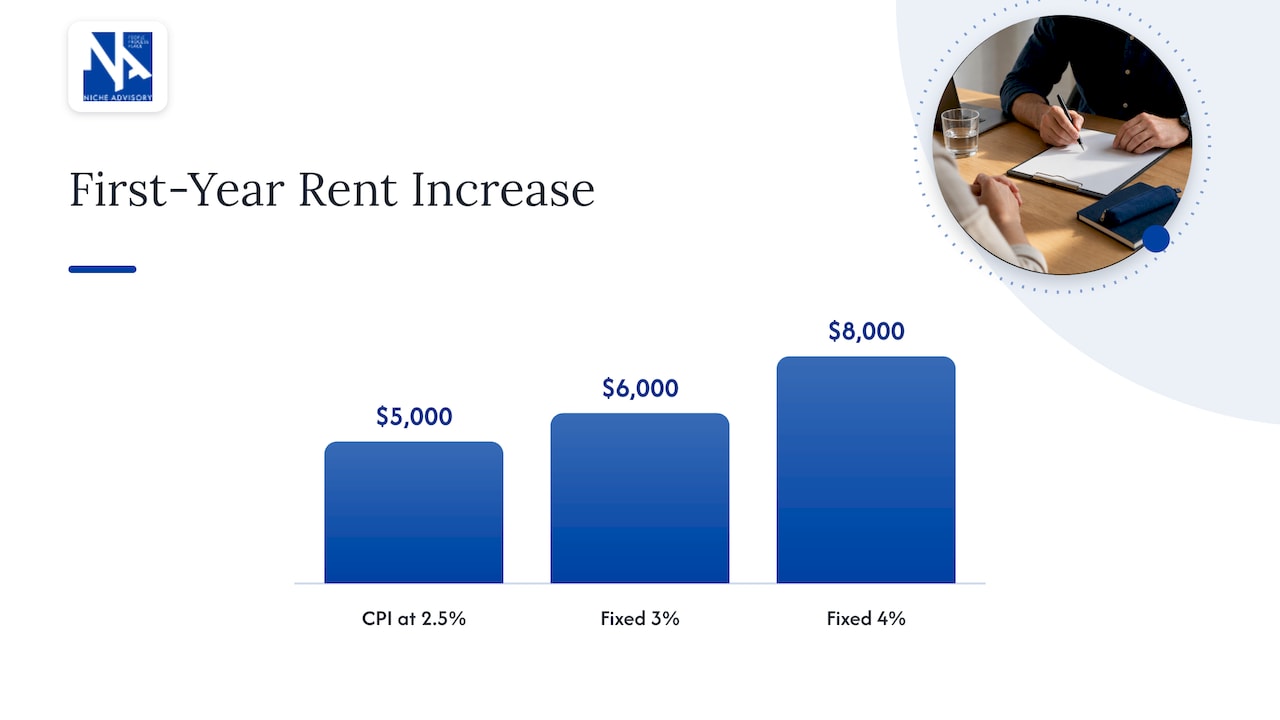
Here is what that means on a $200,000 annual rent. These are illustrative calculations, not forecasts.
| Scenario | Fixed 3% | Fixed 4% | CPI |
|---|---|---|---|
| CPI comes in at 2.5% | $6,000 | $8,000 | $5,000 |
| CPI comes in at 4.0% | $6,000 | $8,000 | $8,000 |
| CPI comes in at 5.5% | $6,000 | $8,000 | $11,000 |
Increase in first-year rent, on $200,000 base rent.
Two things stand out:
- The gap compounds. Each review builds on the last. A $3,000 difference in year one becomes a larger difference by year five, because the higher base carries forward.
- Choosing a method is a view on inflation. If you expect inflation to stay near 4% or above, a fixed 3% is a bargain. If you expect it to ease towards 2.5%, CPI is likely to cost less than a fixed 4%.
Nobody can forecast this reliably over a five or ten year term. That is why the question for most tenants is less “which will be cheaper?” and more “how much uncertainty can our budget absorb?”
Fixed increase vs CPI: comparing the criteria
| Criterion | Fixed increase | CPI review |
|---|---|---|
| Budget certainty | High. Known for the whole term | Lower. Known only once the index is published |
| Inflation risk | Sits with the landlord | Sits with the tenant |
| Cost when inflation is high | Usually lower | Higher |
| Cost when inflation is low | Can be higher than CPI | Lower |
| Drafting complexity | Low | Moderate to high |
| Dispute risk | Low | Higher if the index is vaguely defined |
If you are a business with thin margins or a fixed-price contract book, certainty is often worth paying for. If you run a business whose revenue rises with inflation, you may be happy to carry CPI risk in exchange for a lower expected cost.
The part most tenants miss: drafting the CPI clause
Saying “CPI” in the lease is not enough. The NSW Small Business Commissioner’s retail tenancy guidance sets out that the rent review method must be stated in the lease, and the same guide’s 2022 edition stresses defining how it is calculated. A well-drafted clause specifies:
- The index. For example, CPI All Groups for a named city, or the eight capital cities weighted average. Sydney and national figures can differ.
- The measurement quarters. Which quarter is the start and which is the end. Two parties picking the nearest published figure can land on different answers.
- The review date and notice mechanism. When the new rent applies and how it is communicated.
- What happens if the index changes or is discontinued. A fallback prevents a gap in the clause.
- Whether rent can fall. This is the ratchet question, covered below.
Where both sides use different ABS releases or different city indices, the disagreement can run for years. We see this most often when a facilities manager inherits a lease and the person who negotiated it has moved on. If you manage a portfolio, a periodic lease administration check is cheap insurance, and it is part of what we do through our lease administration and related services.
Caps, collars and ratchets
Tenants often try to get the best of both worlds: CPI, but capped at, say, 4%. Landlords counter with a floor (a collar) or a ratchet that stops rent falling when CPI is negative.
These hybrids are where the legal risk sits.
Why a CPI cap can backfire
In Victoria, a VCAT decision found that a lease providing a CPI increase capped at 4% breached section 35(2) of the Retail Leases Act 2003 (Vic). The cap was treated as a second, alternative method of review, so the clause was void and the rent was determined by market review. Commentary on the decision warns retail landlords and tenants to beware of mixed rent review clauses.
The lesson is uncomfortable: a clause you negotiated as protection can be struck out, and the replacement, a market rent review involving valuers, can cost more than either the capped or uncapped CPI result. The Victorian Act requires that, for retail premises, the review basis is one of a short list of permitted methods: a fixed percentage, an independently published index, a fixed annual amount, or current market rent.
Ratchet clauses
A ratchet stops rent decreasing even if CPI falls. Ratchets are frequently voided in retail leases under state legislation, but a voided clause does not automatically freeze the rent in your favour. It can lead to renegotiation or a market rent determination, each with its own costs and uncertainty.
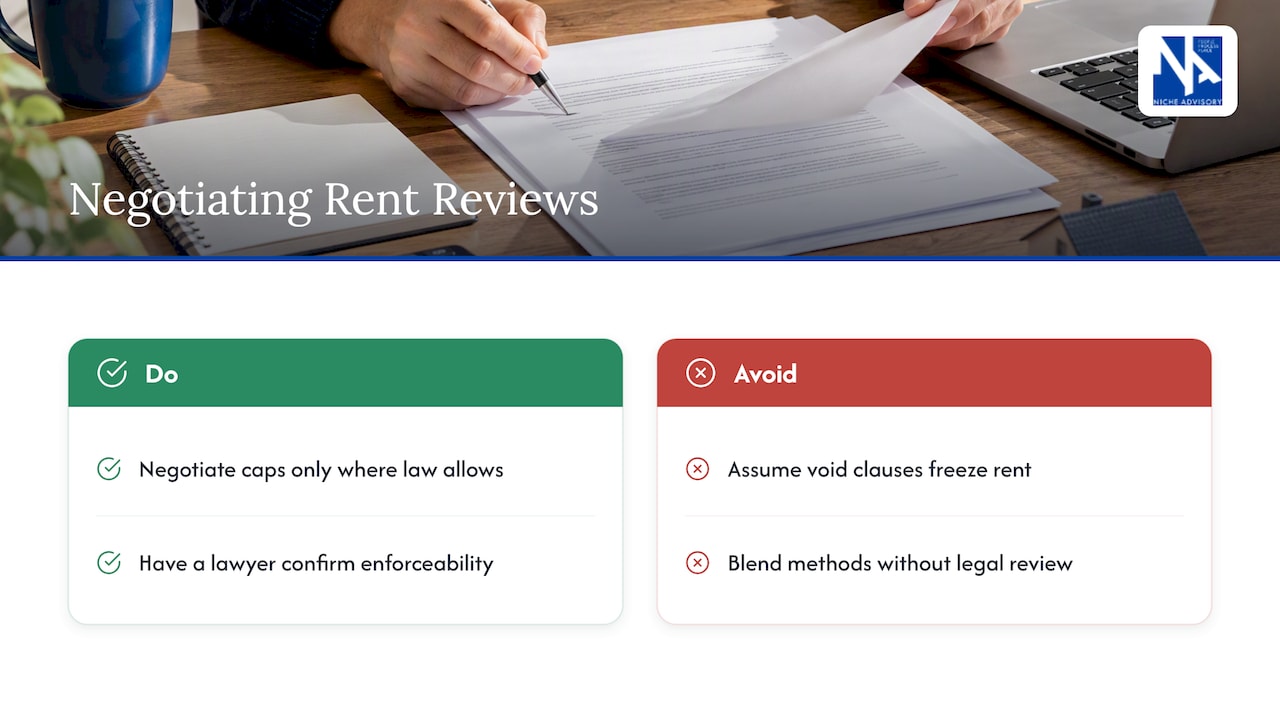
This is why caps and collars are worth negotiating only where your lease type and state law allow them. Before you sign anything that blends methods, have a commercial leasing lawyer confirm it is enforceable. A firm such as West Legal & Associates advises on commercial leasing, and a lawyer’s review of the wording is the right step for any cap or collar.
Retail or commercial: the check that comes first
Much of the case law above concerns retail leases. Industrial and many office leases sit outside retail legislation, which means more freedom to draft caps, collars and ratchets, and less statutory protection if the drafting goes wrong. Whether a premises is “retail” depends on the legislation of your state and the use of the premises, not on what the lease heading says.
Our short guide, 4 checks to tell if a lease is retail or commercial in Australia, walks through the tests. For the wider regulatory picture, see the new code for commercial leases, broken down.
How to choose: a practical framework
- Confirm the lease type. Retail, commercial or industrial. This decides which methods and hybrids are lawful.
- Model both methods over the full term. Use at least three inflation scenarios: low (around 2.5%), current (around 4%) and high (5.5% or more). Include option periods.
- Compare with the fixed rate offered. If the landlord offers a fixed 3% against CPI at 4.0%, the fixed rate is currently the cheaper path. If the offer is a fixed 4% or more, the gap closes quickly if inflation eases.
- Look at the whole rent package. Review method is one lever. Incentives, rent-free periods and outgoings can move your occupancy cost more than a one-point difference in annual escalation.
- Line up the term with your plans. The longer the term, the more the compounding matters. Our piece on matching lease term to fit out payback covers the accounting and payback side.
- Get the wording right. Index, series, quarters, fallback, and review dates, all written out.
- Have the final clause checked by a lawyer if it contains any cap, collar or ratchet.
Market reviews are a third option
We have focused on fixed and CPI, but many leases also include periodic market reviews, usually every few years, where the rent is reset to current market levels. A lease can combine methods across its term in some jurisdictions, for example fixed increases in most years and a market review at year five. Under retail legislation, the rules about combining methods are stricter, so ask before assuming.
Common mistakes tenants make
- Anchoring on the headline rate. The figure in the news is rarely the figure your clause uses. The headline annual number may be a 12-month movement, while your clause may compare two specific quarters.
- Treating a cap as free insurance. As above, in some leases a cap is the very thing that voids the clause.
- Ignoring compounding. A 0.5 percentage point difference looks small. Over ten years on a large rent roll it is not.
- Negotiating the review method last. By the time heads of terms are signed, leverage is gone. Review mechanics belong in the first offer exchange.
- Missing options. Option rents often follow a different method than the initial term, as the Victorian case shows, where the CPI increase applied on exercise of an option.
How we help tenants with rent review mechanics
Niche Advisory acts exclusively for tenants and owner-occupiers, never landlords, so our advice on fixed versus CPI is independent of who receives the rent. Through corporate tenant advocacy we review proposed lease terms, model the escalation options against your budget and negotiate the clause. We also handle lease renewals and rent reviews in Sydney and across the markets we operate in, and where a review has already gone wrong, our dispute resolution services and lease disputes guidance set out the options.
If you have a review coming up or a new lease on the table, talk to us before you sign.
FAQ
How do you calculate a CPI increase for a lease?
Take the percentage change in the index named in your lease between the two quarters the clause specifies, then apply it to the current base rent. For example, a 3.2% movement on $200,000 adds $6,400. Check the clause for the exact series, city and quarters, because using a different release or index can produce a different answer.
Is a fixed increase or CPI better for a tenant?
It depends on future inflation and your appetite for risk. When inflation exceeds the fixed rate, the fixed increase costs less. When inflation falls below it, CPI costs less. A fixed increase gives budget certainty, while CPI is more variable and carries the inflation risk for you.
What is the current CPI rate in Australia?
The ABS reported that CPI rose 4.0% in the 12 months to August 2026, up from 3.5% in July. Your lease will use its own measurement quarters, so the figure that applies to your rent may differ from the latest headline.
Can I negotiate a cap on CPI increases?
Sometimes, depending on your lease type and state. In Victorian retail leases, a CPI cap has been found void by VCAT because it created a second review method. Industrial and some office leases have more flexibility, but have a commercial leasing lawyer check the drafting.
Sources
- Consumer Price Index, Australia, August 2026 (ABS)
- CPI rose 4.0% in the year to August 2026 (ABS media release)
- Commercial Lease Essentials: QLD Business Owner Guide (Bell Senior)
- Retail Tenancy Guide (NSW Small Business Commissioner)
- NSW Retail Tenancy Guide 2022 (PDF)
- Is your rent review void? VCAT finds a cap on CPI review void (Gadens)
- VCAT decision provides clarity for retail landlords and tenants (Mondaq)
- Be Aware! Retail Leases, rent reviews and ratchet clauses (Lewis Holdway)