
A change impact assessment is a structured way to work out who a change will affect, how much, and what each group needs to cope with it. For a workplace project such as an office relocation, a fitout or a move to hybrid work, it turns “we are changing the floorplate” into a list of specific people, routines and support actions. In Australia it also helps you meet a legal duty: employers must manage the psychosocial risks that poorly handled change can create.
This guide covers the steps, a worked example from an office move, a template you can copy into a spreadsheet, and the mistakes that make assessments useless.
TL;DR
- A change impact assessment maps the current state against the future state, then identifies each affected group and the size of the effect on them.
- The value is in the translation: every impact should produce a transition action such as training, communication or an adjusted target.
- In Australia, poor organisational change management is a recognised psychosocial hazard, so consulting workers early is a safety matter, not only a project nicety.
- Treat the assessment as a living document. Revisit it at design, implementation and after move-in, and validate it with the people doing the work.
Table of Contents
- What a change impact assessment is, and what it is not
- Why it matters more for workplace projects
- The Australian legal angle: consultation is a duty
- How to run a change impact assessment: six steps
- A worked example: a 120-person office move
- A template outline you can copy
- Keep it alive: when to revisit
- Common mistakes
- Where this fits in a workplace strategy
- How Niche Advisory can help
- FAQ
- Sources
What a change impact assessment is, and what it is not
A change impact assessment (often called change impact analysis, and the two terms are used interchangeably in practice) evaluates how a project will affect stakeholders, processes, tools, organisation structures, roles and technology. The Jamaican Government’s change management playbook defines it in those terms, and the definition holds for private-sector projects too.
It is the starting point for much of the rest of change management. Imperial College London’s project guidance describes it as a way to understand the impacts on groups of people and what must happen for the change to count as successful. Training needs, communications plans, stakeholder engagement and go/no-go decisions all draw on it.
What it is not:
- A risk register. Risks are things that might go wrong. Impacts are things that will change, for better or worse, even if the project runs perfectly.
- A communications plan. The assessment tells you what needs to be communicated and to whom. The plan comes after.
- A one-off report. An assessment that is written at kick-off and filed is academic paperwork. More on that below.
Why it matters more for workplace projects
Most change programmes touch systems and processes. A workplace change touches where people sit, how they commute, who they bump into, how they concentrate and when they are expected to be there. Those effects are personal, and they show up fast.
Three workplace changes that nearly always need an assessment:
- Relocation to a new building or precinct, for example from a Sydney CBD floor to Parramatta or Macquarie Park.
- Consolidation or reduction of space at a lease event, often paired with activity-based working.
- Hybrid work policy shifts, where the space itself may not change but attendance patterns, meeting habits and manager expectations do.
If you are deciding between these options before a lease expiry, our occupancy planning guide sets out how to time the decisions, and the flexible office strategy article looks at how work-from-home patterns feed into lease choices.
The Australian legal angle: consultation is a duty
In Australia, the assessment is not just good practice. Safe Work Australia states that poor organisational change management is a psychosocial hazard, meaning it can cause psychological and physical harm. It describes this as change that is poorly planned, communicated, supported or managed.
The practical consequences for a workplace project:
- You need to consult workers, and health and safety representatives where you have them, when you are proposing changes to the workplace, tasks or operating model.
- You should identify the risks that arise from the change (role ambiguity, lack of support, unclear goals) and decide on controls.
- Safe Work Australia’s model code of practice on psychosocial hazards sets out the process: identify the hazard, assess the risk where needed, control it, and review.
- In Victoria, WorkSafe’s WorkWell toolkit notes that badly managed change can lead to lower productivity, reduced morale, increased absences and even mental injury claims.
A well-run change impact assessment gives you a documented record that you identified who would be affected, consulted them and put controls in place. It does not replace legal advice on your specific obligations, which vary by state and by whether the harmonised WHS laws apply to you. If you are unsure, speak to your WHS adviser or your state regulator.
If you manage a wellness or quiet space as part of a fitout, our note on office wellness rooms and WHS rules is a useful companion.
How to run a change impact assessment: six steps
The steps below follow the commonly used structure of defining current and future states, describing the change, building an assessment matrix, estimating resources and setting a timeline, as summarised by Questo’s method page and the Australian Government’s change management plan guide, which includes a template and example for management teams.
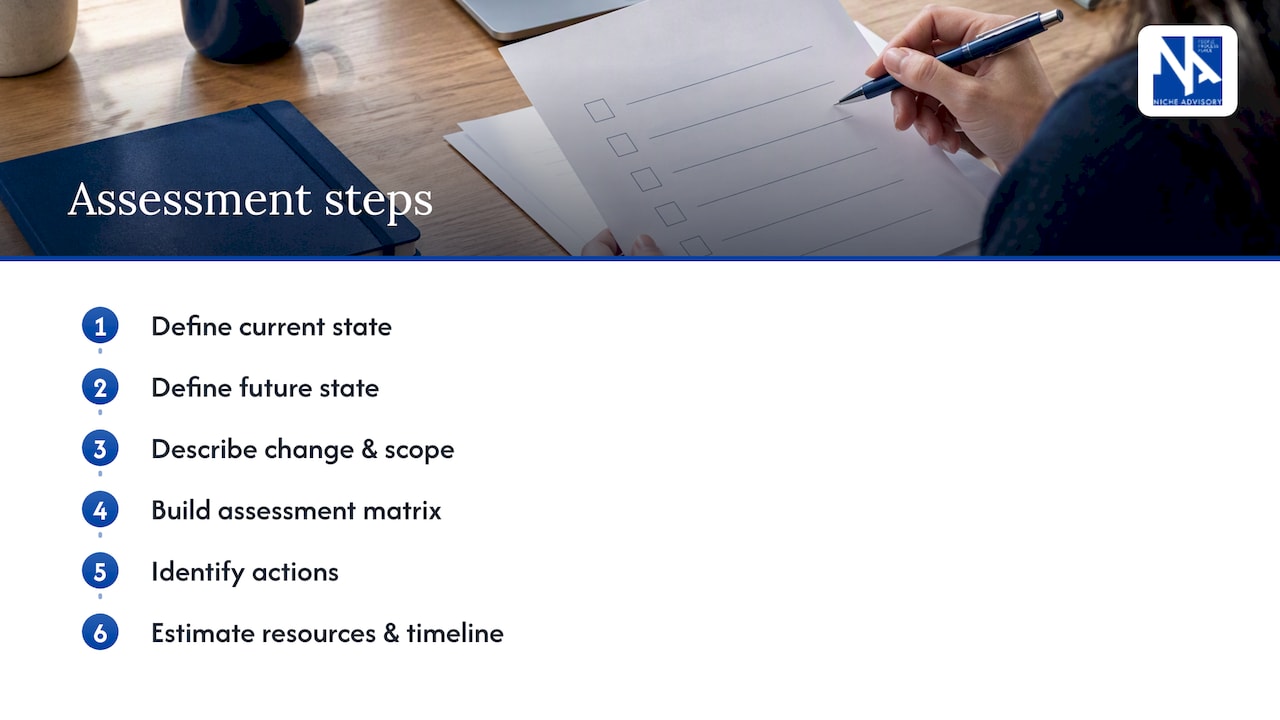
Step 1: Define the current state
Describe how work happens today, in terms people would recognise. Not “open-plan 8 desks per 10 staff” alone, but also: which teams sit together, how many days people attend, where client meetings happen, what systems are used on the floor, how people get to work.
Gather facts, not impressions. Badge data, desk booking records, a short pulse survey and a handful of interviews will tell you more than a workshop with senior managers.
Step 2: Define the future state
Describe the destination just as concretely. If the new space has 0.7 desks per person, say so. If the neighbourhood model puts finance and legal on one floor, say so. If the attendance policy is three anchor days, write that down.
A vague future state is the main reason assessments come out vague. If the design is not settled, record what is decided and what is still open, and flag the open items for the next review.
Step 3: Describe the change and its scope
Write a short statement of what is changing, what is not, the drivers (a lease expiry, a cost target, a hybrid policy), and the timeline. Be explicit about boundaries. Staff will assume the worst about anything left unsaid.
Step 4: Build the assessment matrix
This is the core. List each affected group down the side and each dimension of change across the top. Rate the impact for each cell, for example none, low, medium, high, and note the nature of the impact (positive or negative).
Useful dimensions for a workplace project:
- Location and commute
- Workspace type and personal storage
- Technology and equipment
- Team proximity and collaboration habits
- Policies and manager expectations
- Performance measures
- Health, safety and wellbeing
The last dimension is where the psychosocial hazard sits. Rate it for every group, not just those you expect to struggle.
Step 5: Translate impacts into transition requirements
This step separates useful assessments from decorative ones. Each medium or high impact needs an action with an owner and a date. Examples:
- A team that loses assigned desks needs a booking tool, a short orientation and clear etiquette rules before move-in.
- Managers who lead hybrid teams need training on running meetings with mixed attendance.
- Staff with a longer commute may need adjusted start times or a temporary flexibility arrangement.
- Roles that depend on paper records need a digitisation plan before storage is removed.
Step 6: Estimate resources and set the timeline
Cost the actions: training hours, communications effort, change champions’ time, temporary support on the floor after move-in. Then place them on the project timeline against the lease end date and fitout milestones. This is where the assessment connects to the budget, a point we cover in workplace change management that protects budgets.
A worked example: a 120-person office move
This is an illustrative example, not a client case. A professional services firm with 120 staff is moving from a CBD floor with assigned desks to a smaller floor with shared desks and a neighbourhood layout. Attendance is three days a week.
| Group | Current state | Future state | Impact | Rating | Transition action |
|---|---|---|---|---|---|
| Partners and directors | Private offices | Shared desks, one bookable focus room | Loss of status and privacy cues | High | Leadership briefing, visible adoption of desk sharing, clear focus room rules |
| Client-facing teams | Meet clients in offices | Client suite and meeting rooms | New booking routine | Medium | Booking guide, concierge support in the first month |
| Finance and legal | Paper-heavy, secure storage nearby | Reduced storage, digital workflow | Process change | High | Document digitisation before move, secure lockable storage allocation |
| Graduates and junior staff | Sit beside mentors | Neighbourhoods by function | Possible loss of informal learning | Medium | Anchor days aligned with mentors, buddy scheme |
| Staff with caring responsibilities | Flexible start times | Same policy, longer commute for some | Commute and scheduling | Medium | Individual conversations, start-time guidance |
| IT and facilities | Stable setup | New AV and desk booking tools | Workload peak at move | High | Dedicated project resources, vendor support, post-move hypercare |
Notice what the matrix does. It shows that the groups with the highest impact are not the ones most likely to complain. It also produces a transition action for every rating above low. Without that column, you would have a list of worries.
A template outline you can copy
Build this in a spreadsheet with one tab per element:
- Change summary: what, why, when, scope, sponsor.
- Stakeholder groups: name, headcount, location, leader, key concerns.
- Impact matrix: groups by dimension, with rating and positive or negative flag.
- Psychosocial check: for each group, the risks from lack of consultation, unclear goals or inadequate support, and the controls.
- Transition requirements: action, owner, date, budget, status.
- Review log: date of each review, who validated it, what changed.
The six-tab structure keeps the document short enough that people will actually update it.
Keep it alive: when to revisit
An assessment written once is out of date within weeks. Practitioners recommend treating it as a living document that feeds stakeholder management, training needs and go/no-go decisions. Revisit it at least at these points:
- Design sign-off: when the future state becomes concrete.
- Pre-move readiness: to decide whether groups are ready, or whether to delay.
- Two to four weeks after move-in: to capture what you did not predict.
- Three months after: to check whether the change is embedded.
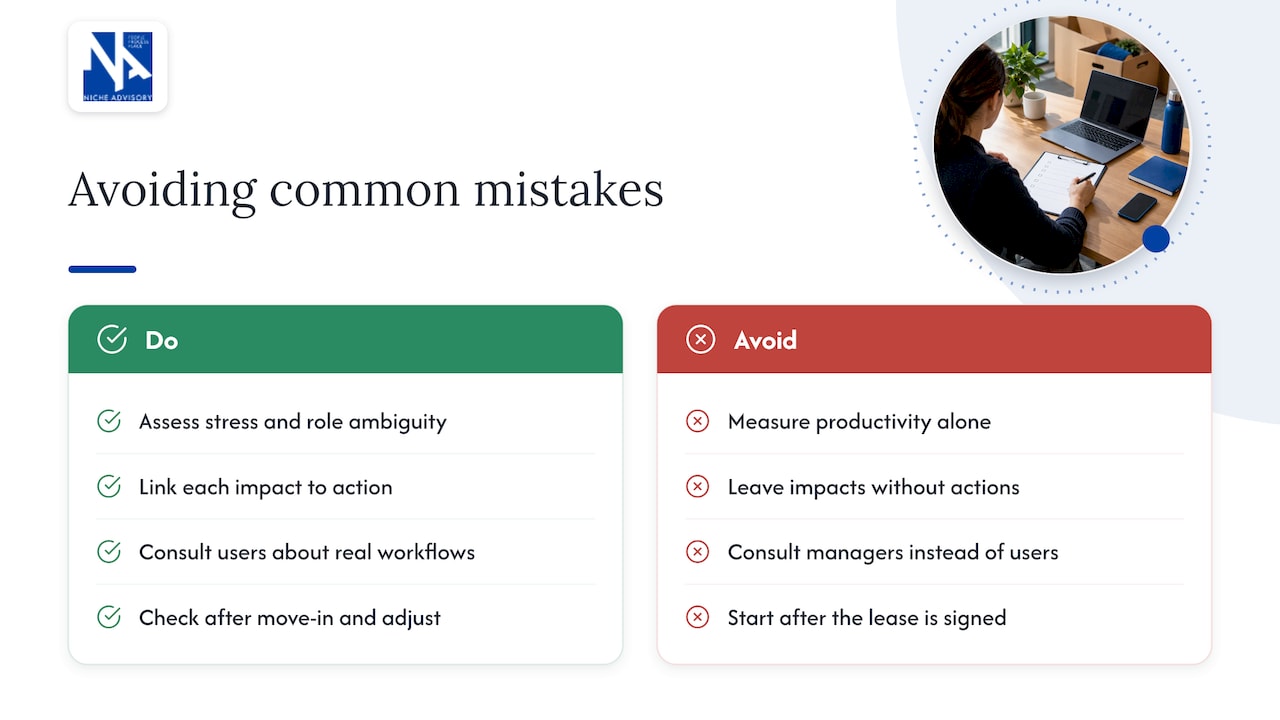
Validate each version with the people who do the work, not just project managers or senior leaders. A process change that looks clean on paper often misses the daily workarounds that staff rely on.
Common mistakes
Treating it as a productivity exercise only. Under Australian WHS rules, you need to look at the potential for stress from role ambiguity or lack of support, not only output.
Describing impacts without actions. If a cell says “loss of private office” and nothing else, the assessment has not done its job.
Consulting managers instead of users. Managers describe the intended process. Users describe the real one.
Ignoring emergent behaviour. A linear before-and-after view cannot predict how people will adapt. Hybrid work is the obvious case: people may cluster on the same days, creating peak-day crowding no model foresaw. Build in a pulse check and the ability to adjust after move-in.
Starting too late. If you begin the assessment after the lease is signed, you have lost the chance to let the findings shape the space. Impacts should inform the brief, the size of the premises and the negotiation.
Where this fits in a workplace strategy
A change impact assessment is a tool inside a larger process. Workplace strategy decides what the space and policies should be. The assessment tests what that means for people. The design and construction phases then deliver it, and the assessment keeps governing the transition plan.
Our workplace strategy framework for the first 90 days shows how the early stages connect, and the employee experience article covers what staff tend to notice once they are in the space. For the cost side of a move, see office fitout project management.
If you want examples of workplace strategy in practice, the matrix above is the pattern: the strategy sets the future state, and the assessment shows what has to happen for each group to get there. The whitepapers collect more of our thinking.
How Niche Advisory can help
We act only for tenants and owner-occupiers, never landlords, so our advice on whether to move, renew or consolidate is independent. We connect workplace strategy with execution, from lease negotiation through design to project and construction management, which means the findings of your change impact assessment can shape the brief, the premises and the budget rather than arriving after the decisions are made. If you are facing a lease event in Sydney, Melbourne, Adelaide or elsewhere, talk to us about your workplace project.
FAQ
What is the difference between change impact assessment and change impact analysis?
In practice they mean the same thing, and most guides use both terms. Some teams use “analysis” for the desk-based mapping and “assessment” for the version validated with stakeholders. Pick one term and use it consistently in your documents.
Who should complete the assessment?
The project or change lead usually owns it, but it should be built with input from team leaders, HR, IT, facilities and a sample of end users. Where you have health and safety representatives, involve them early, as consultation on workplace change is part of managing psychosocial risk.
How long does it take?
For a single-floor office move, a first version can often be drafted in two to three weeks if you have data and access to people. The time depends on how many groups are affected and how settled the design is. Plan for reviews at each project milestone rather than a single large effort.
Is a change impact assessment legally required in Australia?
There is no requirement for a document with that name. However, employers must consult workers and manage risks to health and safety, and Safe Work Australia treats poor change management as a psychosocial hazard. An assessment is a practical way to show you did so. Confirm your specific duties with your WHS adviser or state regulator.
Can I use a template?
Yes, as a starting structure. The Australian Government’s step-by-step change management guide includes a template and example. Adapt the dimensions to your workplace, because a generic template will not include commute, desk ratios or hybrid attendance.
Sources
- Poor organisational change management, Safe Work Australia
- Managing psychosocial hazards at work, model code of practice, Safe Work Australia
- Chapter 3, Change impact analysis, TIU Change Management Playbook
- Change Impact Assessment, Imperial College London
- Change management plan step-by-step guide, Australian Government Department of Health, Disability and Ageing