
The biggest commercial lease red flags are vague make good wording, outgoings that are not clearly defined, uncapped rent reviews, personal guarantees, one-sided relocation or termination rights, and no practical way out if your business changes. Most of these can be negotiated before you sign. Few can be fixed afterwards.
This guide is for business owners, executives and facilities managers who lease offices or warehouses in Australia. If you are looking for rental red flags on a home lease, this is not that article. Residential tenancy law is a different regime.
TL;DR
- Make good is where the largest hidden cost usually sits. Negotiate it before signing, not at exit.
- Ask for outgoings to be defined, itemised and capped where possible, and read the disclosure statement properly.
- Treat personal guarantees, relocation clauses and landlord discretion wording as negotiable, not standard.
- Plan your exit on day one: assignment, sublease, early termination and, if your work pattern is uncertain, a diplomatic-style clause.
- Diarise every critical date at signing. A missed option notice can cost you the premises.
Table of Contents
- First, work out which rules apply to you
- The 12 red flags, in the order they tend to hurt
- A quick screening table
- Red flags in the process, not just the document
- How to use vacancy risk in your favour
- When a dispute is already under way
- Where we can help
- FAQ
- Sources
First, work out which rules apply to you
Australian leasing law is state based. A retail lease in New South Wales, Victoria, Queensland or South Australia can carry protections such as disclosure statements that a pure office or industrial lease may not. Whether your premises count as “retail” depends on the use and the state’s definition, not on what the lease is called.
We set out four checks to tell whether a lease is retail or commercial separately. Do that first, because it decides what the landlord must give you and what you can rely on if there is a dispute.
In New South Wales, for example, a lessor of retail premises must give the lessee a disclosure statement at least seven days before the lease is entered into. If you are handed a lease and told to sign today, that alone is a red flag.
The 12 red flags, in the order they tend to hurt
1. A make good clause that says too little, or too much
Most owners fix on base rent. The make good clause often holds the bigger number. It sets out how you must hand the space back, and industry guidance says it can cost tens of thousands and sometimes hundreds of thousands of dollars when negotiated badly.
Watch for:
- Wording that requires return to a “vacant shell” or “base building” condition, when the space was not a shell on day one.
- Obligations to remove all cabling, ceilings, partitions and services, including work the landlord’s previous tenant left.
- No cap, no scope schedule and no right to pay a cash settlement instead of doing the works.
The safer position is to return the premises in the condition they were in at commencement, fair wear and tear excepted. Our guide to makegood obligations and negotiations goes through the clause line by line.
2. No condition report at the start
Without photos and a written record at the start, arguments about fair wear and tear versus damage are very hard to win. The Queensland Small Business Commissioner’s guidance on entering a commercial lease points tenants to think about this early. If the landlord does not supply a condition report, commission your own, dated and with photos, and have it acknowledged in writing.

3. Outgoings that are open ended
Outgoings are the operating costs passed to you on top of rent: rates, land tax, insurance, repairs, management fees and more. The NSW Small Business Commissioner tells tenants to understand these costs, build them into planning and take independent advice before signing.
Red flags include:
- A disclosure statement or lease that leaves outgoings unspecified. The South Australian Small Business Commissioner’s guide covers the disclosure obligations under that state’s retail and commercial leases legislation.
- Capital expenditure, such as replacing plant or the roof, pushed through as an outgoing.
- Landlord management fees on top of costs already recovered.
- No right to see audited statements.
We cover this in detail in how outgoings can add 20 to 50 per cent to rent.
4. Rent review wording you cannot model
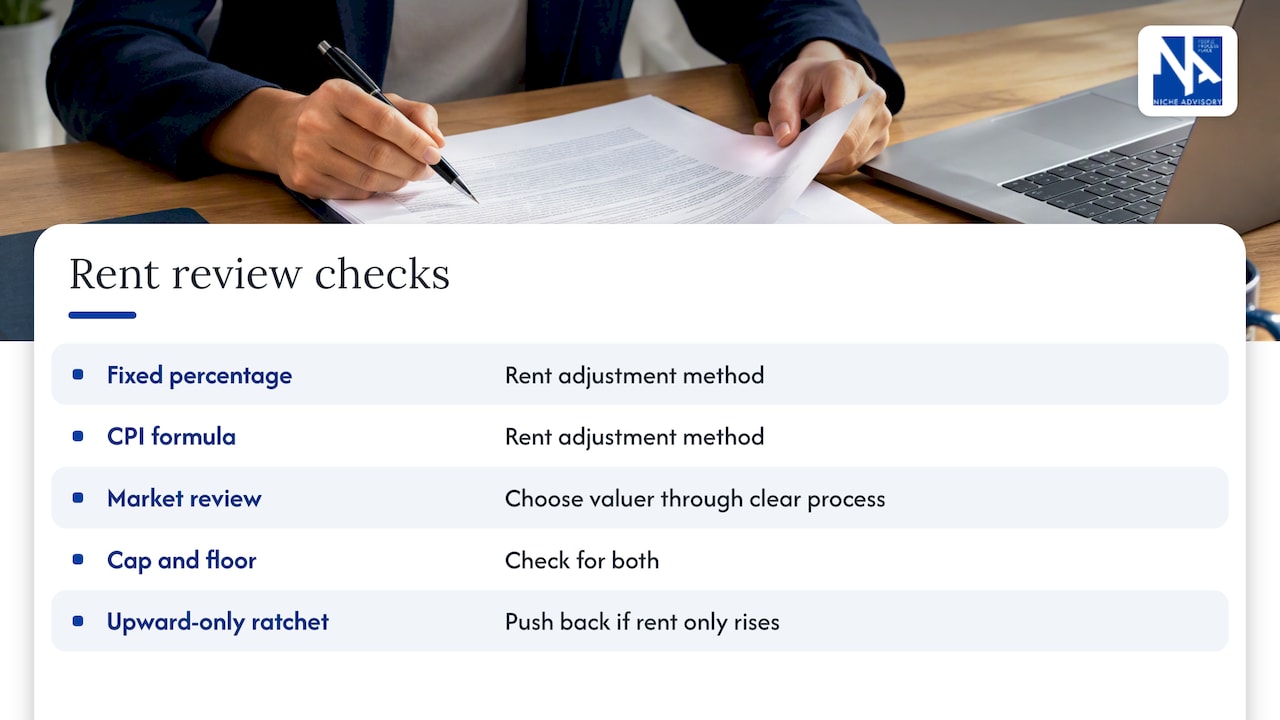
Ask three questions. How is rent adjusted during the term? Is there a fixed percentage, a CPI formula or a market review? And is there a cap and a floor? A market review with no clear process for choosing a valuer, or a “ratchet” that only lets rent move up, is a sign to push back. Queensland’s commissioner lists how rent will be adjusted among the key questions to settle before entering a lease.
Also check the starting number. Asking rent is a negotiating position. Industry guidance suggests negotiating from current market evidence and trading rent for operational concessions, such as incentives or flexibility.
5. Personal guarantees and oversized security
A director’s personal guarantee puts your own assets behind the company’s lease. A large bank guarantee or bond ties up working capital. Both can be negotiated at the outset, and again at renewal. The National Retail Association notes that a renewal is a chance to reduce risks beyond base rent. If you have traded reliably for several years, ask for the guarantee to be reduced or released.
6. Landlord discretion everywhere
Phrases such as “at the lessor’s absolute discretion” or a right for the landlord to vary provisions during the term shift risk onto you. Check consent for assignment, subletting, signage and alterations. Consent should not be unreasonably withheld or delayed, and the lease should say so.
7. Relocation and demolition rights
A clause that lets the landlord move you to other premises, or end the lease for redevelopment, can wipe out your fitout investment. Look for the notice period, who pays relocation and refitting costs, and whether the replacement space must be equivalent. The South Australian guide notes that a lessor may require vacant possession for demolition or substantial repairs in certain circumstances, so confirm what your state’s rules and your lease actually say.
8. Repair and maintenance responsibility that is not defined
The lease should state clearly who repairs what: structure, building services, air conditioning, roof, fire systems, and the tenant’s own fitout. Vague drafting leads to disputes about who pays. This matters most in industrial leases, where the site itself carries risk. See what tenants must check on industrial lease site risk.
9. Construction or disturbance risk
Queensland’s guidance asks tenants to consider whether construction works or disturbances could affect trading. For an office or warehouse, think about access, loading docks, parking and noise. If the landlord plans works, ask for rent abatement and a notice process.
10. A term that does not match your fitout payback
A short term with a large fitout means you may pay for improvements you never recover. A long term with no exit locks you in. Accounting also matters: under AASB 16, the lease term you adopt affects your balance sheet. Our piece on matching lease term to fitout payback explains the trade-offs.
11. No realistic exit
Many owners assume they can leave when the business changes. Usually they cannot. According to Queensland’s commissioner, ending a lease early typically leaves the tenant liable for rent to the end of the term plus the landlord’s re-leasing costs, though the landlord has a duty to try to mitigate its loss. Victoria’s commission makes a similar point: a lease is binding and usually cannot be broken early unless the lease or the law allows it.
So negotiate the exits now:
- Assignment and sublease rights, with reasonable consent tests.
- An early termination option, even if it costs a set fee.
- For uncertain headcount or hybrid plans, a clause allowing exit on pre-agreed events such as relocation or a material change in operations. These are sometimes called diplomatic clauses. They are more common in international and corporate tenancies and are distinct from force majeure. Landlords will not offer them unprompted, so ask.
12. No critical date system
This one is not in the lease text, but it causes real losses. Missing an option to renew notice can end your security of tenure and force an unplanned, costly move. Queensland’s commissioner flags options and renewal rights as things to understand before you sign. Diarise renewal windows, rent review dates, outgoings statements and maintenance obligations on the day the lease is signed, with reminders well ahead of each.
A quick screening table
| Clause | Red flag | What you want |
|---|---|---|
| Make good | Return to shell, no cap | Return as at commencement, scope schedule, cash settlement option |
| Outgoings | Unspecified, capital items included | Itemised, capped, audit right |
| Rent review | Upward only, vague market process | Fixed or capped, clear valuer process |
| Security | Personal guarantee, large bond | Limited guarantee that falls away, smaller bank guarantee |
| Relocation | Landlord can move you | Short list of conditions, landlord pays |
| Exit | None | Assignment, sublease, early termination option |
| Dates | Short option notice window | Longer window, written reminder from landlord |
Red flags in the process, not just the document
Sometimes the warning sign is how the deal is run.
- Pressure to sign quickly. Legitimate deals allow time for review and, where it applies, the statutory disclosure period.
- Verbal promises. If the agent says the landlord will fix something or waive a cost, it must be in writing in the lease or a side letter. In NSW, the disclosure statement process gives both sides a place to record statements or representations made to influence the decision.
- Only one party’s advice. The landlord’s agent acts for the landlord. Industry experts say the most common mistake is skipping independent legal and financial advice and assuming the lease is standard when most terms can be negotiated.
- A lease that is not in writing or not signed by both parties. In Victoria, for example, the Retail Leases Act 2003 requires a retail lease to be written and signed.
For a wider list of avoidable errors, see common mistakes businesses make with a commercial lease in Sydney and common risk factors for tenants.
How to use vacancy risk in your favour
Landlords dislike empty space. A vacant tenancy means lost income, incentives for the next tenant and agent fees. That is leverage for you. When you renew or negotiate an exit, offer certainty: early notice, a plan for assignment, or a longer commitment in exchange for a lower guarantee, rent-free periods or a tighter make good. Queensland’s guidance reminds tenants that a landlord must make reasonable efforts to find a replacement when a lease ends early, which limits what you owe in some cases (ending a lease early).
If you want a structured approach, our guide to the process of a lease re-negotiation covers the timing and sequence.
When a dispute is already under way
If a red flag has already turned into a dispute, for example over make good scope, outgoings charges or rent review, collect your documents first: the lease, disclosure statement, correspondence, condition report and invoices. Then get advice on your state’s dispute process before you escalate. Many states have small business commissioners that offer mediation for eligible leases. For more complex disputes, legal advice on analysing and litigating real estate disputes shows how professional review of lease terms before commitment can reduce the chance of ending up there.
Where we can help
Niche Advisory acts only for tenants and owner-occupiers, never landlords, so our advice on your lease is independent. We handle corporate tenant advocacy, including property search, lease negotiation and renewal, along with make good negotiation and execution, lease administration and dispute resolution. Because we also do workplace strategy and fitout, we can test whether the space and term fit how your people actually work before you commit.
If you have a lease in front of you, or a renewal date approaching in Sydney, Melbourne, Adelaide, Brisbane, Newcastle or the Gold Coast, start at our Corporate Tenant Advocacy page and ask us to review it before you sign.
FAQ
How much does it cost to break a commercial lease in Australia?
There is no fixed figure. Typically you remain liable for rent to the end of the term plus the landlord’s re-leasing costs, such as advertising and agent fees, as Queensland’s commissioner explains. The landlord must take reasonable steps to find a new tenant, which can reduce what you owe. Check your lease and your state’s rules, and get advice before you hand back keys.
What is a diplomatic clause in a lease?
It is a clause that lets a tenant end the lease early without penalty if specific, pre-agreed events happen, such as a relocation or a major change in business operations. It is more common in international and corporate tenancies. It must be negotiated into the lease, because a landlord is not required to offer one.
What are the top red flags in a commercial lease?
The main ones are an unclear make good clause, undefined outgoings, uncapped or upward-only rent reviews, personal guarantees, broad landlord discretion, relocation rights and no exit options. Pressure to sign without independent advice is a warning sign in its own right.
Is a commercial lease negotiable?
Yes, in most cases. Industry guidance says most terms are negotiable, even though many tenants assume the lease is standard. You have most leverage before signing and at renewal.
Sources
- Ending a lease early, Queensland Small Business Commissioner
- Tips when entering a commercial lease, Queensland Small Business Commissioner
- 10 Tips for Tenants Negotiating a Commercial Lease, ABIC
- Retail and commercial leases guide, South Australian Small Business Commissioner
- Retail lease disclosure statement, NSW Small Business Commissioner
- Understanding the costs of leasing, NSW Small Business Commissioner
- Ending a retail lease early, Victorian Small Business Commission
- Retail Leases Act 2003 (Vic)