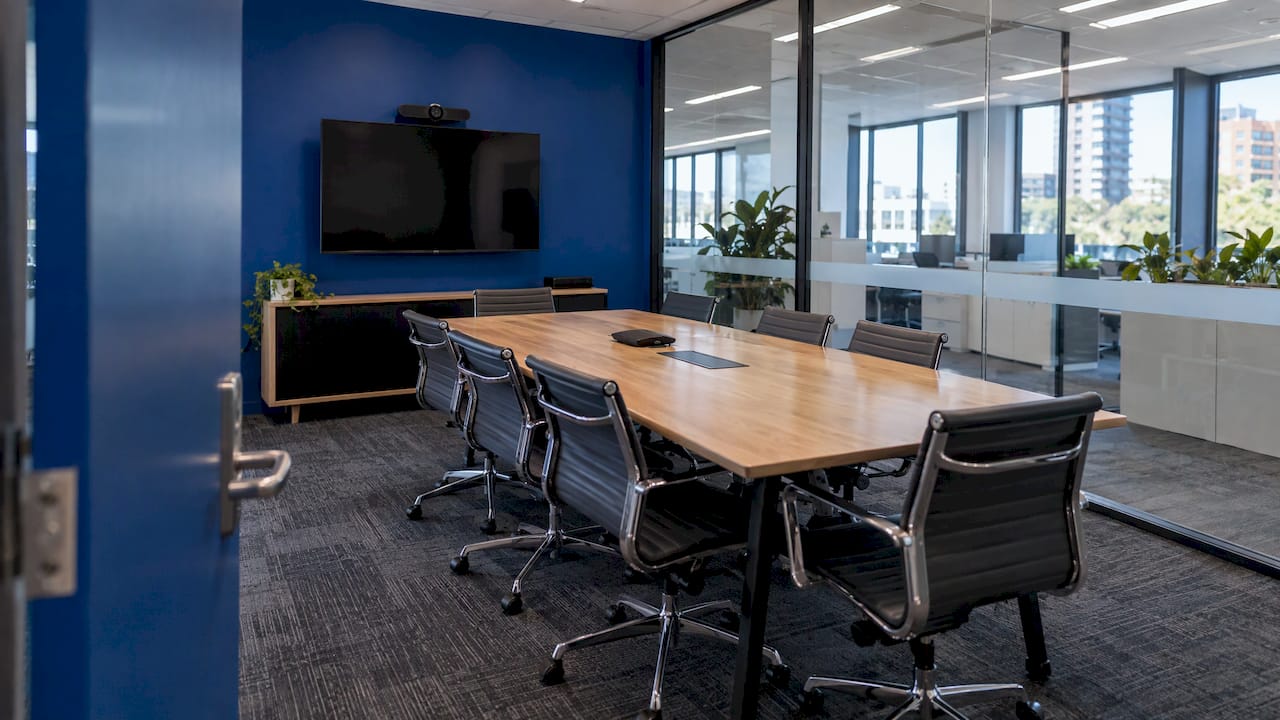
A relocation risk assessment is a structured review of what could go wrong when your business moves office or industrial premises, how likely and how costly each problem is, and what you will do about it before, during and after the move. For a tenant in Australia, the biggest risks usually sit in four places: the lease, the new site, people and WHS duties, and operational continuity (especially IT). This guide shows how to cover each one and turn the findings into a register you can actually manage.
TL;DR
- Treat the move as a business continuity project, not a facilities task. Early decisions on lease terms, timing and fit-out are the hardest to reverse.
- Assess four areas: lease and make-good, site and access, people and WHS consultation, and IT and operations.
- Under the WHS Act 2011, you must consult workers affected by changes such as a new worksite, before decisions are final.
- Score each risk for likelihood and impact, name an owner, choose a control, and review the register after the move.
- Budget for the costs people forget: internal staff time, IT disconnection and reconnection, temporary storage and make-good.
Table of Contents
- What a relocation risk assessment covers
- Step 1: Identify, rate and control the risks
- Step 2: Lease and make-good risks
- Step 3: Site and access risks
- Step 4: People, WHS and consultation
- Step 5: IT, operations and continuity
- Step 6: Budget and financial risk
- Step 7: Monitor the risks and confirm the new workplace works
- A quick example of a rated risk
- Where independent advice helps
- FAQ
- Sources
What a relocation risk assessment covers
A good assessment looks at everything that could affect people, premises, assets and operations. Practical guides on commercial moves list site access, equipment damage, IT downtime and information security as the core categories. For a tenant, we would add two more: the lease itself, and the financial exposure that sits behind it.
It helps to think of the assessment as covering three time windows:
- Before the decision. Is the new premises right for the business, and are the lease terms survivable?
- During the move. What can break, be lost or interrupt service in the days of the move itself?
- After the move. Is the new workplace safe, working and delivering what the business case promised?
Most businesses only assess the second window. The expensive surprises tend to come from the first and third.
Step 1: Identify, rate and control the risks
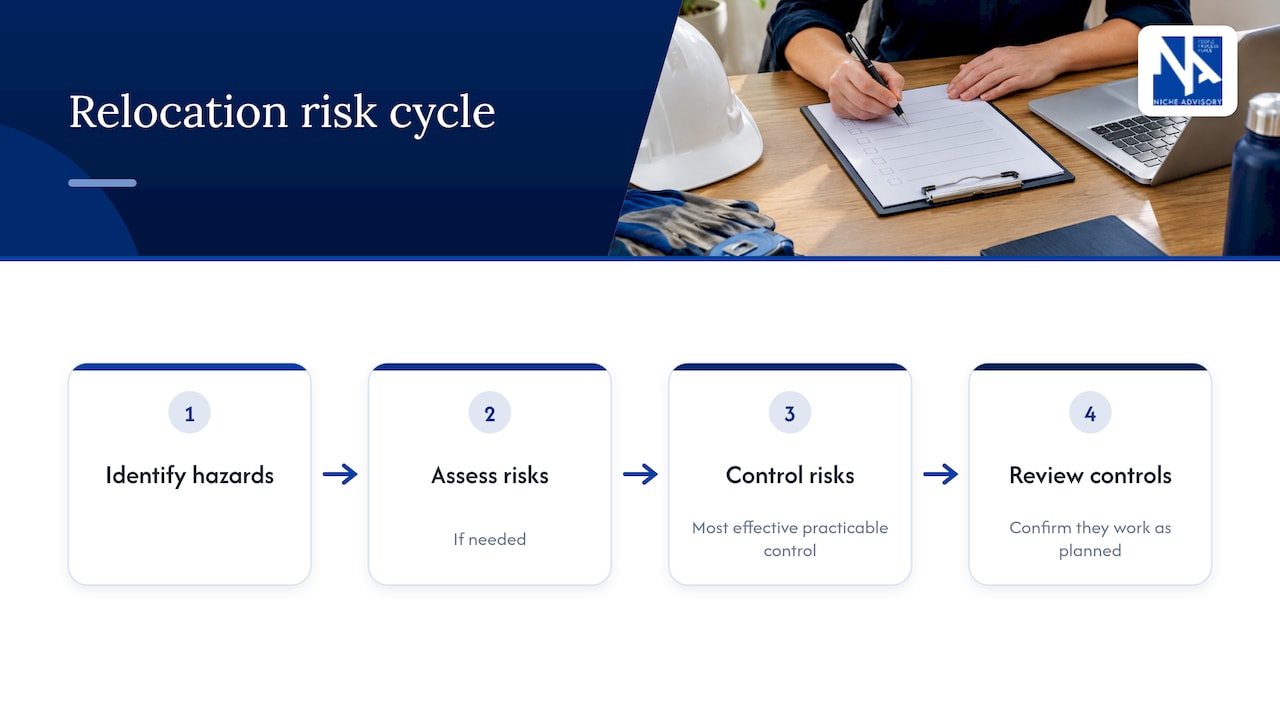
The method is the same one Safe Work Australia sets out for workplace hazards. Its code of practice describes the cycle as identify hazards, assess risks if needed, control risks with the most effective measure that is reasonably practicable, and review the controls to confirm they work as planned. That cycle translates neatly to a relocation.
Build the register
A spreadsheet is enough. Use these columns:
| Column | What to put in it |
|---|---|
| Risk | A plain description, for example “Lift cannot take the largest server rack” |
| Area | Lease, site, people, IT, operations, finance |
| Likelihood | Low, medium or high |
| Impact | Low, medium or high, judged on downtime, cost and safety |
| Control | The action that removes or reduces the risk |
| Owner | One named person |
| Due date | Relative to the move date, such as “T minus 8 weeks” |
| Status | Open, in progress, closed |
Rate likelihood and impact simply. A three-by-three grid is more useful than a ten-point scale nobody agrees on. Anything rated high on both goes to the top of the project plan and gets reported to the executive sponsor.
Choose controls that actually reduce the risk
The strongest controls change the plan itself: moving a server cutover to a weekend, extending the overlap between two leases, or specifying a different loading arrangement. Weaker controls rely on people remembering to be careful. Where you can, remove the risk rather than adding a reminder.
Step 2: Lease and make-good risks
The lease is where a relocation can quietly lose the most money, and the risk starts long before the move.
The old lease. Check your exit position: expiry date, options, holding-over terms and make-good obligations. Make-good is often the largest single exposure. Legal guidance for tenants notes that make-good costs can reach tens or hundreds of thousands of dollars for large or heavily fitted premises, and recommends clear make-good definitions and a documented record of the premises’ condition at the start of the lease. If you do not have that record, assemble whatever photos, plans and correspondence exist now. Our guides on make-good obligations and negotiation and common make-good misconceptions explain where disputes usually start.
The new lease. Risks to test before you sign:
- Lease term versus the payback on your fit-out. A short term on an expensive fit-out is a financial risk; see how AASB 16 affects lease term decisions.
- Landlord incentives, and what happens to them if you leave early. Our nine-step approach to incentive negotiation covers this.
- Handover condition, practical completion dates and what happens if the landlord’s works run late while your old lease is expiring.
- Make-good on the new premises, which you are agreeing to on day one even though it falls due years later.
The timeline. A delayed fit-out with a fixed exit date means paying holding-over rent or running a temporary arrangement. Build a buffer between fit-out completion and your old lease end, and record it as a named risk. Our timeline-first relocation playbook shows how to sequence the work backwards from the exit date.
Step 3: Site and access risks
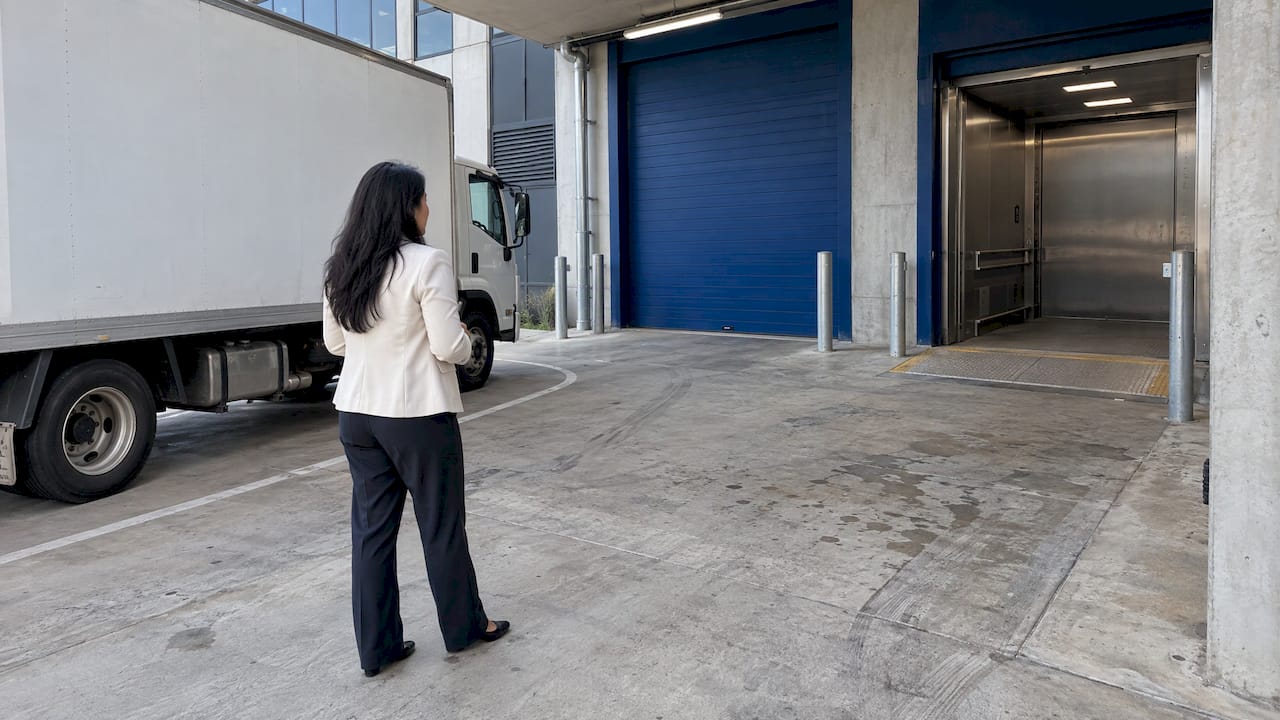
A site that looks perfect on a floor plan can fail on the day. Pre-move inspections are essential to verify lift access, loading dock constraints and whether the layout suits your furniture and equipment.
On the inspection, check:
- Lift size, weight limits and booking rules, plus any building restrictions on move hours.
- Loading dock height, vehicle clearance and whether a truck can wait without blocking others.
- Door widths and corridor turns for large items such as plant, racking, safes and printers.
- Floor loading for heavy equipment, particularly in a warehouse or archive.
- Power, data and cooling for any server or comms room.
- Security: who holds keys and codes at handover, and whether existing locks have been rekeyed. Arranging commercial locksmith services for rekeying and access control before staff arrive closes a gap that is easy to forget.
For industrial and warehouse moves, add truck turning circles, dock leveller condition, forklift access, racking certification and any dangerous goods storage requirements. Each of these has its own approvals and lead times, so list them as separate risks rather than one line reading “warehouse setup”.
Step 4: People, WHS and consultation
This is the area where a legal duty applies, so it should not be treated as a courtesy. Under section 47 of the Work Health and Safety Act 2011, a business must consult workers who are directly affected by changes that could affect their health and safety, such as moving to a new worksite. This is the Commonwealth model Act; the duty applies through each state and territory’s own WHS laws, so confirm the position with the regulator in the state where you operate (SafeWork NSW, WorkSafe Victoria, WorkSafe Queensland, SafeWork SA and so on). Victoria uses its own Occupational Health and Safety Act, with similar consultation duties.
Safe Work Australia’s guidance is clear that early consultation and identification of risks can open up more options to eliminate or minimise risks and reduce costs. Its model code also describes consultation that is genuine, involves health and safety representatives where there are any, and takes place before major decisions are finalised.
In practice:
- Consult before you sign, not after. Staff can tell you about commute changes, accessibility needs, shift patterns, parking, and which teams depend on each other.
- Include the health and safety representative and committee, if you have them, in the risk review.
- Record what you asked, what you heard and what you changed.
- Plan the new workplace for safe use from day one: emergency evacuation, first aid, ergonomic setups, amenity, and quiet or wellness spaces. Our note on wellness rooms that meet WHS expectations is a useful starting point.
- Check that contractors working on your fit-out and move have their own safety documentation, because as the occupier you share duties with them on site.
WHS consultation is separate from other staff communication. A town hall announcement is not consultation. Employment-related questions, such as changes to a regular place of work, can raise separate obligations under employment contracts, awards or enterprise agreements, so take advice from an employment lawyer or your HR adviser where a move materially changes how far people must travel.
Step 5: IT, operations and continuity
Relocations are best managed as business continuity events rather than facilities moves, because early decisions have irreversible effects on service levels and working capital. A relocation is also fundamentally a project management exercise needing a clear timeline, defined responsibilities and control of operational continuity.
The typical controls for IT and operations are:
- Phase the move. One Australian data centre migration case used phased work, mostly overnight and on weekends, with coordinated stakeholders and staff updates. The same logic suits an office: move the least time-critical teams first, keep critical functions running in the old space until the new one is proven.
- Order connectivity early. Internet and phone services often have the longest lead times. Treat the install date as a gating item for the move date.
- Back up and document. Know where every system, device and licence sits before it is disconnected. Verify backups before the move, not after.
- Protect information. Plan secure handling of paper records, hard drives and anything confidential, including who supervises it in transit.
- Tell customers. Update addresses, delivery arrangements, insurers and regulators. List who is responsible for each notification.
- Name a single coordinator. Our move management checklist explains how one accountable person reduces IT downtime and make-good risk.
Step 6: Budget and financial risk
Overruns come from items outside the headline fit-out figure. A practical business relocation guide lists fit-out, IT disconnection and reconnection, rectification, temporary storage and staff time as cost lines to include, and notes that internal costs, such as staff time spent planning or packing, are often overlooked in relocation budgets.
A sensible budget carries:
- A contingency line tied to the high-rated risks in your register.
- The cost of overlapping rent, if you need both premises for a period.
- Make-good on the exit premises, estimated early and tested against the lease wording.
- Furniture, cabling, signage, security and insurance changes.
For an example of how these lines add up, see our Sydney office relocation cost breakdown. It is a single midrange scenario, so use it as a structure for your own numbers, not a quote.
Step 7: Monitor the risks and confirm the new workplace works
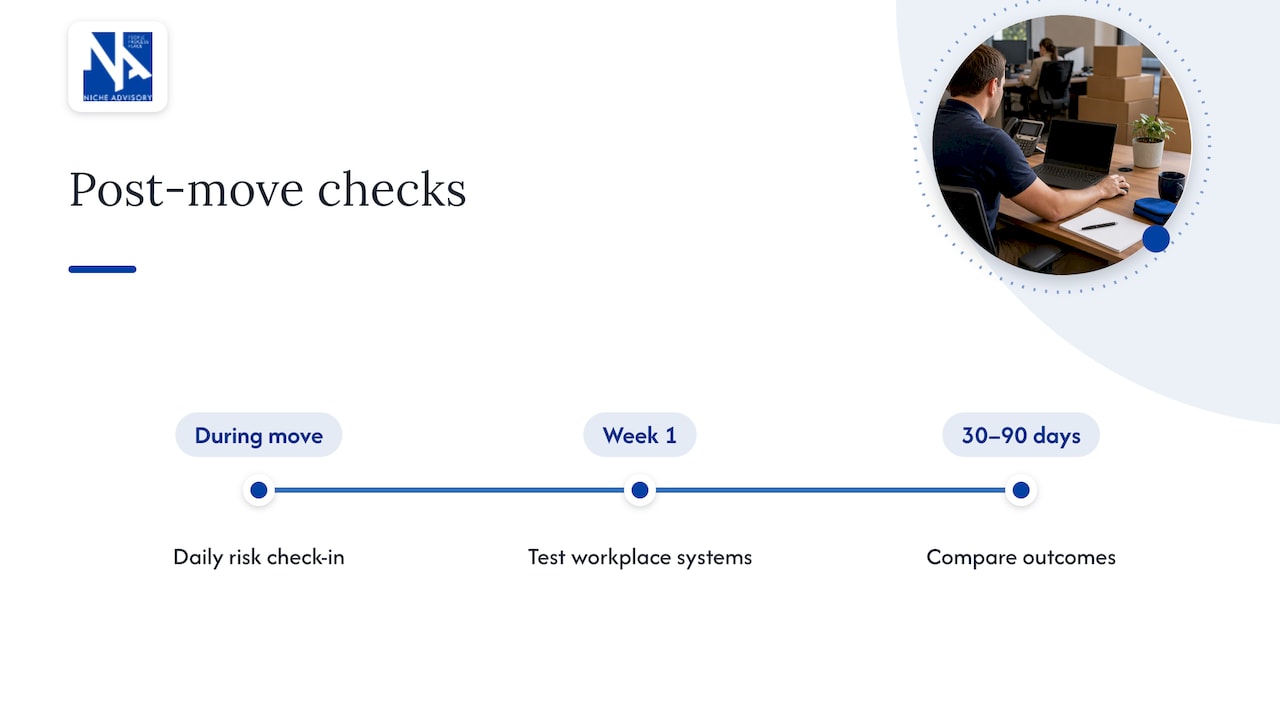
The assessment does not end when the trucks leave. The code of practice’s final step is to review hazards and control measures to make sure they are working as planned. Apply that to the move in three checkpoints:
During the move. Hold a short daily check-in. Update the register: which risks closed, which opened, which changed rating. Keep an incident log for damage, delays and near misses.
First week. Walk the floor with staff. Test emergency exits and lighting, confirm phones, printing, network and access cards work, and ask teams what is slowing them down. Fix safety items the same day.
First 30 to 90 days. Compare the outcomes with the business case: space use, attendance patterns, noise, meeting room demand, cost against budget. Gather staff feedback again and close out remaining defects with the landlord and builder. Our first 90 days workplace framework covers this stage, and workplace change management helps when adoption lags.
Also confirm the old lease is properly closed out: keys returned, make-good agreed or completed, and any dispute resolved. If a disagreement with the landlord emerges, our overview of lease disputes shows the usual paths.
A quick example of a rated risk
To make the register concrete, here is how one risk might look for a 60-person Sydney office moving to a new floor:
| Field | Entry |
|---|---|
| Risk | Internet service not live on move day |
| Area | IT |
| Likelihood | Medium |
| Impact | High (no client-facing work) |
| Control | Order service at signing; hold a second temporary connection; schedule the move after the install is tested |
| Owner | IT manager |
| Due | T minus 10 weeks |
Notice that the control changes the schedule. That is what a useful control looks like.
Where independent advice helps
Many of these risks are decided in the lease negotiation, long before move day. Niche Advisory acts only for tenants and owner-occupiers, never landlords, and our advice is independent. We can support a relocation from the first brief to the finished fit-out, including corporate tenant advocacy for lease negotiation, project and construction management for the build and move, and make-good negotiation and execution on the exit premises. If you want to talk through your risk register or your timeline, start at Niche Advisory.
FAQ
What is a relocation risk assessment?
It is a documented review of what could affect people, premises, assets and operations during and after a move, with a rating, an owner and a control for each risk. For a business tenant it should include the lease, the site, WHS consultation, IT and budget.
Do I have to consult staff before moving premises in Australia?
Under section 47 of the WHS Act 2011 model laws, a business must consult workers directly affected by changes that could affect their health and safety, such as a new worksite. This should happen before decisions are final. Confirm the detail with your state or territory regulator.
What are the main disadvantages and costs of relocating?
The main costs are fit-out, IT disconnection and reconnection, rectification, temporary storage, make-good and staff time. Planning them in a budget with a contingency, and sequencing the move to protect continuity, keeps them manageable.
When should the risk assessment start?
Before you commit to a new lease. The decisions that carry the highest risk, such as lease term, incentives, handover dates and make-good, are made at negotiation. Update the register at each stage through to 90 days after the move.
Sources
- Commercial Relocation Risk Management Plan
- How to manage work health and safety risks, Code of Practice (Safe Work Australia, November 2024)
- Work health and safety consultation, cooperation and coordination (Safe Work Australia, July 2023)
- Model Code of Practice for the healthcare and social assistance industry (Safe Work Australia, July 2025)
- Work Health and Safety Act 2011
- Commercial Lease Essentials: QLD Business Owner Guide 2026
- How to Plan a Corporate Relocation Step by Step
- How to Plan a Business Relocation
- How Deployus Moved icubed’s Data Centre Without Disruption
- Commercial locksmith services