Signage rights are negotiated before you sign, not after. A lease that only says signage is allowed “with the landlord’s consent” gives you very little. The rights that protect you are specific ones: which signs, where, how big, lit or unlit, who approves them, who pays, and what you must remove at the end. Niche Advisory acts only for tenants and owner-occupiers, never landlords, so this is written from the tenant’s side of the table.
TL;DR
- Australian leases usually allow tenant signage only with landlord and authority consent, and that consent is generally not to be unreasonably withheld. Do not rely on that alone: name each sign in the lease.
- Landlord consent and council approval are separate. A council may approve a sign that your lease still prohibits, and the reverse also happens.
- Settle the cost split and the removal obligation up front, because signs are routinely swept into make-good clauses.
- Shopping centres, strata buildings and heritage sites add a second layer of rules (design manuals, owners corporation consent, planning permits) that you need to know about before heads of terms are agreed.
- Raise signage in the first round of negotiation, when you still have leverage, not as a last-minute request.
Table of Contents
- Why signage belongs in the first round of negotiation
- What the standard clause gives you, and what it leaves out
- The signage clause checklist
- Landlord consent and council approval are two different things
- What planning rules apply to building signage
- Special cases: shopping centres, strata and industrial sites
- Who pays: costs to settle before you sign
- Installation, maintenance and removal
- A step-by-step approach to negotiating signage rights
- Where independent tenant advice fits
- FAQ
- Sources
Why signage belongs in the first round of negotiation
Signage affects how customers, couriers and staff find you, and how your brand is seen from the street or the lobby. It is also one of the few lease items that cannot be fixed cheaply after signing, because the landlord’s leverage is highest once you have committed to the space.
One Australian signage company advises that if signage is critical to your business, such as wayfinding for a medical practice, retail visibility or drive-through ordering, you should treat it as a core negotiating point and turn your needs into a clear signage scope early. The same logic applies to office and warehouse tenants: a head-office tenant wants a lobby directory listing and a facade or podium sign, and an industrial tenant wants a street-front pylon panel so trucks and visitors can find the right gate.
If the lease says nothing about signage, assume you have no right to put anything up. Landlords typically control the building exterior, the lobby, common corridors and the monument or pylon signs at the street, so these are the areas where you need a written grant.
What the standard clause gives you, and what it leaves out
Most leases say you may install signage on the premises with the consent of the landlord and relevant authorities, and that consent will not be unreasonably withheld. That sentence sounds protective, but it leaves four problems:
- Common areas are not covered. If you need advertising on a lobby wall, an escalator wall or a signage pod in a car park, the lease must specifically provide for it.
- “Reasonable” is arguable. A landlord who dislikes your colour scheme or lighting can dispute what is reasonable, and you are then negotiating, or in dispute, with your sign already ordered.
- Nothing is fixed in advance. Without agreed parameters, the landlord can approve a smaller or less visible sign than the one you priced.
- Landlord signs are not limited. Without a clause, the landlord can put “For Lease” or “For Sale” boards in front of your premises. Ask for limits on those too.
US lease guidance makes a point that applies equally here: rather than a general statement that signage is permitted, negotiate specific categories, including the number of signs, their general location, whether the signage is exclusive or shared, and any size or illumination limits.
The signage clause checklist
Use this as the list of items to put in the heads of terms, so they carry into the lease rather than being left for later.
| Item | What to specify | Where it goes wrong |
|---|---|---|
| Sign types | Building-top, facade, awning or fascia, window, lobby directory, wayfinding, pylon or monument panel, temporary and A-frame | Only “a sign” is granted, so the landlord can refuse each individual type |
| Location | A marked-up plan or elevation showing each sign position | Vague wording such as “on the building” |
| Size, illumination, content | Maximum dimensions, whether lit, whether digital or static | The landlord later imposes limits that your brand standards cannot meet |
| Exclusivity | Whether you are the only tenant allowed signage in a position, for example the top of the podium | Another tenant is later granted a more prominent position |
| Approvals | Who applies to council, and what the landlord must do to support it | The landlord withholds an owner’s signature needed at lodgement |
| Costs | Who pays design, fabrication, installation, landlord fees and council charges | Fees appear after you have committed |
| Maintenance | Your duty to keep signs in good repair | Open-ended obligations |
| Removal | Whether signs must come down at expiry and what damage must be made good | A hidden make-good cost |
| Relocation | The landlord cannot move or remove your sign without agreement and compensation | A refurbishment removes the sign you paid for |
| Landlord’s own signs | Limits on “For Lease” boards and third-party advertising | Boards obstruct your frontage |
If you already have design renderings when you negotiate, ask the landlord to approve them before signing and attach them to the lease. That gives you clarity on what has been agreed and reduces the risk of redesign, delay or unexpected cost later.
Signage rights also interact with other lease terms such as rent-free periods, fit-out contributions, outgoings caps, make-good and renewal options, which are all commonly listed as negotiating points before signing. Our guide to commercial lease negotiation and the list of lease red flags show where signage sits among them.
Landlord consent and council approval are two different things
This is where tenants most often get caught. Private property consent is distinct from council approval. A council can approve a sign that your lease, the building’s design manual or body corporate rules prohibit, and the safest approach is to get written property consent against a clearly labelled drawing revision rather than relying on an informal email.
Sequencing also varies. Some councils require the owner’s signature or consent at lodgement, and some landlords want to review the council-ready package before authorising submission. Keep every approval aligned to one drawing revision, so you do not end up with several approvals for slightly different designs and no single approved sign.
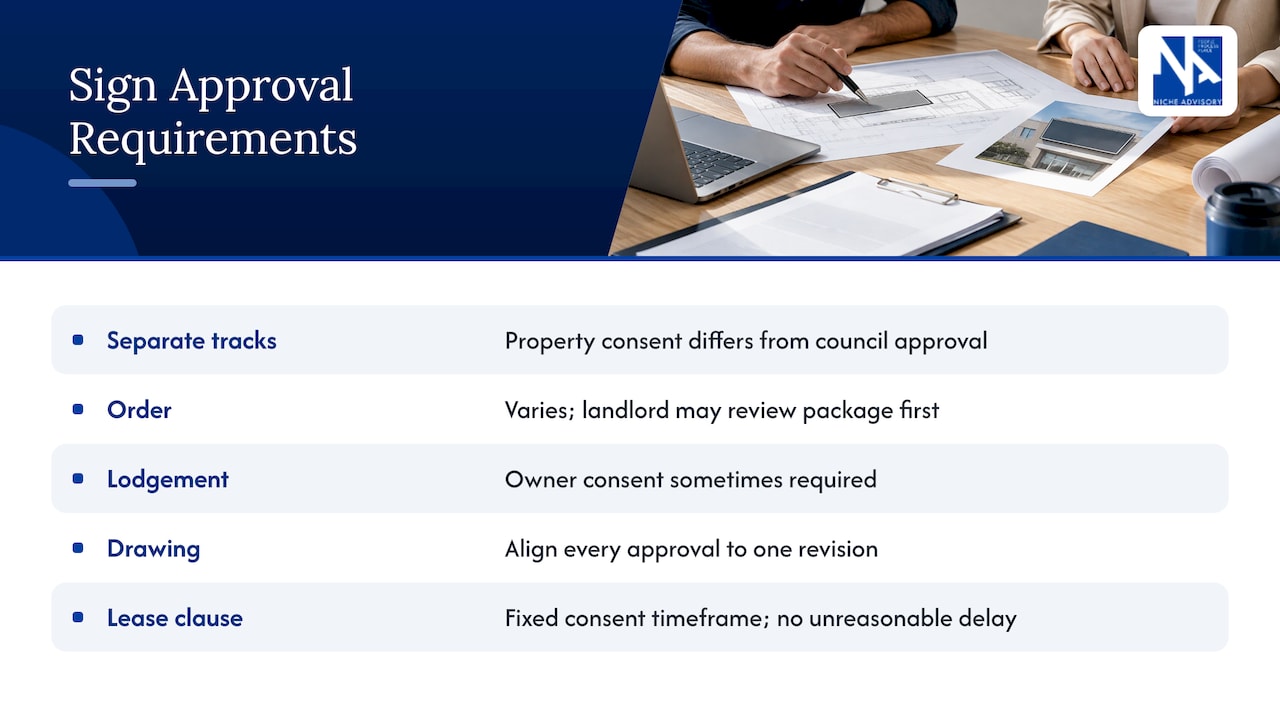
The practical consequence for your lease: ask for a clause obliging the landlord to give its owner’s consent for council applications within a fixed time and not to unreasonably delay it. Without a timeframe, a lease start date can pass while you wait for a signature.
What planning rules apply to building signage
Planning rules are set by state and local government, so there is no single national answer. Three examples show how much they differ.
New South Wales. Some business signage is exempt development and needs no planning permission, but the NSW Planning Portal sets conditions: written consent from the land owner (and any adjoining owner the sign projects over), approval under section 138 of the Roads Act 1993 if the sign projects over a public road or footpath, secure fixing to the building to Australian Standards, and no obstruction of traffic signs or ventilation outlets. The same page caps business identification signs at three where a building has a single commercial tenant, and six in total on any building. In a multi-tenant building, those caps mean your share of the sign count is itself a negotiating point.
Victoria. Most planning schemes contain specific rules in Clause 52.05 on the size, type, location and illumination of business signs, and a planning permit is often required for new illuminated or large-format signs, signs on heritage buildings or in heritage areas, multiple signs on one building, and changes where an existing permit specifies the details.
Queensland. The Queensland Small Business Commissioner advises tenants to confirm zoning, permitted use, council approvals for fit-out and signage, and strata by-laws before signing. It warns that most leases place the onus on the tenant to hold all necessary approvals and to pay for any non-compliance, with costs that can reach tens of thousands of dollars. For a tenant moving into an unfamiliar suburb, a pre-lodgement conversation with the local council’s planning department before committing is the check that prevents that outcome.
If you are an overseas company setting up in Sydney, Melbourne, Brisbane or Adelaide, expect rules to change between local government areas, and do not assume that a sign approved for your head office in London, New York or Singapore translates to an Australian building.
Special cases: shopping centres, strata and industrial sites
Shopping centres and managed precincts. A centre’s design manual may dictate sign types, sizes, finishes and placement independently of council requirements. Ask for the design manual before signing, and check that the sign you need complies with it.
Strata buildings. In an NSW strata scheme, the owners corporation must consent in writing to fit-out that affects the common-property structure, and even minor signage alterations need consent if they involve drilling into or affixing to that structure. Your landlord’s consent does not substitute for the owners corporation’s, so ask the landlord to confirm in the lease that it will apply for it, and by when.
Freestanding or roof signs. In NSW, a lease for signage is treated as a lease of premises, the premises being the physical structure of the sign itself, whether on the ground, on a wall or on a roof. The site must be defined on a plan by reference to walls or structural features. If a sign is a significant revenue or branding asset, for example a roof-top sign for a large tenant, it deserves that level of definition.
Industrial and warehouse sites. Pylon panels, gate signage and truck wayfinding often matter more than a facade sign. Ask who controls the estate pylon, whether panels are allocated by tenancy size, and how the landlord handles the approvals. See our guide to negotiating industrial leases for the other site risks to check at the same time.

Who pays: costs to settle before you sign
Signage costs are more than fabrication. Landlord consent or centre management fees, and any council application charges can all be additional items, and non-retail commercial leases are not covered by the retail leasing laws in the same way, so there is less statutory protection to fall back on.
In most commercial leases the tenant obtains the approvals and bears the cost. Signage provisions should clearly allocate responsibility for design and production, installation, ongoing maintenance and repair, and removal and restoration at expiry. That guidance is from the US, but the structure is a useful checklist for an Australian lease too.
Points to push for:
- A fixed or capped landlord administration fee, rather than an open-ended one.
- An obligation on the landlord to cooperate with council applications at no charge.
- Where the landlord is giving a fit-out contribution, confirmation that signage can be funded from it.
- Consent to a sign in principle on the date of the lease, not a later case-by-case discretion.
The cost of a sign also needs to be set against the term of the lease. A sign that costs a significant amount and is removed at expiry has a very different return on a three-year lease than on a ten-year lease with renewal options.
Installation, maintenance and removal
Approval conditions on installation are often specific. One university’s commercial signage guidelines are a good example of what landlords expect: internal tenancy signage installed by an accredited signage contractor at the tenant’s cost, with mock-ups approved by the lessor before installation, maintained in good repair during the term and removed at expiry with any damage made good. Many private landlords use similar terms.
The last obligation is the one that surprises tenants. Make-good obligations can include removing signage at lease end, and those costs can be significant, especially when removal leaves marks, holes or colour differences on a facade. Ask for the lease to say exactly what removal means (for example, remove the sign and fill and paint fixing holes) and whether you can leave the signage in place if the next occupier wants it. We cover this in more detail in our guide to make-good obligations and negotiations.
A tenant may need landlord, building, council and specialist approvals before fit-out starts, and the approvals pathway and end-of-lease obligations should be confirmed in writing, including approved plans and signage and a list of items to be removed.
A step-by-step approach to negotiating signage rights
- Define your signage scope before you inspect. List every sign you need (external, lobby, wayfinding, temporary), with approximate sizes and whether lit. Include the number of staff and visitors who rely on each.
- Compare buildings on signage, not just rent. A building with no available facade position or a full directory board is worth less to you, and the effective rent should reflect it.
- Ask for the building’s signage policy and design manual. Check the rules for materials, illumination and placement.
- Put signage in the heads of terms. Name each sign, location and approval pathway, and attach plans or renderings where you have them.
- Check planning rules for the address. Confirm with the local council whether the sign is exempt or needs a permit, and whether heritage or zoning rules apply.
- Agree the cost split and timing. Settle fees, the landlord’s consent deadline and who bears council charges.
- Define removal at expiry. Record the specific make-good scope for signs in the lease.
- Get consent in writing against a labelled drawing revision. Do not accept an informal email as the final approval.
Steps 4, 6 and 7 are where most of the value is, and where tenants without leasing experience give away the most. Niche Advisory acts exclusively for tenants and owner-occupiers, and handles property search and lease negotiation, make-good negotiation and project and construction management, so signage terms are negotiated alongside rent, incentives and exit obligations rather than separately. Our tenant representation plan shows how that timeline runs, and our guide to what to know before negotiating a new office lease covers the terms around it.
Where independent tenant advice fits
Signage is rarely negotiated alone. It sits inside a package that includes incentives, outgoings, make-good and renewal rights, and a landlord can trade one against another. A tenant who has negotiated one lease can easily miss that a generous incentive is paid for by a tight signage clause.
Because Niche Advisory never acts for landlords and gives independent advice, our corporate tenant advocacy work is built around the tenant’s business goals. Where a signage dispute with a landlord arises during the term, our dispute resolution services deal with tenant and landlord disagreements. If you are comparing buildings or reviewing a lease renewal, talk to us through the Niche Advisory site before the heads of terms are signed, because that is when signage rights are cheapest to win.
FAQ
Does a tenant have an automatic right to put up a sign?
No. If the lease is silent, you generally have no right to display signage, and the landlord controls the building exterior, lobby and street pylons. Even where the lease allows signage, it is usually subject to landlord and authority consent, so name your signs in the lease.
Do I need council approval as well as landlord consent?
Often yes, and they are separate approvals. Some signs are exempt development, as under NSW rules, while others, such as illuminated or heritage-area signs in Victoria, need a permit. Check with the local council for your address before you sign.
Who pays for building signage?
In most commercial leases the tenant pays for design, installation, approvals and maintenance, and may also pay landlord consent fees. It is negotiable: ask for fees to be capped, for landlord cooperation with council applications, and for signage to be funded from any fit-out contribution.
Do I have to remove my sign at the end of the lease?
Usually, yes, with damage made good, because make-good clauses commonly include signage removal. Negotiate a precise description of removal in the lease so you know the cost when you agree the terms.
When should I raise signage in negotiations?
In the first round, with heads of terms. After you have committed to the space, the landlord has less reason to give you favourable terms, and a refusal can leave you with a premises your customers cannot find.
Sources
- Don’t rush into your franchise lease without checking the details, Franchise Business
- Check Your Franchise Lease Details, Coleman Greig
- A Tenant’s Guide to Negotiating Sign Rights in a Commercial Lease, Hollander Real Estate Law
- Council Approvals, Landlord Rules and Signage Compliance, Blink Digital
- Commercial Lease Agreements: Key Terms and Templates, SignAndGo
- Signage Permit and Approval Management, Sunquest Signs
- Advertising and Signage, NSW Planning Portal
- Permit requirements for commercial property: Signage and fit-outs, AS Planning
- Before You Sign: Understanding Council Planning Rules, Queensland Small Business Commissioner
- Why landlords and tenants face special risks when leasing strata shops, offices and industrial premises
- Lease for signage, NSW Land Registry Services
- Commercial Lease Fees, Sprintlaw
- Standard Commercial Lease Agreement Guide, Sprintlaw
- Commercial Signage Guidelines, University of Wollongong