
A good relocation communication plan does four things. It names every audience, sets the order in which they hear the news, fixes the channel for each message, and puts a date and an owner against every step. Tell managers first, then staff, then clients and suppliers, then the public. Repeat the key messages more often than feels necessary, and keep one written record of what was announced.
This guide is for business owners, executives and facilities managers who occupy leasehold office or warehouse space in Australia. It covers the communication plan, then the two documents that sit behind it: the relocation business case and the risk register. It also covers how to judge afterwards whether the move worked.
TL;DR
- Brief managers before the all-staff announcement, so no one learns about the move at the same moment as their team.
- Work in waves: regulators and critical providers, then clients and suppliers, then public channels such as your website and Google Business Profile.
- Use several channels, with one written record. Email is the record, and meetings and the intranet reinforce it.
- Write the business case first. It says why you are moving, what must improve and what happens if you stay.
- Keep a risk register with an owner, a rating and a mitigation per risk. Review it weekly once the lease is signed.
Table of Contents
- What a relocation communication plan has to cover
- Decide before you announce
- A timeline you can adapt
- Tell managers first, then everyone else
- Choose channels for a reason
- Listen as well as announce
- Clients, suppliers and official bodies: the three waves
- Write the relocation business case first
- Build a relocation risk register
- Measure whether the move worked
- Where independent advice helps
- FAQ
- Sources
What a relocation communication plan has to cover
The plan is a table, not a document full of prose. Each row holds an audience, a message, a channel, a sender, a date and a feedback route. If a row is missing one of those, it is not ready.
Start with the audiences. Most moves involve at least these groups:
- Leadership and managers: they carry the questions from staff.
- Employees: including part-timers, remote staff and anyone on leave.
- Clients and customers: especially anyone who visits you or receives deliveries from you.
- Suppliers and service providers: IT, telecoms, security, cleaning, couriers and freight.
- Landlords and agents: the outgoing landlord and the incoming one.
- Government and financial bodies: ASIC, the ABR and the ATO, insurers and banks.
- The public and your market: website, social profiles, directories and signage.
Then decide the message for each. A manager needs the detail, a client needs to know what changes for them, and a supplier needs the new address, the access rules and the date. Different audiences need different facts, but they should never hear different stories.
Decide before you announce
You cannot communicate a move you have not decided on. Before the first message, have these settled:
- The decision itself, approved by whoever signs the lease.
- The reason, in one or two sentences you are happy to repeat.
- The target move window, even if the exact day is not fixed.
- A named communications owner and a named project lead.
- Where staff can send questions.
The reason matters more than most leaders expect. The business case below is where you build it. If it is vague, the rumour mill will write a better one for you.
If you are still comparing premises, our office relocation planning playbook lays out the timeline that the communication plan hangs from.
A timeline you can adapt
Timing depends on lease dates, fitout length and company size, so treat the following as a starting point. One Australian template suggests sending the main relocation notice 8 to 12 weeks before the move, so staff, clients and suppliers can prepare. In practice, internal communication starts earlier than that, because staff hear about it through the grapevine long before a notice goes out.
| When | Audience | What happens |
|---|---|---|
| After lease or decision is confirmed | Executive team and managers | Briefing pack, key messages, Q&A, agreed script |
| Immediately after | All staff | Announcement: what, why, where, when, what it means for me |
| Within days | Critical providers, landlord, insurers | Formal notice, access and handover requirements |
| 8 to 12 weeks out | Clients, suppliers, partners | Direct notice, with a call for high-value accounts |
| Monthly, then fortnightly, then weekly | Staff | Progress updates, floorplans, FAQs, precinct information |
| 2 to 4 weeks out | Staff and key suppliers | Packing instructions, move-day roles, IT cutover plan |
| Move week | Everyone | Daily short updates, a named contact for issues |
| First week in the new space | Staff and clients | Welcome note, what to do if something is not working |
| 30 to 90 days after | Staff and leadership | Feedback survey and results shared back |
The cadence in the middle is deliberate. One communications guide suggests sending a regular email newsletter whose frequency increases as the move approaches. That fits how people behave: they ignore early noise and need frequent, specific detail near the end.
Tell managers first, then everyone else
The most common mistake is announcing to everyone at once. A change communication guide makes the point that managers who hear about a change at the same moment as their teams cannot answer questions, and an unanswered question becomes a worry.
Give managers a short pack the day before, or the same morning if the news cannot be held:
- The announcement text, word for word.
- Three to five answers to the questions you expect, including the awkward ones about commuting and parking.
- What they should not speculate about, such as seating or redundancies, and who to refer those to.
- A way to pass questions back to the project team.
Then make the all-staff announcement. A useful initial announcement covers the new location and why you chose it, the reason for the move, the broad timeline, how it affects teams (commute, workspace) and where questions go. This matches what a UK fitout firm lists as the core of a first announcement, and it works for Australian workplaces too. Say plainly what you do not yet know, and say when you will know it.
Choose channels for a reason
No single channel does the job. An Australian change management consultancy notes that a message can take three to five exposures before it is absorbed, and recommends mixing face-to-face, email, intranet and social media, each with a slightly different focus.
A workable split looks like this:
- Face to face (all-hands, team huddles, one-to-ones): for the announcement and for emotional or sensitive topics. People pay attention to people.
- Email: the record. Staff can search it later when they ask when they were told something, which is why one change communication guide treats email as the record of the announcement and the other channels as reinforcement.
- Intranet or a shared page: a single source of truth with the timeline, floorplans, photos or video of the new site, who is on the project team, an FAQ and precinct information such as parking, transport and nearby facilities. One communications guide recommends exactly this set.
- Chat channels: quick reminders and move-day logistics.
- Phone calls: for your ten most important clients and suppliers, not a mass email.
For staff in Sydney, Melbourne or Brisbane who face a longer commute, a short precinct guide with train, bus and parking options does more than any slogan about the benefits of the new space.
Listen as well as announce
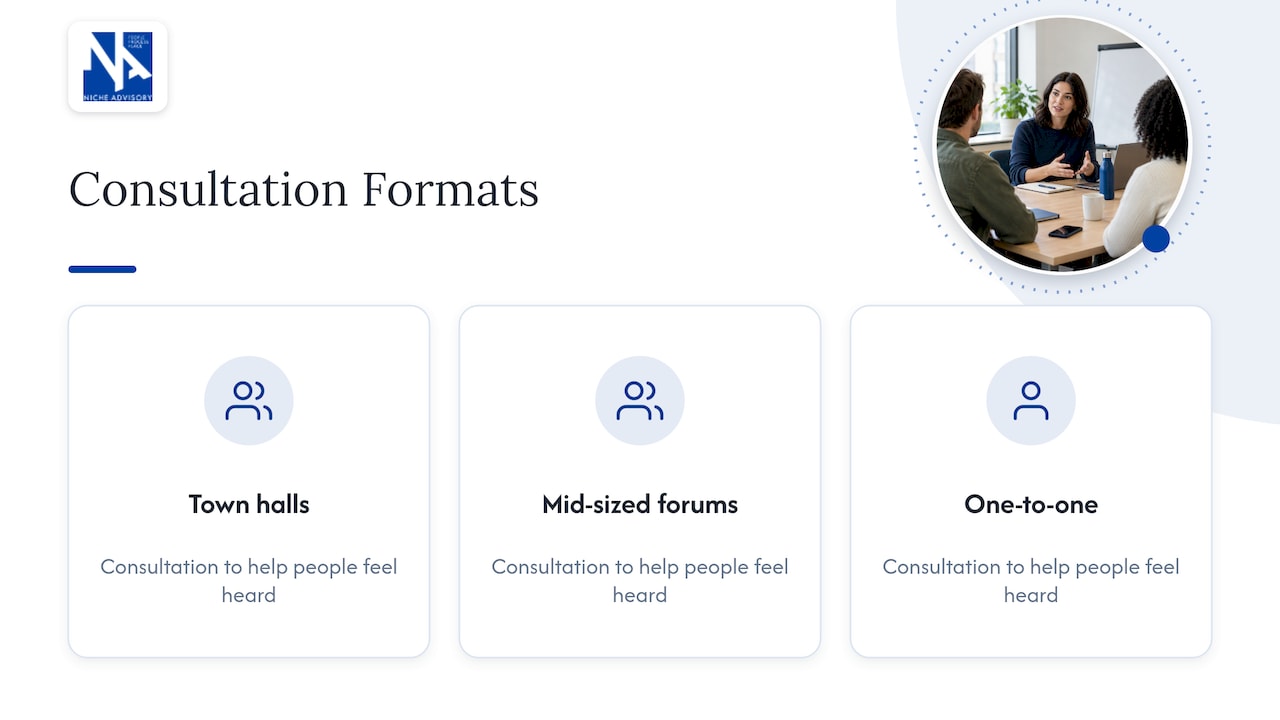
Relocating can be unsettling, and concerns that look small to leadership can matter a great deal to the person raising them. The same Australian consultancy recommends running town halls, mid-sized forums and one-to-one sessions so people feel heard, and being frank when you cannot answer a question yet.
Build listening into the plan as rows in your table: a question inbox, a fortnightly drop-in with the project lead, and a short pulse survey before and after the move. Publish the answers in the FAQ, so the same question is not asked twenty times.
One point of Australian law is worth checking early. Many modern awards include a clause on consultation about major workplace change, and the Fair Work Commission explains the standard consultation clause and its link to the Fair Work Act 2009. If the move changes where people work or their hours, check which award or enterprise agreement applies to your staff and speak to your HR adviser or employment lawyer before you announce.
Clients, suppliers and official bodies: the three waves
Outside the company, the order matters as much as the content. A Sprintlaw guide for Australian businesses recommends three waves for a change of address:
- Wave 1, regulators and critical providers: ASIC, the ABR and ATO, industry regulators, insurers, banks, payroll and HR systems, and critical software vendors.
- Wave 2, customers, suppliers and partners: a direct email or call for high-touch clients, an email campaign for the wider list, and confirmed shipping labels and system settings for suppliers and logistics partners.
- Wave 3, public channels: website contact page and footer, Google Business Profile, social profiles, invoices, quotes, downloadable forms, signage and reception scripts.
Two of those have fixed deadlines. If a company address changes, ASIC requires notice within 28 days or a late fee applies, and that covers the registered office and principal place of business. The ABR also asks that you update ABN details within 28 days of becoming aware of a change. Put both in the project plan with a named owner. Check your lease and insurance policy too, as some require advance notice of a change in premises.
Keeping operations running
Clients care about two things: whether they can still reach you and whether anything changes for them. Your message should answer both in the first two lines. For a move that closes the office for a day or more, give the date, the alternative contact method and the first day at the new address. For warehouse or industrial moves, add dock access, delivery cut-off dates and who confirms inbound freight.
Our move management checklist shows how to coordinate IT cutover so the communication promises and the physical move line up.
Write the relocation business case first
The business case is the source of every key message. It also stops the project drifting when trade-offs arrive. A good one answers four questions: why are we moving, what must improve, what happens if we do nothing, and what will it cost?
What goes in it
- The driver: a lease expiry, growth, consolidation, hybrid attendance, poor acoustics, staff attraction or ageing building services. Be specific about which.
- Current problems with evidence: utilisation data, complaints, workstations at capacity. A local government business case for a council administration move, for example, documented poor functionality, limited disability access, a lack of meeting space and inefficient floorplates before comparing options.
- Options: stay and refurbish, renew with a different footprint, relocate, or consolidate sites. Always include the do-nothing option as the baseline.
- Requirements in three tiers: non-negotiable (legal obligations, move date, security, critical rooms, accessibility, continuity), high value (improves productivity, culture or client experience) and optional.
- Financial comparison: rent, incentives, fitout, make-good on the old premises, moving costs, IT and downtime, over the full lease term.
- Risks and the decision requested: a summary of the top risks and what approval you need.
To size the space, use our office space calculator. Hybrid patterns change the answer a lot, and our piece on flexible office strategy and Australian lease choices explains how attendance shapes the lease.
Costing options honestly
Compare options on total occupancy cost across the lease, not headline rent. Include landlord incentives, fitout contributions, make-good liabilities at the old site and the cost of overlap, where you pay rent on two sites. Our guides on what to know before negotiating a new office lease and landlord incentive negotiation cover the commercial side.
Build a relocation risk register
The risk register is where the communication plan meets the project plan. Keep it short, owned and reviewed. Each line needs six fields: the risk, its likelihood, its impact, a rating, an owner and a mitigation with a date.
A starter set for an Australian office or warehouse move:
| Risk | Typical mitigation | Owner |
|---|---|---|
| Staff attrition or low morale | Early manager briefing, listening sessions, commute information | HR lead |
| IT or phone outage at cutover | Staged cutover plan, test in new site, backup connectivity | IT lead |
| Fitout or building works delayed | Float in the programme, holding-over terms at the old premises | Project manager |
| Make-good costs higher than allowed | Early inspection, scope agreed with the landlord | Lease lead |
| Client or supplier not told | Wave plan, confirmed contact list, follow-up calls | Comms owner |
| Missed statutory notice | Calendar the ASIC and ABR updates | Finance or company secretary |
| Warehouse stock or dock disruption | Staged moves, delivery cut-offs, freight partner briefed | Operations lead |
| Cleaning and handback condition | Scheduled final clean, handback checklist | Facilities lead |
An office cleaning risk assessment is a reasonable model for the handback line: it shows how to list hazards, controls and responsibilities before a cleaning crew enters a space.
Two habits keep a register useful. Review it at every project meeting, and close risks visibly rather than letting the list grow. Pair it with an issue register and an asset register: the first tracks problems that have already happened, the second tracks furniture and equipment through the move.
Measure whether the move worked
Set the measures in the business case, before you move, so you can compare. Reasonable outcome measures include:
- Space utilisation: desk and meeting room use against the pre-move baseline.
- Staff experience: a pulse survey at 30 and 90 days, repeating the questions you asked before the move.
- Retention and attendance: movement in resignations and in office attendance.
- Operational continuity: days of lost trading, missed deliveries, IT incidents.
- Cost: actual against budget for fitout, moving and occupancy.
- Client feedback: complaints or queries linked to the change of address.
Share the results with staff. It closes the communication loop and shows that the earlier consultation was real.
Where independent advice helps
The communication plan is only as strong as the decisions beneath it: the lease terms, the timeline, the fitout programme and the make-good position. Niche Advisory acts only for tenants and owner-occupiers, never landlords, and combines workplace strategy with tenant advocacy and project and construction management. If you are weighing a move and want an independent view on the business case, the risks or the timeline, talk to us before you announce anything.
FAQ
When should you tell staff about an office move?
Tell managers first, then all staff, as soon as the decision is confirmed and before major planning is finalised. Staff hear about moves informally, so early, honest news builds more trust than a polished announcement that arrives late. Say what is decided, what is not and when the next update is due.
Who needs to be told when a business changes address?
Start with ASIC and the ABR, then insurers, banks, payroll systems and critical software providers. Next come clients, suppliers and partners, and last your website, Google Business Profile, invoices and signage. ASIC and the ABR both ask for updates within 28 days.
What should a relocation communication plan include?
A table of audiences, messages, channels, senders, dates and feedback routes. Add a manager briefing pack, an FAQ, a single source of truth for staff and a post-move survey. Review it weekly once the move is within eight weeks.
What is the difference between a business case and a risk register?
The business case explains why you are moving and which option is best. The risk register tracks what could stop the move succeeding, with an owner and a mitigation for each risk. The first is approved once and the second is reviewed throughout the project.
Sources
- ASIC: Change a company address
- Australian Business Register: Update your ABN details
- Fair Work Commission: Consultation clause in modern awards
- Sprintlaw: Writing an effective change of address letter
- CleverOps: Office relocation notice template
- TMS Consulting: Six change management tips for your office relocation
- Cerkl: Change communication plan template
- All Things IC: 10 tips for your office relocation communications plan
- Peldon Rose: How to communicate an office relocation to your employees
- Town of Victoria Park: Strategic business case, March 2023
- Office cleaning risk assessment