An extension of time (EOT) claim is a contractor’s formal request to move the completion date because of a delay that the contract treats as excusable. If you are the tenant paying for a fitout, a warehouse upgrade or a make-good, the claim lands on your desk, and how you assess it decides whether your handover date, your relocation and your holding-over rent hold or slip. The practical answer is to know your contract’s notice rules before work starts, test every claim against the program and the evidence, and keep a clean record of every instruction you give. Done properly, you grant the time that is genuinely owed and refuse the time that is not.
This guide is written for the business owner, executive or facilities manager on the client side of a build. It covers what a claim is, when time is owed, how to assess one, how it connects to variations, and what happens to liquidated damages.
TL;DR
- An EOT claim asks to extend the completion date for a delay the contract excuses. If granted, it also relieves the contractor of delay damages for that period.
- Entitlement turns on three things: a qualifying cause under the contract, notice given on time, and proof the delay hit the critical path (the chain of tasks that sets the completion date).
- Notice periods are strict and differ by contract. Government guidance on one widely used form requires notice within 14 days, and repeated notices every 14 days while the delay continues.
- Variations and EOT claims are linked. Every instruction you give that changes scope, sequence or materials can become both a cost claim and a time claim.
- Tenants with a lease expiry, a relocation or a make-good deadline need a client-side process in place before the first claim arrives.
Table of Contents
- What an extension of time claim actually is
- Who makes the claim and who decides it
- When a contractor is entitled to more time
- Notice: the deadline that decides most claims
- How to assess an EOT claim, step by step
- What a good delay notice looks like
- Construction delay claims and variations
- What happens when a claim is granted or rejected
- Where Niche Advisory fits
- FAQ
- Sources
What an extension of time claim actually is
A construction contract sets a date for completion. If the builder finishes late, the contract normally lets you recover liquidated damages: a pre-agreed daily sum that compensates you for the delay. But some delays are not the builder’s fault. The NSW Government’s procurement guidance explains that a contract generally provides for the completion time to be extended for delays outside the contractor’s control, subject to the contract’s own provisions.
The EOT mechanism exists for two reasons. It gives the builder relief from damages for delays that are not theirs. And it keeps the completion date from becoming “at large”, which is the legal risk that the date stops being enforceable if you cause delay and have no power to extend. A 2003 article in the Australian Arbitrator & Mediator journal explains that an EOT sets a revised completion date and relieves the contractor of delay damages for the excused period.
For a tenant, this matters because your commercial deadlines sit outside the building contract. Your lease may end on a fixed date. Your staff may be moving on a fixed weekend. A claim that shifts practical completion by three weeks can cost you holdover rent, double occupancy and a disrupted move. If your project is a fitout, our guide on procurement methods and fitout variations shows how the way you buy the work shapes your exposure to these claims.
Who makes the claim and who decides it
The contractor makes the claim. Under most Australian standard forms, a person named in the contract (often called the superintendent or the principal’s representative) assesses it and decides the time. On a tenant fitout, that person may be your project manager, your architect or a nominated representative.
If you have not appointed anyone, the task falls to you, usually with a short deadline and no program expertise. That is the gap a client-side project manager fills: someone independent of the builder, acting for you, who reads the program and the claim. Niche Advisory acts exclusively for tenants and owner-occupiers, never landlords, and offers project and construction management alongside design and fitout services.
The contract type also decides how claims work. Lump sum, design and construct and construction management forms allocate delay risk differently. Our overview of which construction contract type suits your project is worth reading before you sign.
When a contractor is entitled to more time
Entitlement depends on the contract’s qualifying causes, its notice requirements and proof of the delay. Common qualifying causes in standard forms include:
- Variations or instructions from you or your representative.
- Late access to site or late supply of items you are responsible for.
- Inclement weather beyond what the contract allows for. A 2003 analysis of AS 2124-1992 describes clause 35.5 as allowing claims for specified causes including inclement weather.
- Latent conditions, meaning hidden site conditions nobody could reasonably foresee.
- Industrial action, or other events the contract names.
What does not qualify is usually the builder’s own risk: late subcontractors, labour shortages, poor sequencing and rework.
Hidden conditions are a frequent source of tenant disputes in older buildings and warehouses. Finding out what is behind the wall before work begins reduces them. For example, pest inspections before renovation help avoid damage and discoveries that surface once finishes are stripped, and our guide to environmental due diligence on leased premises covers the contamination and hazardous material questions that cause the longer stoppages.
Concurrent delay
Concurrent delay is when a delay you are responsible for and a delay the builder is responsible for overlap. How it is treated depends entirely on the wording. Under the NSW Government’s GC21 contract, the guidance states that no EOT is due for days when a contractor-controlled event concurrently contributed to the delay. A 2021 commentary from a construction law firm notes that concurrency should be analysed by assessing each delay and its effect on other activities and on completion, and gives an example of an amended AS 4902 clause that bars time to the extent a concurrent delay includes a non-qualifying cause.
The lesson is not that concurrency always helps you or always hurts you. It is that the clause and the records decide the outcome, so check the clause before the project starts, not after the first dispute.
Notice: the deadline that decides most claims
Most EOT disputes are lost on notice, not on merit. Contracts require the builder to tell you about a delay within a set time, and some treat late notice as a bar to the claim.
The timeframes differ sharply:
| Contract | Notice requirement | Source |
|---|---|---|
| GC21 (NSW Government) | Notice of delay, its cause, facts and expected impact as soon as practicable; clause 54.3 requires notice within 14 days, then further notices every 14 days while the delay continues | NSW Government guide |
| AS 4000-1997 | Written EOT claim within 28 days after the contractor should reasonably have become aware of the cause, with particulars of facts and extent of delay | 2003 journal article |
| AS 4000:2025 | Updated delay-notice timing, refined EOT procedures and recognition of email and digital service | Law firm analysis, 2025 |
Two points follow. First, the AS 4000 edition on your contract matters, because the 1997 and 2025 versions differ. Read the clause in the signed document, including any amendments, since special conditions often shorten the periods. Second, the early warning notice and the formal claim can be separate steps. The 2003 article notes that under the then-standard forms the initial warning was not itself expressed as a condition precedent, but could help the superintendent limit the consequences of the delay.
As the client, you should also know how notices are served. The 2025 revisions to AS 4000 expressly recognise email and digital service, so check whether your contract names an address or a platform, and make sure claims reach the right inbox. A construction document control system makes it easy to prove when a notice arrived.
How to assess an EOT claim, step by step
A good assessment is a routine, not a judgement call. Here is the sequence.
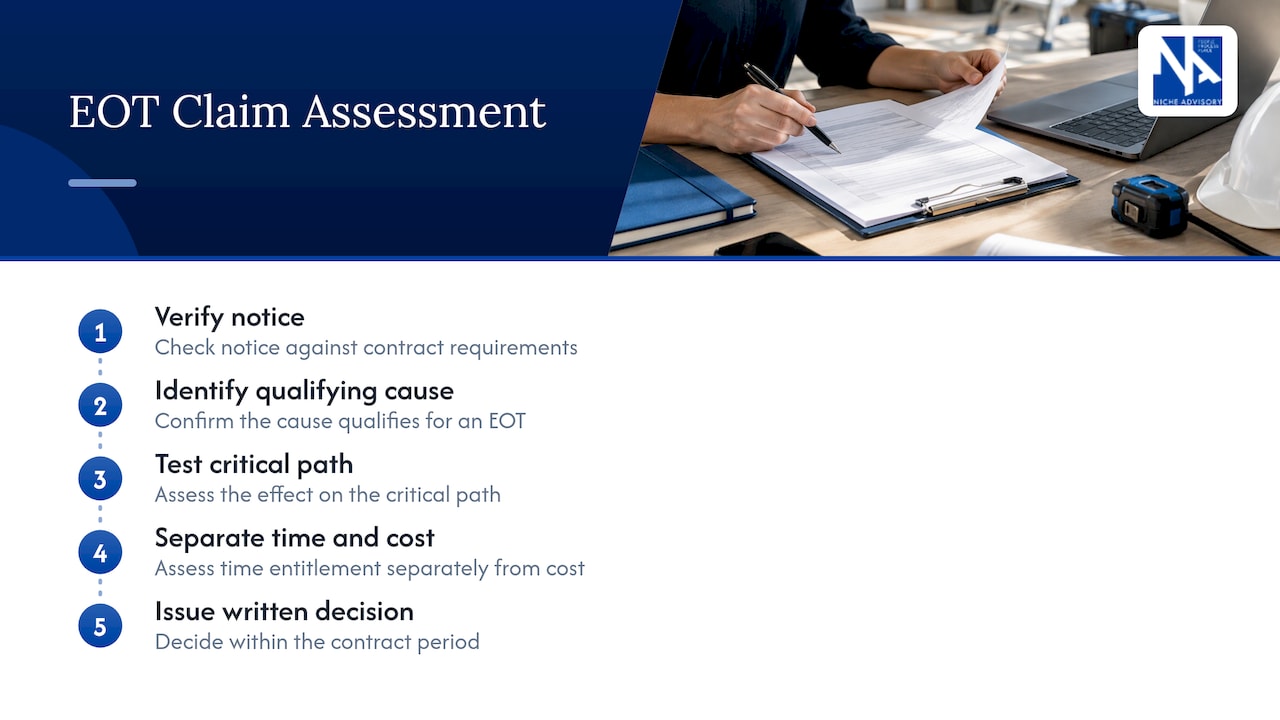
1. Check the notice
Was the notice given in time, to the right person, in the right form? If the contract makes timely notice a condition of the claim and the notice was late, you may have grounds to reject. Take advice before relying on this, because courts read these clauses closely and a wrongly rejected claim can leave the completion date unenforceable. Where the stakes are high, that means your lawyer.
2. Identify the cause
What event is the builder relying on, and is it a qualifying cause in your contract? A practical guide from a construction law firm says to follow the contract’s notice timeframes, identify the delay event and its anticipated effect on completion, and support the claim with records. Vague claims (“delays due to various issues”) should be returned for particulars.
3. Test the critical path
This is the step builders most often skip and clients most often miss. A delay to one task does not automatically delay completion. The NSW guidance says the contractor must establish that the affected work was on the then-current critical path and that completion was consequently delayed. A task with spare time (float) can slip without moving the finish date.
GC21 clause 54.1.4 requires the contractor to demonstrate critical-path delay and to submit a compliant contract program with the claim. Even where your contract does not require it, the same guidance recommends a marked-up program showing the effect on completion. Ask for one every time.
4. Check the evidence
The documents that support or undermine a claim include:
- Contemporaneous programs and updates, not ones drawn up after the event.
- Site diaries, timesheets and delivery dockets.
- Photographs and progress reports.
- Your instructions and the correspondence around them.
- Weather records, if weather is the cause.
- Cost records, where the contract allows delay costs.
That list comes from the practical guide cited above. A claim that rests on a program prepared months later is weaker than one built from records made at the time.
5. Separate time from money
Time and cost are separate entitlements. The 2003 article notes that an EOT claim needs contractual entitlement, compliance with claim procedures, programming analysis of delay and, if the contract permits, proof of resulting costs or damages. Granting time does not automatically mean paying delay costs, and many contracts treat the two differently. Read the wording.
6. Decide, in writing, within the contract period
Record your reasons, state the days granted and the new completion date, and send it by the method the contract requires. Silence can be costly, as some contracts treat a missed assessment deadline as a failure that works against the principal.
What a good delay notice looks like
If you are the one writing a notice, for instance because a landlord’s late works hold up your fitout contractor, the structure is the same. A 2025 guide to delay notices recommends identifying the event, its start date and the facts, then describing the affected work, its dependencies, its relevance to the critical path and the estimated duration. If the duration is uncertain, it advises saying so and explaining the possible effect on completion.
Keep it factual. Do not argue liability in the notice. Attach evidence, and diarise the follow-up dates.
Construction delay claims and variations
Most extension claims on tenant projects trace back to a variation, and variations are where tenants have the most control.
The NSW guidance says to assess a variation’s effect on time against the program and to grant a reasonable extension if it affects the critical path and delays completion. So every instruction you give, whether a revised layout, extra data points or a change of floor finish, has a time price as well as a dollar price.
A variation clause usually deals with a change in the scope, quality or character of work. A commentary from a law firm in 2026 notes that a variation clause does not usually cover a price rise for doing the same work, but that an instructed change such as alternative materials or resequencing should be documented as a potential variation. That distinction matters when material prices move: a cost shock alone may not be a variation, while your direction to change a material or sequence can be.
A workable variations routine for a tenant:
- Instruct in writing only. Verbal changes on site are the main source of disputed claims.
- Ask for time and cost together. Require the builder to state the effect on the program before you approve.
- Approve or decline before work proceeds. An approved variation carries its own time; an unapproved one becomes an argument later.
- Log it. Keep one register for variations, notices and EOT claims so the links between them are visible.
- Freeze design early. Late design changes drive more variations than any other cause. Our guide to builder tender evaluation covers how to compare tenders on scope clarity, so fewer gaps become variations.
What happens when a claim is granted or rejected
If you grant an EOT, the completion date moves and the builder owes no delay damages for the excused days. If you reject a valid claim, or ignore it, the builder may argue that the date no longer binds, which can put your right to liquidated damages at risk. If you reject an invalid claim and the builder disagrees, the matter can move to the contract’s dispute process.
The 2025 AS 4000 revisions, according to a law firm analysis, clarify how delay damages are assessed and add optional dispute-resolution steps, including mediation, expert determination and Dispute Avoidance Board processes, alongside negotiation and final resolution. Check which of these your contract actually includes.
The tenant’s own deadlines sit on top of this. If an EOT pushes practical completion past your lease expiry, you may be negotiating holdover terms with a landlord. If the project is a make-good, a late finish can mean extra rent. Our guides to make-good obligations and negotiations and the 9 to 12 month tenant representation plan show how to build slack into the timeline so a granted extension does not become a crisis.
Once the builder says the work is finished, practical completion and defects is the next place time disputes appear, because defects can determine whether the completion date was really met.
Where Niche Advisory fits
Tenants rarely have a program specialist on staff, and an EOT claim arrives when the project is busiest. Niche Advisory acts only for tenants and owner-occupiers, never landlords, and gives independent advice that links property decisions to your business goals. We run project and construction management for tenant fitouts and workplace changes, and when a delay turns into a disagreement with a landlord or contractor, our dispute resolution services are there. Our firm has applied its methodology across sectors for over 12 years. If you have a project coming up or a claim on your desk, start at Niche Advisory.
FAQ
What is the purpose of an extension of time?
It moves the completion date when the contract excuses a delay, so the builder is not charged delay damages for time they could not control. It also keeps the completion date enforceable, because you keep a power to extend it fairly.
Is AS 2124 still current?
AS 2124-1992 is an older standard form that you may still meet in existing contracts, and its claim periods differ from later forms. The 2003 journal article describes its written claim as due within 28 days after the delay occurred. Check the edition and any amendments written into your signed contract, and use your lawyer for questions about which version applies.
How many days do I have to give notice of a delay?
It depends on the contract. The NSW Government’s GC21 requires notice within 14 days and repeated notices every 14 days while delay continues, and AS 4000-1997 set 28 days from when the contractor should have known of the cause. The 2025 AS 4000 revisions changed notice timing, so read the clause in your signed contract.
Does a delay to one task always justify more time?
No. The contractor has to show the delayed work was on the critical path and that completion was delayed as a result. Ask for a marked-up program that shows the effect on the completion date.
Can a variation lead to an extension of time?
Yes. If a variation affects the critical path and delays completion, a reasonable extension is normally due. Ask for the time effect to be stated before you approve the variation.
Sources
- Construction procurement guide: managing extensions of time, NSW Government
- Australian Arbitrator & Mediator journal article on EOT claims, 2003
- Securing your entitlement to relief for delay, Part 1, CDI Lawyers
- How do construction delay claims work in Australia, Aptum Legal
- How to issue a notice of delay under Australian contracts, Procore
- Oil shock and contracts under pressure, HopgoodGanim
- The new and improved AS 4000-2025, HWL Ebsworth
- Pest inspections before renovation