When a landlord breaches a commercial lease in Australia, a tenant’s main remedies are damages, an injunction to stop the conduct, a negotiated rent reduction or rent-free period, and, for serious breaches, termination. The route you take depends on your lease wording, your state or territory and whether the premises count as retail. The strongest outcomes usually come from tenants who document early and treat the breach as a commercial negotiation first. That is the work Niche Advisory does: we act only for tenants and owner-occupiers, never landlords, and we handle dispute resolution between tenants and landlords.
TL;DR
- A landlord breach is any failure to meet the lease or the law: unperformed repairs, disruptive works, blocked access, cut services or interference with your possession.
- Remedies run from a written notice and negotiated concession up to damages, an injunction or, if the breach is serious enough, termination.
- Rules differ by state and by whether the lease is retail or non-retail, so confirm which regime applies before you act.
- Withholding rent without a clear legal basis can put you in breach yourself. Document first, notify in writing, then escalate.
- Before you sign or renew, negotiate the landlord’s works, repair and dispute clauses. That is cheaper than any remedy.
Table of Contents
- What counts as a landlord breach
- Quiet enjoyment in a commercial lease
- The remedies available
- Retail or non-retail: why it changes your options
- How to respond to a breach, step by step
- When the landlord serves a breach notice on you
- Prevent the breach in the lease itself
- Where Niche Advisory fits
- FAQ
- Sources
What counts as a landlord breach
A lease is a contract, and the landlord is bound by its terms and by obligations the law adds. A breach happens when the landlord fails to do what the lease or the law requires, or does something it must not.
The common categories for business tenants are:
- Repairs and maintenance. Who maintains what is set by the lease first and by statute second. In Queensland, the state’s Small Business Commissioner explains that under the Property Law Act 2023 the tenant keeps the premises, excluding structural elements, in good condition, while the landlord is usually responsible for the building structure, foundations, common areas such as carparks, and lifts and support systems. Agreed lease terms replace those standard terms.
- Services and access. Cutting essential services, blocking entry, removing signage or restricting parking without lawful reason can all breach the lease. Law firm Sprintlaw lists these among conduct that can breach quiet enjoyment.
- Landlord’s works. Building works, façade repairs or refurbishments that disrupt your trading, or are not reasonably minimised.
- Entry and harassment. Unauthorised or excessive entry to your premises, or intimidation.
Not every irritation is a breach. Many leases give the landlord rights to carry out works or enter on notice. The question is whether the landlord exceeded those rights or ignored the limits written around them. This is why the lease text, not the general principle, decides most disputes.
A repair failure can be more than a nuisance
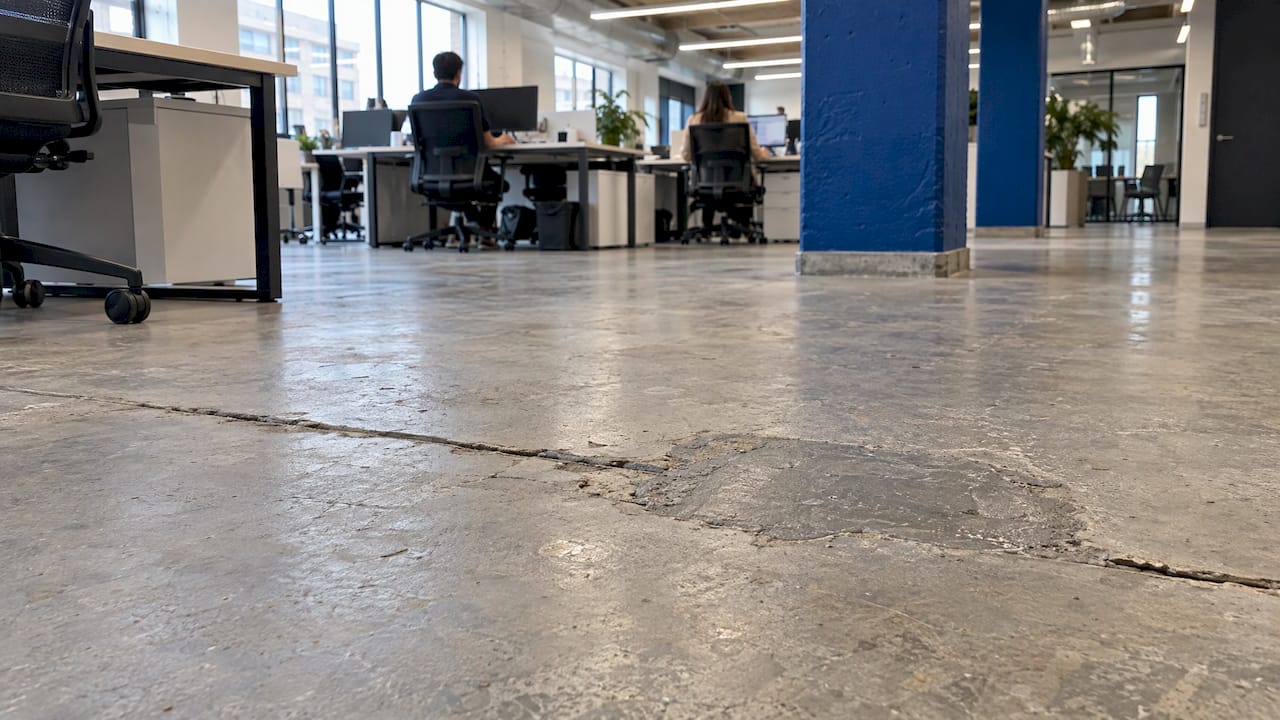
A 2025 Australian decision reported by Coulter Legal shows how far a maintenance failure can go. A landlord was put on notice of a slab problem and failed to investigate. The court treated that as a repudiation of the lease, which let the tenant accept the repudiation and terminate. The court held that the maintenance obligation had a preventative element and required appropriate investigation within a reasonable time. The lesson for tenants: written notice of a defect matters, because it fixes the date from which the landlord’s inaction counts.
Quiet enjoyment in a commercial lease
Quiet enjoyment is the tenant’s right to use the premises for the lease purpose without substantial interference by the landlord. Under every lease it is an express or implied right, alongside an implied obligation on the landlord not to derogate from the grant, meaning the landlord cannot take back in practice what the lease gave you.
The Federal Court put the principle plainly in Hawkesbury Nominees v Battik: a landlord cannot undo its own deed by interfering with the tenant’s possession. It also treated the quiet enjoyment covenant and the covenant not to derogate as instances of the same general contractual rule.
Cases that found breaches show what “substantial” looks like in practice, as summarised by Bartier:
- Noise and vibration from building repairs that disrupted a shop selling hearing aids (Telex v Thomas Cook).
- Façade works that disrupted a call-centre operation (Telstra v Sicard).
- Damages for theft where the landlord’s builders failed to lock doors (Lend Lease Development v Zemlicka).
The common thread is that the interference hit the specific way the tenant earns money. A tenant whose business is sensitive to noise, access or security has a stronger argument than one for whom the same works are a minor inconvenience. Wording matters too: the right can be modified by lease terms or state and territory legislation, so a broad “landlord may carry out works” clause can narrow it.
The remedies available
The remedies sit on a ladder. Most tenants should start at the bottom rung and move up only if needed.
| Remedy | What it does | When it fits |
|---|---|---|
| Written notice and negotiated fix | Puts the breach on record and sets a deadline | Almost every breach, always first |
| Rent reduction or rent-free period | Compensates for disruption without litigation | Ongoing works, partial loss of use |
| Damages | Compensates for loss caused by the breach | Quantifiable loss, such as lost sales or repair costs |
| Injunction | A court order to stop or require specific conduct | Continuing interference where money is no cure |
| Termination | Ends the lease | Serious breach where damages are not enough |
Damages
The NSW Small Business Commissioner’s guide states that when a party does not abide by the lease, the other may recover losses caused by the breach but must take reasonable steps to minimise those losses. That duty to mitigate shapes your evidence: if you could have relocated stock, adjusted hours or arranged a temporary repair, you should show you considered it. The guide applies to retail leases entered into after 1 July 2017, but the contract principle behind it is general.
Where a landlord repudiates the lease, as in the slab case, the consequence for the landlord can include loss of rental income plus damages for the tenant’s reasonably foreseeable loss, according to Coulter Legal’s summary.
Injunction
When interference is continuing, damages after the fact may not save the business. An injunction is a court order requiring the landlord to stop. Bartier notes that significant disruption from works, or failure to reasonably minimise it, may entitle a tenant to common law damages, an injunction or, if serious enough and damages are insufficient, termination of the lease. Victoria’s tribunal lists injunctions among the matters it hears in retail and commercial lease disputes.
Termination
Termination is the last resort. The NSW guide notes that certain breaches may entitle a party to terminate. Ending a lease early means relocating, fitting out again and possibly dealing with makegood on your way out, so the commercial cost is often greater than the breach. If you are weighing that route, read how makegood obligations are negotiated before you commit.
A negotiated concession
Most resolved disputes end with money or time off the rent, not a judgment. Tenants can negotiate a rent-free period or reduction to reflect disruption, and the best moment is before the works start. Bartier’s advice is to check before signing whether landlord works are proposed and to record the start date, duration, scope and any compensation, so legal action is unnecessary if disruption occurs.
Retail or non-retail: why it changes your options
Many states have retail leasing legislation that gives tenants extra protections and dedicated dispute channels. Non-retail leases, such as offices, industrial units and warehouses, usually sit outside those regimes and rely on the lease and general law.
This matters because:
- Victoria: Section 52 of the Retail Leases Act 2003 implies a landlord maintenance obligation into every Victorian retail premises lease. It does not apply to non-retail premises.
- Queensland: The Queensland Small Business Commissioner’s mediation step applies to retail shop leases. According to Stonegate Legal, QCAT’s retail shop lease jurisdiction is not a general commercial lease jurisdiction, so office, industrial or warehouse disputes usually go through the courts.
- South Australia: From 1 July 2025 the prescribed rental threshold for exclusion from the retail leasing Act rose to $420,000 excluding GST, and 2024 amendments restructured dispute resolution, according to Clayton Utz’s comparative analysis, current at 1 January 2026.
If you are unsure which side of the line your premises fall on, our guide to four checks that tell a retail lease from a commercial one is the place to start. For office and warehouse tenants the practical consequence is that your lease is your main protection. Clauses on repairs, works, services, default and dispute resolution carry far more weight than they would under a retail statute.
How to respond to a breach, step by step
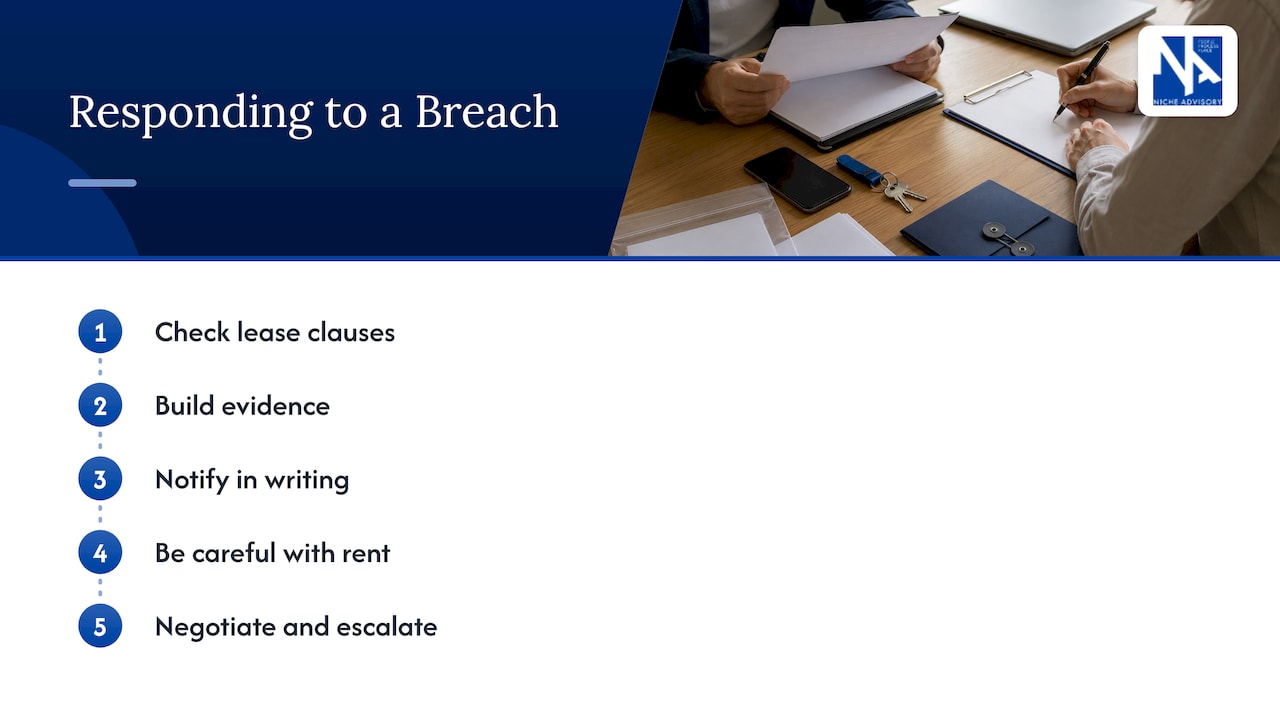
1. Read the lease clauses that apply
Check the quiet enjoyment, access, repairs, redevelopment, services, default and dispute resolution clauses before you write to anyone. Sprintlaw recommends this order because skipping a required dispute step can weaken your position later. An experienced tenant adviser reads the same clauses against your operations: which obligations the landlord has actually missed, and which are your own.
2. Build the evidence
Evidence that carries weight includes emails, photos and video, entry records (including lawful CCTV), customer complaints and sales data showing a drop during the disruption. Sales data is the item tenants most often forget. Without a before-and-after comparison, a damages or rent-reduction claim is guesswork.
3. Notify in writing
Write a factual notice: what happened, when, the impact on your business and the fix you require, with a reasonable deadline. Keep the tone neutral. The letter may later be read by a mediator or a judge, and it also starts the clock on the landlord’s knowledge, which was decisive in the slab case.
4. Be careful with rent
Withholding rent is the most common tenant mistake. Sprintlaw cautions that withholding rent without a clear legal basis can put the tenant in breach even where the landlord is at fault, unless the lease allows set-off. If you cannot trade, negotiate an abatement or rely on specific lease rights, and take legal advice from a lawyer before you stop paying.
5. Negotiate, then escalate
Mediation and negotiation are usually faster and cheaper than proceedings. If they fail, the forum depends on your state and lease type. Victoria’s VCAT hears retail and commercial tenancy disputes, and for damages or non-injunction relief in retail tenancies a section 87 certificate is required, with claims under the Acts generally brought within six years. A lawyer should confirm the forum and limitation periods for your situation.
When the landlord serves a breach notice on you
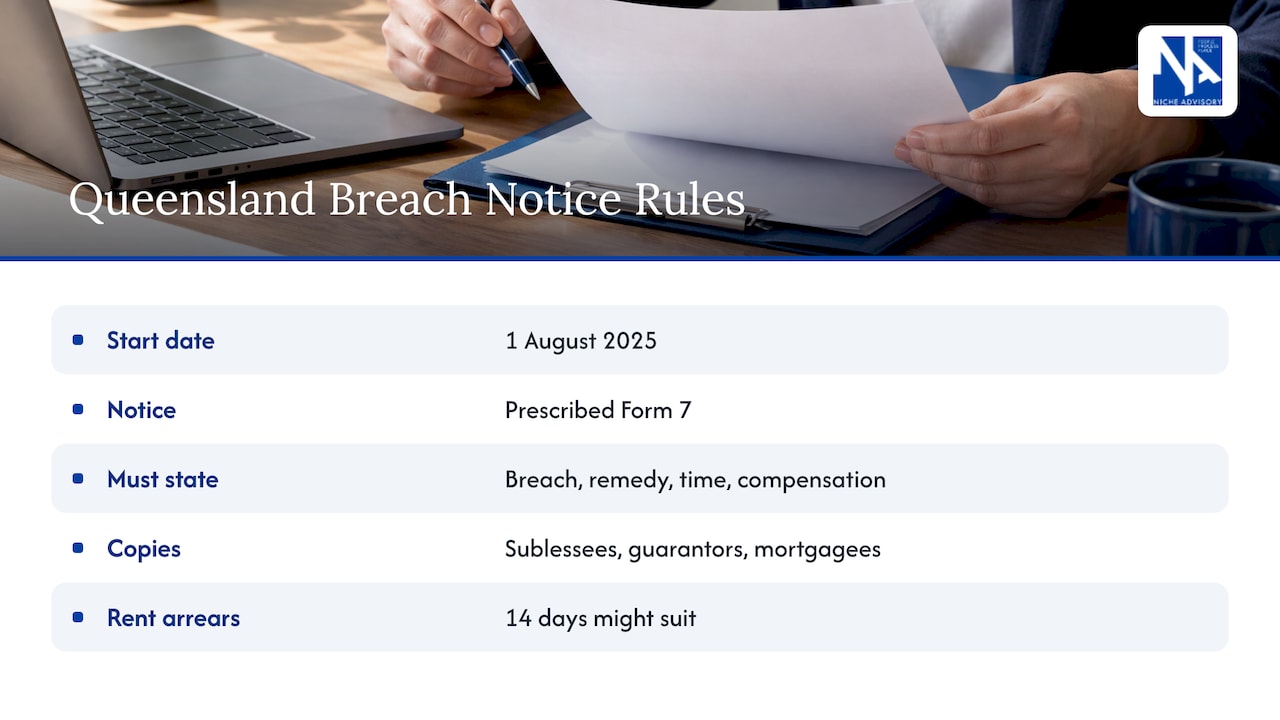
Disputes run both ways, and a tenant who has a grievance often receives a landlord’s notice at the same time. In Queensland, from 1 August 2025 the Property Law Act 2023 requires landlords to use a prescribed Form 7 Notice to Remedy Breach before ending a lease or re-entering. The notice must state the breach, the remedy and a reasonable time to fix it, and any compensation claimed. Landlords must also copy designated persons such as sublessees, guarantors and mortgagees.
What counts as reasonable depends on the breach. According to McTaggart Grant Lawyers, 14 days might suit rent arrears, while complex breaches such as unapproved works can justify longer. Whatever your state, answer any landlord notice within its deadline and do not let your own complaint distract from your compliance.
Prevent the breach in the lease itself
The cheapest remedy is a better lease. Before you sign or renew, push for:
- A works clause with limits. Notice periods, working hours, access guarantees and a right to rent abatement when works materially affect trading.
- Clear repair allocation. State who handles structure, plant, services and common areas, especially for industrial sites where site risk is easy to miss. See our note on negotiating industrial leases.
- A dispute process. Escalation steps, timeframes and a mediation requirement that suits your business.
- Disclosure of planned redevelopment. Ask in writing, and record the answer in the lease.
These terms appear on our list of common risk factors for Sydney commercial tenants, and they are easiest to win during a renewal, where the landlord wants you to stay. Our guide to lease renegotiation walks through that process.
Where Niche Advisory fits
A breach rarely arrives alone. It sits inside a relationship with a landlord you may still need for years, a lease with a renewal or makegood date approaching and a business that cannot stop trading. We act exclusively for tenants and owner-occupiers, never landlords, and our advice is independent. Our corporate tenant advocacy and dispute resolution services cover lease negotiation, lease renewal and review, makegood negotiation and disputes between tenants and landlords. We also provide lease administration, so obligations and dates are tracked before they become disputes. Where a matter needs a lawyer, such as a termination or court filing, you will want one involved alongside us.
If you are at the stage of weighing a rent concession against a formal claim, talk to us about your lease first. The way a breach is documented and put to the landlord often decides whether it ends in a negotiated outcome or a hearing.
FAQ
Can I stop paying rent if my landlord breaches the lease?
Only if the lease allows set-off or a specific abatement right. Withholding rent without a clear legal basis can put you in breach even when the landlord is at fault. Negotiate an abatement and take legal advice before you withhold anything.
What is a breach of quiet enjoyment?
It is substantial interference by the landlord with your use of the premises for the lease purpose. Examples from Australian cases include noisy repair works, façade works disrupting a call centre and failure to secure premises during building works. Lease wording and state legislation can modify the right.
Can I terminate a commercial lease because of a landlord breach?
Sometimes, if the breach is serious enough and damages would not be an adequate remedy. A landlord’s failure to act on a known structural defect has been treated as repudiation. Termination carries relocation and makegood costs, so get legal advice before you act.
Where are commercial lease disputes heard?
It depends on the state and whether the lease is retail. Retail disputes often go through a small business commissioner and a tribunal such as VCAT in Victoria. Office, industrial and warehouse disputes in Queensland usually go to the courts.
Sources
- Repairs and maintenance, Queensland Small Business Commissioner
- Duty to maintain commercial property, Coulter Legal
- Landlord’s works interfering with your quiet enjoyment, Bartier
- Hawkesbury Nominees Pty Ltd v Battik Pty Ltd [2000] FCA 185
- Right to Quiet Enjoyment in Commercial Leases, Sprintlaw
- NSW Commercial Lease Landlord Duties, Sprintlaw
- Retail Tenancy Guide, NSW Small Business Commissioner
- Retail and commercial leases, VCAT
- Can You Exit a Commercial Lease Early in Queensland?, Stonegate Legal
- Retail Leases Comparative Analysis, Clayton Utz
- Queensland’s New Property Law Act, Queensland Small Business Commissioner
- New QLD Property Law Act 2023: Major leasing changes, McTaggart Grant Lawyers