
Enterprise coworking earns its place when you need satellite hubs near where staff live, room to scale a project team fast, or overflow capacity without a five-year lease attached. It trades some privacy and cultural control for speed and flexibility, and that trade only pays off with proper security, IT and governance behind it. The sections below cover exactly how to evaluate, budget and roll it out.
TL;DR:
- Enterprise coworking is suitable for short-term regional expansion, project teams, or suburban hubs but less ideal for full control or branding across entire buildings.
- Benefits include converting fixed leases into scalable operating expenses and improving staff productivity by reducing commute times for near-home locations.
- Key evaluation criteria involve security, contract flexibility, location relevance, capacity scalability, transparent pricing, and clear ownership roles across IT, legal, HR, and facilities.
- A successful pilot requires specific objectives, KPIs, operational protocols, staff training, and regular feedback, with proximity to staff’s actual commute improving attendance and satisfaction.
- Long-term hybrid strategies should combine core leased spaces with multiple coworking hubs, scaling governance and footprint planning based on evolving business needs and hybrid adoption patterns.
Table of Contents
- What is enterprise coworking for corporates?
- What are the real benefits and trade-offs for corporates?
- How do you evaluate and choose a coworking approach?
- How do you pilot and roll out coworking across the business?
- What does enterprise coworking cost and how do you budget for it?
- What have workplace advisors learned from corporate coworking pilots?
- How do you measure whether coworking is actually working?
- What legal and compliance issues apply to corporate coworking agreements?
- How do you integrate corporate IT and technology into a coworking environment?
- What does long-term hybrid workplace strategy look like with coworking included?
- How Niche Advisory helps corporates get enterprise coworking right
- Sources
What is enterprise coworking for corporates?
Enterprise coworking is not the same product a freelancer buys with a laptop and a flat monthly fee. It is a corporate-grade version built around private suites, dedicated IT provisioning, service level agreements (SLAs), and branding rights inside a shared building. You get lockable rooms, your own network segment, visitor management that matches your security policy, and a contract that reads more like a mini-lease than a gym membership.
Standard coworking membership gives an individual a desk and a coffee machine. Enterprise coworking gives a corporate a defined footprint, guaranteed capacity, and contractual protections around data, access and continuity. It sits between a traditional leased office and a casual hot-desk arrangement, borrowing flexibility from one and structure from the other.
The model earns its keep in specific situations: opening a regional presence without signing a decade-long lease, standing up a project team for a twelve-month engagement, or building a suburban hub closer to where your people actually live. It is a poor fit when a business needs total control over its floor plate, permanent branding across an entire building, or absolute certainty over who else shares the lift lobby.
What are the real benefits and trade-offs for corporates?
The financial case is straightforward: coworking converts a fixed lease liability into an operating expense you can scale up or down. That single shift is why so many finance teams have warmed to it, particularly as Australian businesses look to cut exposure to long-term, inflexible lease commitments. You are not locked into a decade of rent on space you may not need in year three.
There’s a talent angle too. Suburban and near-home hubs are seeing rising corporate uptake because staff get their commute back, and organisations report stronger productivity when people work close to home rather than trekking to a CBD tower for a hybrid roster.
Statistic callout: In a survey of coworking users, 43% named collaboration and networking as the biggest advantage of shared space. Almost as many, 48%, named noise and distractions as the biggest downside.
That split matters. The same open layout that sparks a hallway conversation with another tenant also makes a confidential client call awkward. Watch for:
- Data security gaps if IT access isn’t segmented properly
- Confidentiality risk in open meeting areas
- Noise and acoustic issues affecting focused work
- Hidden operational load on facilities and HR teams managing the arrangement
How do you evaluate and choose a coworking approach?
Choosing the right coworking approach is a governance exercise, not a real estate one. Before you sign anything, work through these evaluation criteria:
- Security and IT. Can the provider segment your network, support your device management policy, and prove compliance with your data handling standards?
- Contract terms and SLAs. What happens if capacity isn’t available when you need it? What’s the notice period, and what’s guaranteed versus best effort?
- Location and accessibility. Does the hub sit where your people actually commute from, not just where it looks impressive on a map?
- Private versus shared balance. How much of your footprint is lockable, branded space versus open desks anyone can use?
- Capacity flexibility. Can you flex from ten desks to forty inside a quarter without renegotiating the whole agreement?
- Pricing transparency. Is the quoted rate genuinely all-in, or will meeting rooms, printing and after-hours access appear as line items later?
Internally, assign clear ownership before you talk to a single provider. IT needs to sign off on network and device access. Legal needs to review the SLA and exit clauses. HR needs to own the change management and etiquette side. Facilities needs to own day-to-day operations and vendor relationship.
Pro Tip: Match the provider tier to the actual job. An entry-level membership suits a two-person satellite outpost testing a new region. A dedicated enterprise suite with its own SLA suits a 40-person project team handling client-confidential material. Don’t buy enterprise features you don’t need, and don’t try to run sensitive work on a casual membership.
Enterprise coworking versus a leased office isn’t a binary choice either. Many corporates run both: a core leased headquarters plus two or three enterprise coworking hubs for satellite teams. That blended model, rather than an all-or-nothing switch, is where most large employers actually land.
How do you pilot and roll out coworking across the business?
Running a pilot properly is the difference between a coworking rollout that sticks and one that gets quietly abandoned after six months. Structure it like this:
- Set objectives and a timeframe. Pick one specific goal, such as trialling a satellite hub for a 20-person team over a fixed 90-day window.
- Define KPIs upfront. Track desk utilisation, cost per person against your old benchmark, staff satisfaction scores, and any security incidents.
- Write the operational protocols before day one. Booking rules, visitor sign-in procedures, confidentiality guidelines for shared meeting rooms, and IT access controls all need to exist in writing, not be improvised on the fly.
- Set expense and reimbursement policy. Decide who books, who pays, and how travel or parking near the hub gets reimbursed.
- Train staff on shared-space etiquette. Booking room protocol, screen privacy, and how to handle a confidential call in an open area all need a quick briefing, not an assumption everyone already knows.
- Build a feedback loop. Fortnightly check-ins during the pilot catch problems (noise, booking conflicts, access issues) before they become reasons to abandon the model.
- Review against KPIs and decide. Extend, adjust, or scale based on actual data, not gut feel.
The resurgence of activity-based seating in many corporate offices shows the same lesson applies here: people adapt to shared space fastest when the rules are explicit from day one, not discovered by trial and error.
What does enterprise coworking cost and how do you budget for it?
Providers typically price enterprise coworking one of three ways: per desk or seat, a flat private suite subscription, or a bundled package covering space plus services like reception, meeting rooms and IT support. Total cost of ownership needs to include all three layers, not just the headline rate.
Benchmarking cost per square metre of net lettable area is now standard practice, and fit-out and space benchmarks increasingly reflect activity-based design rather than a flat desk count. That matters because a coworking suite with more collaboration space and fewer fixed desks can cost more per square metre while costing less per employee overall.
Statistic callout: Businesses shifting from long-term leases to flexible coworking arrangements can meaningfully reduce exposure to inflexible, multi-year lease commitments, freeing up capital that would otherwise sit tied to a fixed floor plate.
Watch for hidden costs before you sign:
- After-hours access fees and weekend surcharges
- Meeting room booking limits that force overage charges
- IT setup and integration costs not included in the headline rate
- Exit or downsizing penalties buried in the contract
Coworking rarely produces savings when a corporate needs a large, permanently branded footprint for hundreds of staff. At that scale, a rationalised leased office often beats a coworking subscription on a per-square-metre basis.
What have workplace advisors learned from corporate coworking pilots?
One pattern shows up repeatedly in workplace strategy work: a professional services client trialled a small suburban hub for a project team of 15, expecting a modest productivity bump. Utilisation came in higher than forecast within the first month largely because staff who’d been skipping the CBD commute altogether started showing up consistently once the hub sat fifteen minutes from home.
Three lessons follow from pilots like that. First, test the smallest viable footprint before committing to scale, since demand patterns rarely match what planning assumed. Second, insist on SLA clauses covering IT response time and access continuity, not just desk availability. Third, build a simple protocol for confidential work in shared meeting rooms before your first sensitive client call happens in one.
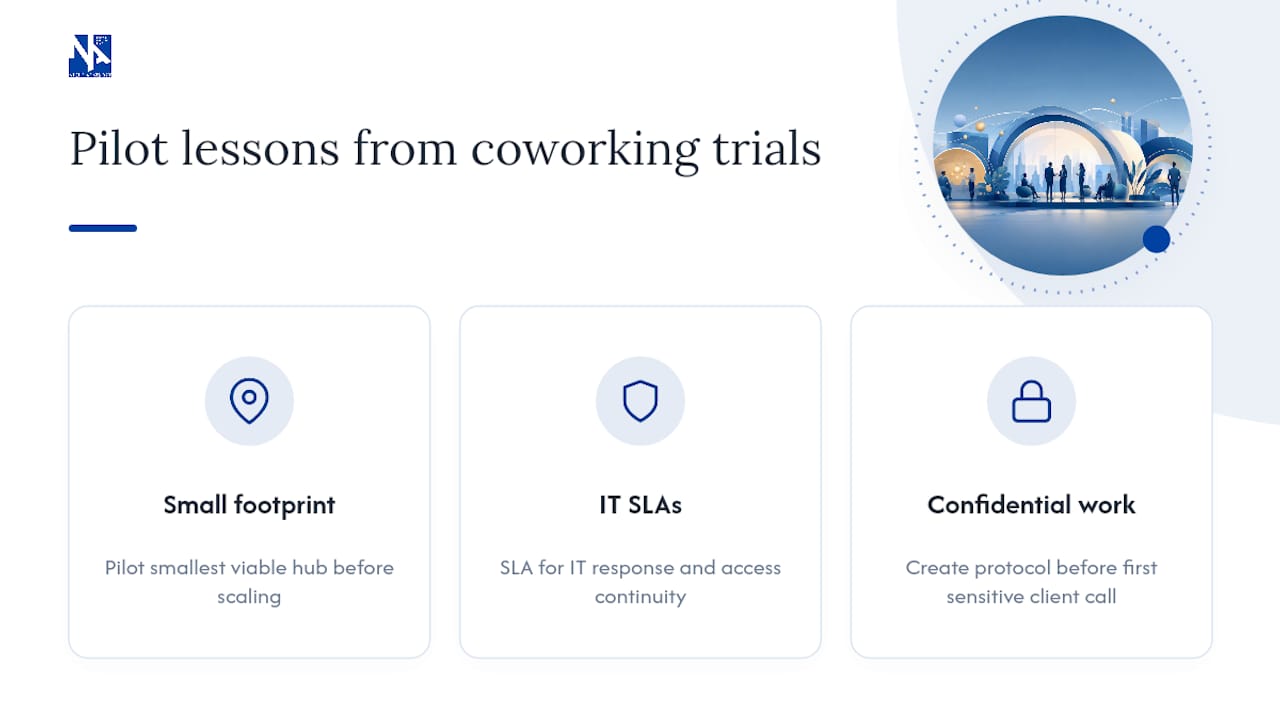
The counterintuitive lesson? Proximity beats prestige. A hub near where staff actually live consistently outperforms a flashier CBD address on attendance and satisfaction, even when the CBD option looks better on a map.
How do you measure whether coworking is actually working?
Utilisation rate is the first number to track: desks booked versus desks available tells you whether the space matches actual demand, not projected demand.
Cost per employee is the second metric, calculated against your previous leased-office baseline so you’re comparing like with like, including all bundled services. Security incidents, however minor, need a running log, since even a single unauthorised access event should trigger a review of provider protocols.
Employee feedback carries as much weight as the harder numbers. A short quarterly pulse survey asking about commute impact, focus quality, and comfort raising confidentiality concerns will surface issues before they show up in resignation data. Productivity itself is harder to isolate, but proxies work well: meeting attendance rates, project delivery timelines, and manager-reported output all move in a pilot’s favour when the hub is genuinely serving the team.
Set a review cadence from the start, quarterly at minimum, and put a named owner against it. Coworking arrangements that drift without anyone formally reviewing them tend to get renewed by default rather than by merit, which is how corporates end up paying for underused space two years after the original pilot ended.
What legal and compliance issues apply to corporate coworking agreements?
Coworking agreements sit in a different legal category to a standard commercial lease, and treating them the same way is a common mistake. Most enterprise coworking contracts are licence agreements, not leases, which changes your rights around notice periods, exclusive possession, and what happens in a dispute.
Data protection clauses need particular scrutiny. If your business handles client information subject to privacy obligations, the agreement should specify who has physical access to your suite, how visitor logs are kept, and what happens to data if the provider changes ownership or ceases trading. Confidentiality clauses matter just as much in shared corridors and lift lobbies as they do inside your own suite.
Check exit and make-good obligations carefully. Some providers apply make-good requirements similar to a traditional lease, requiring you to restore fittings or branding on exit even from what was marketed as a flexible arrangement. Insurance is another area worth clarifying upfront: confirm whether your public liability and contents cover extends to a shared building, and whether the provider’s own insurance covers common areas adequately.
Finally, get legal sign-off on liability allocation if an incident occurs in shared space, such as a data breach traced to inadequate network segmentation. Ambiguity here tends to surface only after something has already gone wrong.
How do you integrate corporate IT and technology into a coworking environment?
Network segmentation is the starting point for any enterprise coworking deployment. Your IT team needs a dedicated, isolated connection rather than shared building Wi-Fi, particularly if staff will access internal systems or client data from the space.
Device management policy has to extend to the coworking site the same way it applies at headquarters. That means the same VPN requirements, the same endpoint monitoring, and the same access controls, regardless of whether staff are logging in from a leased head office or a shared suite three suburbs away.
Physical security integration matters too: swipe access, visitor management, and after-hours entry protocols all need to meet your existing corporate standard, not the provider’s generic offering. Video conferencing infrastructure is worth testing before rollout, since coworking providers vary enormously in room acoustics and bandwidth reliability, and a bad call quality experience undermines confidence in the hub fast.
Build a simple IT onboarding checklist for every new coworking location: network setup, device provisioning, access card issuance, and a test of core systems before the first staff member arrives. Treating a coworking hub as “just another office” from an IT governance perspective, rather than a special case, avoids most of the integration headaches corporates run into during their first deployment.
What does long-term hybrid workplace strategy look like with coworking included?
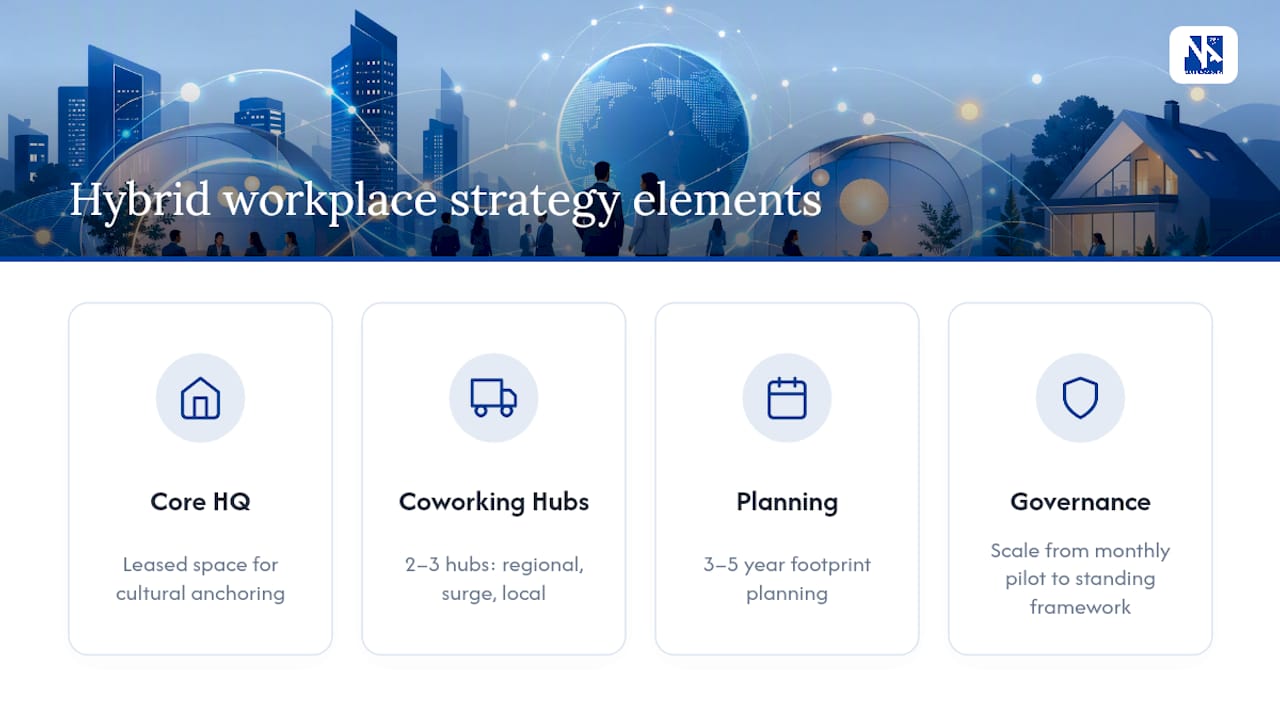
Coworking works best as one component of a broader hybrid workplace strategy, not a wholesale replacement for a corporate headquarters. Most large employers that get this right run a core leased space for cultural anchoring and permanent teams, supplemented by two or three enterprise coworking hubs positioned for specific purposes: regional expansion, project surge capacity, or proximity to where staff actually live.
Planning that footprint three to five years out matters more than optimising this year’s headcount. Lease terms, coworking contracts, and headcount growth rarely move on the same timeline, so the strategy needs enough flexibility built in to rebalance the mix as the business changes. Flexible office space is expected to keep expanding as a category precisely because it lets corporates make that adjustment without a lease renegotiation every time.
Governance needs to scale with the footprint too. A single suburban pilot might need one steering group meeting a month. Five coworking locations across three states need a standing governance framework with IT, legal, HR and facilities represented, plus a clear escalation path when something goes wrong at a site.
The strategic question worth revisiting annually isn’t “should we use coworking,” it’s “what’s the right ratio of owned, leased and coworking space for where our people actually are.” That ratio shifts as hybrid patterns mature, and locking it in too early is its own risk.
How Niche Advisory helps corporates get enterprise coworking right
Working out whether coworking, a leased office, or a blend of both suits your business is exactly the kind of decision Niche Advisory has spent over 12 years helping corporates navigate. Workplace strategy, tenant advisory and project management services cover the path from evaluating providers and negotiating terms through to designing the pilot and running the governance framework once it’s live.
A typical first engagement starts with a scoping call to understand your current footprint and hybrid patterns, followed by a pilot plan with defined KPIs and a governance structure spanning IT, legal, HR and facilities. From there, Niche Advisory manages the project through to rollout, giving you independent advice rather than a provider’s sales pitch. If you’re weighing up how a coworking or relocation project would actually run, get in touch with Niche Advisory to start that scoping conversation.
Sources
- Why Aussie workers are ditching the CBD tower for high-design hubs
- Challenges of coworking spaces
- How hybrid work has reshaped Australian offices and where the money goes
- Shared workspaces: regional and suburban hubs supporting hybrid work (ABC)