Prime Melbourne CBD office rents currently sit in a band that still favours tenants, but that window is closing. Vacancy is easing and the supply pipeline is drying up fast, which means incentives will shrink over the next 18 months. If you’re planning a lease decision this year, budget now, lock in terms early, and get a tenant adviser involved before you sign anything.
TL;DR:
- The shrinking office development pipeline will lead to a supply shortage after 2026, reducing incentives and increasing rental prices over the next 18 months.
- Renting prime-grade office space in Melbourne CBD costs significantly more than secondary stock, especially in prestigious locations like Collins Street or near Southern Cross Station.
- Negotiating effective rent, rather than face rent, is vital since incentives and lease terms can substantially lower overall costs.
- Landlords are beginning to reprice due to scarcity, making early lease agreements with market-appropriate incentives the best way to lock in favorable conditions.
- Engaging a tenant adviser before starting negotiations can significantly improve lease terms, especially in a market with limited supply and rising rents.
Table of Contents
- Melbourne office rents: the current market snapshot
- What drives the difference in Melbourne office rents
- How much does it cost to rent an office in Melbourne?
- Budgeting and negotiating a Melbourne office lease
- Where to search for Melbourne office space
- Get Melbourne-specific lease advice before you sign
- Sources
Melbourne office rents: the current market snapshot
Melbourne’s CBD office market has spent the past few years firmly in tenant territory. Vacancy climbed through the post-pandemic hybrid-work shakeout as businesses gave backspace they no longer needed, and landlords responded with generous incentives to keep buildings filled. That dynamic hasn’t disappeared, but it’s shifting under tenants’ feet.
The real story now is supply, not vacancy. Analysts at Knight Frank report that the Melbourne CBD development pipeline is shrinking sharply. Once stage two of 435 Bourke Street completes in the third quarter of 2026, under-construction stock falls to its lowest level since 2001, with only a small amount of new space expected to land between 2027 and 2030.
That’s not a lot of new floor space for a city this size.
What a near-empty pipeline means for tenants:
- Fewer new buildings competing for tenants means landlords have less incentive to compete on rent-free periods and fitout contributions.
- Prime-grade stock, already the tightest segment, will feel the squeeze first as businesses upgrade quality without new supply to absorb demand.
- Tenants negotiating now are working from a stronger position than tenants negotiating in 2027 or 2028.
The same Knight Frank analysis flags rental growth as a near-term outcome of this supply drought, once vacancy works through the current pipeline of second-hand space being returned to the market. In practical terms: the next 12 to 18 months are the best window tenants will get for a while. Landlords haven’t fully repriced for scarcity yet, but they’re starting to. A tenant who locks in a five or seven-year term today, with a market-appropriate incentive baked in, is protected against the repricing that’s coming. A tenant who waits until 2027 to start negotiating is walking into a tighter, more expensive market with less leverage.
What drives the difference in Melbourne office rents
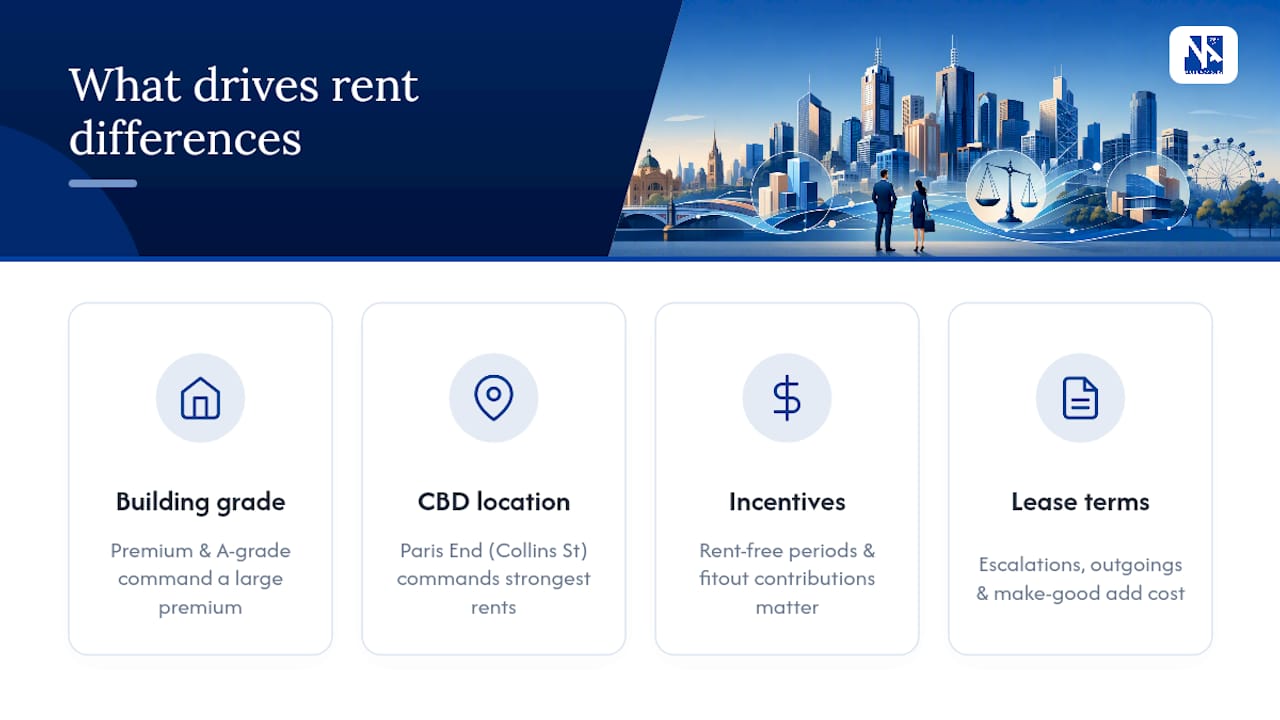
Two tenants signing leases in the same month can pay wildly different effective rents for what looks, on paper, like similar space. The gap comes down to four variables.
Building grade is the biggest lever. Premium and A-grade towers in the core command a real premium over B-grade and secondary stock, and that gap has widened as businesses chase quality space to support return-to-office mandates. A B-grade floor in a less central location can run at a substantial discount to a premium tower, even a few streets away.
Location inside the CBD matters more than most tenants expect. The so-called Paris End around Collins Street and the eastern end of the grid still commands the strongest rents, driven by proximity to laneway retail, hospitality, and the prestige addresses that many professional services firms want on their letterhead. Buildings near Southern Cross Station or Flinders Street trade on convenience rather than prestige, which shows up in the rent.
Incentives are where the real negotiation happens. A quoted face rent means very little until you know the rent-free period and fitout contribution attached to it.
Lease terms also swing your total cost. Annual rent escalations (typically fixed at 3.5 to 4% or tied to CPI), outgoings recovery, and make-good obligations at lease end all add to what you actually pay over the term, not just what’s advertised.
Pro Tip: Always ask for the effective rent, not the face rent, before comparing two offers. A landlord quoting a higher face rent with a longer rent-free period can be cheaper over the lease term than a “cheap” headline figure with minimal incentive.
How much does it cost to rent an office in Melbourne?
Pricing varies enough by grade and precinct that a single number is close to useless. Here’s how to think about it in bands, and how to convert those bands into a number your finance team can actually work with.
- Net face rents for prime CBD space sit at a premium to secondary stock, with the gap between premium towers and B-grade buildings often running to several hundred dollars per square metre annually. Ask your agent or adviser for the current quarter’s range for the specific precinct you’re targeting, since these figures move with each vacancy report.
- Serviced and flexible desk pricing gives you a cleaner per-person figure. Rubberdesk’s Melbourne pricing guide tracks median desk and private-office rates by quarter, and shows that larger teams typically negotiate lower per-desk rates than solo operators or small teams booking a handful of seats.
- Day-pass and casual serviced space sits at the accessible end. GPT’s Space&Co. on Collins Street prices day passes from around $60 per person, useful for teams testing a location before committing to a longer serviced or leased arrangement.
- Converting $/sqm to a per-desk budget is simple math once you know your density ratio. Divide your total annual rent (plus outgoings) by your expected headcount, then divide by 12 for a monthly per-person figure you can compare against serviced alternatives.
Outgoings, fitout costs, and make-good liabilities sit outside the headline rent and deserve their own line item. Outgoings on a full lease typically add another meaningful chunk to your base rent depending on the building, and fitout can run into six figures for anything beyond a basic Cat A refresh. None of that shows up in the quoted rent, and all of it shows up in your first invoice.
Budgeting and negotiating a Melbourne office lease
A good negotiation starts with a budget that captures the true cost, not just the headline figure.
Build your budget around five line items: base rent, outgoings, fitout (net of any landlord contribution), incentive value (rent-free period expressed as a dollar figure), and make-good provision at lease end. Model all five before you start comparing offers, or you’ll end up comparing apples to a much cheaper-looking orange.
Your strongest negotiation levers are lease length, incentive structure, and the scope of tenant works the landlord will fund. A longer term (seven to ten years) generally buys a bigger incentive, but locks you in through a market cycle you can’t predict. Push for a break option at year five if you’re uncertain about headcount growth.
Watch for these red flags:
- Ratchet clauses that only allow rent to rise, never fall, at review.
- Vague make-good language that leaves the scope open to landlord interpretation at exit.
- Outgoings estimates with no cap, which can blow out well past your budget mid-lease.
Pro Tip: Get a tenant adviser involved before you shortlist, not after you’ve picked a favourite. Once you’ve mentally committed to a building, your negotiating leverage drops, and landlords know it.
This is exactly the stage where specialist leasing advice earns its fee, and it’s covered in more depth in Niche Advisory’s guide to signing a new office lease.
Where to search for Melbourne office space
Most tenants start with listing portals, and that’s fine as a first pass. RealCommercial and similar marketplaces show thousands of active listings across the CBD with headline face rents and agent contacts. The catch: headline listings rarely show incentives, so treat every advertised figure as a starting point for a phone call, not a final price.
A workable shortlisting process looks like this:
- Define your brief first: headcount, growth plan, must-have amenities, budget ceiling.
- Capture data on every building that fits your brief, including face rent, outgoings estimate, and incentive if disclosed.
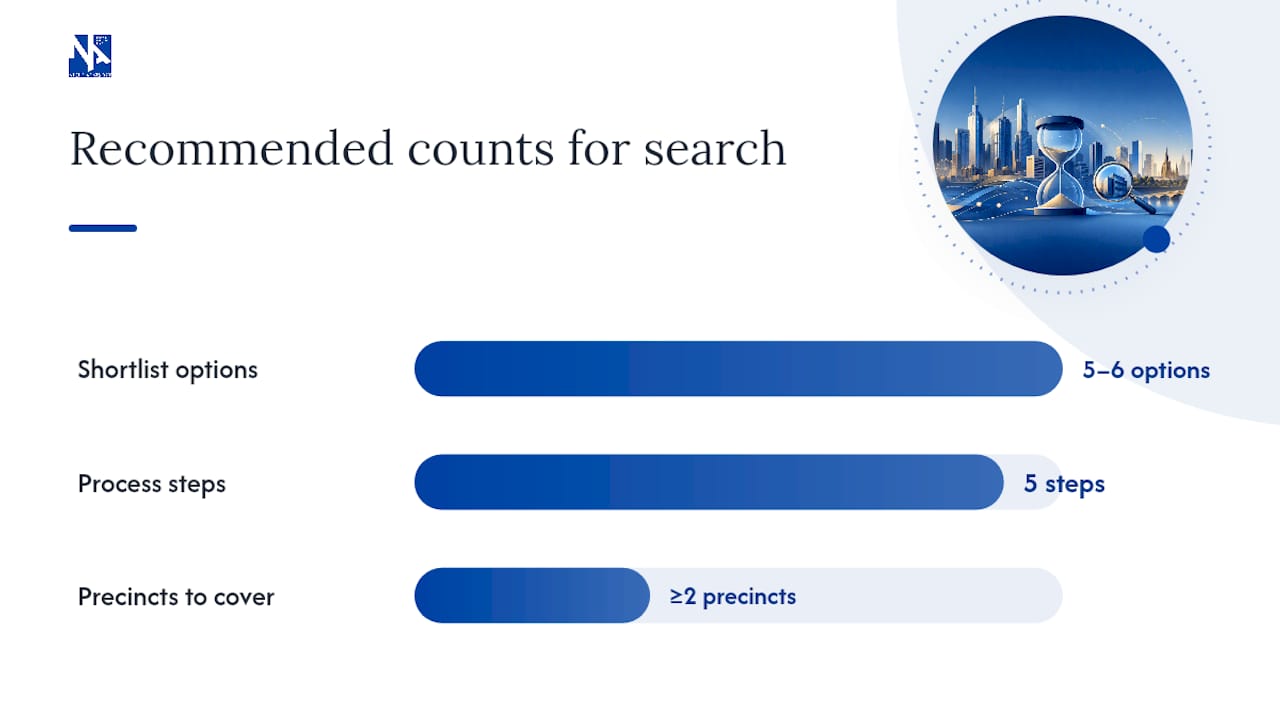
- Shortlist to five or six options across at least two precincts to keep leverage in later negotiations.
- Run viewings with a consistent checklist so you’re comparing like for like, not gut feel.
- Compare final offers on effective rent, not face rent, before you commit.
This is where an experienced tenant-side team adds the most value: running competitive tension across your shortlist, modelling effective rent properly, and managing the RFP process so landlords compete for your tenancy instead of the other way around.
Get Melbourne-specific lease advice before you sign
Most tenants negotiate their own lease once, maybe twice, in a career. Landlords and their agents do it every week, which is a structural mismatch that costs tenants real money on rent-free periods, fitout contributions, and make-good clauses they don’t fully understand until it’s too late to renegotiate. Nicheadvisory works exclusively for tenants, never landlords, which means every recommendation on building choice, incentive structure, and lease term is built around your business outcome, not a landlord’s asking price. Over 12 years advising businesses across Melbourne, Sydney, Adelaide, and Brisbane, Niche Advisory has built the RFP and negotiation processes that turn a tenant’s weak individual bargaining position into genuine competitive tension between landlords.
If you’re weighing a Melbourne CBD lease decision in the next 12 months, this is the window Knight Frank’s own supply forecast suggests you should be acting in, not waiting through. Get in touch with Niche Advisory to scope your brief and start a tenant-side negotiation before your next renewal or relocation decision.
Sources
- Melbourne office space price guide — Rubberdesk
- Offices For Lease in Melbourne City – Greater Region, VIC — RealCommercial
- GPT Space&Co. 530 Collins Street — GPT