Most tenant storage plans trigger at least one regulatory check before a lease is signed: you need to compare your chemical quantities against Schedule 11 thresholds, build a safety data sheet (SDS) backed inventory, and confirm the landlord will consent to the storage and fitout works involved. Planning, lease and fitout requirements follow from there.
TL;DR:
- Storage quantities for hazardous chemicals are aggregated by hazard class, meaning multiple small containers can combine to surpass notification thresholds.
- Major Hazard Facility status occurs at about 10% of Schedule 15 thresholds, requiring comprehensive safety cases and stricter oversight.
- Landlord approval should explicitly cover storage limits, structural modifications, and responsibilities for containment systems before lease signing.
- Proper site screening via SEPP 33 early on can prevent costly delays and restrict the storage capacities if risks are identified.
- Compliance entails detailed registers, manifests, emergency plans, and ongoing inspections, with regulatory enforcement escalating for non-compliance.
Table of Contents
- When notification, manifest and placarding are required
- How zoning and hazardous-industry screening affect site choice
- Lease checks and negotiation points before you commit
- Fitout controls: segregation, bunding, ventilation and fire safety
- Registers, manifests and emergency plan lodgement
- Due diligence checklist and realistic project timeline
- Safety measures and emergency response obligations for tenants
- Handling different dangerous goods classes in a leased site
- Inspections, audits and enforcement by regulators
- How we help tenants deliver compliant storage on time
- FAQ
- Sources
When notification, manifest and placarding are required
Whether you need to notify a regulator depends entirely on quantity, not just the presence of hazardous chemicals on site. The WHS Regulations set placard and manifest quantities for each hazard class in Schedule 11, and crossing them changes your obligations substantially.
- Placards are generally required once bulk storage exceeds specified threshold volumes or weights of a hazardous chemical, as outlined in Safe Work Australia’s storage guidance.
- Manifests apply above higher, class-specific thresholds and must include a site plan and current inventory, lodged with the relevant regulator.
- Major Hazard Facility (MHF) status can apply once holdings reach around 10% of the Schedule 15 threshold quantities, triggering a far more rigorous regime including safety cases, as explained in SafeWork NSW’s major hazard facilities guidance.
Manifest quantities vary widely by hazard class. For example, Safe Work Australia’s guidance lists specific manifest quantities for certain hazard classes including some flammable gases, while other classes have different thresholds, so a single-chemical check is never enough. Say a tenant stores three solvents individually below their manifest thresholds: if they belong to the same hazard class, Schedule 11 generally requires their quantities to be aggregated, which can push the combined total over the line even when no single container looks significant.
How zoning and hazardous-industry screening affect site choice
Before you fall in love with a warehouse or industrial unit, check whether local planning rules treat your proposed storage as potentially hazardous development. In New South Wales, the SEPP 33 and Hazardous and Offensive Development Guidelines set out a screening method that consent authorities use to decide whether a site needs a full risk assessment.
- Collate your full chemical inventory and group it by hazard class and storage location.
- Total the quantities per class and compare them against the planning screening thresholds.
- Measure distances from storage areas to site boundaries and sensitive neighbouring land uses.
- Where the screening flags potential risk, expect a request for a Preliminary Hazard Analysis (PHA), and sometimes a HAZOP study or fire safety study.
Being classed as “potentially hazardous” changes what a site can be used for. It can add conditions to a development approval, restrict permitted storage quantities, or require capital works such as fire separation walls before occupation.
Pro Tip: Run the SEPP 33 screening check against your shortlisted sites before signing anything, not after, because a failed screening can add months to your project.
Lease checks and negotiation points before you commit
A lease that is silent on dangerous goods storage leaves tenants exposed. Before committing to a site, confirm in writing what the landlord will and won’t allow, and at what quantity.
- Written landlord consent for any structural or service changes, including bunding, sprinkler augmentation, and mechanical ventilation.
- A clear ceiling on permitted storage quantities, specified by hazard class rather than a vague reference to “chemicals”.
- Makegood clauses that define who removes bunding, containment systems and dedicated extraction at lease end, since occupiers typically carry primary responsibility for how dangerous goods are stored and handled.
- Insurance and indemnity terms that match the actual risk profile, not a generic public liability clause.
- All agreed responsibilities recorded in a schedule or annexure, not left to verbal understanding.
Our guide to common lease risk factors for Sydney tenants covers how vague lease wording tends to surface as disputes well after occupation, and dangerous goods clauses are one of the clearest examples.
Fitout controls: segregation, bunding, ventilation and fire safety
An operationally compliant fitout is not a layer added after design, it is the design. Segregation rules determine your shelving layout, aisle widths and access points long before you choose a supplier.
- Incompatible hazard classes, such as oxidisers and flammables, generally need physical separation or dedicated bunded areas.
- Bunding and spill containment must hold a specified percentage of total stored volume, consistent with occupier duties set out in WorkSafe Victoria’s Code of Practice for the storage and handling of dangerous goods.
- Ventilation and fire suppression need to match the specific hazard class, not a generic warehouse specification.
- Contaminated water and drainage from spills or firefighting needs a containment path that doesn’t discharge to stormwater.
Retrofitting these controls into an existing tenancy is almost always more expensive than designing them in from the start, since cutting new bunded floors or running fresh extraction ductwork through an occupied building adds both cost and downtime.
Pro Tip: Model your containment and drainage requirements against your actual chemical list before you finalise a floor plan, because generic warehouse specifications rarely satisfy class-specific bunding rules.
Registers, manifests and emergency plan lodgement
Tenants need to understand the difference between three related but distinct documents, and where each one lives.
- The register is an internal record of every hazardous chemical on site, paired with current SDSs that are generally no older than five years, as described in WorkSafe Queensland’s register guidance.
- The manifest is the formal summary lodged with the regulator once Schedule 11 thresholds are exceeded, and a hard copy must be kept accessible on site, typically near the main entrance.
- The emergency plan often needs to be lodged with Fire and Rescue once manifest quantities are reached, so first responders know what they’re walking into.
Notification to SafeWork is required once Schedule 11 thresholds are exceeded, and SafeWork NSW’s notification guidance confirms this can be lodged online and must include a site plan and inventory. Any change in chemical types or quantities should trigger an update to the register, manifest and emergency plan, and inspection records need to be retained to demonstrate ongoing compliance.
Due diligence checklist and realistic project timeline
Treat dangerous goods storage as a gating item in your property search, not an afterthought once a lease is signed.
- Request existing chemical inventories, fire system certifications, site plans and any known contamination history from the landlord before you shortlist a site.
- Run the SEPP 33 style screening early, since a PHA can take several weeks and a HAZOP study or fire safety study adds further time on top.
- Treat development consent variations as a critical-path item, because councils reviewing potentially hazardous development rarely move quickly.
- Sequence fitout construction only once planning and landlord consents are locked in writing.
- If screening suggests major capital works such as new fire separation or bunded flooring, pause and renegotiate the site or lease terms rather than absorbing the cost mid-project.
Pro Tip: A small-scale fitout limited to shelving and SDS management can be completed in weeks, while a site requiring new bunding, fire separation or a PHA can stretch the timeline out by several months, so build that gap into your lease start date.
Safety measures and emergency response obligations for tenants
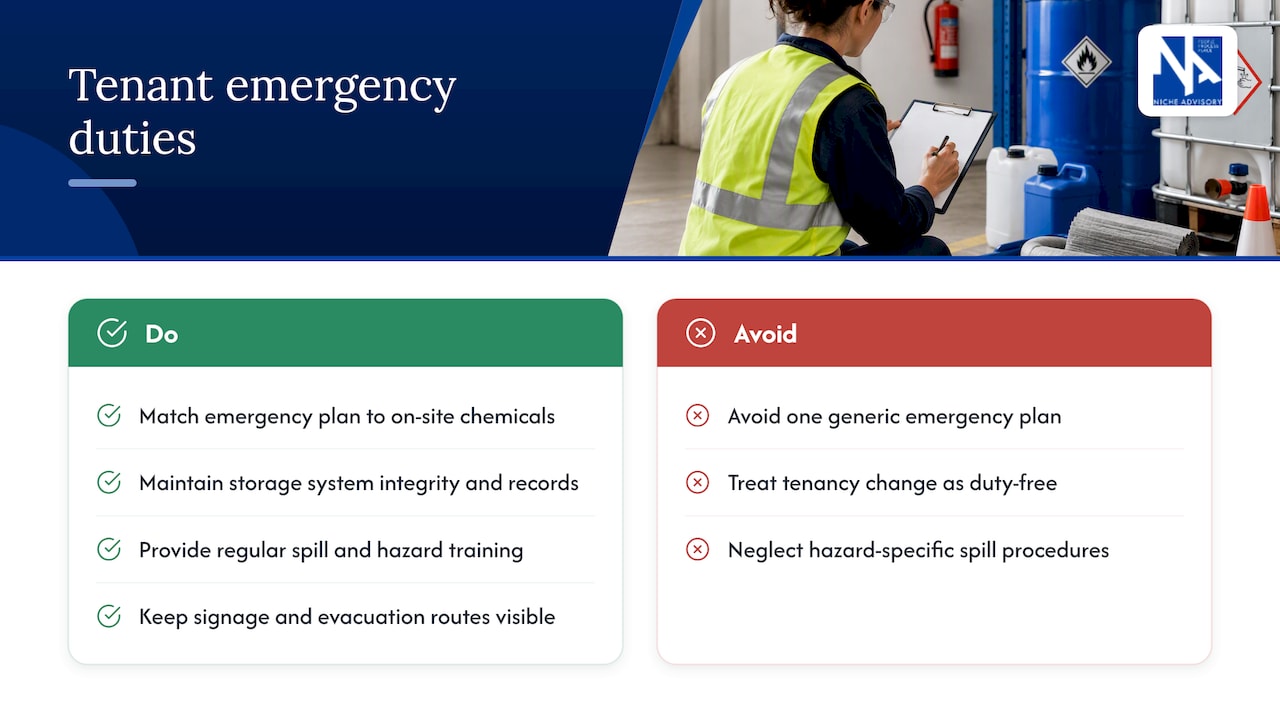
As the occupier, you generally carry the primary legal duty for how dangerous goods are stored and handled on your premises, even when the landlord owns the building. That duty extends to emergency preparedness, not just physical storage.
Your emergency response plan needs to reflect the actual chemicals on site, including spill response procedures matched to each hazard class, evacuation routes that account for storage locations, and clear signage visible to both staff and emergency services. WorkSafe Victoria’s Code of Practice sets out occupier duties including maintaining storage system integrity, keeping inspection records current, and preparing emergency plans once manifest quantities are reached.
Staff training is part of this obligation, not an optional extra. Everyone who works near stored chemicals needs to know what to do in a spill, a fire, or a gas release, and that training needs to be refreshed as inventory changes. If the business ceases to be the site occupier, outgoing obligations around decommissioning, tank removal and final notifications still apply, so a changeover of tenancy is not a clean break from these duties.
Where a facility stores multiple hazard classes, a single generic emergency plan rarely covers every scenario adequately. A flammable liquid fire calls for a different response than a corrosive spill or a toxic gas release, and conflating them in one plan creates confusion exactly when clarity matters most.
Handling different dangerous goods classes in a leased site
Not all dangerous goods behave the same way, and a leased premises needs to accommodate the specific classes you’re storing rather than a one-size-fits-all cabinet-and-shelf approach.
Flammable liquids and gases typically need dedicated ventilation, ignition source control and bunding sized to the volume stored. Oxidising agents need separation from flammables and combustibles, since mixing the two significantly raises fire risk. Corrosives need containment materials that resist chemical attack and drainage that avoids contact with incompatible substances. Toxic substances often require restricted access and additional signage, alongside tighter controls on who can handle them.
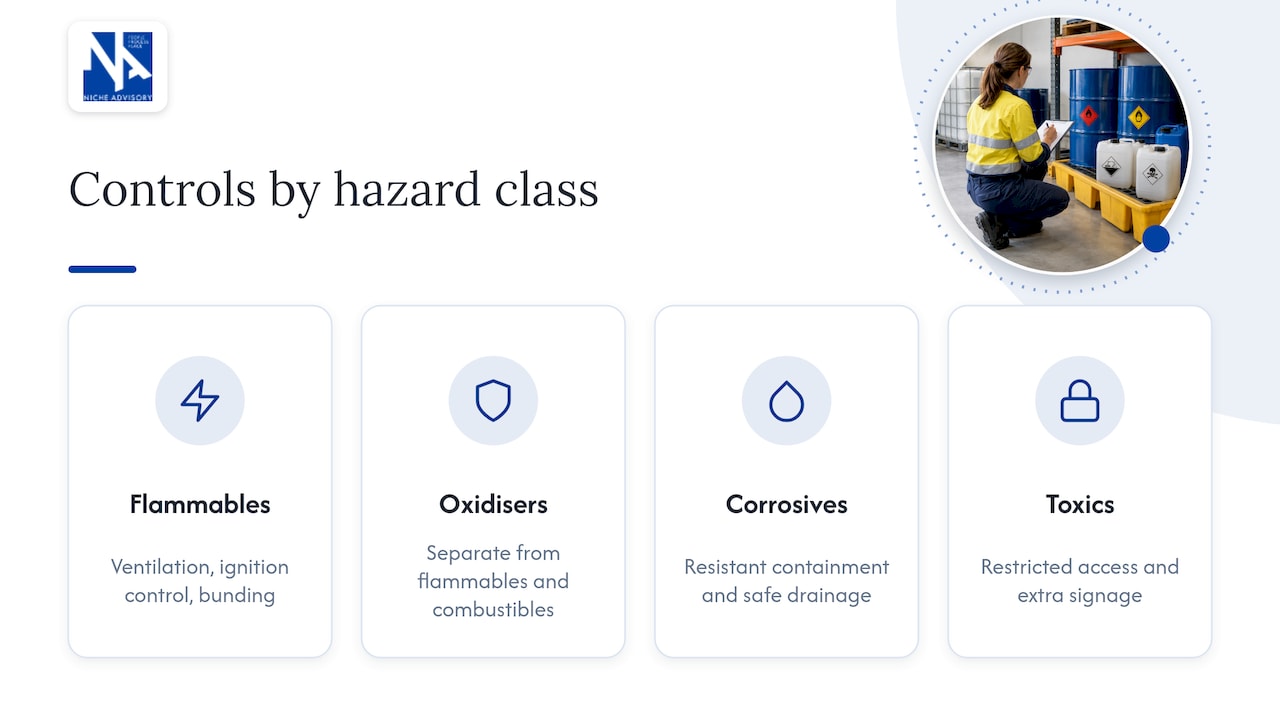
Segregation isn’t just a shelving preference, it is embedded in the Australian Dangerous Goods (ADG) Code and related Australian Standards, and it shapes layout decisions down to aisle width and rack spacing. A site that stores several classes side by side without proper separation is one of the more common compliance gaps found during inspections, because the fix usually means reconfiguring the floor plan rather than just moving a cabinet.
Tenants fitting out a warehouse with mixed storage needs should map hazard classes against the available floor plan before committing to a layout, since retrofitting segregation after shelving and racking are installed is a costly rework.
Inspections, audits and enforcement by regulators
Regulators including SafeWork NSW, WorkSafe Victoria and equivalent state bodies carry out both scheduled and unannounced inspections of sites storing hazardous chemicals. Inspectors typically check that the register and manifest match what’s physically on site, that SDSs are current, and that bunding, ventilation and signage meet the conditions attached to any development consent.
Inspection records themselves form part of your compliance obligations, since WorkSafe Victoria’s Code of Practice requires occupiers to retain evidence that storage systems have been checked for integrity over time. Gaps between what’s recorded and what’s found on an inspection are a common trigger for improvement notices.
Enforcement escalates in stages: an inspector can issue an improvement notice requiring specific fixes within a set timeframe, a prohibition notice halting an activity until a risk is addressed, or, in serious cases, pursue penalty action. Facilities operating above Major Hazard Facility thresholds face a heavier audit regime, including periodic safety case reviews rather than standard inspections alone.
Where site clearance or earthworks are needed to meet separation distances or fire breaks around a storage area, specialist contractors such as Rokworx’s firebreak clearing services handle the land clearing component, which is worth factoring into your project timeline if your site sits close to vegetation or adjoining land.
How we help tenants deliver compliant storage on time
We act exclusively for tenants and owner-occupiers, which means our advice on dangerous goods storage is shaped around your compliance timeline and your budget.
- Site due diligence that checks zoning and hazardous-industry screening before you commit to a lease.
- Lease negotiation that secures the landlord consents, storage limits and makegood terms a compliant fitout actually needs.
- Coordination of PHA, HAZOP and fire safety studies alongside the regulatory lodgements they feed into.
- Project and construction management that sequences fitout works against planning and consent milestones, not before them.
Getting these steps in the wrong order is what turns a straightforward fitout into a stalled one, with unplanned capital works discovered mid-lease. Our project and construction management service is built to catch that sequencing early, so approval delays and hidden retrofit costs surface before they cost you a signed lease.
FAQ
What quantities trigger a Schedule 11 manifest requirement?
Manifest quantities vary by hazard class, and Safe Work Australia’s guidance lists specific thresholds for each, such as 5,000 litres for certain flammable gases. Quantities of the same hazard class held across a site are generally aggregated, so check your total inventory rather than individual containers.
Does a tenant or landlord hold the compliance obligation?
Occupiers generally carry the primary legal responsibility for how dangerous goods are stored and handled, even where the landlord owns the building, according to WorkSafe Victoria’s leasing guidance. Lease terms should still record landlord consents and shared responsibilities explicitly to avoid disputes.
When does a site need planning approval for hazardous storage?
A site may need planning approval when it screens as potentially hazardous under guidelines such as SEPP 33, which can require a Preliminary Hazard Analysis and sometimes a HAZOP or fire safety study. This screening should happen before signing a lease, since it affects what development consent conditions apply.
What happens if storage reaches Major Hazard Facility thresholds?
Once holdings approach around 10% of Schedule 15 threshold quantities, a facility can be classed a Major Hazard Facility, triggering safety case requirements and more rigorous oversight, as explained by SafeWork NSW. This is a materially heavier regulatory regime than standard notification and manifest obligations.
Can Niche Advisory help negotiate dangerous goods storage into a lease?
Yes, our corporate tenant advocacy service negotiates landlord consents, storage limits and makegood terms specifically for tenants with compliance-heavy fitouts. We act only for tenants, so the negotiation position is built around your operational needs rather than the landlord’s.
Sources
- Placard and manifest requirements under the Work Health and Safety Regulations
- Notifications for Schedule 11 hazardous chemicals and abandoned tanks – Guidance material
- Storing hazardous chemicals | Safe Work Australia
- Hazardous and Offensive Development Application Guidelines – Applying SEPP 33
- Code of practice for the storage and handling of dangerous goods