ESFR sprinkler coverage is not a fixed number of square metres per head. It is a listed system design, matched to what you store, how high you stack it, the ceiling above it and the water behind it. For a tenant, that means the sprinklers already in a warehouse decide how you can use it. Check what the system was designed for before you sign a lease, add racking or change your stock. Niche Advisory acts exclusively for tenants and owner-occupiers, never landlords, so we look at warehouse fire protection as a question of what your lease and your operation can actually live with.
TL;DR
- ESFR (Early Suppression Fast Response) sprinklers are designed to suppress a fire early, not just hold it in check, which is why they suit high-piled warehouse storage.
- In Australia, the NCC points to AS 2118.1 for sprinkler systems. Coverage comes from the hazard classification and the listed design, not from a single area-per-head figure.
- Storage height, commodity, ceiling height, rack layout and obstructions all feed into what an ESFR system will cover.
- Changing your racking, stock or layout can put you outside the original design basis, so check before you move in or reconfigure.
- Ask for the hydraulic design basis and the commissioning records as part of lease due diligence.
Table of Contents
- What ESFR sprinklers are and why warehouses use them
- How coverage works: design areas, not a single area per head
- What Australian rules apply
- What drives the coverage you actually get
- What this means if you lease a warehouse
- Questions to settle before you sign or reconfigure
- Where the lease and the sprinkler design meet
- How we help tenants with sprinkler questions
- FAQ
- Sources
What ESFR sprinklers are and why warehouses use them
ESFR stands for Early Suppression Fast Response. The NFPA’s explanation of sprinkler types describes ESFR storage sprinklers as designed to suppress fires rather than merely control them. They apply a large volume of water early, pushing through the rising fire plume to reach the burning fuel before the fire grows.
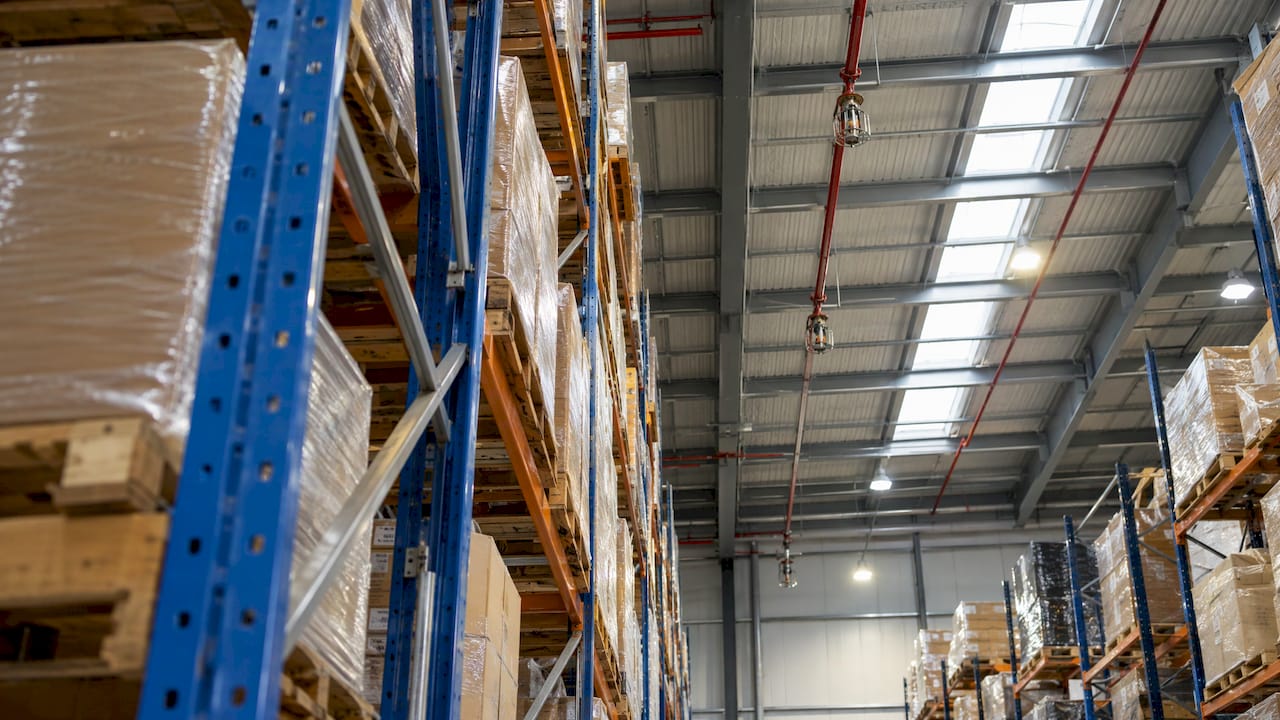
That design suits a warehouse because the fuel is stacked high. A conventional sprinkler can struggle to reach a fire burning deep inside a pallet rack. An ESFR head is built for exactly that high-challenge hazard, and it is listed for it. The listing matters: an ESFR head is only approved to work inside the conditions it was tested for.
The practical consequence for a tenant is that an ESFR system is a package. The heads, the pipework, the pump and tank, the ceiling and the storage arrangement all belong to one design. Change one of them and the others may no longer match.
How coverage works: design areas, not a single area per head
People searching for coverage often expect a number such as “one head covers X square metres”. Standard and extended-coverage sprinklers for ordinary hazards are described that way. ESFR is different. Coverage is a listed system design tied to the commodity, the storage configuration and height, the ceiling conditions, the sprinkler model, the hydraulics and an unobstructed discharge path. That is the framework in AS 2118.1:2017, the Australian Standard covering sprinkler design, installation and commissioning.
Two terms help:
- Design area: Standards Australia defines it as the area containing the maximum number of sprinklers likely to operate in a fire, determined by the hazard classification. The water supply must be able to feed that many heads at once.
- Hazard classification: the category the standard assigns to the occupancy, based on what could burn and how hard it would be to control.
So “coverage” really means three things together: where the heads sit, how many open in a fire, and whether the water supply can keep them running at the required pressure and flow.
What Australian rules apply
Under NCC 2025 Specification 17, automatic sprinkler systems must comply with AS 2118.1 for all building classifications, subject to the exceptions it lists. The NCC is the National Construction Code, the national set of building requirements. Warehouses are typically Class 7b buildings, and the sprinkler requirement is triggered by the building’s size and use.
The same specification also deals with water supply. It requires at least one water supply for a required sprinkler system. It generally requires dual supplies for a required system in a building over 25 m effective height, subject to its stated exception. Most single-storey warehouses sit well below that height, but tall automated facilities can approach it.
Standards Australia lists AS 2118.1:2017 as published on 14 September 2017, with Amendment 3 incorporated in February 2024. That is the latest amendment date shown on the official preview. A system installed years ago may have been designed to an earlier edition, which is one more reason to ask what it was designed to.
The exact minimum and maximum spacing between ESFR heads is not one universal figure you can quote. It comes from the applicable AS 2118.1 provisions and the listing and design basis of the sprinkler model chosen. Treat any spacing number you find online, especially from a United States source, as indicative only. A hydraulic designer works from the Australian Standard and the manufacturer’s listing.
What drives the coverage you actually get
Commodity and hazard classification
The 2017 standard bases occupancy classification on factors including expected heat release, fuel loading and burning characteristics, the quantity and combustibility of contents, stockpile height, and any flammable or combustible liquids, as shown in the standard’s text. It also has high-piled storage categories for different commodity and plastics risks.
In practice, a warehouse of cardboard-packed ambient grocery goods is a different hazard from one holding expanded plastics, aerosols or packaging that wraps combustible product in foam. Moving from one to the other can change the classification, and with it the required discharge density and the design area.
Storage height and ceiling height
A fire engineering firm’s warehouse fire protection guide explains that warehouse classification depends on what is stored, how it is packaged, how high it is stacked and the aisle configuration. It adds that rack storage above 3.5 m may need in-rack sprinklers, and that ESFR needs minimum ceiling heights that depend on storage height.
The same guide gives example design figures for ordinary hazard and high hazard classes: 5.0 to 8.0 mm/min over 216 to 360 m² for OH3, and 12.5 to 17.5 mm/min over 260 m² for HH3. These are illustrations of the scale of water involved. They are not ESFR figures, and they are not a substitute for a design.
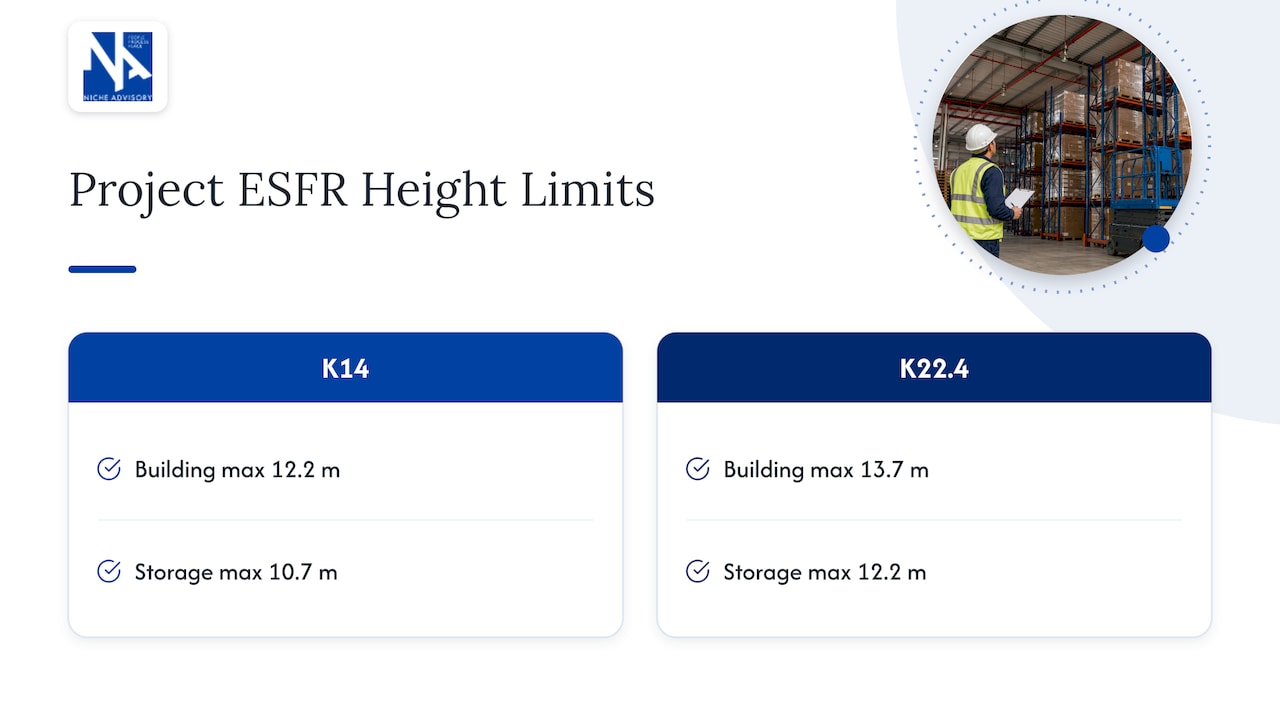
A project-specific Australian example shows how the limits work. A 2012 Northern Territory warehouse expansion document set K14 ESFR limits of 12.2 m building height and 10.7 m storage height, and K22.4 limits of 13.7 m building height and 12.2 m storage height. The same document restricted back-to-back pallet storage without gaps to 7.6 m, and otherwise specified 75 mm clear gaps around pallets. These were conditions for that project, not general Australian rules, but they show the kind of limits a design carries: a maximum storage height, a maximum building height and a required gap around the load.
The K number is the sprinkler’s discharge coefficient. A higher K-factor head discharges more water at a given pressure and is chosen for taller or more challenging storage.
Racks, flues and obstructions
ESFR relies on water reaching the fire without interruption. Anything that blocks the discharge or the rising plume can undermine the design: solid shelving, mezzanine floors, ducts, lighting, cable trays, dividing screens or curtains hung below the heads, and stock stored too close to the deck. Where you hang screens or partitions in a warehouse, the material’s fire-test certification matters, for example NFPA certification for vinyl screens, and so does where they sit relative to the heads.
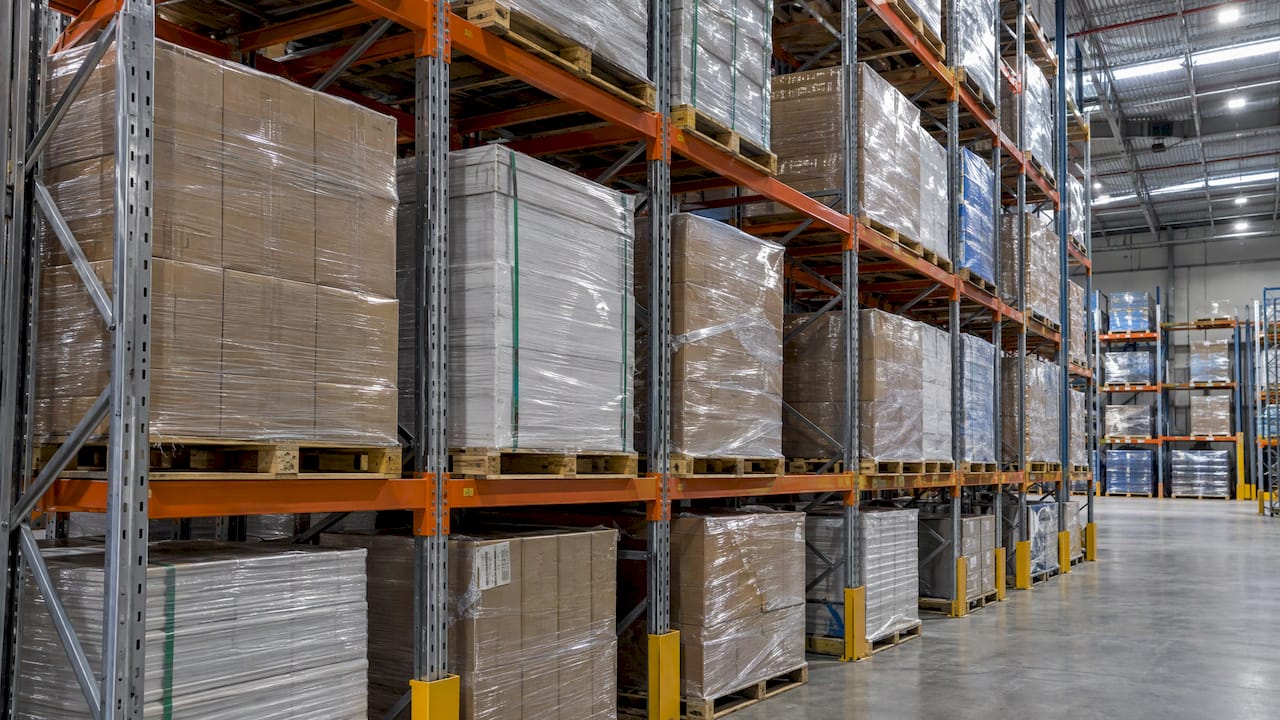
Pallet gaps and flue spaces, the vertical gaps between rack loads, are part of the design too. Racking that fills them in leaves the heads unable to reach a fire inside the stack.
What this means if you lease a warehouse
A landlord’s sprinkler system may have been designed for the previous tenant’s goods. You inherit the system and the limits that come with it. Four situations come up often.
- Inspecting a new site. The building might have clear height you want, but the ESFR design may cap storage well below that. Our guide to warehouse clear height checks for tenants covers the height side. The sprinkler design sets the usable limit.
- Planning racking. A layout that suits your pallet flow must also respect the design basis. See our note on compliant warehouse racking layouts under AS 4084 for the structural side.
- Changing what you store. Adding aerosols, lithium batteries, plastics or flammable liquids can change the hazard class. Our guide to dangerous goods storage for Australian tenants shows how those approvals can delay a move.
- Handing the premises back. Alterations you made to sprinkler pipework or heads can become a makegood item. Read about warehouse and industrial makegood negotiations before you modify anything.
Questions to settle before you sign or reconfigure
Put these to the landlord and to the fire services designer who will assess your plan. Get the answers in writing and tie them to the lease.
| Question | Why it matters |
|---|---|
| What commodity classification and storage height was the system designed for? | Your stock and stack height must sit inside it. |
| Which sprinkler model, K-factor and AS 2118.1 edition was used? | It sets the listing conditions the system has to keep meeting. |
| What is the maximum storage height and the required clearance below the heads? | It decides how many pallet levels you can use. |
| Is in-rack protection installed, or required for your racking? | Rack above 3.5 m may need it. |
| Does the water supply meet the design area demand? | The pump, tank or mains must feed all the heads that could open. |
| Who is responsible for upgrades if your stock changes the hazard? | It avoids a surprise capital cost mid-lease. |
| Are commissioning and maintenance records available? | They show the system was set up and kept as designed. |
The design itself, including any hydraulic calculation, sits with a qualified fire protection designer and the relevant certifier. Your role is to bring them the right facts about your operation and make sure the lease does not leave the cost with you by accident.
Where the lease and the sprinkler design meet
Sprinkler capacity is a hidden term of a warehouse lease. Two otherwise similar buildings can differ by millions in what they can hold, because one has a design that supports high-bay racking and the other does not. A rent comparison that ignores this compares the wrong thing.
Three lease points deserve attention:
- Permitted use and storage clauses. Make sure they match the hazard class you need, not only the use class.
- Landlord’s works and warranties. If the building is sold as suitable for a stated storage height, the lease should say so.
- Make-good and reinstatement. Spell out who restores sprinkler changes, and to what standard.
For a transport-heavy operation, this sits alongside site choice. Our piece on warehouse site selection shows how freight cost can swamp a small rent difference. A building that cannot store what you need loses that advantage.
How we help tenants with sprinkler questions
Niche Advisory provides independent tenant representation, property search and lease negotiation, project and construction management, makegood negotiation and dispute resolution for tenants of leasehold office and warehouse premises. We act exclusively for tenants and owner-occupiers, never landlords. When a sprinkler constraint threatens a move, a racking plan or a makegood bill, we put the question into the search brief and the lease negotiation early, so the answer is in the document before you commit. If you are comparing warehouses or reviewing a lease, see our corporate tenant advocacy service or the broader corporate real estate service.
FAQ
What does ESFR stand for, and how is it different from a standard sprinkler?
ESFR means Early Suppression Fast Response. Standard sprinklers aim to control a fire, while ESFR heads are designed to suppress it by delivering a large volume of water early through the fire plume. They are listed for high-challenge storage hazards.
Is there a set area that one ESFR sprinkler covers in Australia?
No single figure applies. Coverage depends on the listed design for the commodity, storage height, ceiling height, sprinkler model, hydraulics and clear discharge. The spacing and design area come from AS 2118.1 and the sprinkler’s listing, applied by a qualified designer.
Which standard governs warehouse sprinklers in Australia?
NCC 2025 Specification 17 requires automatic sprinkler systems to comply with AS 2118.1, subject to its listed exceptions. The standard covers design, installation and commissioning, and its latest amendment shown on the official store is Amendment 3 from February 2024.
Can I change my racking or stock in a warehouse with ESFR?
Changes can move you outside the original design basis, for example a taller stack, a different commodity or solid shelving. Before changing, get the design basis from the landlord and have a fire protection designer confirm the new layout.
Sources
- Types of Sprinklers, NFPA
- AS 2118.1:2017 preview, Standards Australia Store
- Specification 17 Fire sprinkler systems, NCC 2025
- AS 2118.1:2017 Automatic Fire Sprinkler Systems (incorporating Amendments 1 and 2)
- Warehouse and Industrial Fire Protection Design
- Distribution Facility Expansion Lot 6094 66 O’Sullivan Circuit, Northern Territory planning document
- NFPA certification for vinyl screens