
Headline industrial rents on the Gold Coast vary widely depending on precinct and building quality, and outgoings are the detail that turns an attractive quote into a real budget problem. Before comparing any two listings, ask for an itemised outgoings estimate and the lease’s rent review clause. Those two documents tell you more about true cost than the headline figure ever will.
TL;DR:
- Compare listings using effective occupancy cost per square meter: base rent plus estimated outgoings, applicable GST, and foreseeable operating costs such as security or maintenance.
- Request itemized annual outgoings estimates and the last two years of audited statements, then negotiate reconciliation rights because industrial leases lack retail disclosure protections.
- Check market rent reviews for ratchet clauses that block decreases, and confirm the review timing and formula in the lease before signing.
- Negotiate periods without rent, fitout contributions, or stepped rent, and cap outgoings increases or restoration costs to limit expenses beyond the base rate.
- Planned northern corridor land releases could ease rents and improve incentives over time, while scarce inner precincts favor landlords; weigh freight access against rent savings.
Table of Contents
- Gold Coast rent snapshot: headline ranges by precinct and what they indicate
- What drives industrial rents and the tenant’s true cost in Queensland
- How to benchmark a quoted rent: calculate total occupancy cost and adjust for asset needs
- Practical negotiation and timing advice for Gold Coast tenants
- Lease types and rent review mechanisms you’ll encounter in Queensland
- Current vacancy and how it moves Gold Coast industrial rents
- Benchmarking Gold Coast rents against adjacent markets
- Where Gold Coast industrial rents are heading
- Lease terms beyond rent: length, incentives and renewal
- Tenant incentives common in the Gold Coast industrial market
- Niche Advisory: tenant advocacy and industrial lease support on the Gold Coast
- FAQ
- Sources
Gold Coast rent snapshot: headline ranges by precinct and what they indicate
Industrial rent on the Gold Coast is really two markets wearing one label. Inner precincts such as Molendinar and the pockets near Burleigh sit on scarce, well-located land with easy access to the M1 and the coastal population base, so landlords can hold firmer on price. Northern corridor estates, led by Yatala and Stapylton, offer larger lots, bigger sheds and a different cost structure built around scale rather than proximity.
Asset grade pulls the range apart even further within the same precinct. A modern high-clearance warehouse with ample hardstand and efficient loading now commands a premium over older stock, driven largely by e-commerce and logistics demand favouring efficient layouts. Tenants running distribution or fulfilment operations are willing to pay more for the operational savings that clear-span height and dock access deliver, while a tenant needing basic storage has little reason to pay for features it won’t use.
A few things consistently explain why one quoted rent looks nothing like another for what seems like a similar shed:
- Land scarcity: inner Gold Coast sites have limited new supply, which supports firmer headline rents.
- Building age and clearance height: older, low-clearance stock rents well below modern high-bay facilities.
- Freight access: proximity to the M1 and arterial roads adds value for distribution-heavy tenants.
- Lot size and hardstand: northern corridor sites trade on scale, suiting tenants who need yard space as much as roof space.
- Lease length and incentives offered: a longer commitment or weaker market can shift the effective rent even when the headline figure stays the same.
Future supply is also part of the story. The Yatala Enterprise Area Local Area Plan identifies Yatala as the Gold Coast’s primary large-format industrial precinct, with staged land release designed for major logistics and manufacturing users. That staging matters for anyone weighing up a shorter-term deal against locking in now, because more land coming online in the north can soften pricing pressure there over time, even while inner precincts stay tight.
What drives industrial rents and the tenant’s true cost in Queensland
Headline rent is only the starting point. What a tenant actually pays each year depends heavily on outgoings, which are the operating costs a landlord passes through under the lease. In Queensland, outgoings commonly include council rates, water charges, waste collection, fire protection servicing and building insurance, and they’re usually recovered either through a net lease structure or a budgeted net recovery with a year-end reconciliation, as set out in guidance from the Queensland Small Business Commissioner.
Outgoings routinely add a meaningful slice to total occupancy cost, which is why an itemised estimate matters as much as the headline figure, according to the Queensland Small Business Commissioner.
The lease structure changes who carries the risk of those costs rising:
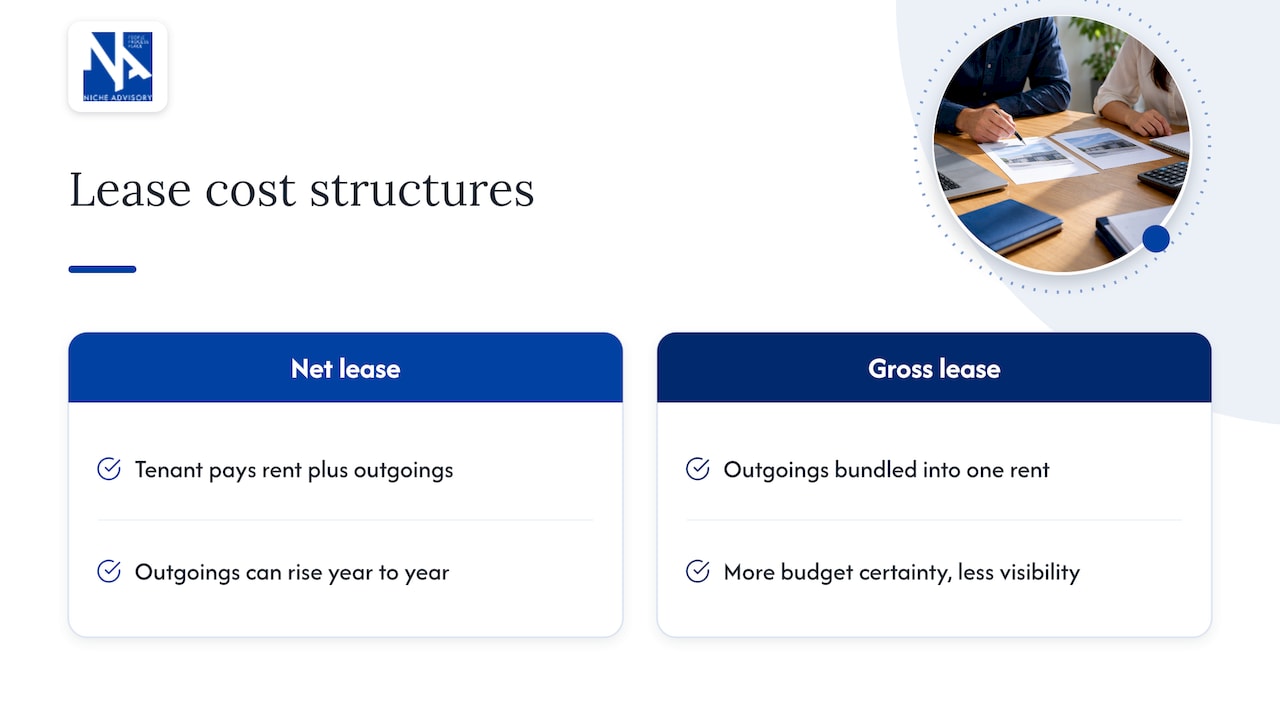
- Net leases: the tenant pays rent plus a share of actual outgoings, so cost can move year to year.
- Gross leases: outgoings are bundled into a single rent figure, giving budget certainty but less visibility into what’s really being charged.
- Direct recovery models: the landlord bills certain costs, like water, straight to the tenant’s account rather than through the lease.
Rent review and outgoings disclosure obligations are formalised for retail premises under the Retail Shop Leases Act 1994, which sets rules around review timing and the provision of outgoings estimates and audited statements. Industrial leases aren’t bound by the same Act, but the same discipline applies in practice: demand an itemised annual estimate before signing, and insist on the right to an audited reconciliation each year. Our guide to outgoings in a lease walks through how these costs inflate total rent and what to push back on.
How to benchmark a quoted rent: calculate total occupancy cost and adjust for asset needs
Comparing two industrial listings on headline rent alone is comparing the wrong number. The fix is a simple calculation that converts every quote into one comparable effective rate.
- Divide the headline annual rent by the leasable area to get your base $/m² figure.
- Add the landlord’s estimated outgoings, expressed in the same $/m² terms.
- Add GST where applicable, since commercial leases are typically subject to it.
- Add any foreseeable operational costs tied to the space, such as additional security or specialised maintenance.
- The total is your effective $/m² occupancy cost, the figure to use when ranking options against each other.
Once you have that number, adjust it against what the building actually gives you. A premium is justified when clearance height, hardstand area or loading configuration genuinely reduces your handling costs or speeds up throughput. It isn’t justified when you’re paying for warehouse features a basic storage or light-manufacturing use will never touch.
Keep a short checklist for every property you inspect, so you’re comparing like with like:
- Leasable area (m²)
- Headline rent ($/m²)
- Estimated outgoings ($/m²)
- Effective total rent ($/m²)
- Lease term and any option periods
- Rent review basis (fixed, CPI-linked or market)
A tenant weighing a smaller inner-precinct shed against a larger northern corridor option should run both through this same sequence before comparing the bottom line.
Practical negotiation and timing advice for Gold Coast tenants
The best time to bring in tenant representation or an independent valuer is before you sign, not after a dispute starts. The same applies at renewal and at any scheduled market rent review, where an adviser can test whether the landlord’s proposed figure actually reflects comparable transactions.
Several levers are genuinely negotiable, even in a tight precinct:
- Lease term: a longer commitment can justify a lower starting rent or a rent-free period.
- Incentives: rent-free months, a fitout contribution or stepped rent can soften the early years.
- Outgoings cap: a negotiated ceiling protects you from unexpected cost spikes.
- Maintenance responsibilities: clarify who fixes what before you sign, not during a dispute.
- Make-good limits: a capped make-good obligation avoids an open-ended cost at lease end.
Pro Tip: Always request the last two years of audited outgoings statements, not just the landlord’s forward estimate, before agreeing to a figure.
Timing matters too. Ongoing planning work on the Yatala-Stapylton industrial area expansion signals more large-format land coming to the northern corridor over the medium term, which can ease pricing pressure there, while scarcity in inner precincts tends to favour the landlord. Before you negotiate, request the itemised outgoings estimate, the last audited outgoings statements, the exact rent review formula and a scaled plan of the premises.
Lease types and rent review mechanisms you’ll encounter in Queensland
Queensland industrial leases generally fall into net or gross structures, and the difference shapes your cashflow risk far more than the headline rent does. Under a net lease, you pay a base rent plus your share of outgoings, which can rise with council rates or insurance premiums. Under a gross lease, the landlord bundles those costs into one number, trading your budget certainty for less visibility into what’s actually being charged.
Rent reviews typically follow one of three bases: a fixed annual increase, a CPI-linked adjustment, or a market rent review that resets the rent to current comparable rates, sometimes with a ratchet clause preventing it from falling. Market reviews are the ones worth scrutinising most closely, since the landlord’s proposed figure is a starting position, not a fact.
Timing of reviews is usually set at lease commencement, commonly at each anniversary or every few years, with the formula and comparison basis spelled out in the lease itself. The Retail Shop Leases Act 1994 sets out review timing and disclosure obligations for retail premises in Queensland, and the same structure, fixed, CPI or market, turns up across industrial leases even though the Act itself doesn’t apply to them. Reading the review clause before you sign, not when the notice arrives, is the single most effective way to avoid an unwelcome surprise mid-term.
Current vacancy and how it moves Gold Coast industrial rents
Vacancy is the mechanism behind every precinct-level price difference described above. Where available stock is scarce, landlords hold firmer on headline rent and offer fewer incentives. Where supply is growing, tenants gain leverage to negotiate rent-free periods or caps on outgoings.
Inner Gold Coast precincts, constrained by limited developable industrial land, tend to sit on the tighter end of that spectrum, which is part of why rents there hold up even when broader conditions soften. The northern corridor is a different story: the Yatala-Stapylton industrial area expansion investigation now underway with the City of Gold Coast signals meaningful future land release, which will add competing stock to that part of the market over the next few years.
For a tenant, the practical takeaway is to check where a precinct sits in that supply cycle before locking in a long term. A precinct with active planning for expansion is one where today’s rent may not hold as firmly once new stock reaches the market, giving a patient tenant more room to negotiate than the current listing price suggests.
Benchmarking Gold Coast rents against adjacent markets
Gold Coast industrial rents don’t exist in isolation. Tenants weighing up a Gold Coast site against options further north in Brisbane or along the broader South East Queensland corridor are effectively comparing two different cost and access trade-offs.
Brisbane’s industrial precincts carry their own supply and demand dynamics, and a tenant benchmarking across both markets should look at the same effective $/m² figure, not just the headline number, on each side of the comparison. Our Brisbane CBD office market update covers broader South East Queensland demand pressures that give useful context for anyone assessing whether a Gold Coast option is genuinely competitive or simply convenient.
The practical question for most Gold Coast tenants isn’t whether Brisbane is cheaper in isolation, it’s whether the freight and labour access a Gold Coast site provides justifies any gap in headline rent. A distribution business serving the coastal population base may lose more in transport time and cost by shifting north than it saves on rent, while a business with no local customer base may find the calculation runs the other way.
Where Gold Coast industrial rents are heading
The push and pull between tight inner precincts and expanding northern corridor supply points to a market that’s unlikely to move in one direction uniformly. Inner Gold Coast rents, supported by land scarcity, are more likely to hold or edge up, while northern corridor rents face more downward pressure as staged land release under the Yatala Enterprise Area Local Area Plan adds competing stock over time.
Demand composition is shifting too. Growing e-commerce and logistics activity is steering tenant preference toward modern, high-clearance assets with efficient loading, which widens the pricing gap between new-generation sheds and older stock rather than lifting rents across the board. A tenant assessing a multi-year commitment should treat that split, not a single market-wide figure, as the real forecast to plan around.
Businesses planning a relocation or major fitout around this cycle should also factor in the practical side of the move itself. Specialist guidance on warehouse relocation planning is worth reviewing early, since moving dates often need to be locked in well before a new lease commences.
Lease terms beyond rent: length, incentives and renewal
Rent is only one line in an industrial lease, and the surrounding terms often matter just as much to total cost and flexibility. Lease length on the Gold Coast industrial market typically runs longer for larger, purpose-fitted premises and shorter for smaller or more generic space, reflecting how much the landlord has invested in the specific tenant’s fitout.
Incentives, covered in more detail below, are usually negotiated as part of the same discussion as term length: a longer commitment generally buys a stronger incentive package. Renewal or option terms deserve particular attention, since they lock in your right to stay but also usually trigger a rent review, often on a market basis.
Make-good obligations, the requirement to restore the premises at lease end, are another term worth capping before signing rather than disputing afterwards. Our lease re-negotiation service page covers how these terms interact when a tenant is approaching renewal and wants to reset more than just the rent figure. Reviewing the full term sheet, not just the headline rent, is the only way to know what you’ve actually agreed to.
Tenant incentives common in the Gold Coast industrial market
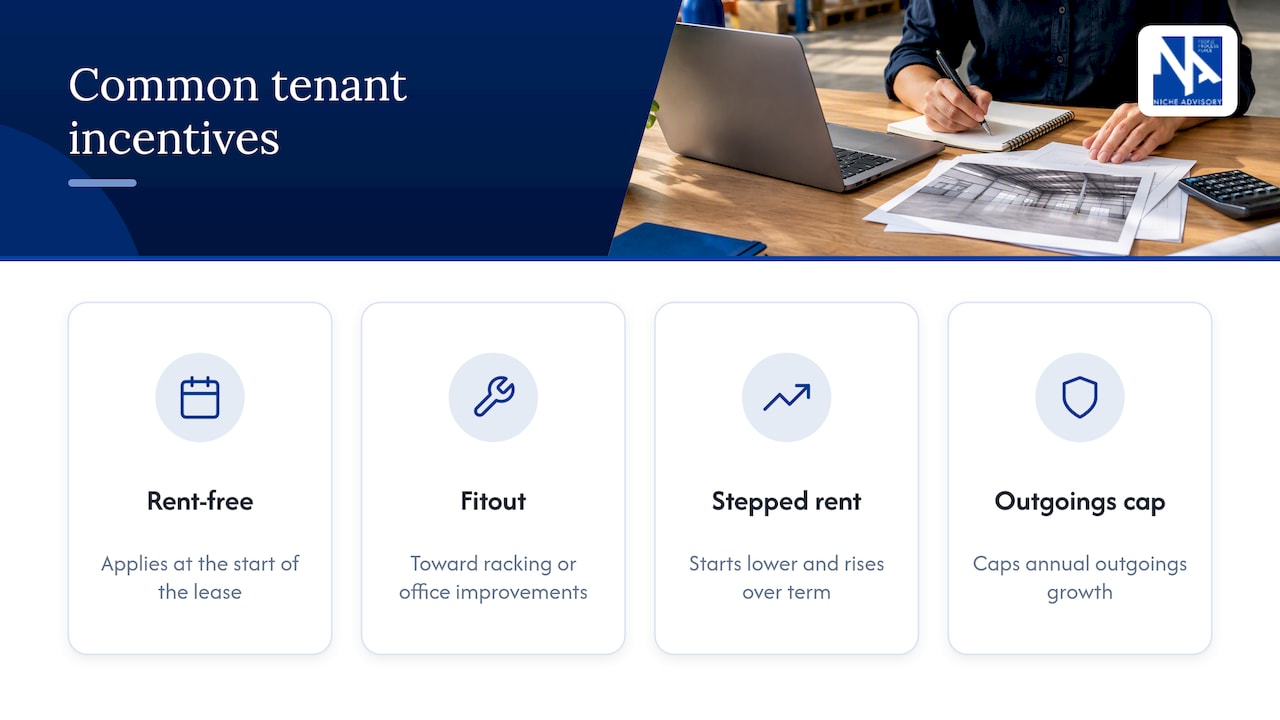
Incentives are the lever landlords use to make a headline rent more attractive without reducing the figure on paper, and they vary with how much negotiating power a tenant brings to the table. The most common forms on the Gold Coast industrial market include a rent-free period at the start of the lease, a fitout contribution toward racking or office improvements, and stepped rent that starts lower and rises over the term.
A cap on annual outgoings growth is a less visible but valuable incentive, protecting a tenant’s budget even when the headline rent itself doesn’t move. Landlords in precincts facing more competing supply, such as the northern corridor as new Yatala land comes online, tend to offer stronger incentive packages to secure a tenant quickly.
The right approach is to treat incentives as part of the same effective-rent calculation covered earlier, spreading any rent-free period or fitout contribution across the full lease term to see what it’s genuinely worth. A generous-looking incentive on a short lease can be worth less than a smaller incentive on a longer term once it’s averaged out.
Niche Advisory: tenant advocacy and industrial lease support on the Gold Coast
Benchmarking a quoted rent against the right precinct data is one problem. Negotiating the outgoings cap, make-good limit and rent review formula into a lease that actually protects your business is another, and it’s where most tenants lose the most value without realising it.
We act exclusively for tenants and owner-occupiers on the Gold Coast, never for landlords, which means every recommendation we make is weighed against your operational and budget needs rather than a landlord’s target yield. Our work on this kind of brief typically covers tenant advocacy and lease negotiation, lease administration, and project and fitout delivery.
Our industrial lease work in Croydon shows how this approach plays out on a comparable industrial brief. If you’re assessing a Gold Coast quote or approaching a renewal, our corporate tenant advocacy team can review the numbers with you before you sign.
FAQ
What is a typical industrial rent range on the Gold Coast?
Headline industrial rents vary significantly by precinct, with inner Gold Coast locations such as Molendinar generally commanding firmer rents than northern corridor estates like Yatala and Stapylton, which offer larger lots at different scale economics. The effective rent you pay depends heavily on outgoings on top of the headline figure, so always request an itemised estimate before comparing listings.
What outgoings should I expect to pay on top of rent?
Outgoings on a Queensland industrial lease commonly include council rates, water charges, waste collection, fire protection servicing and building insurance, recovered either through a net lease or a budgeted net recovery with year-end reconciliation, per the Queensland Small Business Commissioner. These costs can add substantially to the headline rent, which is why an itemised estimate and audited reconciliation rights matter before signing.
How do rent reviews usually work in Queensland industrial leases?
Rent reviews typically follow a fixed increase, a CPI-linked adjustment or a market rent review that resets the rent to current comparable rates, with the review basis and timing set out in the lease itself. The Retail Shop Leases Act 1994 formalises review and disclosure rules for retail premises in Queensland, and similar structures are commonly used across industrial leases.
Is now a good time to negotiate an industrial lease on the Gold Coast?
It depends on the precinct: inner Gold Coast locations remain tight due to land scarcity, while the northern corridor is set to see more supply as the Yatala-Stapylton expansion investigation progresses. A tenant open to a northern corridor location may find more room to negotiate incentives and outgoings caps than one targeting a scarce inner-precinct site.
Should I get professional advice before signing an industrial lease?
Engaging tenant representation before signing, or before a renewal or market rent review, helps you test whether a proposed rent and its terms genuinely reflect comparable transactions rather than a landlord’s opening position. This is particularly useful in constrained precincts or on leases with complex outgoings and make-good clauses.
Sources
- Outgoings – Queensland Small Business Commissioner
- Retail Shop Leases Act 1994
- Yatala Enterprise Area Local Area Plan