
Effective lease portfolio management turns dispersed lease obligations into a single source of truth that produces AASB 16‑ready financials and timely renewal decisions. The output is practical: an expiry calendar nobody misses, dashboards finance and property can both read, and journal numbers that survive an audit. Done well, it serves finance, property teams and executives from one dataset rather than three conflicting ones.
TL;DR:
- Applying the AASB 16 portfolio-level expedient requires careful sampling and sensitivity testing to avoid materiality breaches caused by atypical leases.
- Centralizing lease data into a consistent, integrated register that connects with the general ledger, HR, and document systems significantly reduces errors and improves decision-making.
- A structured review cycle involving monthly reconciliation, quarterly portfolio assessments, and annual option re-evaluations ensures effective lease governance.
- Key KPIs include cost per seat used, vacancy rates by site, and occupancy costs as a percentage of revenue, all derived from a single, well-maintained dataset.
- Engaging a neutral advisory partner can help identify data gaps, optimize lease negotiations, and establish a reliable, audit-ready lease portfolio management process.
Table of Contents
- What is lease portfolio management?
- What core components does every lease portfolio need?
- How does AASB 16 apply to a lease portfolio?
- How do you build a single source of truth for lease data?
- Who should own lease governance, and how often should you review it?
- What KPIs and dashboards actually improve lease decisions?
- How do you implement portfolio management without stalling?
- Where does Niche Advisory fit in this process?
- How can Niche Advisory help you manage your lease portfolio?
- Sources
What is lease portfolio management?
Lease portfolio management is the discipline of overseeing every leased asset an organisation holds as one connected system, not as a folder of individual contracts. It sits a level above lease administration, which handles the transactional work: paying rent, tracking a single expiry date, filing a notice. Portfolio management asks a different question. Given everything we lease, where should we be growing, shrinking, or renegotiating?
A corporate lease portfolio usually spans more than office space. It typically includes:
- Head office and satellite office leases across multiple cities
- Warehouse, distribution and light industrial space
- Retail or branch network leases
- Equipment and plant leases (vehicles, forklifts, data centre racks)
- Car parking and ancillary agreements tied to a head lease
- Sub‑leases where the organisation is landlord to another tenant
That breadth changes what “good” looks like. A single lease administrator can manage one site with a diary and a shared drive. A portfolio of forty leases across five states cannot run that way, because decisions about one site (consolidate two floors, exit a warehouse a year early) have flow‑on effects on capital planning, headcount and statutory reporting elsewhere. Portfolio management is where transactional lease administration best practices meet strategic capital allocation. It is the difference between knowing when a lease expires and knowing whether it should.
What core components does every lease portfolio need?
Before dashboards or forecasting matter, a portfolio needs four operational building blocks in place. Skip one, and everything built on top of it eventually breaks.
- A consistent lease data model. Every lease gets abstracted the same way, whether it is a two‑page car park licence or a 400‑page industrial head lease. Fields like commencement date, term, options, escalation method and outgoings basis need to sit in the same structure across every asset, or comparisons between sites become guesswork.
- Obligation and key‑date tracking. Expiry dates, option notice windows, rent review triggers and make‑good obligations all need owners and lead times, not just dates in a calendar. A notice period missed by a week can lock an organisation into another five‑year term it never intended to sign.
- Payment validation and reconciliation. Rent, outgoings and CPI‑linked increases need to be checked against the lease terms, not just paid because an invoice arrived. Landlords make billing errors more often than most finance teams expect, particularly on outgoings reconciliations and market reviews.
- A clean handoff into accounting. The administrative dataset, dates, payments, options, has to feed the technical accounting model without a separate re‑entry step, or the two datasets drift apart within two reporting cycles.
Pro Tip: Run a “same lease, two sources” test once a quarter. Pick five leases, pull the key terms from the admin register and separately from the finance ledger, and check they match exactly. Discrepancies here are usually the first sign that data has started fragmenting between teams.
Fragmented data between finance and property teams is a well‑documented driver of reporting errors and missed renewal opportunities, and the fix is always the same: one dataset, one set of assumptions, shared by both teams rather than maintained in parallel by each.
How does AASB 16 apply to a lease portfolio?
AASB 16 is more forgiving at portfolio scale than most finance teams assume, but the concession comes with conditions worth understanding properly before relying on it.
The standard permits a portfolio-level practical expedient: entities can apply the lease accounting requirements to a portfolio of leases with similar characteristics, rather than lease by lease, provided the entity reasonably expects the effects would not differ materially from applying the standard to each lease individually, according to the AASB 16 compiled standard. In practice, that means a retailer with forty near‑identical shopping centre leases can group them for measurement purposes rather than modelling each one separately, saving significant close‑time effort.
The expedient is not a blanket shortcut, though. Practitioners note it requires careful sampling and sensitivity testing to confirm materiality thresholds genuinely hold across the group, not just on average. A portfolio with one unusually long or unusually short lease sitting inside an otherwise uniform group can quietly breach that materiality test.
Three areas tend to generate the most audit queries:
- Lease modifications. A rent‑free period, a term extension, or a change in leased area all trigger remeasurement, and the effective date matters as much as the change itself.
- Option and term reassessments. If an organisation is “reasonably certain” to exercise an option, that option period belongs in the lease liability, and changing that judgement mid‑term forces a remeasurement.
- Break clauses and notice periods. Different teams often make different assumptions about whether a break clause will be exercised, which changes the lease term used in the liability calculation.
The practical fix is a shared mapping rule between technical accounting and lease administration: one documented policy on how to treat break clauses, renewal assumptions and notice periods, so the numbers used in the ledger match the numbers property teams are actually managing to. BDO’s IFRS leases guidance frames this alignment as the difference between a clean audit and a drawn‑out one.
How do you build a single source of truth for lease data?
Centralising lease data is the single highest‑leverage move in the entire discipline, and it starts with deciding what actually belongs in the register.
Not every clause needs to be captured, but a defensible register needs commencement and expiry dates, rent review mechanisms and escalation rates, outgoings and cost‑share formulas, break clauses and their notice windows, make‑good obligations, and bank guarantee or security deposit details. Miss the escalation method, fixed versus CPI versus market review, and every forecast built on that lease will be wrong from year one.
Getting the register right matters less than what it connects to. Integration priorities, roughly in order, are:
- General ledger and accounts payable, so payment runs and journal entries reconcile automatically instead of by spreadsheet.
- HR or workforce systems, so headcount and space planning use the same seat counts.
- Document management, so the actual signed lease sits one click from the abstracted data, not in a shared drive nobody can search.
- CMMS or facilities systems, where maintenance and make‑good obligations depend on lease terms.
- Procurement, for fitout and project costs that feed straight‑line lease incentive calculations.
Infrastructure choices matter here too. Low-voltage and building systems that are properly networked make it far easier to pull utilisation and occupancy data into the same environment as lease terms, a point Low Voltage Corp makes when discussing how property teams are wiring buildings for data sharing rather than isolated control.
Spreadsheets stop working at a fairly predictable point: once more than one person edits the master file, once a lease count crosses roughly twenty to thirty active agreements, or once finance and property start keeping separate versions “just in case.” If any of those three describe your organisation today, the register has already outgrown its current format.
Who should own lease governance, and how often should you review it?
Ownership ambiguity is where most portfolios quietly fail. A workable split looks like this: property owns the lease register and day‑to-day administration, finance owns the technical accounting position and journal entries, and legal owns lease negotiation terms and dispute matters. All three need visibility into the same dataset, because a decision made in one function without the others almost always creates rework.
A practical operating rhythm:
- Monthly: reconcile payments against lease terms and flag any variance over an agreed threshold.
- Quarterly: run a full portfolio review, upcoming expiries and options in the next 12 to 18 months, any rent reviews due, any leases trending over budget, and any make‑good exposure on sites earmarked for exit.
- Annually: revisit reasonably-certain option assumptions across the whole portfolio, since a judgement made two years ago may no longer hold given how the business has changed.
- Ad hoc: escalate immediately anything within the notice period for an option or break clause, since these decisions cannot wait for the next scheduled review.
This cadence mirrors how mature Australian portfolio operators run their asset base. PMVA’s guidance on real estate asset management notes that agencies scaling beyond around 250 properties consistently move to structured review frameworks rather than reactive, one‑off decision‑making, and the same logic applies well below that scale for corporate portfolios. Decision thresholds, at what vacancy rate does a site trigger an exit review, at what capital spend does a fitout need executive sign‑off, should be written down once and applied consistently, not re‑debated every quarter.
What KPIs and dashboards actually improve lease decisions?
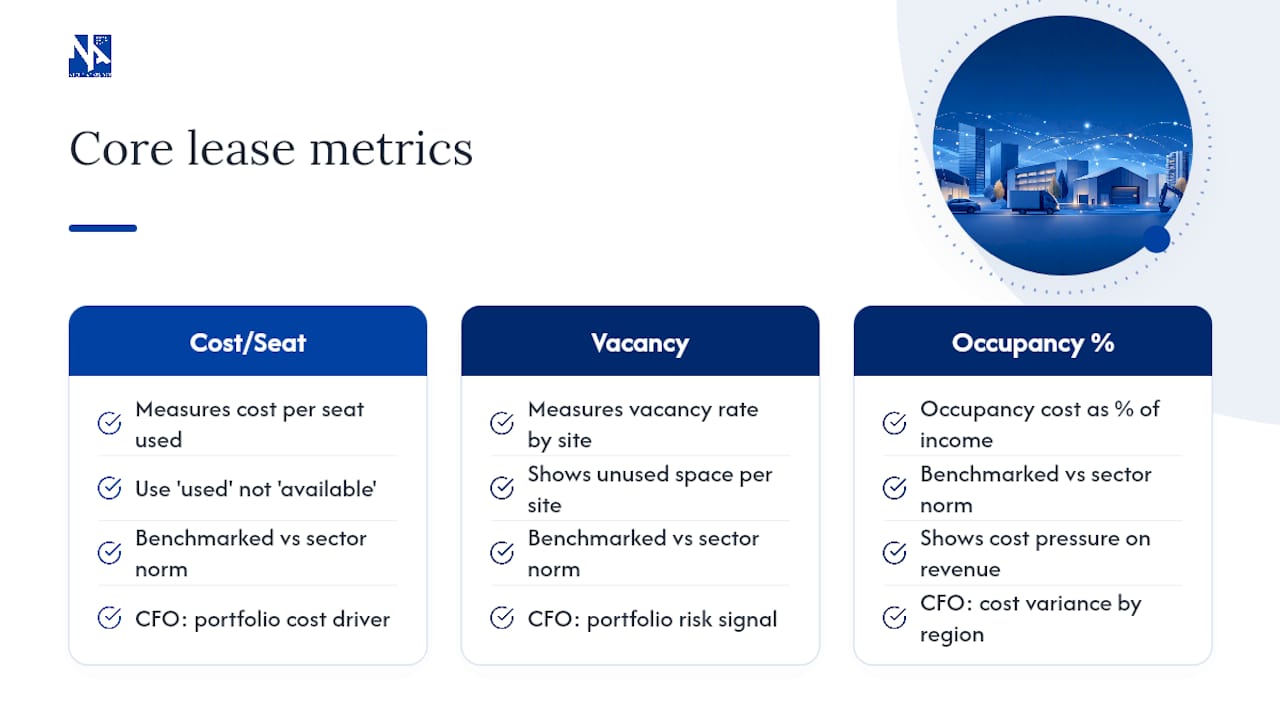
Three metrics do most of the work: cost per seat used (not cost per seat available, a distinction that exposes a surprising amount of waste), vacancy rate by site, and occupancy cost as a percentage of income or revenue, benchmarked against your sector norm.

A CFO dashboard should show, at a glance, total portfolio liability and its trend, upcoming lease events in the next two quarters, and cost variance against budget by region. A property or workplace dashboard needs the same underlying data but sliced differently: utilisation by floor, headcount versus capacity, and make‑good exposure by exit date. Both views should draw from the same register, just filtered differently, which is the entire point of a single source of truth.
Scenario modelling turns that data into a decision tool. Portfolio decisions can be framed as an optimisation problem, balancing cost, utilisation and risk to work out which leases to keep, renegotiate or exit, an approach IBM Research’s work on optimised lease planning has modelled formally using scenario and predictive techniques. Most organisations do not need software that sophisticated to get real value from the underlying idea: even a simple spreadsheet comparing one, two and three‑year cashflow impacts across “renew,” “renegotiate” and “exit” scenarios for each expiring lease will surface the right answer more often than gut instinct.
Pro Tip: When you model an exit scenario, always include make‑good cost and the time to re-let or reabsorb the space elsewhere in the portfolio. Exits that look cheap on rent alone often turn expensive once make‑good and transition costs are added in.
Occupancy and workplace strategy sit upstream of most of these decisions. A lease renewal decided in isolation, without checking whether the space still matches how the team actually works, tends to lock in the wrong footprint for another five years.
How do you implement portfolio management without stalling?
Migrating from scattered spreadsheets to genuine portfolio management works best as three deliberate phases rather than one big‑bang rollout.
- Inventory and abstraction. Locate every lease, including the ones nobody remembers signing, and abstract them into a consistent data model. This is unglamorous work, but inventory accuracy and disciplined abstraction at this stage remove the biggest source of downstream accounting variance, more than any system choice that comes later.
- Reconciliation, integration and a pilot. Pick one region or asset class, reconcile its data against the general ledger, connect it to accounting and reporting, and prove the process works end to end before touching the rest of the portfolio.
- Scale and embed. Roll the proven process across the remaining portfolio, formalise the governance cadence, and build continuous improvement, not a one-off clean-up, into the operating model.
Staged pilots like this reduce scope risk considerably and let a team demonstrate value with real numbers before asking for budget to scale further, a pattern that holds across most Australian portfolio implementations. The two traps that derail this most often are scope that grows before phase one is even finished, and rolling out new governance without finance, property and legal actually agreeing to it beforehand. Both are avoidable with a simple rule: nothing moves to phase two until phase one’s data has been signed off by the team that will rely on it.
Where does Niche Advisory fit in this process?
Niche Advisory has spent over 12 years building the practitioner side of this work, sitting between the accounting standard and the day‑to‑day reality of a portfolio with mismatched lease terms and competing priorities. The methodology runs alongside the roadmap above: an independent portfolio assessment to establish the current state, dashboard build to give finance and property a shared view, and direct support at the negotiation table when a lease decision actually gets made.
The measurable outcomes clients look for are consistent: full visibility across every leased asset, AASB 16‑ready reporting that survives audit scrutiny, and cost avoidance on renewals negotiated from a position of genuine market knowledge rather than landlord‑supplied numbers…
How can Niche Advisory help you manage your lease portfolio?
Most of the failure points in this article, fragmented data, missed options, accounting positions that do not match what property teams believe, come from running lease decisions in isolation from real market leverage. Niche Advisory is built as the independent counterweight to that: tenant‑side advisory with no landlord conflict, covering everything from a portfolio health check through to hands‑on lease negotiation and make‑good resolution.
If your organisation is somewhere between phase one and phase two of the roadmap above, still abstracting leases or about to hit a renewal decision without a clear view of the market, a portfolio health check is the sensible next step. It gives you a clear read on expiries, options and cost exposure across the whole portfolio inside a matter of weeks, before any negotiation clock starts running. From there, Niche Advisory’s tenant advisory and lease negotiation support can sit alongside your finance and property teams for the negotiation itself, or hand back a clean dataset for your team to run with. Get in touch to scope a health check for your next lease decision.
Sources
- AASB 16 compiled standard (Nov 2022)
- Optimized lease planning for real estate portfolios – IBM Research
- Real Estate Asset Management for Australian Portfolios – PMVA