
Minor defects don’t stop practical completion. If the works are substantially finished and fit for their intended use, the certifier can sign off even with a punch list attached, and that certification usually starts the defects liability period, typically running several months. Every defect noted at handover must be recorded and rectified within the timeframes the contract sets, not left to informal goodwill.
TL;DR:
- Minor defects do not prevent certification if the works are substantially fit for their intended use, but safety-critical issues like unpassed fire systems must be rectified.
- The certification process relies on the specific contract wording, with AS 4300 defining practical completion as when defects do not hinder building use and are reasonable to delay fixing.
- Inspections must include visual defects, compliance documentation, and commissioning outcomes, with a detailed, signed defects list supported by photographs and priority ratings.
- The defects liability period typically starts at practical completion and covers patent defects, while latent defects may be subject to longer statutory warranties that extend beyond the DLP.
- Accurate documentation, staged handovers, and formal follow-up procedures reduce disputes and accelerate project close-out, with professional management recommended for owners.
Table of Contents
- What is practical completion? Contract definitions and standard forms
- The practical completion inspection and building your defects list
- Defects liability period: when it starts and what it covers
- Money, risk and liquidated damages at practical completion
- Who certifies practical completion, and why disputes happen
- Checklist for handover and the defects liability period
- Why documentation and staged handover cut disputes
- How Niche Advisory helps owners manage handover and defects risk
- Sources
- FAQ
What is practical completion? Contract definitions and standard forms
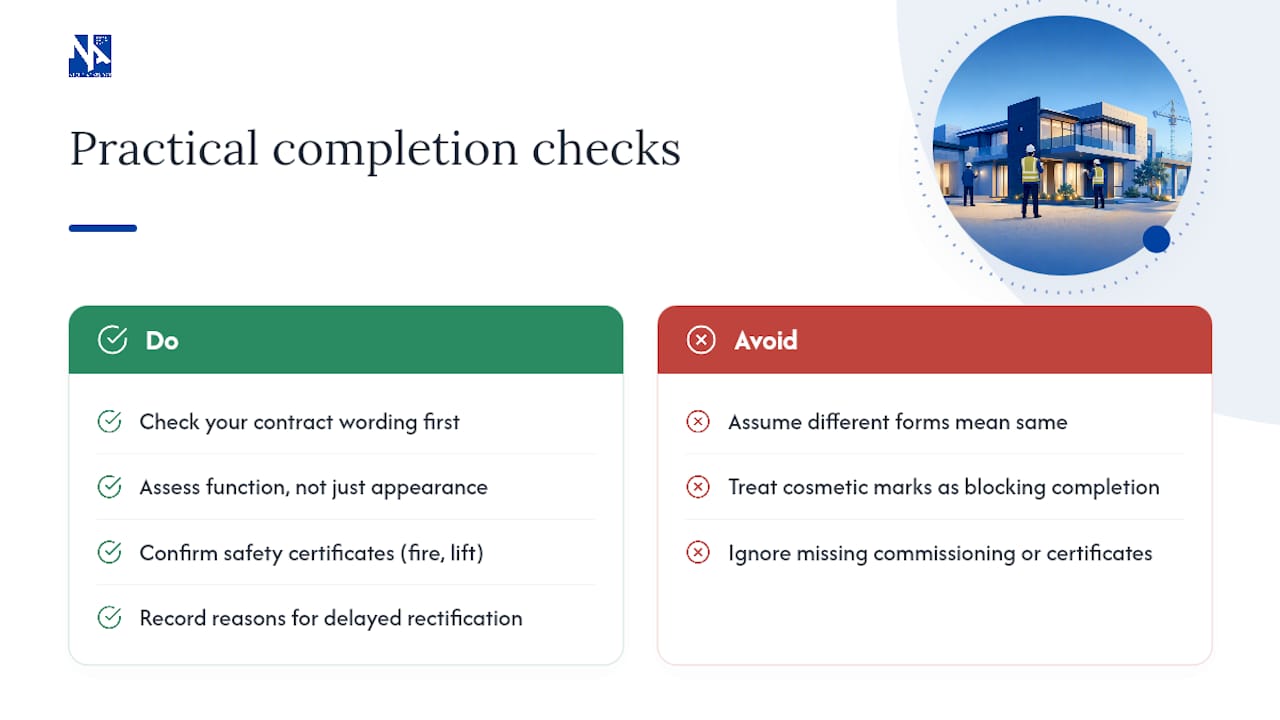
There’s no single national law defining practical completion. It’s a contract-driven concept, and the wording in your specific agreement decides what counts.
AS 4000 and AS 4300 are the two most referenced standard forms for commercial and construction work, while HIA contracts govern most residential builds. AS 4300 sets a three-part test: the defect can’t prevent the works being used for their intended purpose, there must be reasonable grounds for not rectifying it immediately, and letting it sit won’t prejudice that use. AS 4000 and HIA forms use similar but not identical language, which is exactly why two builders working from different contract templates can disagree on whether the same crack in a slab counts as “minor.”
In practice, a missing door handle or a scuff on skirting boards rarely blocks certification. A fire system that hasn’t passed commissioning, a lift without a safety certificate, or an access ramp that doesn’t meet the approved plans usually will. The dividing line is function, not appearance: does the defect stop someone using the building the way it was designed to be used?
The practical completion inspection and building your defects list
Most contracts require the builder to give written notice before the final inspection, and QBCC guidance points to at least five days as common practice. Shorter notice tends to produce rushed inspections and disputed defect lists later.
Whoever certifies the works, whether that’s an owner, a superintendent, or an independent building certifier, should walk the site with the builder present. Focus on:
- Patent defects visible without specialist testing (cracked tiles, paint runs, misaligned doors)
- Incomplete works against the approved drawings and specification
- Missing statutory approvals, occupation certificates or compliance documents
- Commissioning outcomes for fire, hydraulic, mechanical and electrical services
Every item goes onto a written defects list, dated and signed by both parties. Photograph each defect, assign a priority (safety critical, functional, cosmetic), and note the agreed rectification date next to each entry rather than a vague “to be fixed.”
Pro Tip: Number every defect on your list and cross-reference each photo to that number. When a builder disputes what was recorded six months later, a numbered photo log settles the argument in minutes instead of turning into a drawn-out email chain.
The biggest failure point isn’t the inspection itself. It’s what happens after: lists that never get formally closed out because nobody set a deadline for re-inspection.
Defects liability period: when it starts and what it covers
The defects liability period, often shortened to DLP, typically begins on the date of practical completion and usually runs for a period commonly several months in length.
The DLP splits defects into two categories that behave very differently:
- Patent defects: visible or discoverable at handover, listed on the practical completion inspection report, and the builder’s contractual obligation to fix
- Latent defects: hidden problems that surface after handover, such as waterproofing failures behind tiling or structural movement, which can sometimes fall under statutory warranties that extend well beyond the DLP
Queensland’s statutory regime is a good example of this layering. Where a domestic building contract is silent on timeframes, QBCC guidance can supply a statutory defects liability period, and separate notification windows apply to newly discovered defects.
Access matters more than most owners expect during this period. The builder generally has the first right to remedy defects, and contracts usually require the owner to give reasonable notice and access before engaging anyone else to fix the same problem. Skip that step and you risk losing your claim against the builder for those costs.
Money, risk and liquidated damages at practical completion
Certification changes more than just who’s responsible for touch-ups. It resets who carries financial and legal exposure from that date forward.
The main shifts:
- Final payment or final account claims become payable, subject to any amount withheld for outstanding defects
- Retention release is usually staged, with part released at practical completion and the balance held until the DLP ends and rectification is confirmed
- Liquidated damages stop accruing on the certified date, which is exactly why disputes over the actual completion date carry real financial weight for both parties
- Insurance and operational risk transfer from the contractor to the principal, meaning the owner now typically carries building insurance and public liability exposure
- Early occupation, if it happens before formal certification, usually needs explicit contract permission and its own insurance arrangements
Get the certified date wrong by even a week and you can shift tens of thousands of dollars in liquidated damages or insurance exposure. That’s not an exaggeration on larger commercial fitouts, where daily LD rates are often set deliberately high to focus everyone’s attention on the finish line.
Who certifies practical completion, and why disputes happen
The superintendent or project manager named in the contract is usually the one who decides whether practical completion has been reached, and most standard forms set a fixed window, often 10 to 14 business days, for that decision after the builder applies for it.
Case law has repeatedly found that conditional certificates carry no contractual weight unless the contract expressly allows them. A superintendent can’t issue a certificate that says “complete, subject to fixing the balustrade” if the contract doesn’t provide for that kind of qualified sign-off, and doing so anyway is a common source of litigation.
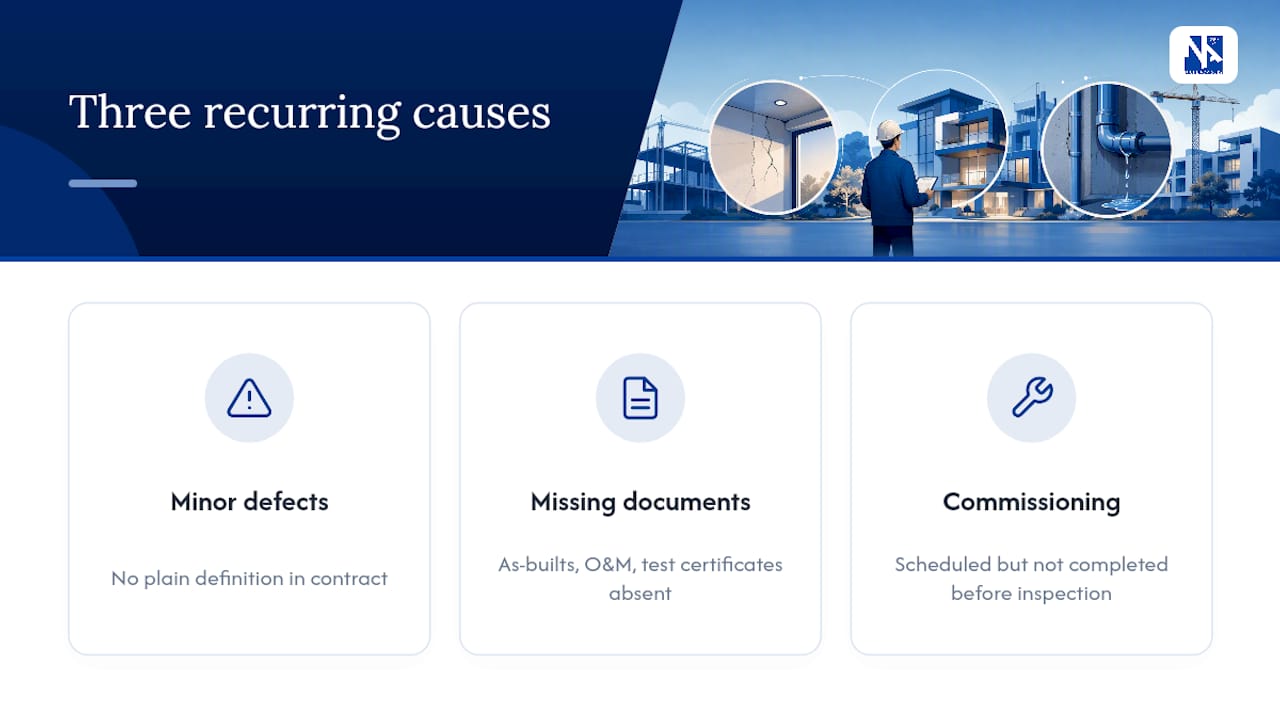
Most disputes trace back to the same three causes: a contract that never defines “minor defect” in the first place, essential documents (as-builts, O&M manuals, test certificates) missing at the point of application, and commissioning that was scheduled but never actually completed before the inspection.
The fix is drafting, not litigation. Define what counts as a minor defect in plain language before the contract is signed. Set a short, fixed response window for the superintendent’s decision. List the exact essential documents required for certification, rather than leaving “all relevant documentation” open to interpretation, an issue also worth understanding if you’re negotiating makegood obligations on a commercial lease, where the same ambiguity problem shows up at lease end.
Checklist for handover and the defects liability period
Run through this before, during and after the inspection to keep the process auditable rather than argued over later.
- Prepare — gather the contract, specification, approved drawings, and every certificate and manual the contract lists as essential before the inspection date is set.
- Inspect — check safety systems, mechanical and electrical services, finishes, external works and commissioning outcomes against the specification, not just visual appearance.
- Record — photograph every defect, number it, get the list signed by both parties, and assign a priority code and an agreed rectification window to each item.
- Follow up — schedule re-inspection dates, agree access arrangements for rectification trades, and run a formal close-out check as the DLP approaches its end date.
Pro Tip: Book your DLP close-out inspection the day practical completion is certified, not a week before the period expires. Builders that know the final date is locked in tend to prioritise rectification work far earlier.
Why documentation and staged handover cut disputes
The physical building is rarely what delays certification. It’s the paperwork. Operations and maintenance manuals, warranties, and commissioning reports are treated as conditions of certification on most commercial contracts, and their absence can lawfully hold up sign off even when the space is otherwise usable.
Staged inspections, fixed access windows for rectification trades, and a single living defects register (rather than three separate spreadsheets held by three separate parties) consistently speed up close-out. Projects that run this way tend to release the balance of retention sooner, simply because there’s no argument left about what was fixed, when, and who signed off on it.
How Niche Advisory helps owners manage handover and defects risk
Chasing down a defects list, checking commissioning reports, and holding a builder to rectification deadlines takes time most business owners don’t have, and it’s easy to let retention sit unreleased simply because nobody followed up. Niche Advisory works exclusively for tenants and owner-occupiers, never landlords, which means the defects register gets managed with your interests as the only priority.
Our project and construction management team runs the inspection, builds the defects register, and tracks rectification through to DLP close-out on your behalf. Where a dispute over a conditional certificate or a contested defect classification does arise, our dispute resolution services step in before it turns into a drawn-out legal fight. If you’ve got a handover coming up and want someone independent watching the defects list and the retention balance, consider engaging a professional to assist with your project.
Sources
Check the primary sources directly when a specific figure or legal position matters to your project: the QBCC’s practical completion inspection guidance covers notice periods and statutory notification windows, Procore’s practical completion explainer breaks down AS 4300’s criteria, and LegalVision’s analysis walks through case law on conditional certificates.
- Practical completion (Procore AU)
- Practical completion inspection (QBCC)
- What is practical completion in construction? (Prosper Law)
FAQ
What does practical completion include?
It includes substantially finished works that are fit for their intended use, essential documents like commissioning reports and O&M manuals, and a signed defects list for any minor items still outstanding.
What is the difference between practical completion and final completion?
Practical completion marks the point where the works are usable with only minor defects remaining, while final completion comes after the defects liability period ends and all rectification work has been confirmed and closed out.
What should I look for at a practical completion inspection?
Check safety systems, commissioning results for mechanical and electrical services, finishes against the specification, and confirm every essential certificate and manual required by the contract is actually on hand.
How long is a builder liable for defects?
The defects liability period typically begins on the date of practical completion and usually runs for a period commonly several months in length, with 12 months being a common period, though latent defects can sometimes fall under statutory warranties that run longer.