A tenant office relocation in Sydney CBD typically lands between $800 and $4,000+ per square metre for fit-out alone, before fees and liabilities. The budget swings most on three line items: fit-out specification, make-good obligations on the old premises, and tenant advisory or project management fees. Council contributions and approval costs add a smaller but still material layer on larger projects that can vary depending on size and scope.
TL;DR:
- For a 500 square metre tenancy, a basic fit out can cost $400,000, while a premium specification can reach $2 million before fees.
- Straightforward make good starts around $80 to $150 per square metre, but full CBD reinstatements can cost more, so negotiate a written cap before signing.
- Architect and designer fees commonly equal 5% to 12% of construction value; larger projects should have an independent quantity surveyor verify cost summaries.
- City of Sydney may apply a 1% Section 61 contribution or a Section 7.12 levy of up to 3%, depending on thresholds; confirm applicability early.
- A fit out cash contribution can reduce upfront capital, while rent free time eases lease cash flow without lowering the total fit out bill.
Table of Contents
- Line-item cost breakdown for Sydney CBD tenant relocations
- How long does a Sydney CBD office relocation take?
- What landlord incentives mean for your relocation cashflow
- Physical relocation costs: packing, moving and IT setup
- What does a typical Sydney office relocation actually cost?
- Common unexpected expenses and how to limit them
- How Niche Advisory helps tenants budget and manage Sydney CBD moves
- FAQ
- Sources
Line-item cost breakdown for Sydney CBD tenant relocations
Fit-out is the biggest lever in any relocation budget. Basic fit-outs in Australia typically run $800 to $1,500 per square metre, mid-range fits sit between $1,500 and $2,500, and premium fit-outs reach $2,500 to $4,000 or more per square metre, according to 2026 industry cost guidance.
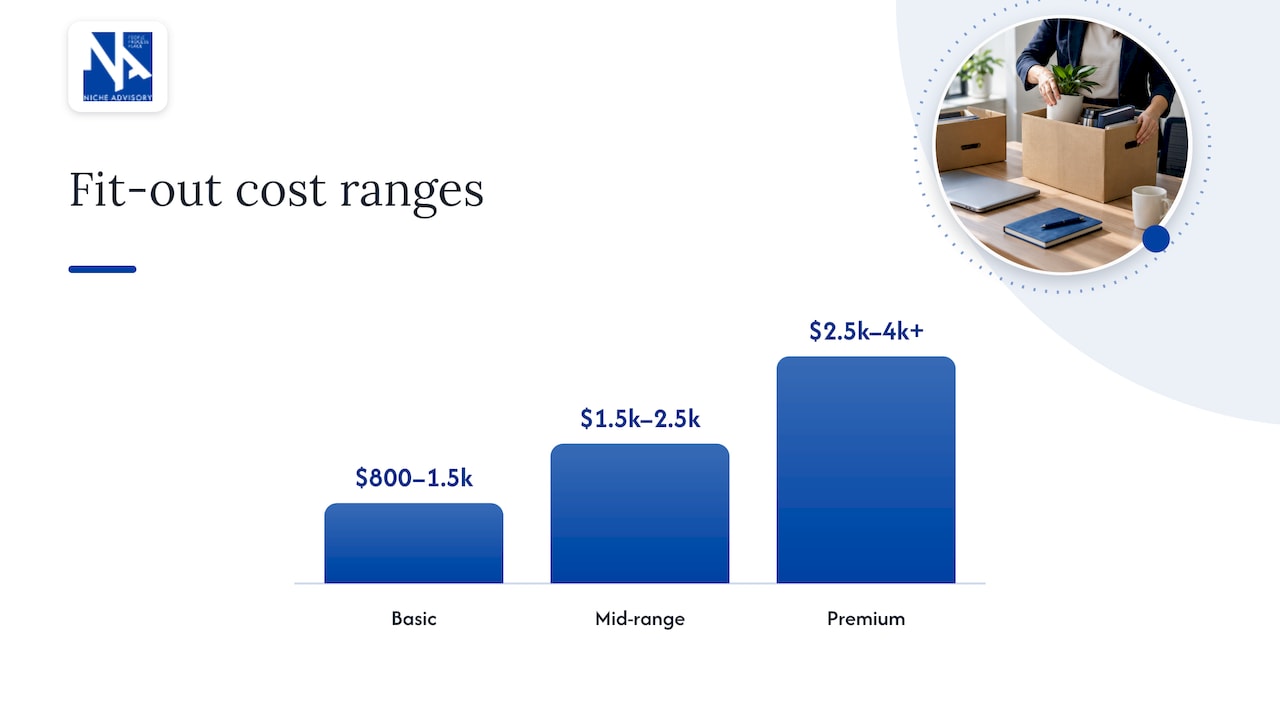
The gap between a basic and premium Sydney fit-out can exceed $3,000 per square metre, which on a 500 square metre tenancy is the difference between a $400,000 job and a $2 million one, according to industry fit-out cost data. Some Sydney indices place high-spec fit-out costs materially higher again, reflecting a wide spread between low-spec and premium outcomes in the same market, per Turner & Townsend’s Sydney fit-out guide.
Consultant and project fees sit on top of construction cost. Workplace architects and designers commonly charge 5% to 12% of construction value, while certification, specialist engineering and approvals or certifier fees typically add a few thousand dollars on a standard tenancy fit-out, per Going Rate’s 2026 fit-out cost guide. Larger fit-outs should have an independent registered quantity surveyor prepare or verify the cost summary, both to satisfy council requirements and to support negotiation with the landlord over contributions and make-good caps, as NSW’s Retail Tenancy Guide recommends.
Approvals and contributions can catch budgets by surprise. The City of Sydney’s recommended conditions of consent require a cost summary report for fit-out works and may apply a Section 61 contribution of 1% at certain development thresholds, with a Section 7.12 levy of up to 3% depending on the total cost band. These triggers depend on project value and scope, so confirm applicability with your designer before locking in a budget.
Make-good and outgoings round out the picture:
- Make-good on the outgoing premises commonly starts around $80 to $150 per square metre for straightforward reinstatements, though full CBD reinstatements can run materially higher, per Mondaq’s guidance on make-good obligations.
- Outgoings such as rates, building insurance contributions and ongoing service charges are occupancy costs, not relocation capital, and should be budgeted separately.
- NSW guidance stresses reviewing the Disclosure Statement early, since fit-out and make-good clauses are usually negotiated as a package, not in isolation, according to the NSW Retail Tenancy Guide.
How long does a Sydney CBD office relocation take?
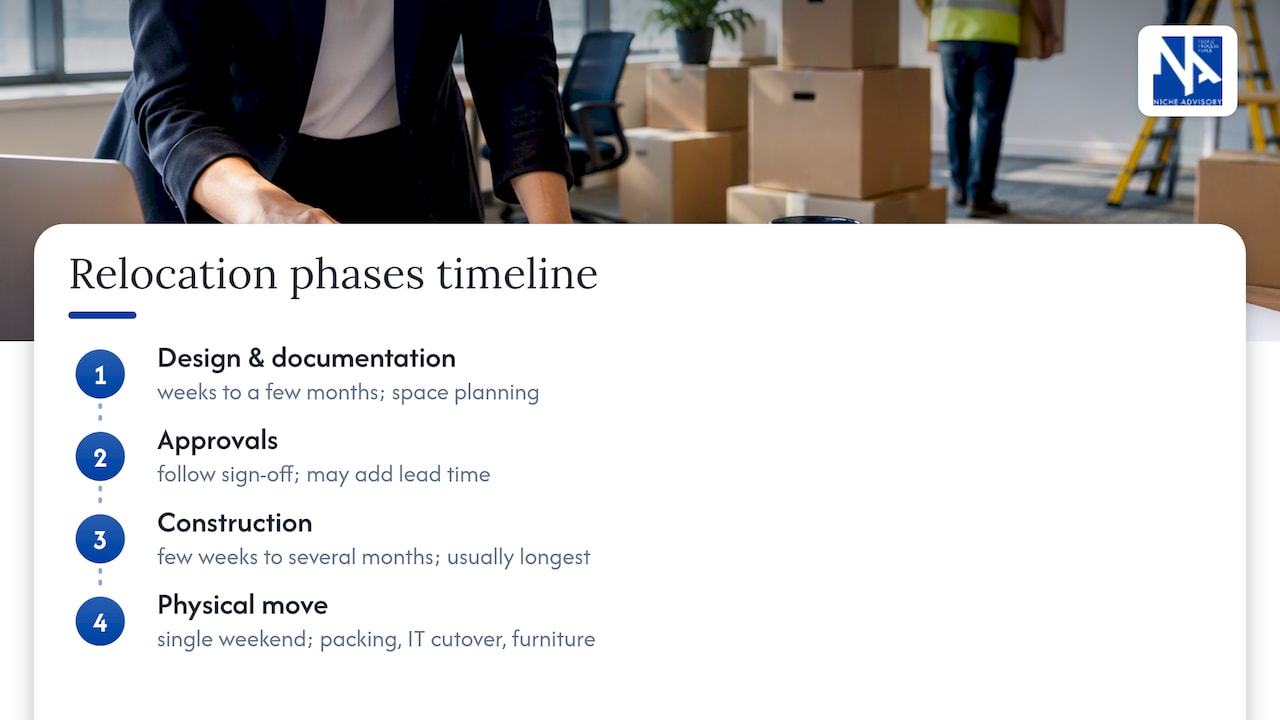
A tenant relocation in Sydney CBD generally moves through four phases: design, approvals, construction and the physical move. Design and documentation, including space planning and early cost estimation, typically run several weeks to a few months depending on fit-out complexity and the number of design iterations the business wants to review.
Approvals follow design sign-off. Where a project triggers council conditions of consent or a certifier review, this phase adds lead time that is easy to underestimate, particularly when Section 61 or Section 7.12 contributions apply under City of Sydney conditions. Builders and project managers should be briefed on these triggers before tender, not after.
Construction is usually the longest phase, running from a few weeks for a light refresh to several months for a full-floor premium fit-out. After-hours access restrictions common to Sydney CBD towers can stretch programme further, since noisy trades are often confined to evenings or weekends.
The physical move, covering packing, IT cutover and furniture relocation, is typically compressed into a single weekend to minimise business disruption. Building a realistic programme early, with contingency built into each phase, is one of the most reliable ways to protect both budget and staff productivity during the transition, a point covered in more detail in our guide to relocating without losing productivity.
What landlord incentives mean for your relocation cashflow
Landlord incentives are one of the most underused levers in a Sydney CBD relocation budget. In a soft leasing market, incentives of roughly 20% to 35% of gross rent over a five-year lease term are typical, according to Going Rate’s 2026 fit-out cost guidance. These incentives are commonly structured as a rent-free period, a cash contribution toward fit-out, or a combination of both.
Where the incentive is a direct fit-out contribution, it can materially reduce the capital a tenant needs to fund upfront, provided the contribution is documented clearly in the agreement for lease rather than left as a verbal understanding. A rent-free period instead smooths cashflow over the lease term without reducing total fit-out spend, which matters for a CFO modelling net present cost rather than headline spend.
The scale of incentive available depends heavily on market conditions, building vacancy and lease term, so it is worth testing multiple buildings before settling on a floor. Negotiating this properly, alongside make-good caps and fit-out contribution clauses, is a core part of tenant representation, and is explored further in our piece on the benefits of tenant advisers and specialist leasing lawyers.
Physical relocation costs: packing, moving and IT setup
Physical relocation activities sit apart from fit-out capital and are often budgeted too lightly. Packing and furniture moving costs scale with headcount and the volume of records, archive boxes and loose furniture being relocated, and are typically quoted per desk or per cubic metre of goods by commercial movers.
IT infrastructure setup is usually the largest line within this category for a modern office. It covers cabling, server room or comms room fit-out, network switch configuration, wifi access points and the physical relocation of desktop hardware, phones and printers. Downtime risk during cutover is the real cost driver here: a weekend move minimises disruption, but complex server migrations may need a staged approach spanning more than one weekend.
Signage, security access card reprogramming and mail redirection are smaller line items that are easy to forget until the final weeks. Building a single consolidated moving schedule, with one party accountable for sequencing packers, IT contractors and furniture installers, avoids the common failure mode where trades arrive out of order and extend the move weekend into a lost working week. Our checklist of common relocation mistakes covers this sequencing risk in more depth.
What does a typical Sydney office relocation actually cost?
Pulling the line items together, a 150 square metre mid-range Sydney CBD relocation gives a useful worked example. At $2,000 per square metre for a mid-range fit-out, the construction cost alone is $300,000.
That brings the core relocation capital to approximately $342,000 before approvals, physical moving costs and contingency, using the fit-out and fee ranges from Going Rate’s 2026 guidance and make-good ranges from Mondaq’s analysis of make-good obligations. A premium fit-out at the same footprint, using the $2,500 to $4,000-plus per square metre premium band, pushes construction cost alone to $375,000 to $600,000 or more, before the same fees and make-good are added.
These figures are illustrative, built from the ranges above rather than a single live project, and every CBD building and lease negotiation will move the actual number up or down. The point for a CFO is that fit-out specification, not moving logistics, is what decides whether a relocation costs $300,000 or $1 million.
Common unexpected expenses and how to limit them
The most common budget blowouts come from scope that was never clearly allocated between landlord and tenant. Make-good disputes are frequent enough that legal guidance on commercial leases treats them as a near-standard risk, often because the lease describes “as built” condition loosely rather than with a schedule of finishes.
Three other items catch budgets consistently. Certification and approvals costs blow out when council conditions of consent, including Section 61 or Section 7.12 contributions under City of Sydney’s framework, are discovered mid-design rather than scoped upfront. After-hours labour premiums in Sydney CBD towers are frequently underestimated in builder quotes. IT cutover downtime, when migrations run long, can cost more in lost productivity than the IT budget line itself.
The fix in each case is the same: get an independent cost summary and a clear make-good schedule attached to the lease before signing, verified by a quantity surveyor where the project size warrants it, per NSW’s Retail Tenancy Guide. A contingency allowance of 10% to 15% on top of the core capital budget is standard practice for exactly this reason, and our guide to negotiating make-good obligations covers how to cap this exposure in the lease itself.
How Niche Advisory helps tenants budget and manage Sydney CBD moves
We act exclusively for tenants and owner-occupiers, never landlords, which means our advice on fit-out budgets, make-good caps and incentive negotiation has no conflict of interest baked in. Over more than 12 years we have built a methodology that integrates workplace strategy with independent advisory and hands-on project management, so the budget we build at the start of a relocation is the one you actually deliver against.
We negotiate landlord incentives, work to manage make-good liability proactively, and oversee governance across design, approvals and construction phases. If you are planning a Sydney CBD move and want a realistic budget before you commit to a building, our project and construction management service is the natural next step, or get in touch to scope a budget review.
FAQ
How much does a typical Sydney CBD office fit-out cost per square metre?
Basic fit-outs typically run $800 to $1,500 per square metre, mid-range fit-outs $1,500 to $2,500, and premium fit-outs $2,500 to $4,000 or more.
Who pays for the office fit-out, the landlord or the tenant?
Under NSW retail tenancy guidance, tenants typically fund fit-out costs directly, though landlords frequently offer incentives such as rent-free periods or cash contributions to offset this, as outlined in the NSW Retail Tenancy Guide. The split between landlord contribution and tenant capital is negotiated as part of the agreement for lease.
What is a realistic make-good budget for a Sydney CBD lease?
A conservative planning range for straightforward make-good obligations is $80 to $150 per square metre, though full reinstatements in CBD offices can cost materially more, according to legal guidance on make-good obligations. Getting this capped in the lease upfront avoids disputes at exit.
Do council contributions apply to every Sydney office fit-out?
Not every fit-out triggers a council contribution, but larger projects can face a Section 61 contribution of around 1% or a Section 7.12 levy of up to 3% of development cost, depending on thresholds set by the City of Sydney. Confirm applicability with your designer or certifier before finalising the budget.
What does Niche Advisory charge for tenant relocation advisory?
Fees depend on project scope and are quoted per engagement rather than published as a fixed rate. You can request a scoped proposal through our Project & Construction Management service page.
Sources
- NSW Retail Tenancy Guide 2022 (Small Business NSW)
- Going Rate — office fitout cost (2026 guidance)
- Turner & Townsend — Office fit‑out cost guide 2026 (Sydney)
- City of Sydney recommended conditions of consent (fit‑out cost reporting and contributions)