Employee experience in the office is the sum of workplace design, work design and manager behaviour, and the highest-priority action for HR is aligning those three around one team before rolling anything out wider. Around 36% of employed people usually worked from home in 2025, so hybrid patterns now sit at the centre of any experience strategy, not the edge of it. Start small, measure fast, then scale what works.
TL;DR:
- Employee experience in hybrid workplaces depends on integrating workplace design, work processes, and management behavior around a single team before scaling initiatives.
- Building a positive experience requires addressing multiple interconnected factors, including leadership behavior, work design, physical space, recognition, and inclusion policies.
- Pilot projects should focus on one team with a clear pain point, involve managers early, and measure specific outcomes such as workload, space satisfaction, and collaboration friction.
- Reconfiguring office zones based on task mapping and meeting room booking data can improve space utilization and support activity-based work environments.
- Using a small set of pulse questions and tracking retention and absenteeism allows effective, ongoing measurement of experience improvements without survey fatigue.
Table of Contents
- What employee experience means and how it differs from engagement
- Key factors that shape experience in office and hybrid workplaces
- A prioritised checklist for improving employee experience
- Designing the office as a connection hub
- Measuring employee experience without survey fatigue
- Getting flexible work arrangements right under the law
- How Niche Advisory turns workplace strategy into better experience
- Where to start if you need outside help
- Sources
- FAQ
What employee experience means and how it differs from engagement
Employee experience covers everything a person encounters from the moment they apply for a role to the day they leave: how they are recruited, onboarded, managed, developed and eventually exit. It is broader than engagement, which measures how motivated and committed someone feels at a point in time. Engagement is a symptom. Experience is the set of conditions that produces it.
Confusing the two leads HR teams to chase engagement scores with morale initiatives while ignoring the structural issues (bad handoffs between managers, an office that cannot support focused work, unclear career pathways) that caused the scores to drop in the first place. Experience is upstream of engagement, and it is more durable because it is built into how work and space actually function, not into a single survey result.
The components leaders need to influence sit across several domains:
- Culture and leadership, including how consistently values show up in day-to-day decisions.
- Work design, meaning whether workload, autonomy and role clarity are manageable.
- Physical space, meaning whether the office supports the tasks people are actually doing there.
- Rewards and recognition, both formal and informal.
- Diversity, equity and inclusion, which shapes whether the experience is consistent across different groups of staff.
- Wellbeing, spanning psychological safety, workload and physical safety.
None of these operate in isolation. A well-designed office cannot compensate for poor management, and generous rewards cannot offset a workspace that makes focused work impossible.
Key factors that shape experience in office and hybrid workplaces
Six factors tend to determine whether an office and hybrid model actually works for the people using it, and most of them are within HR’s direct control.
Leadership behaviour sets the tone before any policy does. Managers who model psychological safety, a willingness to admit mistakes and openness to feedback create teams that report better experience regardless of desk layout. SafeWork NSW guidance identifies workplace design as a key control for psychosocial risk, noting that poor design choices such as excessive noise or layouts that hinder collaboration can themselves become psychosocial hazards.
Work design matters as much as physical design. The Mental Health Commission’s guidance on hybrid work recommends a SMART approach, adjusting the specificity, manageability, adequacy, reasonableness and timing of workloads so hybrid arrangements do not quietly increase demands on staff.
The remaining factors round out the picture:
- Workspace functionality: activity-based settings that match space to task tend to outperform fixed desk allocation on both utilisation and satisfaction.
- Policies and enabling technology: hybrid arrangements only work when scheduling tools, meeting equipment and connectivity are reliable enough that location stops being a source of friction.
- Onboarding and career development: new starters and existing staff both need visible pathways, not just an induction pack.
- Recognition: informal, timely acknowledgement tends to matter more to daily experience than annual award programmes.
Pro Tip: Ask one team to name the single task they find hardest to do well in the current office, then design your next change around fixing that one thing.
A prioritised checklist for improving employee experience
Improvement works best as a staged programme rather than a single overhaul. Trying to fix culture, space and policy simultaneously tends to produce noise without evidence of what actually helped.
- Pilot one team first. Choose a team with a clear, common pain point and test a change (a reconfigured zone, a revised hybrid roster, a manager coaching session) over two to four weeks.
- Train managers before changing space. Manager behaviour shapes how any new policy or layout is received, so brief them on the intent and the metrics before the change lands.
- Add three pulse questions to your next check-in cycle. Ask about workload manageability, sense of belonging and whether the physical space supports their main tasks.
- Reconfigure one high-value zone. Convert underused fixed desks into a mix of collaboration and quiet focus areas based on what the pilot revealed.
- Update the hybrid policy in writing. Set clear expectations on office days, response times and which tasks require in-person overlap.
- Build a compact measurement dashboard. Track retention, absenteeism and pulse results together rather than as separate reports.
- Commission a broader workplace strategy review once pilot data shows which interventions are worth scaling.
Timeframes vary by organisation size, but a realistic sequence runs a pilot over four to six weeks, medium-term projects (zone reconfiguration, policy updates, recognition programmes) over one to two quarters, and long-term initiatives (a major fitout or an integrated measurement system) over six to eighteen months, as outlined in how renovation affects building occupancy.
Involve the right people at each stage:
- Facilities or workplace strategy teams for anything touching physical space.
- Line managers for work design and pulse feedback.
- Finance once a pilot moves toward a funded fitout.
- Senior leadership to sponsor policy changes that affect the whole organisation.
Success is measured by whether the pilot’s specific pain point improved, not by a general sense that things feel better.
Designing the office as a connection hub
Fixed desk occupancy is a weak metric on its own because it tells you how many seats were used, not whether the space did its job. Longitudinal workplace design research from UNSW found that activity-based, adaptable workplaces improve place attachment and professional identity over time, and that co-design pilots increase how readily staff take up new layouts.
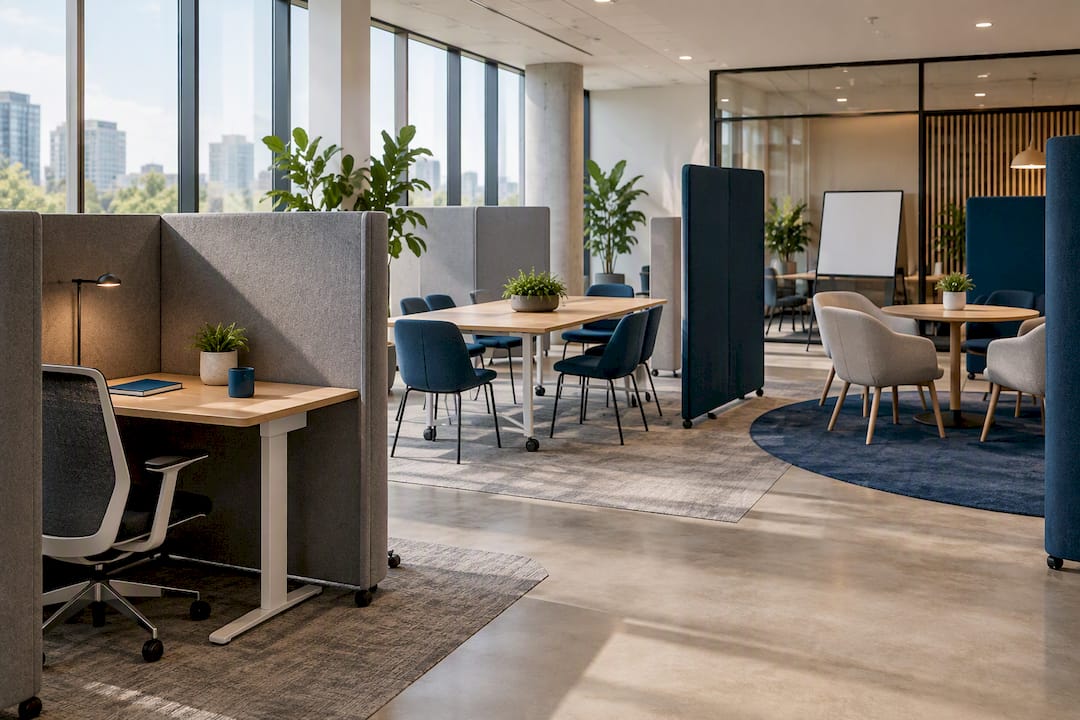
The practical starting point is mapping tasks to places: which activities genuinely need in-person overlap (mentoring, complex problem-solving, onboarding), and which are better done at home or in a third space. Reconfigurable furniture lets a single zone flex between a collaboration hub and a quiet focus area depending on the day, which matters more in offices where desk demand fluctuates by team and by week.
Layout priorities worth protecting in any redesign:
- Collaboration zones sized for the kind of work actually happening, not a generic meeting room ratio.
- Quiet focus areas protected from adjacent noise, since poor acoustic design is flagged as a psychosocial hazard.
- Hospitality touches, such as a decent coffee setup or a shared kitchen worth lingering in.
- Small rituals, like a regular team lunch day, that give people a reason to choose the office over home.
Pro Tip: Track meeting room and focus room bookings for a month before you touch desk ratios: the gap between space types is usually more telling than desk occupancy alone.
Pilot a spatial change against a small set of metrics: booking rates for the new zone, a three-question pulse on whether the space supported that week’s main tasks, and manager-reported changes in collaboration friction.
Measuring employee experience without survey fatigue
A compact set of metrics beats a long annual survey for keeping pace with iterative changes. The Mental Health Commission’s guidance recommends prioritising a small number of high-signal metrics, such as pulse items, retention and role clarity, over broad surveys that slow down decision-making.
A workable framework combines:
- Quarterly pulse surveys on workload, belonging and space fit, run more often for pilot teams.
- Retention and absenteeism data, tracked alongside pulse results rather than in a separate report.
- Qualitative feedback, gathered through manager check-ins or short focus sessions after a change lands.
- Three to five fixed pulse questions, such as “Does the office support your main task this week?” and “Do you feel your workload is manageable?”, kept consistent so results are comparable over time.
Use the results to refine the next pilot rather than to produce a static report. If a pulse score on space fit does not move after a reconfiguration, that is a signal to adjust the layout again, not to wait for the next annual cycle.
Getting flexible work arrangements right under the law
Employees in Australia have a right under the National Employment Standards to request flexible working arrangements, and employers must respond in writing within 21 days, according to Fair Work Ombudsman guidance. A request can only be refused on reasonable business grounds, such as significant cost, impracticality given the operation’s structure, or a lack of capacity to reorganise other staff’s work.
Embedding this into an experience programme means treating the legal process as a baseline, not a compliance afterthought.
- Document every request and response, including the reasons given for any refusal.
- Review arrangements on a set cadence, not only when an employee raises an issue.
- Train managers on the 21-day response duty so requests do not stall informally.
- Offer a genuine discussion before refusing, since Fair Work guidance expects employers to have explored alternatives.
Handled well, this process becomes part of the experience itself: employees notice whether a request was taken seriously, regardless of the outcome.
How Niche Advisory turns workplace strategy into better experience
The firm works exclusively for tenants and owner-occupiers, which means advice on office design and space allocation is shaped around what actually improves the occupant’s experience rather than what suits a building owner. The approach starts by aligning the workplace strategy with business goals, then works through stakeholder engagement and activity mapping before any physical change is committed to.
A typical engagement follows steps HR teams should expect to see and measure against:
- Business requirement identification, clarifying what the space needs to support before any design work begins.
- Stakeholder and activity mapping, similar in spirit to the task-to-place approach described earlier, tailored to the client’s teams.
- Pilot and phased delivery, testing changes before committing to a full fitout.
- Project and construction management, carrying the design through to delivery once a direction is confirmed.
This end-to-end model, spanning workplace strategy through to project and construction management, means HR is not left translating a strategy document into a fitout brief alone. The method has been applied across sectors for over a decade, with independence from landlord interests built into every recommendation.
Where to start if you need outside help
Most HR teams can run a pulse survey or brief a manager on the NES, but turning a pilot into a properly executed fitout is a different skill set, and that is where an independent workplace strategy partner earns its fee. Niche Advisory’s workplace strategy service picks up exactly where an internal pilot leaves off: mapping activities to space, negotiating the property side through corporate tenant advocacy, and carrying the change through to delivery with project and construction management. Because the firm acts only for tenants, the recommendations are built around what improves your team’s day-to-day experience, not what suits a landlord’s asset.
If your organisation is weighing a reconfiguration, a lease renewal, or a full relocation, the full range of services covers each stage from strategy through to fitout. Book a conversation with Niche Advisory to scope what a pilot to full delivery pathway would look like for your office.
Sources
- Designing work to manage psychosocial risks | SafeWork NSW
- Working arrangements, August 2025 | Australian Bureau of Statistics
- Requests for flexible working arrangements | Fair Work Ombudsman
- Designing mentally healthy hybrid work — guiding principles | Mental Health Commission
- Longitudinal workplace design research (2019–2025) | UNSW thesis/report
FAQ
How do you describe office experience?
Office experience is how well the physical workspace, work design and manager behaviour combine to support the tasks people actually do each day. A strong description looks at whether staff can find the right setting for focused work versus collaboration, whether the space feels psychologically safe, and whether policies around hybrid days are clear and consistently applied.
What are red flag words for HR?
There is no official canonical list, but HR practitioners generally treat vague or dismissive language around workload (“just deal with it”), inconsistent references to “culture fit,” and repeated complaints about noise or lack of focus space as signals worth investigating. These often point to the same psychosocial hazards flagged in SafeWork NSW’s design guidance.
What are the 5 pillars of EVP?
Definitions of employer value proposition vary between practitioners and consultancies, so there is no single fixed list. Common versions include compensation, career development, work environment, culture and benefits, though the exact framing depends on the model an organisation chooses to adopt.
What are the 5 C’s of performance management?
There is no single agreed “5 C’s” framework in official guidance, and definitions vary across HR practitioners. Rather than relying on an unverified acronym, focus performance management on clear expectations, regular feedback, documented reviews and alignment with the flexible work processes required under the National Employment Standards.